Topical Drugs Packaging Market Size and Growth
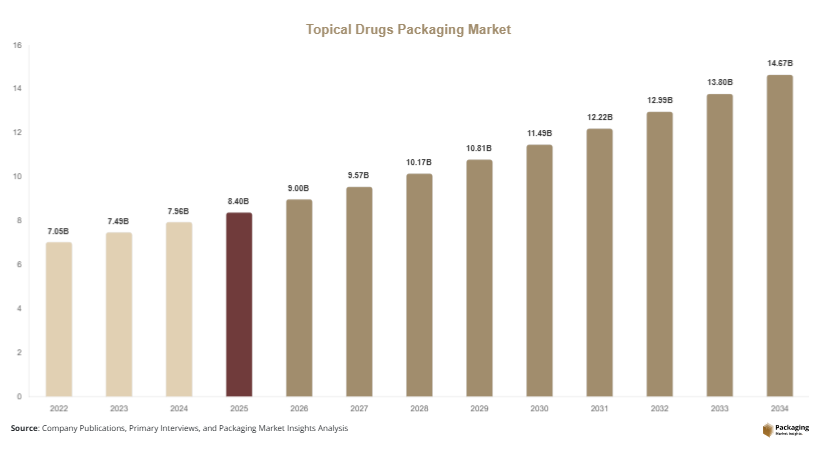
The global topical drugs packaging market size is estimated at USD 8.4 billion in 2025, which is projected to reach USD 9.0 billion in 2026. Over the forecast period from 2025 to 2034, the market is expected to grow to USD 15.6 billion in 2034, registering a CAGR of 6.3%. The topical drugs packaging market is witnessing consistent growth due to rising demand for dermatological treatments, increasing prevalence of skin disorders, and expanding use of topical formulations across pharmaceutical and cosmeceutical sectors. Topical drug packaging includes tubes, bottles, jars, and sachets designed to preserve product integrity, ensure dosage accuracy, and enhance patient convenience.
The growth of the topical drugs packaging market is driven by several factors. First, the increasing incidence of dermatological conditions such as eczema, psoriasis, and acne is driving demand for topical medications, thereby boosting packaging requirements. Second, the expansion of over-the-counter (OTC) topical drug sales is contributing to higher consumption volumes, particularly in emerging markets. Third, advancements in packaging technologies, including airless pumps and tamper-evident closures, are improving product safety and shelf life, supporting market expansion.
Key Market Insights:
- Asia Pacific dominated the market with a 35.8% share in 2025.
- Latin America is projected to grow at the fastest CAGR of 6.9%.
- Tubes led the type segment with a 41.6% share.
- Plastic materials dominated with a 54.7% share.
- Dermatology applications led the segment with 44.2% share.
- The US remained the dominant country with a market size of USD 2.1 billion in 2025 and USD 2.3 billion in 2026.
Explore more data points, trends and opportunities Download Free Sample Report
Market Trends
Growing adoption of sustainable and eco-friendly packaging solutions
Sustainability is becoming a defining trend in the topical drugs packaging market, as regulatory bodies and consumers increasingly demand environmentally responsible packaging. Manufacturers are shifting from conventional plastic materials to recyclable plastics, paper-based laminates, and biodegradable polymers. For example, pharmaceutical companies are introducing mono-material tubes that simplify recycling processes while maintaining barrier properties. This transition is also supported by government regulations aimed at reducing plastic waste and carbon emissions. In addition, companies are investing in life cycle assessments to evaluate the environmental impact of packaging materials. In the future, advancements in compostable packaging and closed-loop recycling systems are expected to further drive adoption, enabling manufacturers to align with sustainability goals while maintaining product safety and performance.
Increasing demand for innovative and user-friendly packaging formats
The demand for convenience and usability is driving innovation in packaging formats for topical drugs. Consumers prefer packaging that ensures ease of application, accurate dosing, and minimal contamination risk. Airless pumps, roll-on applicators, and single-dose sachets are gaining popularity due to their hygienic and efficient design. For instance, dermatology products are increasingly packaged in airless containers to prevent oxidation and extend shelf life. Digital integration is also emerging, with QR codes providing product information, usage instructions, and authentication features. In the coming years, smart packaging technologies are expected to enhance patient engagement and adherence to treatment regimens. This trend will continue to shape product differentiation strategies in the market.
Market Drivers
Rising prevalence of skin disorders and dermatological conditions
The increasing incidence of skin-related conditions is a major driver of the topical drugs packaging market. Conditions such as acne, dermatitis, fungal infections, and psoriasis are becoming more common due to lifestyle changes, environmental factors, and aging populations. This is leading to higher demand for topical medications, including creams, gels, and ointments. As a result, pharmaceutical companies require reliable and protective packaging solutions to maintain product efficacy and safety. For example, dermatology clinics and hospitals are witnessing increased patient volumes, driving demand for prescription topical drugs. In addition, the growing awareness of skin health is encouraging consumers to seek treatment, further boosting market demand. This trend is expected to continue, supported by ongoing research and development in dermatology.
Expansion of over-the-counter (OTC) and cosmeceutical products
The growth of OTC and cosmeceutical products is significantly contributing to market expansion. Consumers are increasingly opting for self-medication and preventive skincare solutions, leading to higher sales of topical drugs available without prescriptions. This trend is particularly strong in urban areas, where consumers have access to a wide range of products through retail and online channels. Packaging plays a critical role in influencing purchasing decisions, as attractive and functional designs enhance product appeal. For instance, cosmeceutical brands are using innovative packaging formats to differentiate their products in competitive markets. As the demand for OTC products continues to rise, the need for advanced packaging solutions will also increase, driving market growth.
Market Restraint
High cost of advanced packaging materials and regulatory compliance
One of the key restraints in the topical drugs packaging market is the high cost associated with advanced packaging materials and compliance requirements. Pharmaceutical packaging must meet strict regulatory standards to ensure product safety, stability, and quality. This includes requirements for barrier properties, tamper evidence, and labeling, which can increase production costs. For example, airless pumps and multi-layer tubes require specialized materials and manufacturing processes, making them more expensive than conventional packaging. Small and medium-sized manufacturers may face challenges in adopting these technologies due to limited budgets. Additionally, compliance with international regulations can create complexity in global supply chains. These factors can impact profit margins and limit market growth, particularly in price-sensitive regions.
Market Opportunities
Growth in emerging markets and expanding healthcare infrastructure
Emerging markets present significant opportunities for the topical drugs packaging market. Countries in Asia Pacific, Latin America, and Africa are experiencing improvements in healthcare infrastructure and increased access to medical treatments. Rising disposable incomes and growing awareness of personal health are driving demand for topical drugs in these regions. For example, the expansion of retail pharmacy chains and online healthcare platforms is improving product availability. Governments are also investing in healthcare systems, which supports the distribution of pharmaceutical products. In the future, these regions are expected to contribute a larger share of global market growth, creating opportunities for packaging manufacturers to expand their presence and develop cost-effective solutions.
Advancements in smart and functional packaging technologies
Technological advancements are creating new opportunities in the market. Smart packaging solutions, such as temperature-sensitive labels and digital tracking systems, are improving product safety and traceability. These technologies are particularly important for pharmaceutical products, where maintaining quality during storage and transportation is critical. For instance, companies are developing packaging with built-in sensors to monitor environmental conditions. In addition, innovations in material science are enabling the development of lightweight and durable packaging solutions. These advancements not only improve performance but also reduce costs and environmental impact. As technology continues to evolve, it will play a key role in shaping the future of the topical drugs packaging market.
Report Scope
| Report Metric | Details |
|---|---|
| Market Size in 2025 | USD 8.4 Billion |
| Market Size in 2026 | USD 9.0 Billion |
| Market Size in 2034 | USD 15.6 Billion |
| CAGR | 6.3% (2026-2034) |
| Base Year for Estimation | 2025 |
| Historical Data | 2022-2024 |
| Forecast Period | 2026-2034 |
| Report Coverage | Revenue Forecast, Competitive Landscape, Supply Chain Disruption, Growth Factors, Environment & Regulatory Landscape and Trends |
| Geographies Covered | North America, Europe, APAC, Middle East and Africa, LATAM |
| Countries Covered | U.S., Canada, U.K., Germany, France, Spain, Italy, Russia, Nordic, Benelux, Rest of Europe, China, South Korea, Japan, India, Australia, Singapore, Taiwan, South East Asia, Rest of Asia-Pacific, UAE, Turky, Saudi Arabia, South Africa, Egypt, Nigeria, Rest of MEA, Brazil, Mexico, Argentina, Chile, Colombia, Rest of LATAM |
Explore more data points, trends and opportunities Download Free Sample Report
Segmental Analysis
By Type
Tubes dominated the topical drugs packaging market in 2024 with a 41.6% share, driven by their versatility, ease of use, and cost efficiency. Tubes are widely used for packaging creams, gels, and ointments, making them a preferred choice for pharmaceutical and cosmeceutical products. Their ability to provide controlled dispensing and protect products from contamination supports their widespread adoption. For example, dermatology products are commonly packaged in laminated or aluminum tubes to ensure product stability. In addition, tubes can be easily customized with printing and labeling, enhancing brand visibility. The dominance of this segment is further supported by the availability of various sizes and materials, which cater to different product requirements.
Stick packs and sachets are the fastest-growing segment, with a projected CAGR of 6.8%. These packaging formats are gaining popularity due to their convenience and single-dose functionality. They are particularly suitable for travel-sized products and sample distribution. The growth is driven by increasing demand for hygienic and portable packaging solutions. In the future, advancements in material technology are expected to improve barrier properties and sustainability. Companies are also focusing on innovative designs to enhance user experience and reduce material usage.
By Material
Plastic materials dominated the market with a 54.7% share in 2024, driven by their durability, flexibility, and cost efficiency. Plastics are widely used in topical drug packaging due to their ability to provide excellent barrier properties and protect products from contamination. For instance, polyethylene and polypropylene are commonly used for tubes and bottles. The dominance of this segment is also supported by the availability of various grades and formulations, which enable manufacturers to meet specific requirements. In addition, plastic packaging is lightweight, which reduces transportation costs and improves supply chain efficiency.
Paper-based materials are the fastest-growing segment, with a CAGR of 6.5%. This growth is driven by increasing demand for sustainable packaging solutions. Manufacturers are developing paper-based laminates and biodegradable materials to reduce environmental impact. For example, companies are introducing paper-based tubes with protective coatings to maintain product quality. The future outlook for this segment is positive, as regulatory pressures and consumer preferences continue to drive adoption. Innovations in material science are expected to enhance performance and expand applications.
By End-Use
Dermatology applications accounted for the largest share of 44.2% in 2024, driven by the high prevalence of skin conditions and increasing demand for topical treatments. Rigid and flexible packaging solutions are widely used to ensure product safety and efficacy. For example, prescription creams and ointments require packaging that prevents contamination and maintains stability. The growth of this segment is also supported by increasing awareness of skin health and the availability of advanced treatments. Pharmaceutical companies are investing in packaging innovations to improve product performance and patient compliance.
Cosmeceuticals are the fastest-growing segment, with a CAGR of 6.7%. The growth is driven by increasing consumer interest in skincare and beauty products with therapeutic benefits. Packaging plays a critical role in product differentiation, as attractive and functional designs enhance brand appeal. For instance, premium skincare products are often packaged in airless containers to maintain quality. In the future, the demand for innovative and sustainable packaging solutions is expected to drive growth in this segment.
Topical Drugs Packaging Market Segmentations
By Product Type
- Tubes (Plastic & Aluminum)
- Bottles & Containers
- Jars & Pots
- Stick Packs & Sachets
By Application
- Dermatology Treatments
- Pain Relief & Anti-inflammatory
- Cosmeceuticals
- Wound Care & Antifungal Treatments
By Distribution Channel
- Pharmacies & Drug Stores
- Hospital Pharmacies
- Online Retail
- Supermarkets & Retail Chains
- Direct-to-Consumer Channels
Regional Analysis
North America
North America accounted for approximately 28.4% of the global topical drugs packaging market share in 2025 and is projected to grow at a CAGR of 5.9% through 2034. The region benefits from a well-established pharmaceutical industry, strong regulatory framework, and high healthcare expenditure. The demand for advanced packaging solutions is driven by the need for product safety, compliance, and convenience. Additionally, the increasing adoption of OTC drugs and e-commerce distribution channels is influencing packaging innovation. Sustainability initiatives are also gaining traction, with companies focusing on recyclable and eco-friendly materials. The presence of leading pharmaceutical companies further supports market growth, as they invest in advanced packaging technologies to enhance product quality and differentiation.
The United States dominates the North American market due to its large consumer base and advanced healthcare infrastructure. A unique growth driver is the increasing demand for personalized medicine, which requires specialized packaging solutions. For example, dermatology clinics are using customized packaging formats to improve patient compliance and treatment outcomes. The rise of online pharmacies is also contributing to demand for secure and durable packaging. In addition, the growing focus on sustainability is encouraging companies to adopt innovative materials and production processes. This trend is expected to support market growth in the region.
Europe
Europe held a market share of 24.1% in 2025 and is expected to grow at a CAGR of 5.7% during the forecast period. The region’s emphasis on sustainability and stringent regulatory standards is shaping the topical drugs packaging market. Countries such as Germany, France, and the UK are leading the adoption of eco-friendly packaging solutions. The demand for recyclable materials and reduced plastic usage is increasing, driven by environmental regulations and consumer awareness. In addition, the presence of a strong pharmaceutical manufacturing base supports market growth. Companies are investing in advanced packaging technologies to meet regulatory requirements and improve product safety.
Germany is the dominant country in the European market, supported by its robust pharmaceutical and packaging industries. A key growth driver is the focus on high-quality manufacturing and innovation. For instance, German companies are developing advanced tube packaging solutions with improved barrier properties. The region is also witnessing increased adoption of smart packaging technologies, such as digital labeling and tracking systems. These innovations enhance product safety and traceability, supporting market growth. As sustainability continues to be a priority, the adoption of eco-friendly packaging solutions is expected to increase.
Asia Pacific
Asia Pacific emerged as the largest regional market with a 35.8% share in 2025 and is projected to grow at a CAGR of 6.7%. Rapid urbanization, rising disposable incomes, and expanding healthcare infrastructure are driving market growth in the region. Countries such as China, India, and Japan are major contributors to market expansion. The increasing prevalence of skin disorders and growing awareness of personal care are boosting demand for topical drugs. In addition, the expansion of retail and e-commerce channels is improving product accessibility. The region is also benefiting from cost-effective manufacturing and a large consumer base.
China dominates the Asia Pacific market due to its extensive pharmaceutical production capabilities and growing domestic demand. A unique growth driver is the expansion of local cosmeceutical brands, which require innovative packaging solutions. For example, Chinese companies are adopting advanced printing and design techniques to enhance product appeal. Government support for the pharmaceutical industry is also contributing to market growth. In addition, the increasing focus on exports is driving demand for high-quality packaging solutions that meet international standards. This trend is expected to continue, supporting regional growth.
Middle East & Africa
The Middle East & Africa region accounted for 6.8% of the market share in 2025 and is expected to grow at a CAGR of 6.1%. The region’s growth is driven by increasing investments in healthcare infrastructure and rising demand for pharmaceutical products. Countries such as the UAE and South Africa are focusing on improving access to healthcare services, which is boosting demand for topical drugs and associated packaging solutions. In addition, the growing awareness of personal health and hygiene is contributing to market expansion. The region is also witnessing increased adoption of modern retail channels, which supports product distribution.
The UAE is a key market in the region, supported by its strong healthcare sector and growing pharmaceutical industry. A unique growth driver is the increasing demand for premium packaging solutions in the cosmetics and healthcare sectors. For example, companies are using advanced packaging designs to enhance product appeal and ensure safety. The region is also benefiting from government initiatives aimed at improving healthcare infrastructure. As investments in healthcare continue to grow, the demand for packaging solutions is expected to increase, supporting market growth.
Latin America
Latin America held a 10.9% market share in 2025 and is projected to grow at the fastest CAGR of 6.9%. The region is experiencing growth due to expanding healthcare systems and increasing demand for pharmaceutical products. Countries such as Brazil and Mexico are key contributors to market expansion. The rising prevalence of skin disorders and growing awareness of personal care are driving demand for topical drugs. In addition, the expansion of retail and e-commerce channels is improving product accessibility. The region is also benefiting from economic development and increasing consumer spending.
Brazil dominates the regional market, supported by its large population and growing pharmaceutical industry. A key growth driver is the increasing demand for affordable healthcare solutions. For instance, local manufacturers are focusing on cost-effective packaging solutions to meet consumer needs. The region is also witnessing increased adoption of sustainable packaging materials, driven by environmental concerns. As the healthcare sector continues to expand, the demand for packaging solutions is expected to grow, supporting market development.
Competitive Landscape
The topical drugs packaging market is moderately competitive, with several global and regional players focusing on innovation, sustainability, and product differentiation. Companies are investing in advanced manufacturing technologies to improve efficiency and reduce costs. The market leader is Amcor Plc, which has a strong global presence and extensive product portfolio. The company focuses on sustainable packaging solutions and has introduced recyclable and lightweight materials to meet evolving consumer demands.
Other major players include WestRock Company, Berry Global Inc., Gerresheimer AG, and AptarGroup, Inc. These companies are adopting strategies such as mergers, acquisitions, and partnerships to strengthen their market position. For example, companies are collaborating with pharmaceutical firms to develop customized packaging solutions. In addition, investments in digital printing and smart packaging technologies are enabling manufacturers to enhance product functionality and traceability. Recent developments include the introduction of eco-friendly materials, advancements in barrier technologies, and increased automation in production processes.
Key Players
- Amcor Plc
- WestRock Company
- Berry Global Inc.
- Gerresheimer AG
- Schott AG
- AptarGroup, Inc.
- Albéa Group
- Constantia Flexibles
- Huhtamaki Oyj
- UFlex Ltd.
- Mondi Group
- Sonoco Products Company
- Sealed Air Corporation
- Coveris Holdings S.A.
- Winpak Ltd.