Tissue Paper Packaging Machine Market Size and Growth
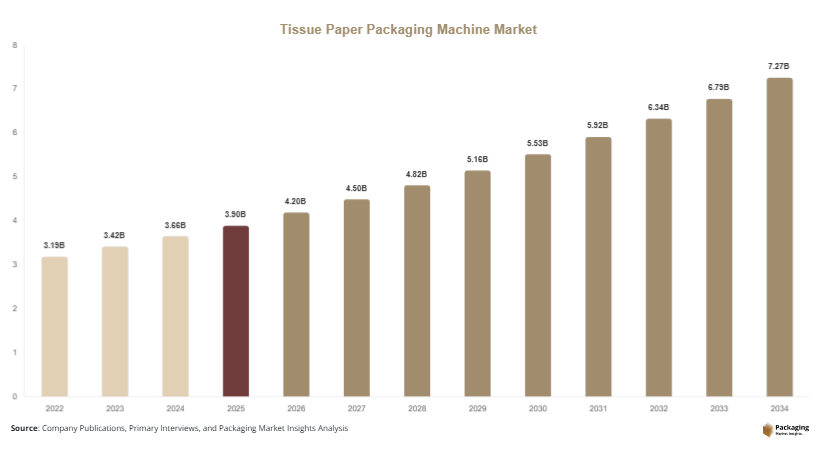
The global tissue paper packaging machine market size was valued at approximately USD 3.9 billion in 2025 and is projected to reach USD 4.2 billion in 2026. By 2034, the market is expected to grow to nearly USD 7.5 billion, registering a CAGR of 7.1% during the forecast period from 2025 to 2034. Tissue paper packaging machines are widely used for wrapping, sealing, bundling, and cartoning products such as toilet paper, facial tissues, napkins, kitchen towels, and industrial wipes. The tissue paper packaging machine market is experiencing consistent expansion due to the increasing demand for hygienic paper products, automation in packaging operations, and rising investments in high-speed converting machinery across the tissue manufacturing sector.
Growing urbanization and increasing consumer awareness regarding hygiene standards are encouraging tissue manufacturers to expand production capacity and modernize packaging lines. Automated tissue packaging systems are gaining adoption because they improve operational efficiency, reduce labor costs, and maintain consistent packaging quality. In addition, manufacturers are increasingly integrating robotic handling systems, smart sensors, and programmable controls into packaging machinery to enhance productivity and reduce downtime.
Key Highlights
- Asia Pacific dominated the tissue paper packaging machine market with a 39.8% share in 2025.
- Latin America is projected to grow at the fastest CAGR of 7.6% during the forecast period.
- Automatic tissue packaging machines led the machine type segment with a 36.4% share in 2025.
- Facial tissue packaging applications accounted for 42.1% of the market share in 2025 due to rising hygiene awareness and household consumption.
- Horizontal flow wrapping systems dominated the packaging format segment with a 34.7% share in 2025.
- The US remained the dominant country with a market size of USD 1.1 billion in 2025 and USD 1.2 billion in 2026.
Explore more data points, trends and opportunities Download Free Sample Report
Market Trends
Increasing Adoption of Smart Automated Packaging Systems
The growing adoption of smart automated packaging systems is emerging as a major trend in the tissue paper packaging machine market. Tissue manufacturers are increasingly integrating advanced automation technologies such as robotic arms, AI-enabled inspection systems, IoT connectivity, and machine monitoring software into packaging operations. These technologies improve packaging precision, minimize downtime, and increase overall production efficiency. Smart machines can monitor equipment performance in real time, predict maintenance requirements, and reduce material waste during production cycles. Large tissue manufacturers are investing in automated end-of-line systems that streamline wrapping, bundling, palletizing, and labeling processes. The trend is particularly strong in developed economies where labor costs are higher and operational efficiency is a priority for manufacturers.
Shift Toward Sustainable and Eco-Friendly Packaging Compatibility
Another important trend influencing the tissue paper packaging machine market is the increasing focus on sustainability and eco-friendly packaging compatibility. Tissue manufacturers are transitioning toward recyclable and biodegradable packaging materials to comply with environmental regulations and changing consumer preferences. This shift is encouraging machinery manufacturers to develop advanced packaging equipment capable of handling paper wraps, compostable films, and lightweight packaging substrates without compromising speed or sealing performance. Companies are also focusing on energy-efficient machinery designs that reduce power consumption and production waste. Packaging machines equipped with optimized sealing systems and material-saving technologies are becoming increasingly popular among tissue product manufacturers seeking to improve sustainability performance while maintaining operational productivity.
Market Drivers
Rising Demand for Hygienic Tissue Products
The increasing global demand for hygienic tissue products is a major driver supporting the growth of the tissue paper packaging machine market. Rising awareness regarding personal hygiene, sanitation, and infection prevention has significantly increased the consumption of toilet tissues, facial tissues, kitchen towels, and disposable wipes across residential and commercial sectors. Healthcare facilities, hotels, restaurants, airports, and offices are increasing their procurement of tissue products, encouraging manufacturers to expand production and packaging capabilities. High-speed packaging machinery helps tissue manufacturers meet rising product demand while ensuring consistent packaging quality and operational efficiency. The COVID-19 pandemic also accelerated long-term hygiene awareness, which continues to positively influence tissue product demand across global markets.
Expansion of Automated Manufacturing Facilities
The growing expansion of automated manufacturing facilities is another key factor driving market growth. Tissue paper manufacturers are investing in modern converting and packaging lines to increase productivity, reduce labor dependency, and improve operational accuracy. Fully automatic packaging machines enable continuous high-volume production with minimal manual intervention. Automation also helps manufacturers maintain product consistency, improve workplace safety, and reduce packaging errors. In addition, rising labor costs in developed economies are encouraging companies to adopt robotic packaging systems capable of performing wrapping, cartoning, and palletizing tasks efficiently. Increasing industrial investments in smart factories and Industry 4.0 integration are expected to accelerate demand for technologically advanced tissue packaging machinery during the forecast period.
Market Restraint
High Initial Investment and Maintenance Costs
High initial investment and maintenance costs remain a major restraint affecting the tissue paper packaging machine market. Advanced automated machinery equipped with robotic systems, smart sensors, and integrated software solutions often requires substantial capital investment, making adoption difficult for small and medium-sized tissue manufacturers. Installation expenses, operator training, maintenance requirements, and system upgrades further increase overall operational costs. In developing regions, many manufacturers continue to rely on semi-automatic or conventional machinery due to budget limitations and lack of technical expertise. Additionally, fluctuations in raw material prices and economic uncertainty may delay investments in new packaging equipment. For example, small tissue converting companies in emerging economies often postpone machinery modernization projects because of financing constraints and concerns regarding long-term return on investment. These factors may limit market penetration in cost-sensitive regions despite growing tissue product demand.
Market Opportunities
Growth in E-Commerce Tissue Product Distribution
The rapid growth of e-commerce distribution channels presents a significant opportunity for the tissue paper packaging machine market. Online retail platforms are increasing sales of household tissue products, requiring manufacturers to improve packaging durability and logistics efficiency. Tissue products shipped through e-commerce channels must withstand transportation handling while maintaining product integrity and visual appeal. This requirement is encouraging manufacturers to invest in advanced packaging machinery capable of producing compact, secure, and transport-friendly packaging formats. Automated packaging systems with integrated labeling and tracking technologies are gaining popularity among tissue manufacturers serving online retail platforms. The expansion of direct-to-consumer business models is expected to create additional demand for flexible and high-speed packaging equipment globally.
Increasing Demand for Sustainable Packaging Machinery
Growing environmental awareness and stricter packaging regulations are creating opportunities for machinery manufacturers focused on sustainable solutions. Tissue manufacturers are increasingly adopting recyclable packaging films, biodegradable materials, and paper-based wraps to reduce environmental impact. This transition requires packaging machines capable of handling delicate eco-friendly substrates without affecting production speed or packaging quality. Machinery suppliers that develop energy-efficient and material-optimized systems are likely to gain competitive advantages in the market. In addition, government initiatives supporting sustainable manufacturing practices are encouraging tissue producers to modernize packaging operations with environmentally compatible technologies. The rising emphasis on carbon reduction and waste minimization is expected to support long-term investment in sustainable tissue packaging machinery solutions.
Report Scope
| Report Metric | Details |
|---|---|
| Market Size in 2025 | USD 3.9 Billion |
| Market Size in 2026 | USD 4.2 Billion |
| Market Size in 2034 | USD 7.5 Billion |
| CAGR | 7.1% (2026-2034) |
| Base Year for Estimation | 2025 |
| Historical Data | 2022-2024 |
| Forecast Period | 2026-2034 |
| Report Coverage | Revenue Forecast, Competitive Landscape, Supply Chain Disruption, Growth Factors, Environment & Regulatory Landscape and Trends |
| Geographies Covered | North America, Europe, APAC, Middle East and Africa, LATAM |
| Countries Covered | U.S., Canada, U.K., Germany, France, Spain, Italy, Russia, Nordic, Benelux, Rest of Europe, China, South Korea, Japan, India, Australia, Singapore, Taiwan, South East Asia, Rest of Asia-Pacific, UAE, Turky, Saudi Arabia, South Africa, Egypt, Nigeria, Rest of MEA, Brazil, Mexico, Argentina, Chile, Colombia, Rest of LATAM |
Explore more data points, trends and opportunities Download Free Sample Report
Segmental Analysis
By Machine Type
Fully automatic tissue paper packaging machines dominated the tissue paper packaging machine market in 2024, accounting for approximately 58% of the total market share. These machines are widely preferred by large-scale tissue manufacturers because they support high-speed operations, reduce labor dependency, and improve packaging consistency. Fully automatic systems integrate wrapping, sealing, labeling, and palletizing functions into a single production line, increasing operational efficiency. The growing demand for bulk tissue production in supermarkets, hotels, healthcare facilities, and commercial establishments is encouraging manufacturers to invest in automated machinery. In addition, advanced automatic machines equipped with smart monitoring systems help manufacturers reduce downtime and improve packaging accuracy, further supporting segment growth across developed and emerging markets.
Robotic-integrated packaging machines are projected to be the fastest-growing subsegment, registering a CAGR of 8.4% during the forecast period. Rising investments in smart manufacturing technologies and Industry 4.0 integration are supporting demand for robotic systems capable of handling complex packaging tasks with minimal human intervention. Robotic packaging machines offer flexibility, high operational precision, and faster product handling speeds, making them suitable for large-scale tissue production facilities. Increasing labor shortages and rising wage costs are also encouraging manufacturers to adopt robotic packaging technologies. Furthermore, improvements in artificial intelligence, machine vision, and predictive maintenance capabilities are helping tissue producers optimize production efficiency and reduce packaging material waste across manufacturing operations.
By Application
Toilet tissue packaging emerged as the dominant application segment in 2024, accounting for nearly 41% of the global tissue paper packaging machine market share. The segment benefits from the widespread use of toilet paper products in residential, commercial, healthcare, and hospitality sectors. Rising hygiene awareness and population growth are increasing global demand for toilet tissue products, encouraging manufacturers to expand production and packaging capacities. Packaging machinery used for toilet tissues must support high-speed wrapping and bundling operations while ensuring product protection during transportation and storage. Manufacturers are increasingly adopting automated machinery capable of handling multiple roll sizes and packaging configurations efficiently. Growing retail demand for bulk-pack tissue products is also supporting investments in advanced toilet tissue packaging systems globally.
Facial tissue packaging is expected to witness the fastest CAGR of 7.9% through 2034 due to increasing consumer demand for convenient and premium hygiene products. Facial tissue manufacturers are focusing on attractive packaging formats, compact designs, and sustainable materials to improve product differentiation and brand visibility. This trend is encouraging investments in flexible and precision-based packaging machinery capable of handling decorative cartons, soft packs, and travel-sized tissue products. The expansion of personal care and healthcare sectors is also increasing demand for hygienic and portable facial tissue products. Additionally, rising e-commerce sales of premium facial tissues are creating opportunities for advanced packaging systems designed for protective and visually appealing packaging formats.
By End User
Tissue manufacturing companies accounted for the largest share of the tissue paper packaging machine market in 2024, representing approximately 63% of overall revenue. Large tissue producers require high-capacity packaging machinery to support continuous production operations and maintain supply chain efficiency. Manufacturers are investing in automated packaging lines to reduce operational costs, improve packaging consistency, and meet growing retail demand. Increasing consumption of toilet paper, kitchen towels, napkins, and industrial wipes is encouraging tissue producers to expand production infrastructure and modernize packaging facilities. Advanced packaging machinery also supports product customization and multiple packaging formats, allowing manufacturers to cater to diverse consumer preferences and retail requirements across global markets.
Contract packaging companies are projected to register the fastest growth rate during the forecast period, expanding at a CAGR of 8.2%. Rising outsourcing trends among tissue product brands are encouraging third-party packaging providers to invest in advanced machinery capable of handling large production volumes and customized packaging requirements. Contract packaging companies offer flexible packaging services, shorter production cycles, and cost-efficient operations for regional and international tissue brands. Increasing demand for private-label tissue products from supermarkets and online retailers is also contributing to segment growth. Furthermore, contract packaging providers are increasingly adopting automated and robotic systems to improve productivity, reduce turnaround times, and support sustainable packaging initiatives requested by major retail customers.
Tissue Paper Packaging Machine Market Segmentations
By Machine Type
- Automatic Tissue Packaging Machines
- Semi-Automatic Tissue Packaging Machines
- Horizontal Flow Wrapping Machines
- Vertical Packaging Machines
By Application
- Toilet Paper Packaging
- Facial Tissue Packaging
- Paper Napkin Packaging
- Kitchen Towel Packaging
By End-User Industry
- Tissue Manufacturing Companies
- Household Paper Product Suppliers
- Commercial Hygiene Product Manufacturers
- Private Label Packaging Companies
- Retail Distribution Centers
Regional Analysis
North America
North America accounted for approximately 31% of the global tissue paper packaging machine market share in 2025 and is expected to maintain steady growth at a CAGR of 6.6% through 2034. Strong automation adoption, advanced manufacturing infrastructure, and high consumption of tissue products are supporting regional market expansion. Tissue manufacturers across the United States and Canada are investing in automated packaging systems to improve operational efficiency and reduce labor dependency. The region also benefits from increasing demand for sustainable packaging solutions and advanced robotic packaging technologies.
The United States dominates the North American market due to large-scale tissue manufacturing operations and high consumer demand for hygiene products. One unique growth factor in the country is the increasing adoption of smart factory technologies within the paper and packaging industry. Manufacturers are integrating AI-enabled monitoring systems and predictive maintenance tools into packaging lines to improve productivity and minimize downtime. Rising investments in sustainable packaging materials are further encouraging modernization of tissue packaging machinery across the country.
Europe
Europe represented nearly 26% of the global tissue paper packaging machine market in 2025 and is projected to grow at a CAGR of 6.8% during the forecast period. The region benefits from strict sustainability regulations, high demand for eco-friendly packaging formats, and strong industrial automation capabilities. European tissue manufacturers are increasingly investing in energy-efficient packaging equipment compatible with recyclable materials. Countries across the region are focusing on reducing packaging waste and improving manufacturing efficiency through advanced automation technologies.
Germany leads the European market due to its strong engineering sector and extensive packaging machinery manufacturing base. A unique growth factor driving the German market is the country's emphasis on Industry 4.0 adoption within manufacturing facilities. Tissue producers are implementing intelligent packaging systems that support real-time performance monitoring and automated production management. This technological transition is increasing demand for advanced tissue packaging machinery capable of supporting high-speed and sustainable operations.
Asia Pacific
Asia Pacific held around 29% of the global tissue paper packaging machine market share in 2025 and is anticipated to register the fastest CAGR of 8.1% through 2034. Rapid urbanization, rising disposable incomes, and expanding tissue product consumption are major factors supporting market growth in the region. Increasing investments in manufacturing infrastructure and automation technologies are encouraging tissue producers to modernize packaging operations. Demand for affordable and high-capacity machinery is particularly strong across emerging economies.
China dominates the Asia Pacific market due to its extensive tissue manufacturing capacity and rapidly growing consumer goods sector. One unique growth factor in China is the expansion of domestic e-commerce platforms, which is increasing demand for efficient and durable packaging solutions for tissue products. Chinese manufacturers are investing in high-speed automated machinery to meet rising domestic and export demand while improving operational productivity and packaging consistency.
Middle East & Africa
The Middle East & Africa region accounted for approximately 7% of the global tissue paper packaging machine market in 2025 and is projected to grow at a CAGR of 6.3% during the forecast period. Increasing urbanization, hospitality sector expansion, and improving hygiene awareness are contributing to rising tissue product demand across the region. Governments and private investors are supporting industrial diversification projects that include investments in consumer goods manufacturing and packaging infrastructure.
Saudi Arabia dominates the regional market due to its growing retail, hospitality, and healthcare industries. A unique growth factor driving the Saudi Arabian market is the rapid expansion of tourism-related infrastructure projects. Hotels, airports, shopping centers, and healthcare facilities require large volumes of hygienic tissue products, encouraging manufacturers to expand local production capabilities. This trend is increasing investments in automated packaging machinery designed for high-volume tissue packaging operations.
Latin America
Latin America captured nearly 7% of the global tissue paper packaging machine market share in 2025 and is expected to grow at a CAGR of 6.5% through 2034. Rising consumer spending, urban population growth, and increasing hygiene awareness are supporting regional market development. Tissue manufacturers are gradually adopting automated packaging systems to improve efficiency and meet growing demand from retail and institutional customers. Expansion of supermarket chains and organized retail distribution is also contributing to higher tissue product consumption.
Brazil leads the Latin American market due to its large population base and expanding consumer goods manufacturing sector. One unique growth factor supporting the Brazilian market is the increasing demand for affordable household hygiene products among middle-income consumers. Local tissue manufacturers are investing in efficient and cost-effective packaging machinery to improve production capacity and maintain competitive pricing. Government support for industrial modernization is further encouraging investments in packaging automation technologies.
Competitive Landscape
The tissue paper packaging machine market is moderately competitive, with several international and regional players focusing on automation, energy efficiency, and smart packaging technologies to strengthen their market presence. Companies are investing in research and development activities to introduce advanced machinery capable of supporting high-speed packaging operations and sustainable material compatibility. Strategic partnerships, product launches, and manufacturing facility expansions remain common growth strategies among leading participants.
IMA Group, Körber AG, FUTURA S.p.A., Baosuo Paper Machinery Manufacture Co., Ltd., and Valmet Corporation are among the major companies operating in the market. IMA Group is recognized as one of the leading players due to its broad portfolio of automated packaging solutions and strong global distribution network. The company recently introduced an upgraded intelligent packaging platform featuring AI-enabled monitoring systems and predictive maintenance functions for tissue converting facilities. Manufacturers are also emphasizing modular machine designs that allow customers to upgrade production lines according to changing operational requirements. Competition is expected to intensify as demand for sustainable and fully automated packaging machinery continues to increase globally.
Key Players List
- IMA Group
- Körber AG
- FUTURA S.p.A.
- Valmet Corporation
- Baosuo Paper Machinery Manufacture Co., Ltd.
- Fabio Perini S.p.A.
- MTC S.R.L.
- PCMC
- Ean Tissue Machinery Company
- Beston Machinery
- Delta Paper Machine Group
- Chan Li Machinery Co., Ltd.
- Paper Converting Machine Company
- Guangxi Guitang Group
- Jori Machine
- Hup Seng Machinery Factory
- Optima Packaging Group GmbH
- Maruishi Co., Ltd.