Time Temperature Indicator Labels Market Size
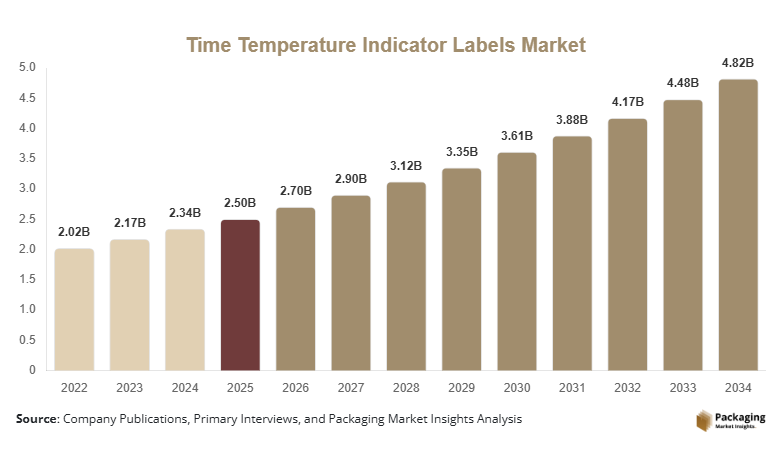
Time Temperature Indicator The labels' market size is projected at USD 2.7 billion in 2026 and is expected to hit USD 4.8 billion by 2034 with a CAGR of 7.5%. Increasing emphasis on cold chain monitoring, food safety regulations, and pharmaceutical logistics continues to support industry expansion. The report provides detailed analysis of production capacity, segmentation, competitive landscape, technology developments, and regional performance throughout the forecast period.
Time temperature indicator (TTI) labels are smart packaging solutions that visually monitor cumulative temperature exposure throughout storage and transportation. Global production exceeded 18.9 billion labels during 2025 and is projected to surpass 33.6 billion labels by 2034. Food and beverage applications account for approximately 54% of total consumption, pharmaceuticals and healthcare contribute 34%, while chemical applications represent nearly 12%. Adoption across temperature-sensitive supply chains has exceeded 66%, reinforcing the time-temperature indicator labels' market.
Explore more data points, trends and opportunities Download Free Sample Report
Time-Temperature Indicator Labels Market Trends
Rising adoption of intelligent cold chain packaging
Global production of intelligent indicator labels increased by 16% during 2025, while deployment across pharmaceutical logistics expanded by approximately 2.4 billion labels. Advanced irreversible color-changing technologies now achieve monitoring accuracy above 98%, supporting improved product integrity. Continuous expansion of cold chain logistics strengthens the time-temperature indicator labels' market.
Manufacturers are integrating printable electronics, RFID compatibility, and environmentally friendly indicator materials into next-generation labels. More than 61% of newly developed indicator products utilize low-toxicity chemical formulations, while automated inspection technologies improve production efficiency by 18%. Increasing demand from vaccine distribution and fresh food exports continues supporting the time-temperature indicator labels market.
Time-temperature indicator labels drive.
Growing demand for cold chain monitoring solutions
Global cold chain logistics investments increased by 15% during 2025, while pharmaceutical temperature-sensitive shipments expanded by 13%. More than 12.8 billion indicator labels were used across food, biologics, vaccines, and healthcare packaging. Regulatory compliance and product safety requirements continue driving the time-temperature indicator labels market.
Time Temperature Indicator Labels Restraints
High implementation costs for advanced smart labels
Advanced indicator labels cost approximately 20%–35% more than conventional tracking labels due to specialized chemicals and manufacturing processes. Quality validation, calibration, and compliance testing contribute nearly 18% of production costs, moderately restraining the time-temperature indicator label market.
Time-Temperature Indicator Labels Opportunities
Expansion of biologics, vaccine logistics, and premium food exports
Global biologics transportation increased by 17%, while premium food exports expanded by approximately 11% during 2025. Investments in digital cold chain infrastructure exceeded USD 4.2 billion, creating strong opportunities for manufacturers developing advanced monitoring labels for the Time Temperature Indicator Labels market.
Challenges in the Time-Temperature Indicator Labels Market
Maintaining indicator accuracy across diverse temperature conditions
Manufacturers must ensure indicator accuracy above 98%, response consistency within ±2°C, and shelf life exceeding 18 months. Environmental sensitivity, material compatibility, and regulatory certification across international markets remain significant operational challenges for the time-temperature indicator label market.
Report Scope
| Report Metric | Details |
|---|---|
| Market Size in 2025 | USD 2.5 Billion |
| Market Size in 2026 | USD 2.7 Billion |
| Market Size in 2034 | USD 4.8 Billion |
| CAGR | 7.5% (2026-2034) |
| Base Year for Estimation | 2025 |
| Historical Data | 2022-2024 |
| Forecast Period | 2026-2034 |
| Report Coverage | Revenue Forecast, Competitive Landscape, Supply Chain Disruption, Growth Factors, Environment & Regulatory Landscape and Trends |
| Geographies Covered | North America, Europe, APAC, Middle East and Africa, LATAM |
| Countries Covered | U.S., Canada, U.K., Germany, France, Spain, Italy, Russia, Nordic, Benelux, Rest of Europe, China, South Korea, Japan, India, Australia, Singapore, Taiwan, South East Asia, Rest of Asia-Pacific, UAE, Turkey, Saudi Arabia, South Africa, Egypt, Nigeria, Rest of MEA, Brazil, Mexico, Argentina, Chile, Colombia, Rest of LATAM |
Explore more data points, trends and opportunities Download Free Sample Report
Time Temperature Indicator Labels Market Segmentation
The market is segmented by label type and end-use industry. Critical time temperature indicators account for approximately 47% of total market revenue, while food and beverage applications dominate with nearly 54% of global demand owing to increasing food safety compliance.
By Label Type
Critical time-temperature indicators account for approximately 47% of the market, with annual production exceeding 8.9 billion labels. These indicators continuously monitor cumulative temperature exposure and are widely used in vaccine logistics, seafood, dairy, and biologics packaging.
Critical temperature indicators contribute nearly 32% of global demand, with production exceeding 6.0 billion labels annually. These labels provide an irreversible visual indication when products exceed predefined temperature thresholds during storage or transportation.
Partial history indicators represent approximately 21% of market revenue, with production surpassing 4.0 billion labels annually. They are primarily used for pharmaceuticals, chemicals, and specialty food products requiring partial temperature history monitoring.
By End-use Industry
Food and beverage applications account for approximately 54% of global demand, consuming more than 10.2 billion labels annually. TTI labels improve food safety, reduce spoilage, and support compliance across dairy, meat, seafood, frozen foods, and fresh produce supply chains.
Pharmaceuticals and healthcare contribute around 34% of market demand, utilizing over 6.4 billion labels annually. Applications include vaccines, biologics, insulin, blood products, and temperature-sensitive medicines requiring continuous cold chain monitoring.
Chemical applications represent approximately 12% of the market with annual consumption exceeding 2.3 billion labels. Indicator labels are used to monitor specialty chemicals, laboratory reagents, and industrial products requiring temperature-controlled storage.
Time Temperature Indicator Labels Market Segmentations
Label Type
- Critical Time Temperature Indicators
- Critical Temperature Indicators
- Partial History Indicators
End-use Industry
- Food & Beverage
- Pharmaceuticals & Healthcare
- Chemicals
Time-Temperature Indicator Labels: Regional Outlook
North America
North America accounts for approximately 33% of global revenue. The United States contributes nearly 84% of regional demand, supported by advanced pharmaceutical logistics, food safety regulations, and annual consumption exceeding 6.1 billion labels.
Europe
Europe represents approximately 30% of the market. Germany, France, the United Kingdom, Italy, and the Netherlands remain major adopters, supported by strict cold chain regulations and pharmaceutical exports.
Asia-Pacific
Asia-Pacific accounts for approximately 29% of global demand and records the fastest growth. China contributes nearly 41% of regional production, followed by Japan, India, and South Korea, supported by expanding food processing and healthcare industries.
Latin America
Latin America contributes around 5% of market revenue. Brazil and Mexico dominate regional demand due to growing pharmaceutical distribution and food export industries.
Middle East & Africa
The Middle East & Africa account for approximately 3% of global demand, supported by expanding vaccine distribution programs, healthcare infrastructure, and temperature-controlled logistics.
Top Players In The Time-Temperature Indicator Label Market
- SpotSee,
- 3M Company,
- Temptime Corporation,
- Bizerba SE & Co. KG,
- CCL Industries Inc.
- Insignia Technologies Ltd.
- Avery Dennison Corporation
- DeltaTrak, Inc.
- Cryolog S.A.
- Varcode Ltd.
SpotSee: Estimated global market presence of approximately 15%. Leading supplier of condition-monitoring indicators for cold chain logistics, pharmaceutical packaging, and industrial transportation. The company develops advanced time-temperature indicators, shock monitoring devices, and environmental sensing technologies with an emphasis on accuracy, regulatory compliance, and digital monitoring integration. Continuous investments in smart logistics solutions and global distribution strengthen its competitive position across pharmaceutical and food supply chains. 3M Company's estimated market presence is approximately 12%. Strong global presence in healthcare, packaging, and industrial monitoring technologies. The company focuses on high-performance indicator labels, specialty adhesives, smart packaging materials, and innovative monitoring solutions. Investments in sustainable materials, research and development, and advanced manufacturing technologies continue reinforcing its leadership across temperature-sensitive packaging applications.