Thermoforming Packaging Machines Market Size and Growth
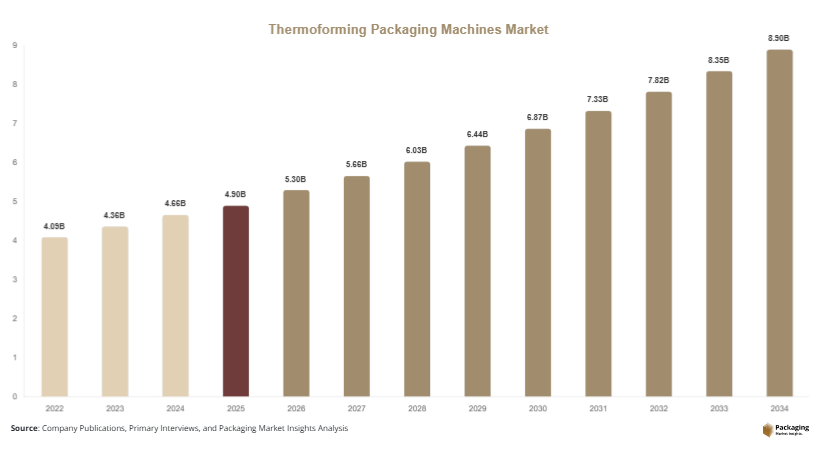
The global thermoforming packaging machines market size was valued at approximately USD 4.9 billion in 2025 and is projected to reach USD 5.3 billion in 2026. By 2034, the market is expected to attain nearly USD 8.9 billion, expanding at a CAGR of 6.7% during 2025–2034. The thermoforming packaging machines market is witnessing substantial growth due to rising demand for efficient packaging systems across food, pharmaceutical, consumer goods, and industrial sectors. Thermoforming packaging machines are widely used for forming plastic sheets into trays, containers, blister packs, clamshells, and vacuum-sealed packaging products. These systems provide high-speed production, packaging precision, and material flexibility, making them suitable for mass-scale manufacturing operations.
One of the major growth factors driving the thermoforming packaging machines market is the rapid expansion of the food packaging industry. Increasing demand for packaged meat, dairy products, ready-to-eat meals, and fresh produce is encouraging manufacturers to adopt advanced thermoforming systems for hygienic and efficient packaging. Another important factor is the growing pharmaceutical industry, where thermoforming technology is extensively used in blister packaging applications for tablets, capsules, and medical devices. Additionally, rising automation in packaging facilities is increasing the adoption of high-speed thermoforming equipment capable of reducing labor costs and improving production consistency.
Key Highlights
- Asia Pacific dominated the market with a 40.4% share in 2025.
- Latin America is projected to grow at the fastest CAGR of 7.2%.
- Automatic thermoforming machines led the type segment with a 57.8% share.
- Plastic packaging applications dominated with a 49.2% share.
- Food packaging applications led the market with 46.5% share.
- The US remained the dominant country with a market size of USD 1.1 billion in 2025 and USD 1.2 billion in 2026.
Explore more data points, trends and opportunities Download Free Sample Report
Market Trends
Increasing Adoption of Sustainable Packaging-Compatible Machinery
Manufacturers in the thermoforming packaging machines market are increasingly developing systems compatible with recyclable and biodegradable packaging materials. Packaging companies are under pressure to reduce plastic waste and comply with environmental regulations, leading to rising demand for machines capable of processing paper-based trays, recycled PET, and compostable materials. This trend is encouraging machine manufacturers to redesign forming systems and heating technologies that maintain efficiency while reducing material waste. Companies are also integrating energy-saving components and lightweight machine structures to improve sustainability performance. The growing emphasis on environmentally responsible packaging across food and consumer goods industries is expected to continue influencing machine design and production strategies during the forecast period.
Integration of Smart Automation and Digital Monitoring Technologies
Digital automation is becoming a major trend in the thermoforming packaging machines market as manufacturers seek higher operational efficiency and predictive maintenance capabilities. Modern thermoforming systems are increasingly equipped with touchscreen controls, IoT-based monitoring platforms, and automated quality inspection technologies. These features help packaging companies monitor machine performance, reduce downtime, and improve production accuracy. Smart systems also support real-time diagnostics and remote maintenance, enabling manufacturers to optimize operational efficiency. The pharmaceutical and food industries are particularly adopting automated thermoforming equipment to meet strict quality standards and high production requirements. This trend is expected to strengthen as industries continue investing in smart manufacturing and Industry 4.0 technologies.
Market Drivers
Rising Demand for Packaged Food and Convenience Products
The increasing consumption of packaged food products is one of the major drivers of the thermoforming packaging machines market. Consumers are increasingly purchasing ready-to-eat meals, frozen foods, fresh produce, and packaged meat products due to changing lifestyles and urbanization. Thermoforming machines provide efficient packaging solutions that improve shelf life, hygiene, and product visibility. Food manufacturers are investing in automated thermoforming equipment to increase production capacity and maintain packaging consistency. In addition, rising demand for portion-controlled and single-use food packaging formats is supporting machine adoption across global food processing industries. Expanding retail and e-commerce distribution networks are further increasing the need for durable and attractive food packaging solutions.
Expansion of Pharmaceutical Packaging Applications
The pharmaceutical industry is significantly contributing to market growth due to increasing demand for blister packaging and sterile medical packaging systems. Thermoforming packaging machines are widely used for manufacturing pharmaceutical trays, blister packs, and medical device packaging because they provide accurate cavity formation and contamination protection. Growing healthcare expenditure, increasing generic medicine production, and rising pharmaceutical exports are driving demand for advanced packaging equipment. Pharmaceutical manufacturers are also adopting automated thermoforming systems to comply with regulatory standards related to traceability, hygiene, and packaging accuracy. The growing production of biologics and specialty medicines is further creating demand for high-performance thermoforming packaging machinery.
Market Restraint
High Equipment Costs and Maintenance Requirements
One of the major restraints affecting the thermoforming packaging machines market is the high initial investment associated with advanced machinery and automation technologies. Fully automatic thermoforming systems equipped with servo drives, digital monitoring interfaces, and robotic integration require substantial capital expenditure, making them less accessible for small and medium-sized packaging companies. In addition to purchase costs, maintenance and operational expenses can also be significant due to the need for regular servicing, replacement components, and skilled technical personnel. For example, pharmaceutical packaging facilities using precision thermoforming systems often require frequent calibration and maintenance to meet strict regulatory standards. These cost-related challenges may slow adoption in price-sensitive markets where manufacturers prioritize lower-cost packaging alternatives and shorter return-on-investment periods.
Market Opportunities
Growth in Sustainable and Recyclable Packaging Production
The growing focus on sustainable packaging solutions presents a significant opportunity for the thermoforming packaging machines market. Packaging manufacturers are increasingly shifting toward recyclable plastics, molded fiber packaging, and biodegradable materials due to rising environmental awareness and government regulations. This transition is creating demand for thermoforming machines capable of processing eco-friendly materials without compromising production efficiency or packaging quality. Machine manufacturers are investing in research and development to create adaptable systems suitable for sustainable packaging applications. The increasing use of recyclable trays and compostable containers in food and retail industries is expected to support long-term growth opportunities for thermoforming equipment providers.
Expansion of Packaging Automation in Emerging Economies
Emerging economies are creating strong opportunities for thermoforming packaging machine manufacturers due to rapid industrialization and modernization of packaging infrastructure. Countries across Asia Pacific, Latin America, and the Middle East are experiencing rising investments in food processing, pharmaceutical manufacturing, and consumer goods production. Packaging companies in these regions are increasingly adopting automated machinery to improve operational efficiency and product quality. Government initiatives supporting industrial manufacturing and export activities are further encouraging investments in advanced packaging equipment. Additionally, growing middle-class populations and changing consumer preferences are increasing demand for packaged goods, creating favorable market conditions for thermoforming machine suppliers.
Report Scope
| Report Metric | Details |
|---|---|
| Market Size in 2025 | USD 4.9 Billion |
| Market Size in 2026 | USD 5.3 Billion |
| Market Size in 2034 | USD 8.9 Billion |
| CAGR | 6.7% (2026-2034) |
| Base Year for Estimation | 2025 |
| Historical Data | 2022-2024 |
| Forecast Period | 2026-2034 |
| Report Coverage | Revenue Forecast, Competitive Landscape, Supply Chain Disruption, Growth Factors, Environment & Regulatory Landscape and Trends |
| Geographies Covered | North America, Europe, APAC, Middle East and Africa, LATAM |
| Countries Covered | U.S., Canada, U.K., Germany, France, Spain, Italy, Russia, Nordic, Benelux, Rest of Europe, China, South Korea, Japan, India, Australia, Singapore, Taiwan, South East Asia, Rest of Asia-Pacific, UAE, Turky, Saudi Arabia, South Africa, Egypt, Nigeria, Rest of MEA, Brazil, Mexico, Argentina, Chile, Colombia, Rest of LATAM |
Explore more data points, trends and opportunities Download Free Sample Report
Segmental Analysis
By Type
Automatic thermoforming machines dominated the thermoforming packaging machines market in 2024, accounting for approximately 57.8% of the total market share. These machines are widely preferred because they offer high production speed, reduced labor requirements, and improved packaging consistency. Large-scale food, pharmaceutical, and consumer goods manufacturers increasingly utilize automatic systems to meet rising production demands while maintaining operational efficiency. Automatic thermoforming machines also support advanced features such as digital controls, robotic integration, and real-time monitoring systems, which improve production accuracy and reduce downtime. Growing investments in industrial automation and smart manufacturing technologies are further supporting segment dominance. Additionally, increasing demand for large-volume packaging operations across global manufacturing industries continues to strengthen adoption of fully automatic thermoforming systems.
Semi-automatic thermoforming machines are projected to be the fastest-growing type segment, expanding at a CAGR of 6.9% during the forecast period. This growth is supported by increasing adoption among small and medium-sized enterprises seeking cost-effective packaging solutions with moderate automation capabilities. Semi-automatic machines provide operational flexibility and lower investment requirements compared to fully automatic systems, making them suitable for regional packaging manufacturers and customized production operations. Food startups, local pharmaceutical companies, and specialty packaging businesses are increasingly investing in semi-automatic equipment to improve production efficiency while controlling operational costs. Furthermore, technological advancements in compact machine design and user-friendly control systems are encouraging wider adoption of semi-automatic thermoforming packaging machines across emerging markets.
By Application
Food packaging dominated the application segment in 2024 with approximately 46.5% of the total market share. Thermoforming packaging machines are extensively used for meat packaging, dairy trays, ready-to-eat meal containers, and fresh produce packaging because they provide strong sealing performance and extended product shelf life. Rising global consumption of packaged and convenience foods is significantly contributing to segment growth. Food manufacturers are adopting advanced thermoforming systems to improve packaging hygiene, increase operational efficiency, and support large-scale production requirements. In addition, increasing retail and online grocery distribution activities are creating demand for durable and visually attractive food packaging solutions. The growing focus on sustainable food packaging materials is also influencing investments in advanced thermoforming technologies compatible with recyclable packaging formats.
Pharmaceutical packaging is expected to register the fastest CAGR of 7.1% during the forecast period. The pharmaceutical industry increasingly relies on thermoforming packaging machines for blister packs, medical trays, and sterile packaging solutions due to strict regulatory requirements and growing healthcare demand. Increasing production of generic medicines, biologics, and specialty drugs is driving investments in precision thermoforming systems capable of ensuring packaging accuracy and contamination protection. Pharmaceutical manufacturers are also adopting automated machinery to comply with serialization and traceability regulations while improving production efficiency. Furthermore, growth in medical device manufacturing and rising demand for unit-dose packaging are creating additional opportunities for thermoforming packaging machine suppliers serving pharmaceutical and healthcare industries.
By End-Use
Food processing companies dominated the end-use segment in 2024, holding approximately 43.7% of the market share. These companies rely heavily on thermoforming packaging machines for vacuum packaging, modified atmosphere packaging, and tray sealing applications. Increasing consumer preference for packaged foods and extended shelf-life products is supporting demand for advanced thermoforming systems within food processing facilities. Manufacturers are focusing on automated packaging solutions that improve productivity, reduce material waste, and maintain food safety standards. Rising investments in cold chain logistics and packaged food exports are also strengthening segment growth. Additionally, increasing adoption of recyclable packaging materials in the food industry is encouraging investments in modern thermoforming equipment compatible with sustainable packaging applications.
Pharmaceutical manufacturers are projected to be the fastest-growing end-use segment, expanding at a CAGR of 7.3% during the forecast period. This growth is driven by rising pharmaceutical production, increasing demand for sterile packaging, and expanding biologic drug manufacturing activities. Pharmaceutical companies require precision thermoforming systems capable of maintaining strict hygiene standards and ensuring accurate packaging quality for tablets, capsules, and medical devices. The growing adoption of automated packaging lines and digital monitoring technologies is further supporting demand within this segment. In addition, increasing healthcare expenditure and rising pharmaceutical exports from emerging economies are encouraging investments in advanced packaging infrastructure and thermoforming machinery across global pharmaceutical manufacturing facilities.
Thermoforming Packaging Machines Market Segmentations
By Type
- Automatic Thermoforming Machines
- Semi-Automatic Thermoforming Machines
- Manual Thermoforming Machines
By Application
- Food Packaging
- Pharmaceutical Packaging
- Consumer Goods Packaging
- Industrial Packaging
By End-User
- Food Processing Companies
- Pharmaceutical Manufacturers
- Consumer Goods Manufacturers
- Packaging Service Providers
By Material Compatibility
- Plastic Materials
- Recyclable Materials
- Biodegradable Materials
Regional Analysis
North America
North America accounted for approximately 28.3% of the global thermoforming packaging machines market share in 2025 and is projected to grow at a CAGR of 6.0% during the forecast period. The region benefits from advanced packaging infrastructure, strong food processing industries, and increasing investments in packaging automation technologies. Rising demand for sustainable packaging and smart manufacturing systems is also supporting market growth across the United States and Canada.
The United States dominates the North American market due to its large-scale food and pharmaceutical manufacturing sectors. A unique growth factor is the increasing adoption of automated packaging lines integrated with digital monitoring systems for predictive maintenance and quality control. This trend is encouraging investments in advanced thermoforming machinery capable of supporting high-speed and precision packaging applications across industrial sectors.
Europe
Europe held nearly 23.8% of the thermoforming packaging machines market share in 2025 and is expected to grow at a CAGR of 5.8% through 2034. Growth in the region is supported by strict packaging regulations, increasing demand for recyclable packaging materials, and strong pharmaceutical manufacturing activities. Packaging companies are investing in energy-efficient machinery to improve sustainability and reduce operational costs.
Germany remains the dominant country within Europe because of its advanced industrial manufacturing capabilities and strong packaging machinery sector. One unique growth factor is the increasing development of eco-friendly thermoforming technologies designed for biodegradable and recycled materials. German manufacturers are focusing on precision engineering and automation to strengthen competitiveness in sustainable packaging equipment production.
Asia Pacific
Asia Pacific dominated the market with a 40.4% share in 2025 and is forecasted to grow at a CAGR of 7.0% during the forecast period. Rapid industrialization, expanding food processing industries, and increasing pharmaceutical manufacturing activities are major factors supporting regional growth. The region is also witnessing rising investments in automated packaging systems and export-oriented manufacturing facilities.
China leads the Asia Pacific market due to its large manufacturing base and strong demand for packaged consumer products. A unique growth factor is the rapid expansion of e-commerce and online grocery delivery services, which require durable and visually appealing packaging solutions. This trend is increasing demand for high-capacity thermoforming packaging machinery across the country’s packaging and logistics sectors.
Middle East & Africa
The Middle East & Africa region represented approximately 4.6% of the market share in 2025 and is anticipated to grow at a CAGR of 6.5% during the forecast period. Growth is supported by increasing investments in food packaging infrastructure, pharmaceutical manufacturing, and industrial diversification initiatives. Governments in the region are encouraging domestic manufacturing to improve supply chain stability and economic development.
Saudi Arabia dominates the regional market due to its expanding food processing and industrial manufacturing sectors. One unique growth factor is the establishment of new industrial packaging facilities supported by economic diversification programs. These developments are increasing demand for advanced thermoforming packaging machinery capable of supporting high-volume production and export-oriented packaging operations.
Latin America
Latin America accounted for nearly 2.9% of the global thermoforming packaging machines market share in 2025 and is projected to grow at the fastest CAGR of 7.2% during the forecast period. Rising packaged food consumption, increasing pharmaceutical production, and modernization of packaging facilities are supporting market growth across the region. Manufacturers are increasingly adopting automated packaging systems to improve productivity and packaging quality.
Brazil remains the dominant country in Latin America due to its large food processing industry and growing consumer goods market. A unique growth factor is the increasing demand for convenience food packaging driven by urbanization and changing consumer lifestyles. This trend is encouraging investments in thermoforming packaging technologies across the country’s food manufacturing sector.
Competitive Landscape
The thermoforming packaging machines market is moderately competitive, with leading manufacturers focusing on automation technologies, sustainable machine design, and global expansion strategies. Companies are investing in digital monitoring systems, energy-efficient machinery, and advanced forming technologies to strengthen operational efficiency and product performance. Strategic partnerships with packaging manufacturers and food processing companies remain important competitive approaches within the market.
MULTIVAC Group is one of the leading companies in the thermoforming packaging machines market due to its extensive product portfolio and strong global distribution network. In 2024, the company introduced upgraded thermoforming systems integrated with predictive maintenance software and recyclable material compatibility features. Other major market participants include ULMA Packaging, ILLIG Maschinenbau, Kiefel GmbH, and GEA Group. These companies are emphasizing research and development activities to improve machine efficiency, reduce energy consumption, and support sustainable packaging applications. Market players are also expanding manufacturing facilities and strengthening after-sales service networks to improve customer support and regional market presence.