Thermoformed Trays Market Size and Growth
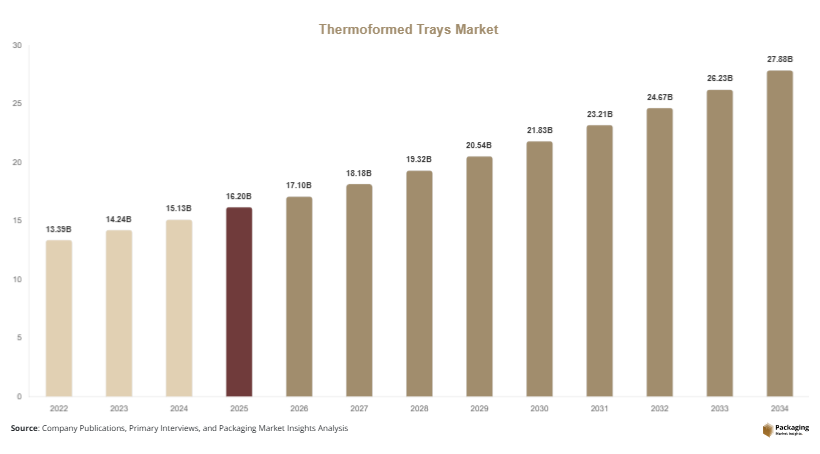
The thermoformed trays market is witnessing consistent expansion due to increasing demand for lightweight, durable, and cost-effective packaging solutions across industries such as food, healthcare, electronics, and consumer goods. Thermoformed trays are widely used for packaging and product protection because of their design flexibility, low production cost, and compatibility with various materials such as polyethylene terephthalate (PET), polypropylene (PP), and polystyrene (PS). In 2025, the global market size is estimated at USD 16.2 billion, and it is projected to reach USD 17.1 billion in 2026. Over the forecast period from 2025 to 2034, the market is expected to grow at a CAGR of 6.3%, reaching approximately USD 28.9 billion by 2034.
One of the primary growth factors is the rapid expansion of the food packaging industry. Thermoformed trays are extensively used for packaging fresh produce, ready-to-eat meals, meat, and bakery products. The increasing demand for convenience foods and on-the-go consumption is driving the need for efficient packaging solutions, thereby boosting market growth.
Key Highlights:
- Market size valued at USD 16.2 billion in 2025
- Expected to reach USD 28.9 billion by 2034
- CAGR of 6.3% during 2025–2034
- Strong demand from food and healthcare sectors
- Increasing adoption of sustainable packaging materials
Explore more data points, trends and opportunities Download Free Sample Report
Market Trends
Shift Toward Sustainable and Recyclable Materials
Sustainability is becoming a central trend in the thermoformed trays market. Manufacturers are focusing on developing trays made from recyclable materials such as PET and bio-based plastics. The growing regulatory pressure to reduce plastic waste is encouraging companies to adopt eco-friendly solutions. Many organizations are investing in research and development to produce trays with reduced material usage while maintaining performance. This trend is particularly evident in the food packaging sector, where sustainability is a key consideration. The adoption of closed-loop recycling systems is further supporting the use of recyclable thermoformed trays.
Increasing Adoption of Custom and Smart Packaging Designs
The demand for customized and smart packaging designs is rising in the market. Thermoformed trays offer flexibility in design, allowing manufacturers to create packaging solutions tailored to specific product requirements. This includes features such as compartments, tamper-evident seals, and enhanced product visibility. Additionally, the integration of smart packaging technologies, such as QR codes and RFID tags, is gaining traction. These features provide consumers with product information and improve supply chain efficiency. The trend is driven by the need for improved product differentiation and consumer engagement.
Market Drivers
Growth in Food Packaging Industry
The growth of the food packaging industry is a major driver of the thermoformed trays market. Thermoformed trays are widely used for packaging fresh and processed food products due to their durability and ability to preserve product quality. The increasing demand for ready-to-eat meals and convenience foods is driving the adoption of these trays. Additionally, the need for extended shelf life and improved food safety is supporting market growth. The expansion of retail chains and online food delivery services is further contributing to the demand for thermoformed trays.
Rising Demand in Healthcare and Pharmaceutical Sectors
The healthcare and pharmaceutical sectors are significant contributors to market growth. Thermoformed trays are used for packaging medical devices and pharmaceutical products due to their protective properties and compliance with hygiene standards. The increasing demand for medical supplies and the growth of the pharmaceutical industry are driving the adoption of thermoformed trays. Additionally, the need for sterile packaging solutions is supporting market expansion. The ongoing advancements in healthcare infrastructure are further boosting demand.
Market Restraint
Environmental Concerns Related to Plastic Waste
Environmental concerns related to plastic waste pose a challenge to the thermoformed trays market. Despite efforts to develop recyclable materials, the widespread use of plastic trays contributes to environmental pollution. Improper disposal and limited recycling infrastructure in some regions exacerbate the issue. Governments and regulatory bodies are implementing strict regulations to reduce plastic waste, which can impact market growth.
For example, bans on single-use plastics in certain regions have led to a decline in the use of conventional plastic trays. Manufacturers are required to invest in alternative materials, which can increase production costs. Additionally, consumer awareness regarding environmental issues is influencing purchasing decisions. While sustainable solutions are being developed, the transition from traditional materials to eco-friendly alternatives remains a challenge for the industry.
Market Opportunities
Development of Biodegradable and Compostable Trays
The development of biodegradable and compostable trays presents significant opportunities for the market. Manufacturers are focusing on creating trays from materials such as polylactic acid (PLA) and other bio-based polymers. These materials offer environmental benefits and align with sustainability goals. The increasing demand for eco-friendly packaging solutions is driving the adoption of biodegradable trays. This trend is expected to create new growth opportunities for market players.
Expansion in E-commerce and Logistics Sector
The growth of the e-commerce and logistics sector is creating new opportunities for the thermoformed trays market. The need for protective packaging solutions to ensure safe product delivery is increasing. Thermoformed trays provide cushioning and support, reducing the risk of damage during transportation. The expansion of online retail platforms and global trade is driving demand for packaging solutions. Additionally, the increasing use of automation in logistics is supporting the adoption of standardized packaging formats.
Report Scope
| Report Metric | Details |
|---|---|
| Market Size in 2025 | USD 16.2 Billion |
| Market Size in 2026 | USD 17.1 Billion |
| Market Size in 2034 | USD 28.9 Billion |
| CAGR | 6.3% (2026-2034) |
| Base Year for Estimation | 2025 |
| Historical Data | 2022-2024 |
| Forecast Period | 2026-2034 |
| Report Coverage | Revenue Forecast, Competitive Landscape, Supply Chain Disruption, Growth Factors, Environment & Regulatory Landscape and Trends |
| Geographies Covered | North America, Europe, APAC, Middle East and Africa, LATAM |
| Countries Covered | U.S., Canada, U.K., Germany, France, Spain, Italy, Russia, Nordic, Benelux, Rest of Europe, China, South Korea, Japan, India, Australia, Singapore, Taiwan, South East Asia, Rest of Asia-Pacific, UAE, Turky, Saudi Arabia, South Africa, Egypt, Nigeria, Rest of MEA, Brazil, Mexico, Argentina, Chile, Colombia, Rest of LATAM |
Explore more data points, trends and opportunities Download Free Sample Report
Segmental Analysis
By Material Type
PET-based thermoformed trays dominated the market in 2024, accounting for approximately 48% of the total share. PET trays are widely used due to their clarity, strength, and recyclability. These trays are suitable for food packaging applications where product visibility is important. Additionally, PET offers good barrier properties, making it ideal for preserving product freshness. The availability of recycled PET is further supporting the adoption of this material.
The fastest-growing subsegment is biodegradable materials, expected to grow at a CAGR of 7.5%. The growth is driven by increasing environmental concerns and regulatory pressure to reduce plastic waste. Biodegradable trays are gaining popularity in the food packaging sector. Manufacturers are investing in new materials to enhance performance and sustainability.
By Application
Food packaging held the largest share in 2024, accounting for around 58% of the market. Thermoformed trays are widely used for packaging fresh and processed food products. The increasing demand for convenience foods and ready-to-eat meals is driving this segment. Additionally, the need for improved food safety and shelf life is supporting growth.
The fastest-growing subsegment is healthcare packaging, with a projected CAGR of 7.1%. The growth is driven by the increasing demand for medical devices and pharmaceutical products. Thermoformed trays provide secure and hygienic packaging solutions, making them suitable for this segment.
By End-Use Industry
The food and beverage industry accounted for the largest share in 2024, contributing approximately 60% of the market. Thermoformed trays are widely used in this industry for packaging applications. The increasing consumption of packaged food and beverages is driving demand.
The fastest-growing subsegment is the electronics industry, expected to grow at a CAGR of 6.9%. The growth is driven by the need for protective packaging solutions for electronic components. Thermoformed trays provide cushioning and support, reducing the risk of damage during transportation.
Thermoformed Trays Market Segmentations
Material Type
- PET
- PP
- PS
- Biodegradable Materials
Application
- Food Packaging
- Healthcare Packaging
- Electronics Packaging
- Consumer Goods Packaging
End-Use Industry
- Food & Beverage
- Healthcare
- Electronics
- Consumer Goods
Regional Analysis
North America
North America accounted for approximately 29% of the thermoformed trays market share in 2025 and is expected to grow at a CAGR of 6.0% during the forecast period. The region benefits from strong demand in food and healthcare industries. The presence of advanced packaging technologies and established market players is supporting growth.
The United States dominates the regional market due to its large consumer base and developed retail sector. A unique growth factor is the increasing adoption of sustainable packaging practices. Companies are focusing on recyclable materials and reducing environmental impact, which is driving demand for thermoformed trays.
Europe
Europe held around 24% of the market share in 2025 and is projected to grow at a CAGR of 5.9%. The region is characterized by strict environmental regulations and a strong focus on sustainability. These factors are encouraging the adoption of eco-friendly packaging solutions.
Germany leads the European market, supported by its strong manufacturing sector. A key growth factor is the implementation of stringent packaging waste regulations. Companies are investing in innovative materials to comply with these regulations, driving market growth.
Asia Pacific
Asia Pacific accounted for nearly 34% of the market share in 2025 and is expected to register the highest CAGR of 7.2%. Rapid urbanization and industrialization are driving demand for packaging solutions in the region. The expanding food and beverage industries are key contributors to market growth.
China dominates the regional market due to its large manufacturing base. A major growth factor is the increasing demand for packaged food and consumer goods. The region’s cost-effective production capabilities are attracting investments from global players.
Middle East & Africa
The Middle East & Africa region held a market share of approximately 6% in 2025 and is projected to grow at a CAGR of 6.1%. The market is driven by increasing investments in infrastructure and industrial development. The demand for packaging solutions is rising in various sectors.
Saudi Arabia is a leading country in the region, supported by its growing industrial sector. A unique growth factor is the expansion of the retail and food industries, which require advanced packaging solutions.
Latin America
Latin America accounted for around 7% of the market share in 2025 and is expected to grow at a CAGR of 6.2%. The region is witnessing steady growth due to increasing demand for packaged goods. Economic development and urbanization are supporting market expansion.
Brazil dominates the regional market, driven by its large consumer base. A key growth factor is the growth of the food and beverage industry, which requires efficient packaging solutions.
Competitive Landscape
The thermoformed trays market is moderately fragmented, with several global and regional players competing based on product innovation, sustainability, and pricing strategies. Companies are focusing on developing eco-friendly materials and enhancing product performance to meet evolving consumer and regulatory requirements. Strategic partnerships and capacity expansions are common approaches adopted by key players to strengthen their market position.
Amcor plc is a leading player in the market, known for its focus on sustainable packaging solutions. The company has recently introduced recyclable thermoformed trays designed for food packaging applications. Other prominent players such as Berry Global Inc., Sonoco Products Company, Pactiv Evergreen Inc., and Genpak LLC are also investing in advanced technologies and expanding their product portfolios. These companies are emphasizing innovation and sustainability to gain a competitive edge.
Key Players List
- Amcor plc
- Berry Global Inc.
- Sonoco Products Company
- Pactiv Evergreen Inc.
- Genpak LLC
- D&W Fine Pack LLC
- Anchor Packaging Inc.
- Placon Corporation
- Sabert Corporation
- Dart Container Corporation
- Huhtamaki Oyj
- Sealed Air Corporation
- Coveris Holdings S.A.
- WestRock Company
- DS Smith Plc