Teractive Packaging Market Size and Growth
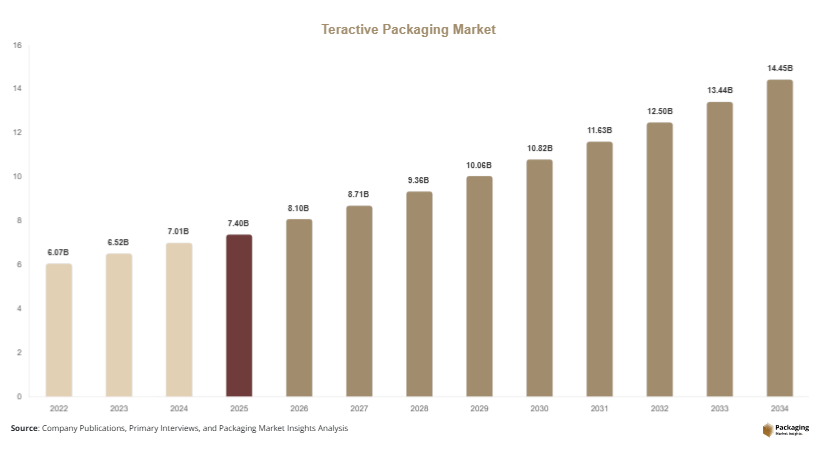
The global Teractive Packaging Market size was valued at approximately USD 7.4 billion in 2025 and is projected to reach USD 8.1 billion in 2026. Over the forecast period, the market is expected to grow significantly and reach USD 15.2 billion by 2034, registering a CAGR of 7.5% from 2025 to 2034. This growth reflects the rising demand for intelligent and functional packaging solutions across multiple industries, particularly food, pharmaceuticals, and consumer goods.
One of the primary growth factors is the increasing demand for extended shelf life in perishable products. Teractive packaging systems incorporate components such as oxygen scavengers, moisture absorbers, and antimicrobial agents, which actively maintain product freshness and reduce spoilage. This is particularly important in the food and beverage sector, where product quality and safety are critical.
Key Highlights:
- The market size reached USD 7.4 billion in 2025 and is projected to reach USD 15.2 billion by 2034. This growth reflects increasing demand for advanced packaging solutions across multiple industries.
- The market is expected to grow at a CAGR of 7.5% from 2025 to 2034. Consistent expansion is supported by rising need for product protection and innovation in packaging technologies.
- Rising demand for extended shelf life and product safety is a key growth factor. Consumers and manufacturers are focusing on maintaining quality and reducing product spoilage.
- Increasing adoption in food, pharmaceutical, and consumer goods industries is driving market expansion. These sectors require reliable packaging solutions to ensure product integrity and safety.
- Advancements in smart and functional packaging technologies are enhancing overall performance. Innovations such as active and intelligent packaging are improving efficiency and usability.
Explore more data points, trends and opportunities Download Free Sample Report
Market Trends
Increasing Integration of Smart and Active Packaging Technologies
A significant trend in the teractive packaging market is the integration of smart and active packaging technologies. These solutions combine active components such as oxygen scavengers and antimicrobial agents with intelligent features like sensors and indicators. This integration allows packaging to not only preserve product quality but also provide real-time information about product conditions. For instance, temperature-sensitive indicators can alert consumers to potential spoilage. This trend is particularly relevant in the food and pharmaceutical sectors, where maintaining product integrity is essential. As technology continues to evolve, the adoption of smart teractive packaging is expected to increase.
Rising Demand for Sustainable and Eco-Friendly Packaging Solutions
Sustainability is becoming a key focus area in the teractive packaging market. Manufacturers are developing eco-friendly packaging solutions that incorporate biodegradable materials and reduce environmental impact. This trend is driven by regulatory pressures and growing consumer awareness regarding sustainability. Companies are exploring the use of bio-based polymers and recyclable materials in teractive packaging. These innovations aim to balance functionality with environmental responsibility. As sustainability becomes a priority, the demand for eco-friendly teractive packaging solutions is expected to grow.
Market Drivers
Growing Demand for Food Safety and Shelf-Life Extension
The increasing demand for food safety and extended shelf life is a major driver of the teractive packaging market. Consumers are seeking products that remain fresh for longer periods without compromising quality. Teractive packaging solutions address this need by actively controlling factors such as moisture and oxygen levels. This helps prevent spoilage and maintain product quality. The growth of the global food industry and increasing consumption of packaged foods are further driving demand for these solutions. Additionally, regulatory requirements for food safety are encouraging manufacturers to adopt advanced packaging technologies.
Expansion of Pharmaceutical and Healthcare Industries
The expansion of pharmaceutical and healthcare industries is another key driver of the market. Teractive packaging plays a crucial role in protecting sensitive medical products from environmental factors. This is particularly important for drugs that require controlled storage conditions. The increasing production of pharmaceuticals and the growing demand for healthcare products are driving the adoption of teractive packaging solutions. Furthermore, the need for compliance with strict regulatory standards is encouraging manufacturers to invest in advanced packaging technologies.
Market Restraint
High Cost of Advanced Packaging Technologies
One of the major challenges facing the teractive packaging market is the high cost associated with advanced packaging technologies. The development and production of teractive packaging solutions involve the use of specialized materials and technologies, which can increase costs. This can be a barrier for small and medium-sized enterprises that may have limited budgets. Additionally, the integration of smart features such as sensors and indicators further adds to the cost. For example, incorporating temperature-sensitive indicators into packaging can significantly increase production expenses. These cost challenges can limit the adoption of teractive packaging, particularly in price-sensitive markets. As a result, manufacturers must balance innovation with cost efficiency to remain competitive.
Market Opportunities
Expansion in Emerging Markets with Growing Packaged Food Demand
Emerging markets present significant growth opportunities for the teractive packaging market. Rapid urbanization, increasing disposable incomes, and changing consumer lifestyles are driving demand for packaged foods in regions such as Asia Pacific and Latin America. As consumers shift toward convenience foods, the need for packaging solutions that ensure product freshness and safety is increasing. Teractive packaging can play a crucial role in meeting these demands. Additionally, the expansion of retail infrastructure and e-commerce platforms is creating new opportunities for market growth. Companies can capitalize on these trends by offering cost-effective and innovative packaging solutions tailored to regional needs.
Development of Cost-Effective and Scalable Packaging Solutions
The development of cost-effective and scalable teractive packaging solutions presents another significant opportunity. Manufacturers are focusing on reducing production costs while maintaining functionality and performance. Innovations in material science and manufacturing processes are enabling the production of affordable teractive packaging solutions. These advancements are making it possible for smaller companies to adopt these technologies. Additionally, the development of standardized solutions that can be used across multiple applications is helping to reduce costs. This trend is expected to drive wider adoption of teractive packaging across various industries.
Report Scope
| Report Metric | Details |
|---|---|
| Market Size in 2025 | USD 7.4 Billion |
| Market Size in 2026 | USD 8.1 Billion |
| Market Size in 2034 | USD 15.2 Billion |
| CAGR | 7.5% (2026-2034) |
| Base Year for Estimation | 2025 |
| Historical Data | 2022-2024 |
| Forecast Period | 2026-2034 |
| Report Coverage | Revenue Forecast, Competitive Landscape, Supply Chain Disruption, Growth Factors, Environment & Regulatory Landscape and Trends |
| Geographies Covered | North America, Europe, APAC, Middle East and Africa, LATAM |
| Countries Covered | U.S., Canada, U.K., Germany, France, Spain, Italy, Russia, Nordic, Benelux, Rest of Europe, China, South Korea, Japan, India, Australia, Singapore, Taiwan, South East Asia, Rest of Asia-Pacific, UAE, Turky, Saudi Arabia, South Africa, Egypt, Nigeria, Rest of MEA, Brazil, Mexico, Argentina, Chile, Colombia, Rest of LATAM |
Explore more data points, trends and opportunities Download Free Sample Report
Segmental Analysis
By Type
Active packaging dominated the market in 2024, accounting for approximately 54% of the total share. This segment includes technologies such as oxygen scavengers, moisture absorbers, and antimicrobial packaging, which actively interact with the product to enhance shelf life and safety. These solutions are widely used in food and pharmaceutical applications due to their ability to maintain product quality. The increasing demand for extended shelf life and improved product safety is driving the adoption of active packaging solutions. Additionally, advancements in material science are enabling the development of more efficient and effective active packaging technologies.
Intelligent packaging is the fastest-growing segment, with a CAGR of 8.2%. This segment includes packaging solutions with sensors, indicators, and tracking technologies that provide real-time information about product conditions. The growing demand for transparency and traceability in supply chains is driving the adoption of intelligent packaging. These solutions are particularly useful in the food and pharmaceutical industries, where monitoring product conditions is critical. The integration of digital technologies is further enhancing the functionality of intelligent packaging.
By Application
Food and beverage applications dominated the market in 2024, accounting for approximately 49% of the total share. The increasing consumption of packaged foods and the need for extended shelf life are driving this segment. Teractive packaging solutions help maintain product freshness and prevent spoilage, making them essential in the food industry. The growth of the global food industry and increasing demand for convenience foods are further supporting this segment.
Pharmaceutical applications are the fastest-growing segment, with a CAGR of 8.0%. The increasing demand for safe and effective packaging solutions for medical products is driving this segment. Teractive packaging helps protect sensitive drugs from environmental factors, ensuring product integrity. The growth of the pharmaceutical industry and increasing focus on healthcare are contributing to the expansion of this segment.
By End-Use
Food manufacturers dominated the market in 2024, accounting for approximately 46% of the total share. These companies rely on teractive packaging solutions to ensure product quality and extend shelf life. The increasing demand for packaged foods and the need for efficient supply chain management are driving this segment.
Healthcare providers and pharmaceutical companies are the fastest-growing end-use segment, with a CAGR of 7.9%. The increasing demand for advanced packaging solutions in the healthcare sector is driving this segment. Teractive packaging plays a crucial role in ensuring the safety and efficacy of medical products. The growth of healthcare infrastructure and increasing investment in pharmaceutical production are supporting this segment.
Teractive Packaging Market Segmentations
By Type
- Active Packaging
- Intelligent Packaging
By Application
- Food & Beverage
- Pharmaceuticals
- Consumer Goods
By End-Use
- Food Manufacturers
- Pharmaceutical Companies
- Retail & Others
Regional Analysis
North America
North America accounted for approximately 35% of the global teractive packaging market share in 2025 and is expected to grow at a CAGR of 6.8% during the forecast period. The region’s growth is driven by high demand for advanced packaging solutions and strong presence of food and pharmaceutical industries. Increasing consumer awareness regarding food safety and quality is also contributing to market growth.
The United States dominates the regional market due to its large consumer base and advanced technological capabilities. A unique growth factor is the widespread adoption of smart packaging technologies, which are enhancing product quality and safety. This is driving demand for teractive packaging solutions.
Europe
Europe held around 26% of the market share in 2025 and is projected to grow at a CAGR of 6.6%. The region is characterized by stringent regulations related to food safety and packaging materials. These regulations are driving the adoption of advanced packaging solutions.
Germany leads the European market due to its strong manufacturing base and focus on sustainability. A unique growth factor is the increasing demand for eco-friendly packaging solutions, which is encouraging innovation in teractive packaging technologies.
Asia Pacific
Asia Pacific accounted for approximately 24% of the market share in 2025 and is expected to grow at a CAGR of 8.5%, making it the fastest-growing region. Rapid urbanization and increasing demand for packaged foods are key drivers of market growth.
China dominates the regional market due to its large population and expanding food industry. A unique growth factor is the increasing penetration of e-commerce platforms, which is driving demand for advanced packaging solutions.
Middle East & Africa
The Middle East & Africa region held around 8% of the market share in 2025 and is projected to grow at a CAGR of 7.2%. The growing demand for packaged foods and increasing investment in the food industry are driving market growth.
Saudi Arabia is the dominant country in this region, supported by its expanding retail sector. A unique growth factor is the increasing demand for imported packaged foods, which require advanced packaging solutions.
Latin America
Latin America accounted for approximately 7% of the market share in 2025 and is expected to grow at a CAGR of 7.4%. The region is experiencing steady growth due to increasing urbanization and changing consumer lifestyles.
Brazil leads the regional market due to its large population and growing food industry. A unique growth factor is the increasing adoption of modern retail formats, which is driving demand for teractive packaging solutions.
Competitive Landscape
The teractive packaging market is moderately competitive, with several global and regional players focusing on innovation and product development. Companies are investing in research and development to create advanced packaging solutions that meet evolving customer needs. Strategic collaborations and partnerships are also common in the market.
Amcor Plc is a leading player in the market, known for its extensive portfolio of advanced packaging solutions. The company recently introduced new active packaging solutions designed to enhance product shelf life and safety. Other key players are also focusing on expanding their product offerings and strengthening their market presence through innovation and strategic initiatives.
Key Players List
- Amcor Plc
- Sealed Air Corporation
- Berry Global Inc.
- Mondi Group
- Sonoco Products Company
- Constantia Flexibles
- Huhtamaki Oyj
- Coveris Holdings S.A.
- Winpak Ltd.
- Uflex Ltd.
- DS Smith Plc
- ProAmpac LLC
- Clondalkin Group
- Tetra Pak International S.A.
- Smurfit Kappa Group