Tear Tape Dispenser Market Size
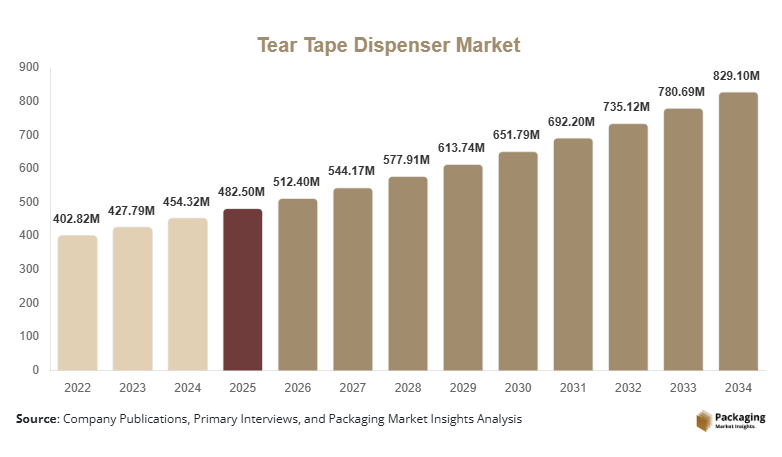
The tear tape dispenser market size is projected at USD 512.4 million in 2026 and is expected to hit USD 826.8 million by 2034 with a CAGR of 6.2%. The market continues to expand with rising investments in automated packaging lines, product authentication, and premium consumer packaging. The report provides detailed segmentation, production analysis, regional assessment, and competitive landscape to support strategic business decisions across the value chain.
The tear tape dispenser market consists of dispensing equipment designed to accurately apply tear tapes onto cartons, flexible packaging, and paperboard products to improve package opening convenience and tamper evidence. Global production exceeded 118,000 units in 2025, while installations are projected to surpass 173,000 units by 2034. Automatic systems account for approximately 47% of installed capacity, semi-automatic systems represent 31%, and manual systems contribute 22%. Packaging manufacturers achieved adoption rates exceeding 68% across premium consumer goods and 61% within pharmaceutical packaging operations, reinforcing sustained expansion of the tear tape dispenser market.
Explore more data points, trends and opportunities Download Free Sample Report
Tear Tape Dispenser Market Trends
Rising Automation Across Packaging Facilities
Packaging manufacturers are increasingly integrating intelligent dispensing technologies to improve throughput and reduce operational waste. Annual production of tear tape dispenser equipment is projected to rise from 124,000 units in 2026 to over 182,000 units by 2034. Nearly 64% of newly commissioned packaging lines incorporate automated dispensing modules, while servo-controlled systems have achieved adoption rates of 41%. Growing demand from food processing, pharmaceutical, and e-commerce packaging continues to strengthen the tear tape dispenser market.
Automation also enables higher dispensing precision, reducing material wastage by nearly 18% while increasing operational efficiency by approximately 22%. Production capacity of automated systems expanded by 8.1% year-over-year, supported by increasing investments in Industry 4.0 manufacturing. Advanced monitoring technologies now represent nearly 35% of newly installed systems, contributing to long-term expansion of the tear tape dispenser market.
Tear Tape Dispenser Market Drivers
Growing Automation in Packaging Manufacturing
Increasing demand for high-speed packaging has accelerated investment in automated dispensing equipment. More than 71% of large packaging manufacturers now utilize automated tear tape dispensing systems, compared with 54% five years ago. Global packaging output exceeded 5.6 trillion packages annually, with premium packaging accounting for nearly 29% of production. Improved dispensing accuracy exceeding 99%, reduced downtime of 17%, and production capacity improvements of 20% continue supporting the tear tape dispenser market.
Tear Tape Dispenser Market Restraints
High Initial Capital Investment
Advanced dispensing systems require significant installation and integration costs. Automatic equipment may cost 2.8 to 4.5 times more than manual alternatives, limiting adoption among small manufacturers. Nearly 36% of SMEs continue operating conventional packaging equipment due to budget constraints. Maintenance expenses represent approximately 8% of annual operating costs, restricting wider deployment across developing regions and slowing the tear tape dispenser market growth.
Tear Tape Dispenser Market Opportunities
Expansion of Sustainable Packaging
Sustainable packaging initiatives continue creating opportunities for equipment manufacturers. Over 59% of global packaging companies have introduced recyclable packaging formats, increasing demand for compatible dispensing technologies. Paper-based packaging production exceeded 460 billion units annually, while recyclable carton applications expanded by 11% year-over-year. Investments in eco-friendly packaging machinery continue supporting the Tear Tape Dispenser Market.
Challenges in Tear Tape Dispenser Market
Raw Material Price Volatility and Equipment Standardization
Steel, aluminum, precision motors, and electronic component prices have fluctuated between 9% and 18% during recent years, affecting equipment manufacturing costs. Component shortages temporarily delayed approximately 14% of equipment deliveries. Diverse packaging specifications across industries further complicate equipment standardization, requiring customized engineering that increases lead times and influences the tear tape dispenser market.
Report Scope
| Report Metric | Details |
|---|---|
| Market Size in 2025 | USD 482.5 Million |
| Market Size in 2026 | USD 512.4 Million |
| Market Size in 2034 | USD 826.8 Million |
| CAGR | 6.2% (2026-2034) |
| Base Year for Estimation | 2025 |
| Historical Data | 2022-2024 |
| Forecast Period | 2026-2034 |
| Report Coverage | Revenue Forecast, Competitive Landscape, Supply Chain Disruption, Growth Factors, Environment & Regulatory Landscape and Trends |
| Geographies Covered | North America, Europe, APAC, Middle East and Africa, LATAM |
| Countries Covered | U.S., Canada, U.K., Germany, France, Spain, Italy, Russia, Nordic, Benelux, Rest of Europe, China, South Korea, Japan, India, Australia, Singapore, Taiwan, South East Asia, Rest of Asia-Pacific, UAE, Turky, Saudi Arabia, South Africa, Egypt, Nigeria, Rest of MEA, Brazil, Mexico, Argentina, Chile, Colombia, Rest of LATAM |
Explore more data points, trends and opportunities Download Free Sample Report
Tear Tape Dispenser Market Segmentation
The market is segmented by equipment type and application. Automatic systems account for nearly 47% of market demand, while food and beverage packaging contributes approximately 44% of total equipment installations. Rising automation and production efficiency continue supporting segment expansion.
By Type
Manual Tear Tape Dispenser
Manual systems account for approximately 22% of global demand, with annual production exceeding 26,000 units. These dispensers remain suitable for low-volume packaging operations, specialty production, and customized packaging environments requiring flexible operation.
Semi-Automatic Tear Tape Dispenser
Semi-automatic equipment contributes nearly 31% of total shipments, producing over 37,000 units annually. These systems deliver dispensing speeds reaching 55 meters per minute, balancing affordability and operational efficiency for medium-scale manufacturers.
Automatic Tear Tape Dispenser
Automatic systems dominate with approximately 47% market share and annual production exceeding 61,000 units. Operating speeds exceeding 120 meters per minute, precision levels above 99%, and compatibility with high-volume production lines support widespread industrial adoption.
By Application
Food and beverage packaging represents approximately 44% of market demand, supported by production volumes exceeding 2 trillion packaged food products annually. Tear tape solutions improve consumer convenience while supporting premium shelf presentation and tamper evidence.
Pharmaceutical applications account for nearly 29% of installations. Annual pharmaceutical carton production exceeds 170 billion units, while regulatory compliance requirements have increased adoption of precision dispensing equipment by nearly 16% over recent years.
Consumer goods packaging contributes approximately 27% of demand. Personal care, electronics, and household product manufacturers collectively utilize over 31,000 dispensing systems, with premium packaging penetration exceeding 58%.
Tear Tape Dispenser Market Segmentations
Product Type
- Manual Tear Tape Dispenser
- Semi-Automatic Tear Tape Dispenser
- Automatic Tear Tape Dispenser
Application
- Food & Beverage Packaging
- Pharmaceutical Packaging
- Consumer Goods Packaging
Tear Tape Dispenser Market Regional Outlook
North America
North America accounts for approximately 31% of global demand, with annual equipment production exceeding 34,000 units. The United States contributes nearly 82% of regional installations, supported by pharmaceutical, food processing, and e-commerce packaging investments.
Europe
Europe represents around 28% of the market. Germany, Italy, France, and the United Kingdom collectively contribute over 74% of regional manufacturing output. Sustainable packaging regulations continue accelerating equipment modernization.
Asia-Pacific
Asia-Pacific leads production with approximately 34% market share. China contributes nearly 46% of regional output, followed by Japan, India, and South Korea. Packaging production continues expanding at annual rates exceeding 8%, supporting equipment demand.
Latin America
Latin America contributes approximately 4% of global demand. Brazil and Mexico collectively account for over 68% of regional installations, supported by growing consumer goods manufacturing.
Middle East & Africa
The Middle East & Africa holds nearly 3% of global demand. Industrial investments across GCC countries and South Africa continue improving regional packaging automation capabilities.
Top Players In The Tear Tape Dispenser Market
- 3M Company
- Tann Germany GmbH
- Essentra plc
- MGL International
- CMC Machinery
- W. H. Leary Company
- Kohmann GmbH
- Baumer hhs GmbH
- BGM Srl
- Newlong Industrial Co., Ltd.
3M Company
- Estimated market share: 14%
- Strong global distribution network across packaging industries.
- Extensive portfolio of tear tape materials and dispensing technologies.
- Focuses on automation, innovation, and integrated packaging solutions.
- Significant presence in pharmaceutical, food, and consumer goods applications with continuous investment in advanced manufacturing.
Essentra plc
- Estimated market share: 10%
- Recognized supplier of specialty packaging components.
- Strong customer relationships across healthcare and consumer packaging sectors.
- Invests in sustainable packaging innovations and customized dispensing solutions.
- Expanding manufacturing capabilities and automation technologies to strengthen competitive positioning globally.