Tamper Proof Packaging Market Size and Growth
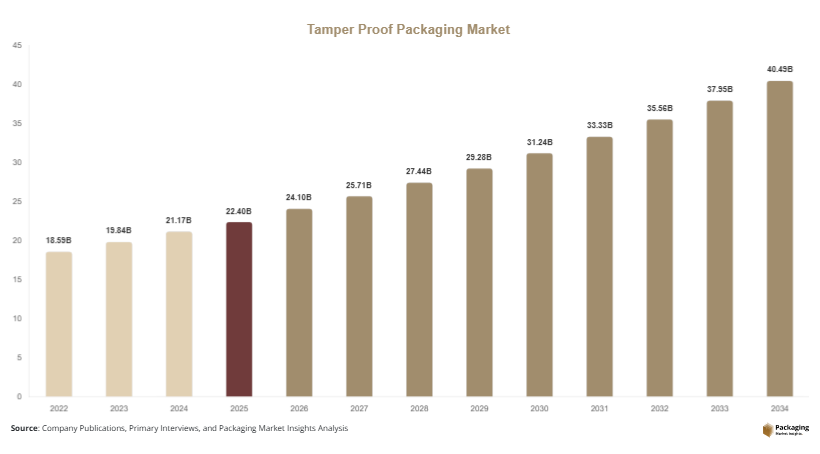
The global tamper proof packaging market is projected to grow from USD 22.4 billion in 2025 to USD 39.8 billion by 2034, registering a CAGR of 6.7% during 2025–2034. In 2026, the market size is estimated at USD 24.1 billion, driven by rising demand for secure packaging in pharmaceuticals, food safety compliance, and expansion of global e-commerce logistics.
Several key growth factors are shaping the market. First, increasing incidents of counterfeiting and product adulteration are pushing companies to adopt advanced tamper-proof solutions. Second, stringent regulatory frameworks in the pharmaceutical and food industries are mandating secure packaging systems. Third, growth in global e-commerce and direct-to-consumer distribution is increasing demand for protective and traceable packaging solutions.
Key Highlights
- Asia Pacific dominated the market with a 37.4% share in 2025.
- Latin America is projected to grow at the fastest CAGR of 6.2%.
- Labels & seals segment led the type category with a 38.6% share.
- Plastic-based packaging dominated with a 51.2% share.
- Pharmaceutical applications led with 44.1% share, while e-commerce logistics is the fastest-growing segment.
- The US remained the dominant country with a market size of USD 11.2 billion in 2025 and USD 11.9 billion in 2026.
Explore more data points, trends and opportunities Download Free Sample Report
Market Trends
Integration of Smart Authentication Technologies
A major trend in the tamper proof packaging market is the integration of smart authentication technologies such as QR codes, RFID tags, and blockchain-enabled tracking systems. These technologies allow consumers and supply chain stakeholders to verify product authenticity in real time. For example, pharmaceutical companies are increasingly using QR-coded packaging that allows patients to scan and verify drug authenticity before consumption. Similarly, luxury cosmetic brands are embedding NFC chips in packaging to prevent counterfeiting. This trend is driven by rising digitalization and demand for traceable supply chains. In the future, AI-driven authentication systems and blockchain-based packaging ecosystems are expected to become standard in high-value product categories.
Shift Toward Sustainable Tamper-Evident Materials
Another key trend is the increasing adoption of sustainable tamper proof packaging materials. Manufacturers are transitioning from plastic-heavy security seals to biodegradable films, recyclable adhesives, and paper-based tamper labels. For instance, food packaging companies in Europe are introducing compostable tamper-evident seals for organic food products. This shift is influenced by environmental regulations and corporate sustainability commitments. However, maintaining durability while ensuring eco-friendliness remains a challenge. In the future, hybrid biodegradable security materials combining strength and sustainability are expected to dominate packaging innovation.
Market Drivers
Rising Counterfeit and Product Fraud Incidents
Increasing incidents of counterfeit products across pharmaceuticals, electronics, and luxury goods are a major driver of the tamper proof packaging market. Counterfeit medicines, in particular, pose significant risks to public health and have led to stricter regulatory enforcement. For example, global pharmaceutical companies are adopting tamper-evident blister packaging and serialized labels to prevent duplication. Electronics manufacturers are also using security seals to protect high-value components during transit. This growing threat is compelling companies to invest in advanced packaging security solutions.
Expansion of Pharmaceutical and Food Safety Regulations
Stringent regulations mandating tamper-evident packaging in pharmaceuticals and food industries are another key driver. Regulatory bodies such as the FDA and European Medicines Agency require tamper-proof features on prescription drugs and over-the-counter medications. For example, drug manufacturers in the U.S. must include sealed blister packs or breakable caps on medicine bottles. Similarly, food companies are required to ensure packaging integrity to prevent contamination. These regulations significantly boost demand for tamper-proof packaging solutions globally.
Market Restraint
A major restraint in the tamper proof packaging market is the higher cost associated with advanced security packaging solutions. Technologies such as holographic seals, RFID tags, and smart labels significantly increase production costs, making them less accessible for small and mid-sized manufacturers.
Additionally, integration complexity with existing packaging lines creates operational challenges. For example, retrofitting production lines to accommodate smart packaging systems requires capital investment and technical expertise. This limits adoption in cost-sensitive industries and developing economies.
Market Opportunities
Expansion of E-Commerce and Direct-to-Consumer Shipping
The rapid expansion of e-commerce presents a major opportunity for the tamper proof packaging market. Online retail requires secure packaging to ensure safe delivery of products. For example, electronics and cosmetic companies use tamper-evident seals to ensure product integrity during transit. This trend is particularly strong in emerging markets where online shopping is growing rapidly.
Growth in Pharmaceutical Serialization and Track-and-Trace Systems
The increasing adoption of serialization and track-and-trace systems in pharmaceuticals represents another major opportunity. Governments are mandating unique identification codes on drug packaging to prevent counterfeiting. For instance, pharmaceutical companies are implementing serialized QR-coded packaging systems to track drug movement across supply chains. This enhances transparency and supports regulatory compliance.
Report Scope
| Report Metric | Details |
|---|---|
| Market Size in 2025 | USD 22.4 Billion |
| Market Size in 2026 | USD 24.1 Billion |
| Market Size in 2034 | USD 39.8 Billion |
| CAGR | 6.7% (2026-2034) |
| Base Year for Estimation | 2025 |
| Historical Data | 2022-2024 |
| Forecast Period | 2026-2034 |
| Report Coverage | Revenue Forecast, Competitive Landscape, Supply Chain Disruption, Growth Factors, Environment & Regulatory Landscape and Trends |
| Geographies Covered | North America, Europe, APAC, Middle East and Africa, LATAM |
| Countries Covered | U.S., Canada, U.K., Germany, France, Spain, Italy, Russia, Nordic, Benelux, Rest of Europe, China, South Korea, Japan, India, Australia, Singapore, Taiwan, South East Asia, Rest of Asia-Pacific, UAE, Turky, Saudi Arabia, South Africa, Egypt, Nigeria, Rest of MEA, Brazil, Mexico, Argentina, Chile, Colombia, Rest of LATAM |
Explore more data points, trends and opportunities Download Free Sample Report
Segmental Analysis
Type
The tamper-evident labels and seals segment dominated with a 2024 market share of 38.6%, driven by widespread adoption across pharmaceuticals, food, and personal care industries. These solutions are cost-effective and easy to integrate into existing packaging lines. For example, pharmaceutical companies use breakable seals and induction closures to ensure product integrity. Food manufacturers use shrink bands to indicate package opening.
Blister packaging also holds significant share but is more application-specific.
The fastest-growing segment is smart tamper-evident packaging, with a CAGR of 8.4%, driven by integration of digital authentication systems. These solutions include QR-coded seals and RFID-enabled packaging. Future outlook suggests strong expansion as digital traceability becomes mandatory in pharmaceutical supply chains.
Material
Plastic-based tamper-proof packaging dominated with a 2024 share of 51.2%, due to durability, cost efficiency, and versatility. It is widely used in pharmaceutical bottles, food packaging, and electronic goods protection.
Paper-based solutions are gaining traction but are limited by durability constraints.
The fastest-growing segment is biodegradable tamper-proof materials, driven by sustainability regulations. CAGR stands at 7.2%, supported by innovation in eco-friendly adhesives and compostable seals.
End-Use
Pharmaceutical applications dominated with a 2024 share of 44.1%, driven by strict regulatory requirements and high risk of counterfeit drugs. For example, blister packs and sealed bottles are standard in prescription medicine packaging.
E-commerce logistics is the fastest-growing segment, driven by rising online retail and direct-to-consumer shipping. CAGR stands at 7.6%, supported by demand for secure delivery packaging in electronics and cosmetics.
Tamper Proof Packaging Market Segmentations
By Type
- Tamper-Evident Labels & Seals
- Blister Packaging
- Shrink Bands
- Security Tapes
- Smart Tamper-Evident Packaging
By Material
- Plastic-Based Packaging
- Paper-Based Packaging
- Biodegradable Materials
By End-User
- Pharmaceuticals
- Food & Beverage
- Personal Care & Cosmetics
- Electronics
- E-commerce & Logistics
Regional Analysis
North America
North America accounted for approximately 28.3% share of the tamper proof packaging market in 2025, with a projected CAGR of 6.4% through 2034. The region benefits from strong regulatory frameworks, advanced pharmaceutical manufacturing, and high consumer awareness regarding product safety. The United States and Canada are leading markets due to robust healthcare infrastructure and strict packaging compliance requirements.
A key growth factor is the presence of stringent FDA regulations mandating tamper-evident packaging for pharmaceuticals and food products. For example, prescription drugs in the U.S. are required to use sealed blister packs or breakable caps to ensure safety. The expansion of e-commerce further supports demand for secure packaging solutions across logistics and retail sectors.
The United States dominates the region due to its large pharmaceutical and consumer goods industries. A unique growth driver is the rapid adoption of smart packaging technologies, such as RFID-enabled seals and blockchain-based traceability systems. For instance, major pharmaceutical companies in the U.S. are integrating digital authentication tools to combat counterfeit drugs in distribution networks.
Europe
Europe held around 26.9% market share in 2025, growing at a CAGR of 6.5%. The region is characterized by strict regulatory enforcement, high pharmaceutical standards, and strong focus on consumer safety. Countries such as Germany, France, Italy, and the UK are major contributors.
A key growth factor is EU regulatory mandates on packaging integrity and anti-counterfeit measures. For example, pharmaceutical serialization requirements across Europe ensure that every drug package is traceable throughout the supply chain. Food safety regulations also mandate tamper-evident packaging for packaged food products.
Germany dominates the region due to its advanced manufacturing and pharmaceutical industries. A unique growth driver is the integration of high-security holographic packaging in export-oriented pharmaceutical products, ensuring authenticity in global markets.
Asia Pacific
Asia Pacific dominated with a 37.4% share in 2025, and is projected to grow at a CAGR of 7.3%. The region benefits from rapid industrialization, expanding pharmaceutical production, and rising e-commerce penetration in countries such as China, India, and Japan.
A key growth factor is increasing regulatory enforcement on drug safety and food packaging standards. For example, India’s pharmaceutical export industry is adopting tamper-evident blister packaging to comply with international regulations. China is also investing heavily in anti-counterfeit packaging technologies.
China dominates the region due to its large manufacturing base. A unique driver is the expansion of digital anti-counterfeit labeling systems integrated into export pharmaceutical products, enhancing global supply chain security.
Middle East & Africa
Middle East & Africa accounted for 6.2% share in 2025, with a CAGR of 5.8%. Growth is driven by increasing healthcare investments and expanding retail infrastructure.
A key growth factor is rising demand for pharmaceutical packaging security in urban healthcare systems. For example, Gulf countries are implementing stricter drug packaging standards to combat counterfeit medicines.
The UAE dominates the region due to its advanced logistics and healthcare infrastructure. A unique driver is the adoption of smart labeling systems in imported pharmaceutical products to ensure authenticity in retail distribution.
Latin America
Latin America held around 3.2% share in 2025, and is projected to grow at the fastest CAGR of 6.2%. Brazil and Mexico are the major contributors due to expanding pharmaceutical production and retail growth.
A key growth factor is increasing awareness of counterfeit drug risks. For example, Brazil’s pharmaceutical industry is adopting tamper-evident packaging to ensure drug safety in domestic distribution.
Brazil dominates the region due to its large healthcare market. A unique driver is expansion of serialized packaging systems in pharmaceutical exports to North America and Europe.
Competitive Landscape
The tamper proof packaging market is moderately consolidated with strong presence of global packaging and security solution providers. Key players include Avery Dennison, 3M Company, Sealed Air Corporation, Amcor plc, and DuPont de Nemours Inc. Among these, Avery Dennison leads due to its extensive portfolio of security labels and RFID-enabled packaging solutions.
Companies are focusing on smart packaging technologies, expansion of anti-counterfeit solutions, and sustainable security materials. Strategic partnerships with pharmaceutical companies and e-commerce platforms are increasing to enhance supply chain security.
Key Players List
- Avery Dennison Corporation
- 3M Company
- Sealed Air Corporation
- Amcor plc
- DuPont de Nemours Inc.
- CCL Industries Inc.
- Huhtamaki
- WestRock Company
- Berry Global Inc.
- Mondi Group
- Securikett
- Integraf LLC
- UPM Raflatac
- Intertape Polymer Group
- Essentra plc