Tamper Evident Labels Market Size and Growth
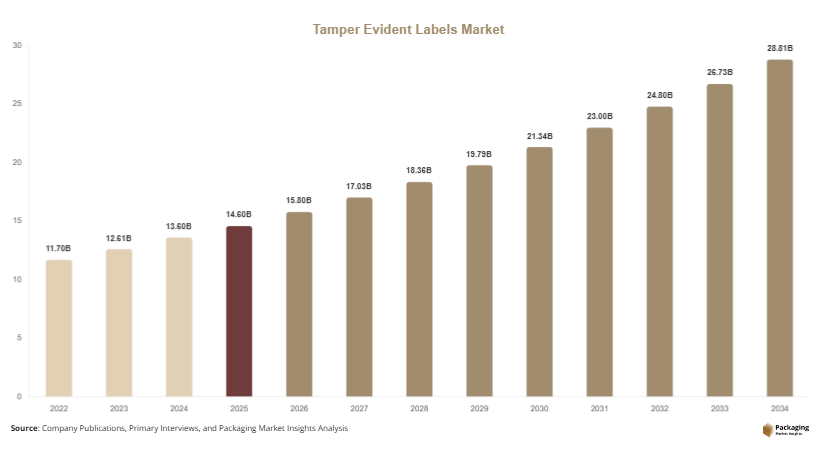
In 2025, the global tamper evident labels market size is estimated at USD 14.6 billion, and it is projected to reach USD 15.8 billion in 2026. By 2034, the market is expected to attain approximately USD 29.4 billion, growing at a CAGR of 7.8% (2025–2034). The tamper evident labels market is experiencing steady expansion due to increasing global emphasis on product authentication, supply chain security, and regulatory compliance across industries such as pharmaceuticals, food & beverages, cosmetics, electronics, and logistics.
Growth in this market is primarily driven by rising incidents of product counterfeiting, increasing adoption of smart packaging technologies, and stringent government regulations requiring traceability and product integrity. Additionally, expanding e-commerce distribution channels are accelerating demand for secure packaging solutions, further supporting tamper evident label adoption across multiple industries.
Key Highlights:
- Asia Pacific dominated the market with a 37.4% share in 2025, while Latin America is projected to grow at the fastest CAGR of 6.2%.
- Pressure-sensitive tamper evident labels led the type segment with a 29.6% share, while RFID-enabled labels are expected to grow at a CAGR of 6.5%.
- Plastic-based labels dominated with a 52.3% share, while paper-based eco-friendly labels are forecasted to grow at a CAGR of 5.9%.
- Food & beverage applications led with a 43.1% share, while healthcare packaging is expected to grow at a CAGR of 6.3%.
- China remained the dominant country with a market size of USD 11.2 billion in 2025 and USD 11.9 billion in 2026.
Explore more data points, trends and opportunities Download Free Sample Report
Market Trends
Increasing Adoption of Smart and Connected Label Technologies
One of the most significant trends in the tamper evident labels market is the increasing integration of smart technologies such as RFID, NFC, and QR-enabled security labels. These technologies allow real-time tracking, authentication, and verification of packaged goods throughout the supply chain. Industries such as pharmaceuticals and high-value electronics are increasingly adopting smart tamper evident labels to reduce counterfeiting risks and improve traceability. Additionally, the combination of digital connectivity with physical security features is enhancing consumer engagement, as buyers can verify product authenticity using smartphones. This convergence of physical and digital security systems is reshaping the packaging landscape and increasing investment in intelligent labeling solutions.
Shift Toward Sustainable and Eco-Friendly Security Labels
Another emerging trend is the growing shift toward sustainable tamper evident labeling solutions. Manufacturers are increasingly developing biodegradable, recyclable, and bio-based label materials to align with global sustainability goals. Regulatory pressure and corporate environmental responsibility initiatives are driving demand for paper-based and compostable tamper evident labels. In addition, brands are focusing on reducing plastic usage while maintaining high security standards. Innovations in water-based adhesives and eco-friendly inks are supporting this transition. The combination of sustainability and product protection is expected to create new opportunities in environmentally conscious markets, particularly in Europe and North America.
Market Drivers
Rising Counterfeiting and Product Fraud Across Industries
A major driver of the tamper evident labels market is the increasing prevalence of counterfeit goods across global supply chains. Industries such as pharmaceuticals, food & beverages, and luxury goods are particularly vulnerable to product duplication and tampering. Governments and regulatory bodies are enforcing strict packaging authentication standards to protect consumers and ensure product safety. This has significantly increased the adoption of tamper evident labeling solutions that provide visible proof of interference. Companies are investing in advanced label technologies such as holographic seals and destructible films to strengthen product security and brand protection strategies.
Expansion of E-Commerce and Global Supply Chain Networks
The rapid expansion of e-commerce platforms and global trade networks is another key growth driver. As products move through complex logistics chains, the risk of tampering and contamination increases. Tamper evident labels help ensure that goods remain intact from manufacturer to end consumer. E-commerce giants and logistics providers are increasingly mandating secure packaging standards to maintain consumer trust. Additionally, cross-border trade regulations are encouraging the use of authentication labels for customs verification. This growing need for secure product delivery is significantly boosting demand for tamper evident labeling solutions worldwide.
Market Restraint
High Cost of Advanced Security Labeling Technologies
A major restraint in the tamper evident labels market is the relatively high cost associated with advanced labeling technologies such as RFID-enabled, holographic, and smart labels. Small and medium-sized enterprises often face budget constraints when adopting these solutions. The integration of digital authentication systems increases production complexity and overall packaging costs. In price-sensitive markets, companies may prefer traditional labeling methods, limiting widespread adoption. Additionally, maintenance and technological upgrades further add to operational expenses. This cost barrier can slow down market penetration, especially in developing economies where affordability remains a key concern.
Market Opportunities
Expansion in Emerging Economies and Industrialization Growth
Emerging economies in Asia Pacific, Latin America, and parts of Africa present significant growth opportunities for the tamper evident labels market. Rapid industrialization, expanding pharmaceutical manufacturing, and increasing food export activities are driving demand for secure packaging solutions. Governments in these regions are introducing stricter packaging and labeling regulations, encouraging adoption of tamper evident technologies. Additionally, rising consumer awareness regarding product safety is boosting demand for authentication labels. Local manufacturers are also investing in cost-effective labeling solutions tailored for regional industries, creating a strong growth environment for market expansion.
Technological Innovation in Digital Authentication Systems
Another key opportunity lies in the advancement of digital authentication technologies integrated into tamper evident labels. Innovations such as blockchain-based traceability, AI-powered verification systems, and cloud-connected packaging are enhancing product security. These technologies allow real-time monitoring of product movement and tampering incidents. Companies investing in digital transformation are likely to benefit from improved supply chain transparency and reduced fraud risks. The integration of smart packaging with tamper evident features is expected to open new revenue streams and redefine future packaging security standards.
Report Scope
| Report Metric | Details |
|---|---|
| Market Size in 2025 | USD 14.6 Billion |
| Market Size in 2026 | USD 15.8 Billion |
| Market Size in 2034 | USD 29.4 Billion |
| CAGR | 7.8% (2026-2034) |
| Base Year for Estimation | 2025 |
| Historical Data | 2022-2024 |
| Forecast Period | 2026-2034 |
| Report Coverage | Revenue Forecast, Competitive Landscape, Supply Chain Disruption, Growth Factors, Environment & Regulatory Landscape and Trends |
| Geographies Covered | North America, Europe, APAC, Middle East and Africa, LATAM |
| Countries Covered | U.S., Canada, U.K., Germany, France, Spain, Italy, Russia, Nordic, Benelux, Rest of Europe, China, South Korea, Japan, India, Australia, Singapore, Taiwan, South East Asia, Rest of Asia-Pacific, UAE, Turky, Saudi Arabia, South Africa, Egypt, Nigeria, Rest of MEA, Brazil, Mexico, Argentina, Chile, Colombia, Rest of LATAM |
Explore more data points, trends and opportunities Download Free Sample Report
Segmental Analysis
By Type
Pressure-sensitive tamper evident labels dominated the segment with a 2024 share of 29.6%, driven by their cost-effectiveness and ease of application across multiple industries. These labels are widely used in pharmaceuticals, logistics, and food packaging due to their reliable sealing properties and clear indication of tampering attempts.
RFID-enabled and holographic tamper evident labels are expected to grow at a CAGR of 7.9%, driven by increasing demand for digital authentication and advanced security features. Integration of smart technologies enhances traceability and reduces counterfeiting risks, particularly in high-value goods.
By Material
Plastic-based tamper evident labels held a 52.3% share in 2024, primarily due to durability and strong adhesive properties. These materials are widely used in industrial and logistics applications where product protection is critical.
Paper-based and biodegradable labels are expected to grow at a CAGR of 6.8%, driven by sustainability initiatives and regulatory pressure to reduce plastic usage in packaging materials.
By Application
Food & beverage packaging dominated with a 43.1% share in 2024, driven by strict safety regulations and rising consumer awareness. Tamper evident labels ensure product integrity and prevent contamination.
Healthcare packaging is expected to grow at a CAGR of 7.5%, driven by rising pharmaceutical demand, counterfeit drug concerns, and stringent regulatory compliance requirements.
Tamper Evident Labels Market Segmentations
By Type
- Pressure Sensitive Labels
- Void Labels
- RFID Tamper Evident Labels
- Holographic Labels
By Material
- Plastic-based Labels
- Paper-based Labels
- Biodegradable Labels
- Metal Foil Labels
By Application
- Food & Beverages
- Pharmaceuticals
- Electronics
- Logistics & Shipping
- Cosmetics & Personal Care
Regional Analysis
North America
North America accounted for approximately 28.6% market share in 2025, with a projected CAGR of 7.2% through 2034. The region benefits from strong regulatory frameworks and high adoption of advanced packaging technologies across pharmaceuticals and food industries.
The United States dominates the regional market due to strict FDA packaging compliance requirements and increasing demand for product authentication solutions. Growth is further supported by technological innovation in smart labeling systems and strong presence of major packaging companies.
Europe
Europe held around 24.1% market share in 2025, with a CAGR of 6.9%. The region emphasizes sustainability and regulatory compliance, driving adoption of eco-friendly tamper evident labels.
Germany leads the European market due to its strong pharmaceutical manufacturing base and advanced packaging infrastructure. Increasing focus on circular economy initiatives is encouraging the use of recyclable and biodegradable tamper evident solutions.
Asia Pacific
Asia Pacific dominated with a 37.4% share in 2025 and is projected to grow at a CAGR of 8.4%, making it the fastest-growing region. Rapid industrialization and expanding manufacturing sectors are key drivers.
China leads the regional market due to large-scale pharmaceutical production and strong export-oriented manufacturing. Increasing government regulations on product safety and rising e-commerce penetration are further boosting demand.
Middle East & Africa
The Middle East & Africa accounted for 6.5% market share in 2025, with a CAGR of 6.8%. Growth is supported by expanding healthcare infrastructure and increasing food import regulations.
The United Arab Emirates dominates the region due to its advanced logistics infrastructure and strict import-export security requirements, encouraging adoption of tamper evident labeling systems.
Latin America
Latin America held 3.4% market share in 2025, with a projected CAGR of 6.2%, the fastest in emerging markets. Growth is driven by rising pharmaceutical production and food export activities.
Brazil leads the region due to its expanding packaged food industry and increasing regulatory focus on product safety and anti-counterfeit packaging solutions.
Competitive Landscape
The tamper evident labels market is moderately fragmented, with key players focusing on innovation, sustainability, and digital integration. Leading companies include Avery Dennison Corporation, 3M Company, CCL Industries Inc., Zebra Technologies, and Brady Corporation.
Avery Dennison Corporation remains a market leader due to its extensive product portfolio and global distribution network. The company recently expanded its smart labeling solutions by integrating RFID-based authentication technologies to strengthen supply chain security and traceability capabilities.
Key Players List
- Avery Dennison Corporation
- 3M Company
- CCL Industries Inc.
- Zebra Technologies Corporation
- Brady Corporation
- SATO Holdings Corporation
- UPM Raflatac
- Constantia Flexibles
- Huhtamaki Group
- Seiko Epson Corporation
- Dunmore Corporation
- Identiv Inc.
- Invengo Technology
- Alien Technology
- Label Lock International