Tablet Packaging Machines Market Size and Growth
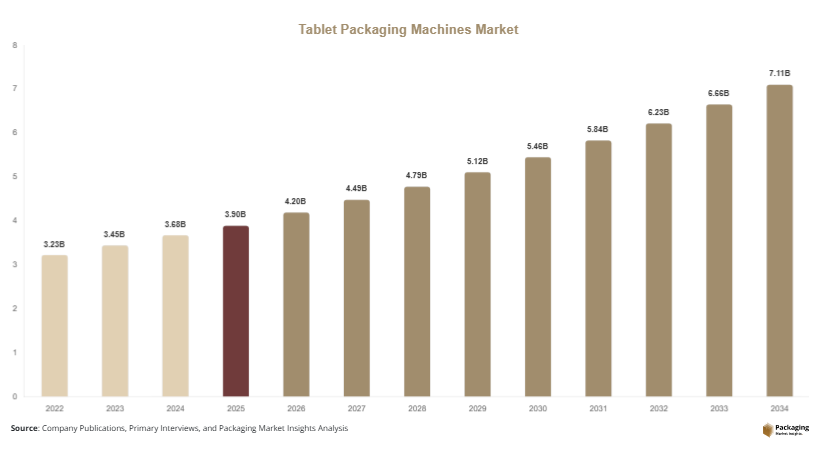
The global tablet packaging machines market size was valued at approximately USD 3.9 billion in 2025 and is projected to reach USD 4.2 billion in 2026. By 2034, the market is expected to reach nearly USD 7.1 billion, registering a CAGR of 6.8% during 2025–2034. The tablet packaging machines market is experiencing stable growth due to increasing pharmaceutical manufacturing activities, rising demand for automated packaging systems, and growing production of generic medicines worldwide. Tablet packaging machines are widely used for blister packaging, strip packaging, bottle filling, pouch packaging, and cartoning applications across pharmaceutical and nutraceutical industries. These systems help improve packaging accuracy, product safety, and production efficiency while supporting regulatory compliance requirements.
One of the primary growth factors driving the tablet packaging machines market is the rapid expansion of pharmaceutical production, particularly in emerging economies. Increasing healthcare demand, aging populations, and rising prevalence of chronic diseases are encouraging pharmaceutical manufacturers to expand tablet manufacturing and packaging capacities. Another important factor is the growing demand for blister packaging due to its ability to improve product protection, dosage accuracy, and tamper resistance. Pharmaceutical companies are increasingly investing in automated blister packaging systems to meet large-scale production requirements.
Key Highlights
- Asia Pacific dominated the market with a 39.6% share in 2025.
- Latin America is projected to grow at the fastest CAGR of 7.3%.
- Blister packaging machines led the type segment with a 44.1% share.
- Automatic machines dominated with a 58.4% share.
- Pharmaceutical applications led the market with 71.3% share.
- The US remained the dominant country with a market size of USD 890 million in 2025 and USD 950 million in 2026.
Explore more data points, trends and opportunities Download Free Sample Report
Market Trends
Increasing Adoption of Smart and Automated Packaging Systems
Automation and digitalization are becoming major trends in the tablet packaging machines market as pharmaceutical manufacturers seek improved production efficiency and regulatory compliance. Modern packaging systems are increasingly integrated with robotic handling systems, touchscreen interfaces, and automated inspection technologies that reduce operational errors and improve packaging consistency. Manufacturers are also adopting real-time monitoring systems and predictive maintenance software to minimize downtime and improve equipment utilization. Smart packaging machines support serialization and track-and-trace requirements by integrating barcode printing and digital verification systems directly into packaging lines. The increasing emphasis on operational efficiency and pharmaceutical safety standards is encouraging companies to invest in intelligent packaging machinery across both developed and emerging markets.
Rising Demand for Sustainable Pharmaceutical Packaging Solutions
Sustainability is becoming an important trend in the tablet packaging machines market as pharmaceutical companies seek environmentally responsible packaging solutions. Manufacturers are developing machines capable of handling recyclable blister materials, lightweight packaging films, and paper-based packaging alternatives. Regulatory pressure related to plastic waste reduction is also encouraging pharmaceutical packaging companies to adopt sustainable packaging practices. Equipment suppliers are introducing energy-efficient machines designed to reduce material waste and optimize power consumption during packaging operations. In addition, growing consumer awareness regarding environmentally friendly healthcare packaging is supporting investments in eco-conscious packaging technologies. This trend is expected to influence future machine design and packaging material selection throughout the pharmaceutical packaging industry.
Market Drivers
Expansion of Global Pharmaceutical Manufacturing Activities
The rapid growth of pharmaceutical manufacturing is one of the primary drivers supporting the tablet packaging machines market. Increasing prevalence of chronic diseases, rising healthcare expenditure, and growing demand for generic medicines are encouraging pharmaceutical companies to expand production capacities worldwide. Tablet packaging machines play a critical role in ensuring dosage accuracy, product protection, and efficient packaging operations for large-scale pharmaceutical manufacturing. Emerging economies are witnessing substantial investments in pharmaceutical production facilities, particularly for generic drug manufacturing and export activities. In addition, growing demand for over-the-counter medicines and nutraceutical supplements is increasing the need for flexible packaging systems capable of handling multiple packaging formats and production volumes.
Growing Demand for Blister Packaging in Pharmaceuticals
Blister packaging is becoming increasingly popular within the pharmaceutical industry because it provides enhanced product protection, tamper evidence, and dosage control. Tablet packaging machines designed for blister applications are experiencing strong demand due to increasing pharmaceutical safety regulations and consumer preference for unit-dose packaging. Blister packs improve product shelf life by protecting tablets from moisture, contamination, and physical damage. Pharmaceutical companies are also using blister packaging to improve patient compliance and medication tracking. The expansion of clinical trial activities and specialty pharmaceutical production is further supporting demand for high-precision blister packaging machinery. Technological advancements in thermoforming and cold-form blister systems are additionally contributing to segment growth.
Market Restraint
High Capital Costs and Regulatory Compliance Challenges
One of the major restraints affecting the tablet packaging machines market is the high capital investment required for advanced automated packaging systems and regulatory compliance technologies. Pharmaceutical packaging equipment must comply with strict industry regulations related to hygiene, serialization, product traceability, and packaging accuracy. As a result, manufacturers often need to invest heavily in advanced inspection systems, digital monitoring platforms, and validation procedures. Small and medium-sized pharmaceutical companies may face financial limitations when adopting fully automated packaging machinery. For example, serialization-compliant blister packaging systems integrated with barcode verification and vision inspection technologies can significantly increase operational costs. In addition, maintaining regulatory compliance across different countries requires continuous equipment upgrades and process validation activities, which can create financial and operational challenges for packaging companies operating in global pharmaceutical markets.
Market Opportunities
Increasing Demand for Nutraceutical and OTC Product Packaging
The rising consumption of nutraceutical products and over-the-counter medicines is creating strong opportunities for the tablet packaging machines market. Consumers are increasingly purchasing dietary supplements, vitamins, immunity boosters, and wellness products due to growing health awareness and preventive healthcare trends. Nutraceutical manufacturers require flexible packaging systems capable of handling different tablet sizes, packaging formats, and labeling requirements. Packaging equipment suppliers are developing adaptable tablet packaging machines suitable for both pharmaceutical and nutraceutical applications. The growing expansion of online healthcare retail platforms is also increasing demand for secure and durable packaging solutions that support product safety during transportation and storage.
Growth in Pharmaceutical Manufacturing in Emerging Economies
Emerging economies are creating substantial growth opportunities for tablet packaging machine manufacturers due to expanding pharmaceutical production capabilities and healthcare infrastructure investments. Countries across Asia Pacific, Latin America, and the Middle East are increasing domestic pharmaceutical manufacturing activities to reduce import dependence and strengthen healthcare access. Governments are supporting local pharmaceutical production through incentive programs and industrial development policies. As pharmaceutical production facilities expand, demand for automated tablet packaging systems is increasing to improve operational efficiency and comply with international quality standards. In addition, rising pharmaceutical exports from emerging economies are encouraging investments in high-speed and serialization-compliant packaging machinery.
Report Scope
| Report Metric | Details |
|---|---|
| Market Size in 2025 | USD 3.9 Billion |
| Market Size in 2026 | USD 4.2 Billion |
| Market Size in 2034 | USD 7.1 Billion |
| CAGR | 6.8% (2026-2034) |
| Base Year for Estimation | 2025 |
| Historical Data | 2022-2024 |
| Forecast Period | 2026-2034 |
| Report Coverage | Revenue Forecast, Competitive Landscape, Supply Chain Disruption, Growth Factors, Environment & Regulatory Landscape and Trends |
| Geographies Covered | North America, Europe, APAC, Middle East and Africa, LATAM |
| Countries Covered | U.S., Canada, U.K., Germany, France, Spain, Italy, Russia, Nordic, Benelux, Rest of Europe, China, South Korea, Japan, India, Australia, Singapore, Taiwan, South East Asia, Rest of Asia-Pacific, UAE, Turky, Saudi Arabia, South Africa, Egypt, Nigeria, Rest of MEA, Brazil, Mexico, Argentina, Chile, Colombia, Rest of LATAM |
Explore more data points, trends and opportunities Download Free Sample Report
Segmental Analysis
By Type
Blister packaging machines dominated the tablet packaging machines market in 2024, accounting for approximately 44.1% of the total market share. These machines are widely used in pharmaceutical packaging because they provide strong product protection, dosage accuracy, and tamper-evident packaging capabilities. Pharmaceutical manufacturers increasingly prefer blister packaging for tablets and capsules because it improves shelf life and reduces contamination risks. Rising demand for unit-dose packaging and patient compliance solutions is significantly contributing to segment growth. Blister packaging machines are also compatible with serialization and track-and-trace technologies required by pharmaceutical regulations. Technological advancements such as high-speed thermoforming systems, automated inspection systems, and digital printing integration are further improving machine efficiency and production flexibility across pharmaceutical packaging facilities worldwide.
Strip packaging machines are projected to be the fastest-growing type segment, expanding at a CAGR of 7.0% during the forecast period. This growth is supported by increasing demand for compact pharmaceutical packaging solutions and cost-effective packaging formats. Strip packaging provides effective moisture protection and reduced material usage, making it suitable for pharmaceutical and nutraceutical applications. Pharmaceutical companies are increasingly adopting strip packaging systems for tablets intended for emerging markets and hospital distribution channels. In addition, growing production of generic medicines and over-the-counter drugs is increasing demand for flexible strip packaging machinery capable of supporting high-speed production. Equipment manufacturers are also introducing automated strip packaging systems integrated with digital monitoring technologies to improve operational efficiency and packaging accuracy.
By Automation Level
Automatic tablet packaging machines dominated the market in 2024, holding approximately 58.4% of the total market share. Large pharmaceutical manufacturers prefer automatic systems because they provide higher production efficiency, reduced labor dependency, and improved packaging consistency. These systems are widely used for blister packaging, bottle filling, cartoning, and labeling operations within high-volume pharmaceutical production facilities. Increasing implementation of serialization regulations and digital inspection requirements is also supporting adoption of automated packaging systems. Automatic machines help pharmaceutical companies maintain regulatory compliance while minimizing operational errors and production downtime. Furthermore, technological advancements in robotic handling systems, AI-based inspection technologies, and servo-driven machinery are improving production speed and packaging precision across automated tablet packaging operations.
Semi-automatic tablet packaging machines are expected to register the fastest CAGR of 6.5% during the forecast period. This growth is driven by increasing demand from small and medium-sized pharmaceutical manufacturers seeking affordable packaging automation solutions. Semi-automatic systems provide operational flexibility and lower initial investment costs compared to fully automatic packaging lines. Emerging pharmaceutical companies and nutraceutical manufacturers are increasingly adopting semi-automatic packaging systems to improve production efficiency while maintaining cost control. In addition, these machines are suitable for smaller production batches and customized packaging operations. Equipment manufacturers are developing compact and user-friendly semi-automatic systems with improved digital controls and quick changeover capabilities to support wider market adoption.
By End-Use
Pharmaceutical companies dominated the end-use segment in 2024, accounting for approximately 71.3% of the total market share. The segment leads because pharmaceutical manufacturers require highly reliable and regulatory-compliant packaging systems for tablets and capsules. Increasing global medicine consumption, rising generic drug production, and growing pharmaceutical exports are supporting demand for advanced tablet packaging machines. Pharmaceutical companies are investing heavily in automated blister packaging, serialization systems, and digital inspection technologies to improve operational efficiency and packaging safety. Additionally, stringent pharmaceutical regulations related to product traceability and contamination prevention are encouraging adoption of advanced packaging equipment. The increasing development of specialty medicines and clinical trial products is also contributing to demand for flexible and precision-oriented tablet packaging systems.
Nutraceutical manufacturers are anticipated to be the fastest-growing end-use segment, expanding at a CAGR of 7.4% during the forecast period. This growth is supported by increasing consumer demand for vitamins, dietary supplements, and preventive healthcare products. Nutraceutical companies require packaging systems capable of handling different tablet shapes, sizes, and packaging formats. Rising health awareness and expanding online supplement retail channels are encouraging investments in high-speed and visually attractive packaging solutions. In addition, manufacturers are increasingly adopting eco-friendly packaging materials and flexible packaging formats to meet changing consumer preferences. Equipment suppliers are responding by developing adaptable packaging machines suitable for both pharmaceutical and nutraceutical applications, supporting broader adoption across the wellness products industry.
Tablet Packaging Machines Market Segmentations
By Type
- Blister Packaging Machines
- Strip Packaging Machines
- Bottle Filling Machines
- Cartoning Machines
By Automation Level
- Automatic Machines
- Semi-Automatic Machines
- Manual Machines
By End-User
- Pharmaceutical Companies
- Nutraceutical Manufacturers
- Contract Packaging Organizations
Regional Analysis
North America
North America accounted for approximately 29.1% of the global tablet packaging machines market share in 2025 and is projected to grow at a CAGR of 6.1% during the forecast period. The region benefits from advanced pharmaceutical manufacturing infrastructure, increasing adoption of automation technologies, and strict pharmaceutical packaging regulations. Demand for serialization-compliant packaging equipment and high-speed blister packaging systems is also supporting regional market expansion.
The United States dominates the North American market due to its large pharmaceutical manufacturing industry and strong healthcare infrastructure. A unique growth factor is the increasing adoption of track-and-trace packaging technologies to comply with pharmaceutical safety regulations. Pharmaceutical manufacturers are investing in advanced tablet packaging systems integrated with digital inspection and serialization technologies to improve supply chain transparency and product security.
Europe
Europe held nearly 24.8% of the tablet packaging machines market share in 2025 and is expected to grow at a CAGR of 5.9% through 2034. Growth in the region is supported by increasing pharmaceutical exports, strong regulatory compliance standards, and rising investments in sustainable pharmaceutical packaging technologies. European packaging companies are focusing on automation and environmentally responsible packaging solutions.
Germany remains the dominant country within Europe because of its advanced pharmaceutical manufacturing sector and strong engineering capabilities. A unique growth factor is the growing development of recyclable pharmaceutical blister packaging materials and energy-efficient packaging systems. German manufacturers are investing in advanced packaging technologies designed to improve sustainability and operational efficiency across pharmaceutical production facilities.
Asia Pacific
Asia Pacific dominated the market with a 39.6% share in 2025 and is forecasted to grow at a CAGR of 7.1% during the forecast period. The region benefits from expanding pharmaceutical manufacturing, rising healthcare expenditure, and increasing production of generic medicines. Countries across Asia Pacific are also witnessing growing investments in automated packaging infrastructure and pharmaceutical export facilities.
China leads the Asia Pacific market due to its large pharmaceutical manufacturing base and increasing demand for high-speed packaging systems. A unique growth factor is the rapid expansion of domestic generic drug production and pharmaceutical export activities. Pharmaceutical companies are investing heavily in automated tablet packaging machinery to improve production capacity and comply with international packaging standards.
Middle East & Africa
The Middle East & Africa region represented approximately 3.9% of the market share in 2025 and is anticipated to grow at a CAGR of 6.6% during the forecast period. Increasing healthcare infrastructure development, pharmaceutical manufacturing expansion, and government initiatives supporting local medicine production are contributing to regional market growth. Packaging automation is also gaining importance within pharmaceutical production facilities.
Saudi Arabia dominates the regional market due to its growing pharmaceutical manufacturing investments and healthcare sector modernization programs. A unique growth factor is the increasing establishment of domestic pharmaceutical production facilities aimed at reducing medicine import dependence. These developments are creating rising demand for advanced tablet packaging systems within the country’s pharmaceutical industry.
Latin America
Latin America accounted for approximately 2.6% of the global tablet packaging machines market share in 2025 and is projected to grow at the fastest CAGR of 7.3% during the forecast period. Rising pharmaceutical production, increasing healthcare awareness, and expanding generic medicine markets are supporting regional growth. Pharmaceutical companies are modernizing packaging operations to improve efficiency and comply with international quality standards.
Brazil remains the dominant country in Latin America due to its expanding pharmaceutical manufacturing sector and rising demand for packaged medicines. A unique growth factor is the increasing investment in local generic medicine production supported by government healthcare initiatives. This trend is encouraging pharmaceutical companies to adopt automated tablet packaging machinery capable of supporting high-volume production operations.
Competitive Landscape
The tablet packaging machines market is moderately competitive, with leading companies focusing on automation technologies, serialization compliance, and flexible packaging capabilities to strengthen market position. Manufacturers are investing in digital monitoring systems, robotic automation, and energy-efficient machinery to improve packaging efficiency and meet evolving pharmaceutical industry requirements. Strategic collaborations with pharmaceutical companies and packaging service providers remain important competitive strategies within the market.
Uhlmann Group is considered one of the leading companies in the tablet packaging machines market due to its advanced pharmaceutical packaging technology portfolio and strong global distribution network. In 2024, the company introduced upgraded blister packaging systems integrated with AI-based inspection and predictive maintenance capabilities. Other major market participants include Marchesini Group, IMA Group, Körber Pharma, and Romaco Group. These companies are focusing on product innovation, regional expansion, and automation integration to improve market competitiveness. Increasing investments in smart packaging technologies and sustainable packaging systems are expected to influence future competitive strategies across the industry.
Key Players List
- Uhlmann Group
- Marchesini Group
- IMA Group
- Körber Pharma
- Romaco Group
- ACG Worldwide
- Mediseal GmbH
- Hoonga Co., Ltd.
- Syntegon Technology
- Jornen Machinery
- CAM Packaging Systems
- Accutek Packaging Equipment
- Vanguard Pharmaceutical Machinery
- Omnicell Inc.
- MG2 S.r.l.