Sustainable Pharmaceutical Packaging Market Size and Growth
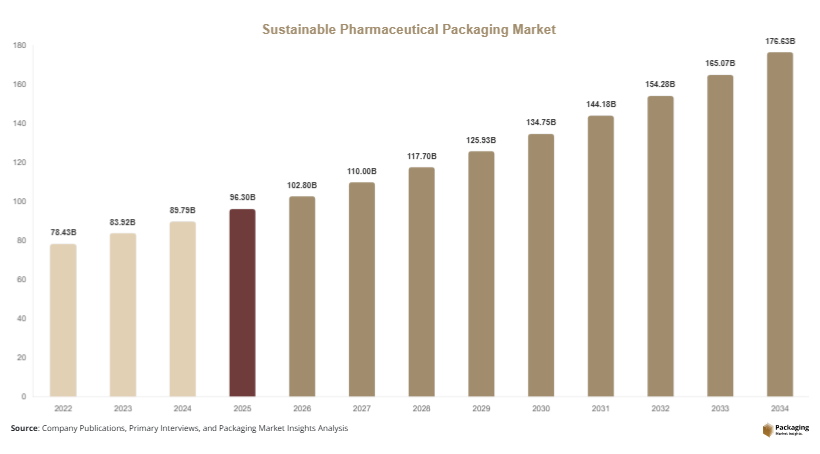
The sustainable pharmaceutical packaging market is experiencing steady expansion as the healthcare sector adopts environmentally responsible solutions without compromising safety and compliance. The market size was valued at USD 96.3 billion in 2025 and is projected to reach USD 102.8 billion in 2026. Over the forecast period, the market is expected to grow to USD 189.5 billion by 2034, registering a CAGR of 7.0% from 2025 to 2034.
Sustainable pharmaceutical packaging includes recyclable, biodegradable, and reusable materials used in primary, secondary, and tertiary packaging applications. These solutions aim to reduce environmental impact while ensuring product integrity, sterility, and regulatory compliance. Pharmaceutical packaging requires strict adherence to quality standards, making the transition to sustainable materials both critical and complex.
Key Highlights:
- Market size reached USD 96.3 billion in 2025
- Expected to grow at a CAGR of 7.0% (2025–2034)
- Forecasted to reach USD 189.5 billion by 2034
- Rising demand for eco-friendly pharmaceutical packaging
- Increasing regulatory and sustainability compliance requirements
Explore more data points, trends and opportunities Download Free Sample Report
Market Trends
Adoption of Recyclable and Bio-Based Materials
A major trend in the sustainable pharmaceutical packaging market is the increasing adoption of recyclable and bio-based materials. Pharmaceutical companies are transitioning from conventional plastics to materials that can be easily recycled or are derived from renewable sources. This shift is driven by sustainability goals and regulatory requirements. Manufacturers are developing packaging solutions such as recyclable blister packs and bio-based bottles that meet pharmaceutical standards. The challenge lies in maintaining product safety and barrier properties while ensuring sustainability. Advances in material science are addressing these challenges, enabling wider adoption across the industry.
Lightweight and Minimalist Packaging Designs
Another key trend is the move toward lightweight and minimalist packaging designs. Pharmaceutical companies are focusing on reducing material usage without compromising product protection. This approach not only reduces environmental impact but also lowers transportation costs and carbon emissions. Lightweight packaging solutions are particularly important for large-scale distribution of pharmaceuticals. Companies are redesigning packaging structures to eliminate unnecessary components and improve efficiency. This trend is gaining momentum as sustainability becomes a core focus in the pharmaceutical industry.
Market Drivers
Stringent Environmental Regulations in Healthcare
Stringent environmental regulations are a significant driver of the sustainable pharmaceutical packaging market. Governments and regulatory bodies are implementing policies to reduce waste and promote sustainable practices in the healthcare sector. These regulations require pharmaceutical companies to adopt packaging solutions that minimize environmental impact. Compliance with these regulations is becoming essential for market participation. As a result, companies are investing in sustainable materials and technologies to meet regulatory standards. This driver is expected to continue influencing market growth as regulations become more comprehensive.
Growing Demand for Pharmaceuticals and Biologics
The increasing demand for pharmaceuticals, particularly biologics, is driving the need for advanced packaging solutions. Biologics require specialized packaging to maintain stability and efficacy. Sustainable packaging solutions are being developed to meet these requirements while reducing environmental impact. The growth of the pharmaceutical industry, driven by aging populations and rising healthcare needs, is further supporting market expansion. Companies are focusing on developing packaging solutions that balance performance and sustainability.
Market Restraint
High Cost and Regulatory Complexity of Sustainable Materials
One of the major restraints in the sustainable pharmaceutical packaging market is the high cost and regulatory complexity associated with sustainable materials. Developing packaging solutions that meet pharmaceutical standards while being environmentally friendly requires significant investment in research and development. Sustainable materials often have higher production costs compared to conventional options, making them less accessible for smaller companies.
Additionally, the regulatory approval process for pharmaceutical packaging is rigorous and time-consuming. Any changes in packaging materials must undergo extensive testing to ensure safety and compliance. For example, switching to a bio-based polymer for drug packaging requires validation of its compatibility with the product and its ability to maintain stability. This complexity can delay the adoption of sustainable packaging solutions. The combined impact of high costs and regulatory challenges can slow market growth, particularly in regions with strict compliance requirements.
Market Opportunities
Development of Recyclable Blister Packaging
The development of recyclable blister packaging presents a significant opportunity for the sustainable pharmaceutical packaging market. Blister packs are widely used in the pharmaceutical industry but are often difficult to recycle due to their multi-material structure. Innovations in mono-material and recyclable blister packaging are addressing this challenge. Companies are investing in new materials and designs that enable easier recycling while maintaining product protection. This opportunity is expected to drive innovation and create new growth avenues for market participants.
Expansion in Emerging Healthcare Markets
The expansion of healthcare infrastructure in emerging markets offers substantial opportunities for the market. Countries in Asia Pacific, Latin America, and Africa are witnessing increased demand for pharmaceuticals due to improving healthcare access. As these regions adopt sustainability practices, there is a growing demand for eco-friendly packaging solutions. Manufacturers can capitalize on this opportunity by offering cost-effective and sustainable packaging tailored to local needs. The growth of generic drug manufacturing in these regions is also supporting market expansion.
Report Scope
| Report Metric | Details |
|---|---|
| Market Size in 2025 | USD 96.3 Billion |
| Market Size in 2026 | USD 102.8 Billion |
| Market Size in 2034 | USD 189.5 Billion |
| CAGR | 7.0% (2026-2034) |
| Base Year for Estimation | 2025 |
| Historical Data | 2022-2024 |
| Forecast Period | 2026-2034 |
| Report Coverage | Revenue Forecast, Competitive Landscape, Supply Chain Disruption, Growth Factors, Environment & Regulatory Landscape and Trends |
| Geographies Covered | North America, Europe, APAC, Middle East and Africa, LATAM |
| Countries Covered | U.S., Canada, U.K., Germany, France, Spain, Italy, Russia, Nordic, Benelux, Rest of Europe, China, South Korea, Japan, India, Australia, Singapore, Taiwan, South East Asia, Rest of Asia-Pacific, UAE, Turky, Saudi Arabia, South Africa, Egypt, Nigeria, Rest of MEA, Brazil, Mexico, Argentina, Chile, Colombia, Rest of LATAM |
Explore more data points, trends and opportunities Download Free Sample Report
Segmental Analysis
By Type
The recyclable packaging segment dominated the market in 2024, accounting for approximately 45% of the total share. This segment includes materials such as recyclable plastics, paper-based packaging, and glass. The dominance is attributed to increasing regulatory pressure and the need for sustainable solutions in pharmaceutical packaging. Recyclable packaging offers a balance between environmental benefits and performance requirements. Companies are focusing on developing innovative materials that meet pharmaceutical standards while being recyclable.
The biodegradable packaging segment is expected to be the fastest-growing, with a CAGR of 8.2% during the forecast period. This growth is driven by increasing demand for environmentally friendly alternatives. Biodegradable materials are gaining traction in applications where recycling is challenging. Advances in material science are improving the performance and affordability of biodegradable packaging, supporting its adoption across the pharmaceutical industry.
By Application
The primary packaging segment held the largest share in 2024, accounting for approximately 54% of the market. Primary packaging directly contacts the pharmaceutical product and plays a critical role in maintaining product integrity. Sustainable solutions in this segment are gaining importance as companies seek to reduce environmental impact while ensuring safety. Innovations such as recyclable blister packs and bio-based bottles are driving growth in this segment.
The secondary packaging segment is projected to grow at the fastest CAGR of 7.6% during the forecast period. Secondary packaging includes cartons, labels, and inserts, which are easier to make sustainable compared to primary packaging. The increasing focus on reducing material usage and improving recyclability is driving growth in this segment.
By End-Use
The pharmaceutical companies segment dominated the market in 2024, accounting for approximately 48% of the total share. These companies are the primary users of packaging solutions and are increasingly adopting sustainable practices. The need to comply with regulations and meet consumer expectations is driving the adoption of eco-friendly packaging solutions.
The contract packaging organizations segment is expected to grow at the fastest CAGR of 7.9%. These organizations provide packaging services to pharmaceutical companies and are adopting sustainable solutions to remain competitive. The increasing trend of outsourcing packaging services is supporting the growth of this segment.
Sustainable Pharmaceutical Packaging Market Segmentations
Type
- Recyclable Packaging
- Biodegradable Packaging
- Reusable Packaging
Application
- Primary Packaging
- Secondary Packaging
- Tertiary Packaging
End-Use
- Pharmaceutical Companies
- Contract Packaging Organizations
Regional Analysis
North America
North America accounted for approximately 30% of the sustainable pharmaceutical packaging market share in 2025 and is expected to grow at a CAGR of 6.7% during the forecast period. The region benefits from advanced healthcare infrastructure and strong regulatory frameworks supporting sustainability. Pharmaceutical companies are actively adopting eco-friendly packaging solutions to meet regulatory requirements and corporate sustainability goals.
The United States dominates the regional market due to its large pharmaceutical industry and high level of innovation. A key growth factor is the increasing adoption of recyclable packaging in drug delivery systems, driven by regulatory guidelines and sustainability initiatives.
Europe
Europe held around 26% of the market share in 2025 and is projected to grow at a CAGR of 6.9%. The region is known for its strict environmental regulations and commitment to sustainability. Policies aimed at reducing plastic waste are driving the adoption of sustainable packaging solutions in the pharmaceutical sector.
Germany is the leading country in the region, supported by its strong pharmaceutical manufacturing base. A unique growth factor is the implementation of extended producer responsibility programs, which encourage companies to adopt sustainable packaging practices.
Asia Pacific
Asia Pacific dominated the market with a share of 28% in 2025 and is expected to grow at the fastest CAGR of 7.8% during the forecast period. The region’s growth is driven by expanding healthcare infrastructure and increasing pharmaceutical production.
China is the dominant country in the region, supported by its large-scale manufacturing capabilities. A key growth factor is the rising demand for affordable and sustainable packaging solutions in the pharmaceutical industry.
Middle East & Africa
The Middle East & Africa region accounted for about 7% of the market share in 2025 and is projected to grow at a CAGR of 6.0%. The market is supported by increasing investments in healthcare infrastructure and growing awareness of sustainability.
The United Arab Emirates leads the regional market, with a key growth factor being the development of sustainable healthcare initiatives. These initiatives are encouraging the adoption of eco-friendly packaging solutions.
Latin America
Latin America held approximately 9% of the market share in 2025 and is expected to grow at a CAGR of 6.3%. The region is witnessing increasing demand for pharmaceuticals and sustainable packaging solutions.
Brazil is the dominant country in the region, supported by its expanding pharmaceutical industry. A unique growth factor is the growing focus on reducing environmental impact through government initiatives and public awareness campaigns.
Competitive Landscape
The sustainable pharmaceutical packaging market is characterized by the presence of several global players focusing on innovation and sustainability. Companies are investing in research and development to create packaging solutions that meet stringent pharmaceutical requirements while reducing environmental impact. Strategic collaborations and partnerships are common, enabling companies to expand their capabilities and market reach.
Amcor plc is a leading player in the market, known for its focus on sustainable packaging solutions. The company has introduced a range of recyclable and bio-based packaging products for pharmaceutical applications. A recent development includes the launch of recyclable blister packaging designed to improve sustainability while maintaining product protection.
Other major players such as Berry Global Inc., Gerresheimer AG, West Pharmaceutical Services, Inc., and Schott AG are also actively investing in sustainable packaging technologies. These companies are focusing on innovation and capacity expansion to strengthen their market position.
Key Players List
- Amcor plc
- Berry Global Inc.
- Gerresheimer AG
- West Pharmaceutical Services, Inc.
- Schott AG
- AptarGroup, Inc.
- SGD Pharma
- Nipro Corporation
- Bormioli Pharma S.p.A.
- Uflex Ltd.
- Constantia Flexibles Group GmbH
- Sonoco Products Company
- Sealed Air Corporation
- Mondi Group
- Klöckner Pentaplast