Sustainable Flexible Packaging Market Size and Growth
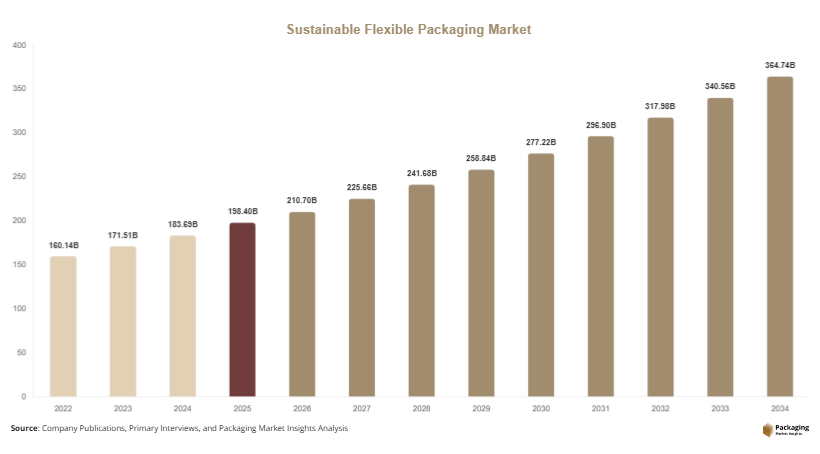
The sustainable flexible packaging market is gaining steady traction as industries shift toward environmentally responsible materials and circular economy practices. The market size was valued at USD 198.4 billion in 2025 and is expected to reach USD 210.7 billion in 2026. Over the forecast period, the market is projected to expand to USD 382.6 billion by 2034, registering a CAGR of 7.1% from 2025 to 2034.
Sustainable flexible packaging includes recyclable, biodegradable, compostable, and reusable packaging solutions designed to reduce environmental impact while maintaining product protection and shelf life. The shift from rigid packaging to flexible formats has further supported this transition, as flexible packaging uses less material and reduces transportation costs. Industries such as food and beverage, pharmaceuticals, and personal care are increasingly adopting sustainable packaging solutions to meet regulatory requirements and consumer expectations.
Key Highlights:
- Market size reached USD 198.4 billion in 2025
- Expected to grow at a CAGR of 7.1% (2025–2034)
- Forecasted to reach USD 382.6 billion by 2034
- Strong demand from food & beverage and e-commerce sectors
- Rising focus on recyclable and biodegradable materials
Explore more data points, trends and opportunities Download Free Sample Report
Market Trends
Shift Toward Recyclable and Mono-Material Packaging
A key trend shaping the sustainable flexible packaging market is the increasing adoption of recyclable and mono-material packaging solutions. Traditional multi-layer packaging structures are often difficult to recycle due to the combination of different materials. As a result, manufacturers are developing mono-material alternatives that maintain performance while enabling easier recycling. This shift is supported by regulatory frameworks and industry commitments to improve recyclability rates. Companies are investing in research to enhance barrier properties and durability of mono-material films, ensuring they meet the requirements of various applications such as food packaging. This trend is expected to continue as sustainability becomes a core focus across industries.
Growth of Bio-Based and Compostable Materials
Another important trend is the growing use of bio-based and compostable materials in flexible packaging. These materials are derived from renewable resources such as plant-based polymers and agricultural waste. They offer an alternative to conventional plastics, reducing reliance on fossil fuels. Compostable packaging solutions are gaining popularity in applications where recycling is challenging. Advances in material technology are improving the performance of bio-based materials, making them suitable for a wider range of applications. This trend is driven by increasing consumer demand for environmentally friendly products and the need to reduce carbon emissions across the packaging value chain.
Market Drivers
Increasing Environmental Regulations
The implementation of strict environmental regulations is a major driver of the sustainable flexible packaging market. Governments worldwide are introducing policies to reduce plastic waste and promote sustainable practices. Regulations such as bans on single-use plastics and mandates for recyclable packaging are pushing companies to adopt sustainable alternatives. These policies are encouraging innovation in packaging materials and design. Manufacturers are investing in technologies that enable the production of recyclable and biodegradable packaging solutions. Compliance with these regulations is becoming a key factor influencing purchasing decisions among businesses and consumers alike.
Rising Demand from Food and Beverage Industry
The food and beverage industry is a significant driver of market growth. Flexible packaging is widely used in this sector due to its convenience, cost-effectiveness, and ability to extend shelf life. As sustainability becomes a priority, food and beverage companies are transitioning to eco-friendly packaging solutions. This shift is driven by consumer preferences and brand commitments to reduce environmental impact. Sustainable flexible packaging solutions help maintain product quality while reducing material usage. The increasing demand for packaged food products and the growth of online grocery platforms are further supporting the adoption of sustainable packaging in this sector.
Market Restraint
Limited Recycling Infrastructure and High Material Costs
One of the key challenges in the sustainable flexible packaging market is the limited availability of recycling infrastructure and the high cost of sustainable materials. While demand for eco-friendly packaging is increasing, the existing recycling systems in many regions are not equipped to handle flexible packaging materials effectively. This creates challenges in achieving circularity and limits the overall impact of sustainable packaging initiatives.
Additionally, sustainable materials such as bio-based polymers and compostable films often have higher production costs compared to conventional plastics. This cost difference can be a barrier for small and medium-sized enterprises, which may struggle to adopt these solutions. For example, food manufacturers operating on thin margins may find it difficult to switch to more expensive sustainable packaging options. This restraint affects market growth by slowing the adoption rate of sustainable solutions, particularly in price-sensitive markets. Addressing these challenges requires investment in recycling infrastructure and technological advancements to reduce material costs.
Market Opportunities
Expansion of Circular Economy Initiatives
The increasing focus on circular economy initiatives presents significant opportunities for the sustainable flexible packaging market. Companies are adopting strategies that emphasize recycling, reuse, and waste reduction. These initiatives are driving the development of packaging solutions that can be easily recycled or composted. Collaboration among stakeholders, including manufacturers, governments, and recycling organizations, is supporting the growth of circular systems. Brands are also investing in closed-loop systems to ensure that packaging materials are reused efficiently. This opportunity is expected to drive innovation and create new revenue streams for market participants.
Technological Advancements in Sustainable Materials
Technological advancements in material science are creating new opportunities for the market. Innovations in bio-based polymers, barrier coatings, and recycling technologies are enabling the development of high-performance sustainable packaging solutions. These advancements are addressing key challenges such as durability, moisture resistance, and shelf life. For example, new coating technologies allow recyclable films to achieve barrier properties similar to traditional multi-layer packaging. As research and development efforts continue, the cost and performance of sustainable materials are expected to improve, driving wider adoption across industries.
Report Scope
| Report Metric | Details |
|---|---|
| Market Size in 2025 | USD 198.4 Billion |
| Market Size in 2026 | USD 210.7 Billion |
| Market Size in 2034 | USD 382.6 Billion |
| CAGR | 7.1% (2026-2034) |
| Base Year for Estimation | 2025 |
| Historical Data | 2022-2024 |
| Forecast Period | 2026-2034 |
| Report Coverage | Revenue Forecast, Competitive Landscape, Supply Chain Disruption, Growth Factors, Environment & Regulatory Landscape and Trends |
| Geographies Covered | North America, Europe, APAC, Middle East and Africa, LATAM |
| Countries Covered | U.S., Canada, U.K., Germany, France, Spain, Italy, Russia, Nordic, Benelux, Rest of Europe, China, South Korea, Japan, India, Australia, Singapore, Taiwan, South East Asia, Rest of Asia-Pacific, UAE, Turky, Saudi Arabia, South Africa, Egypt, Nigeria, Rest of MEA, Brazil, Mexico, Argentina, Chile, Colombia, Rest of LATAM |
Explore more data points, trends and opportunities Download Free Sample Report
Segmental Analysis
By Type
The recyclable packaging segment dominated the market in 2024, accounting for approximately 46% of the total share. This dominance is attributed to the increasing demand for packaging solutions that can be easily processed through existing recycling systems. Recyclable flexible packaging is widely used in food, beverage, and personal care applications due to its cost-effectiveness and environmental benefits. Companies are focusing on developing mono-material structures that enhance recyclability without compromising performance. The growing emphasis on reducing plastic waste and improving recycling rates is supporting the adoption of recyclable packaging solutions across industries.
The biodegradable and compostable packaging segment is expected to be the fastest-growing, with a CAGR of 8.4% during the forecast period. This growth is driven by increasing demand for environmentally friendly alternatives to conventional plastics. These packaging solutions are particularly suitable for applications where recycling is challenging. Advances in material science are improving the performance and affordability of biodegradable materials, making them more accessible to a wider range of industries.
By Application
The food and beverage segment held the largest share in 2024, accounting for approximately 52% of the market. Flexible packaging is widely used in this sector due to its ability to extend shelf life and reduce food waste. Sustainable packaging solutions are becoming increasingly important as consumers demand eco-friendly products. Companies are adopting recyclable and compostable packaging to meet these expectations. The growth of online food delivery and packaged food consumption is further driving demand in this segment.
The healthcare segment is projected to grow at the fastest CAGR of 7.8% during the forecast period. The increasing demand for safe and sustainable packaging solutions in the pharmaceutical industry is driving this growth. Sustainable flexible packaging solutions help maintain product integrity while reducing environmental impact. Regulatory requirements and the need for cost-effective packaging solutions are also contributing to the growth of this segment.
By End-Use
The food processing companies segment dominated the market in 2024, accounting for approximately 49% of the total share. These companies rely heavily on flexible packaging to ensure product safety and extend shelf life. The adoption of sustainable packaging solutions is driven by consumer demand and regulatory requirements. Food processing companies are investing in innovative packaging technologies to reduce environmental impact while maintaining product quality.
The e-commerce and retail segment is expected to grow at the fastest CAGR of 8.1%. The rapid expansion of online shopping is driving demand for sustainable packaging solutions that are lightweight and durable. Companies are focusing on reducing packaging waste and improving recyclability. This trend is expected to continue as e-commerce platforms prioritize sustainability and environmental responsibility.
Sustainable Flexible Packaging Market Segmentations
Type
- Recyclable Packaging
- Biodegradable & Compostable Packaging
- Reusable Packaging
Application
- Food & Beverage
- Healthcare
- Personal Care
- Industrial
End-Use
- Food Processing Companies
- E-commerce & Retail
- Pharmaceutical Companies
Regional Analysis
North America
North America accounted for approximately 27% of the sustainable flexible packaging market share in 2025 and is expected to grow at a CAGR of 6.6% during the forecast period. The region’s growth is driven by strong regulatory frameworks and increasing consumer awareness regarding sustainability. Companies are actively adopting eco-friendly packaging solutions to meet regulatory requirements and enhance brand image.
The United States dominates the regional market due to its advanced packaging industry and high demand for sustainable products. A key growth factor is the increasing adoption of recyclable packaging in the food and beverage sector, supported by government initiatives and corporate sustainability goals.
Europe
Europe held around 24% of the market share in 2025 and is projected to grow at a CAGR of 6.9%. The region is at the forefront of sustainability initiatives, with strict regulations aimed at reducing plastic waste. The European Union’s policies are encouraging the adoption of recyclable and biodegradable packaging solutions.
Germany is the leading country in the region, driven by its strong manufacturing base and focus on environmental sustainability. A unique growth factor is the implementation of extended producer responsibility programs, which require companies to manage the lifecycle of their packaging products.
Asia Pacific
Asia Pacific dominated the market with a share of 34% in 2025 and is expected to grow at the fastest CAGR of 7.9% during the forecast period. The region’s growth is supported by rapid industrialization, urbanization, and increasing demand for packaged goods.
China is the dominant country in the region, driven by its large-scale manufacturing capabilities. A key growth factor is the rising adoption of sustainable packaging in e-commerce, as companies seek to reduce environmental impact while meeting consumer expectations.
Middle East & Africa
The Middle East & Africa region accounted for about 7% of the market share in 2025 and is projected to grow at a CAGR of 5.8%. The market is supported by increasing investments in sustainable infrastructure and growing awareness of environmental issues.
The United Arab Emirates leads the regional market, with a key growth factor being the development of sustainable retail and packaging initiatives. Government policies promoting eco-friendly practices are encouraging the adoption of sustainable flexible packaging solutions.
Latin America
Latin America held approximately 8% of the market share in 2025 and is expected to grow at a CAGR of 6.2%. The region is witnessing increasing demand for sustainable packaging solutions in the food and beverage sector.
Brazil is the dominant country in the region, driven by its expanding consumer goods industry. A unique growth factor is the growing focus on reducing plastic waste, supported by government initiatives and consumer awareness campaigns.
Competitive Landscape
The sustainable flexible packaging market is characterized by the presence of several global and regional players focusing on innovation and sustainability. Companies are investing in research and development to create eco-friendly packaging solutions that meet performance requirements. Strategic collaborations and partnerships are also common, enabling companies to expand their product portfolios and market reach.
Amcor plc is one of the leading players in the market, known for its strong focus on sustainable packaging solutions. The company has introduced a range of recyclable and reusable packaging products to meet growing demand. A recent development includes the launch of advanced recyclable flexible packaging designed for food applications, aimed at reducing environmental impact.
Other major players such as Sealed Air Corporation, Mondi Group, Berry Global Inc., and Huhtamaki Oyj are also actively investing in sustainable packaging technologies. These companies are focusing on capacity expansion and product innovation to strengthen their market position.
Key Players List
- Amcor plc
- Sealed Air Corporation
- Mondi Group
- Berry Global Inc.
- Huhtamaki Oyj
- Sonoco Products Company
- Constantia Flexibles Group GmbH
- Coveris Holdings S.A.
- Uflex Ltd.
- DS Smith Plc
- Clondalkin Group Holdings B.V.
- ProAmpac LLC
- Winpak Ltd.
- Glenroy, Inc.
- Novolex Holdings, LLC