Sustainable Films For Packaging Market Size and Growth
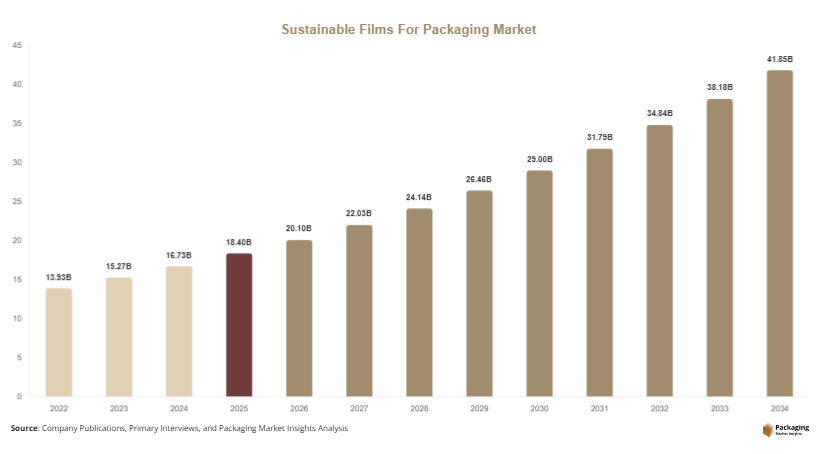
In 2025, the global sustainable films for packaging market size is estimated at USD 18.4 billion, reflecting increased adoption across food packaging, e-commerce logistics, and personal care industries. By 2026, the market is projected to reach USD 20.1 billion, supported by rising regulatory pressure on conventional plastics and growing corporate sustainability commitments. Looking ahead, the market is expected to reach USD 41.6 billion by 2034, expanding at a CAGR of 9.6% during 2025–2034.
The growth of the market is influenced by several structural factors. First, increasing environmental regulations targeting single-use plastics are pushing manufacturers toward compostable and recyclable film alternatives. Second, rising consumer awareness regarding plastic pollution is accelerating demand for sustainable packaging solutions in retail and food delivery sectors. Third, advancements in biopolymer technology are improving film durability, barrier protection, and cost efficiency, making sustainable films more commercially viable across industries.
Key Highlights:
- The Sustainable Films For Packaging Market size in 2025 is USD 18.4 billion. This reflects strong adoption across food packaging, e-commerce logistics, and FMCG industries, where demand for eco-friendly and recyclable packaging solutions is increasing.
- In 2026, the market is projected to reach USD 20.1 billion, supported by rising regulatory restrictions on conventional plastics and growing investments in bio-based and compostable film technologies.
- By 2034, the market is expected to reach USD 41.6 billion, driven by widespread adoption of sustainable packaging materials and increasing integration of circular economy practices across global supply chains.
- The market is projected to grow at a CAGR of 9.6% during 2025–2034, reflecting strong long-term expansion supported by environmental regulations and corporate sustainability commitments.
- Strong regulatory push toward eco-friendly packaging is accelerating the transition from conventional plastics to biodegradable and recyclable film solutions across multiple industries.
- Rising adoption in food, beverage, and e-commerce sectors is further driving demand, as companies focus on lightweight, cost-efficient, and environmentally responsible packaging formats.
Explore more data points, trends and opportunities Download Free Sample Report
Market Trends
Rapid Shift Toward Bio-Based and Compostable Films
The sustainable films for packaging market is witnessing a strong shift toward bio-based and compostable film materials derived from renewable sources such as corn starch, sugarcane, and cellulose. This trend is driven by increasing restrictions on petroleum-based plastics and growing consumer preference for environmentally responsible packaging. Manufacturers are investing in polylactic acid (PLA) and polyhydroxyalkanoates (PHA) films that offer biodegradability while maintaining sufficient mechanical strength for packaging applications. Food service providers and retail chains are adopting compostable films for wraps, bags, and flexible packaging formats. This transition is further supported by government incentives promoting green packaging technologies and circular economy initiatives across major economies.
Integration of High-Barrier Sustainable Film Technologies
Another key trend shaping the market is the integration of high-barrier performance into sustainable films. Traditionally, eco-friendly films struggled to match conventional plastics in moisture and oxygen resistance. However, advancements in multilayer biodegradable structures and nano-coating technologies are bridging this performance gap. These innovations are enabling sustainable films to be used in sensitive applications such as pharmaceuticals, dairy products, and frozen foods. Packaging manufacturers are increasingly combining recyclable polymers with barrier-enhancing coatings to extend shelf life while maintaining sustainability standards. This trend is also supported by increased R&D investments focused on improving film transparency, sealing strength, and thermal resistance.
Market Drivers
Regulatory Push Against Conventional Plastic Packaging
One of the primary drivers of the sustainable films for packaging market is the increasing regulatory pressure on single-use plastics and non-recyclable packaging formats. Governments across Europe, North America, and parts of Asia Pacific are implementing strict policies such as bans on plastic bags, extended producer responsibility (EPR) programs, and mandatory recycling targets. These regulations are forcing manufacturers and brand owners to shift toward sustainable alternatives, including biodegradable and recyclable films. The enforcement of environmental compliance standards in packaging supply chains is accelerating material substitution and driving long-term demand for sustainable film technologies. Industries that fail to adapt face higher compliance costs and reputational risks, further boosting adoption rates.
Rising Consumer Demand for Sustainable Packaging Solutions
Another major driver is the increasing consumer preference for sustainable and environmentally friendly packaging. Modern consumers are becoming more aware of the environmental impact of plastic waste, influencing purchasing decisions across food, personal care, and e-commerce sectors. Brands are responding by incorporating sustainable films into their packaging strategies to enhance brand image and meet sustainability expectations. This demand is particularly strong in urban markets, where eco-conscious consumption patterns are more prevalent. As a result, companies are redesigning packaging portfolios to include compostable wraps, recyclable pouches, and biodegradable films, thereby driving consistent market expansion.
Market Restraint
High Production Costs and Limited Industrial Scalability
The sustainable films for packaging market faces a key restraint in the form of high production costs and limited large-scale manufacturing infrastructure. Bio-based polymers and compostable materials often require complex processing technologies and raw materials that are more expensive than conventional plastics. This cost disparity makes it challenging for price-sensitive industries such as low-margin food packaging and mass retail to fully transition to sustainable films. Additionally, scalability remains a concern, as global production capacity for biopolymers is still developing. For example, small and medium packaging converters often struggle to adopt sustainable films due to equipment modification requirements and supply chain limitations. These cost-related challenges slow down widespread adoption, particularly in developing regions where affordability remains a key purchasing factor.
Market Opportunities
Expansion of Circular Economy and Recycling Infrastructure
A significant opportunity in the market lies in the expansion of circular economy frameworks and advanced recycling infrastructure. Governments and private players are investing in systems that support collection, sorting, and reprocessing of recyclable packaging films. This creates strong demand for mono-material sustainable films that can be efficiently recycled without contamination issues. Packaging manufacturers that align their product designs with circular economy principles are likely to benefit from long-term contracts with FMCG and retail brands. Additionally, technological advancements in chemical recycling and enzymatic breakdown processes are expected to enhance material recovery rates, further increasing the attractiveness of sustainable films.
Growth in E-commerce and Food Delivery Packaging Applications
The rapid growth of e-commerce and online food delivery services presents a major opportunity for sustainable film adoption. These industries require lightweight, flexible, and protective packaging materials that can withstand transportation stress while minimizing environmental impact. Sustainable films are increasingly being used for courier bags, wrapping films, and food-safe packaging pouches. The rise of quick-commerce platforms and cloud kitchens further accelerates demand for compostable and recyclable packaging formats. Companies that develop cost-effective sustainable film solutions tailored for high-volume logistics applications are expected to gain significant market share.
Report Scope
| Report Metric | Details |
|---|---|
| Market Size in 2025 | USD 18.4 Billion |
| Market Size in 2026 | USD 20.1 Billion |
| Market Size in 2034 | USD 41.6 Billion |
| CAGR | 9.6% (2026-2034) |
| Base Year for Estimation | 2025 |
| Historical Data | 2022-2024 |
| Forecast Period | 2026-2034 |
| Report Coverage | Revenue Forecast, Competitive Landscape, Supply Chain Disruption, Growth Factors, Environment & Regulatory Landscape and Trends |
| Geographies Covered | North America, Europe, APAC, Middle East and Africa, LATAM |
| Countries Covered | U.S., Canada, U.K., Germany, France, Spain, Italy, Russia, Nordic, Benelux, Rest of Europe, China, South Korea, Japan, India, Australia, Singapore, Taiwan, South East Asia, Rest of Asia-Pacific, UAE, Turky, Saudi Arabia, South Africa, Egypt, Nigeria, Rest of MEA, Brazil, Mexico, Argentina, Chile, Colombia, Rest of LATAM |
Explore more data points, trends and opportunities Download Free Sample Report
Segmental Analysis
By Material Type
PLA dominates the market with approximately 42% share in 2024, due to its wide availability and strong biodegradability profile. It is extensively used in food packaging films, shopping bags, and wrapping applications across retail and food service industries. Its compatibility with industrial composting systems makes it a preferred choice among packaging converters.
PHA is the fastest-growing subsegment with a CAGR of 11.3%, driven by its superior biodegradability in marine and soil environments. Increasing R&D investments and improvements in production scalability are enhancing its adoption in premium packaging applications.
By Application
Food packaging holds the dominant share of 48% in 2024, driven by increasing demand for sustainable wraps, pouches, and trays. The need for hygiene, freshness, and environmental compliance is boosting adoption.
Industrial packaging is the fastest-growing subsegment with a CAGR of 10.1%, supported by rising use in logistics and protective packaging solutions for e-commerce shipments.
By End-Use Industry
FMCG leads with 46% share in 2024, driven by large-scale adoption of sustainable packaging in food and beverage products. Brand sustainability commitments further support growth.
E-commerce is the fastest-growing segment with a CAGR of 10.6%, driven by rapid online retail expansion and increasing demand for eco-friendly shipping materials.
Sustainable Films For Packaging Market Segmentations
By Material Type
- PLA (Polylactic Acid)
- PHA (Polyhydroxyalkanoates)
- Bio-PET
- Others
By Application
- Food Packaging
- Industrial Packaging
- Personal Care Packaging
- Medical Packaging
By End-Use Industry
- FMCG
- Healthcare
- E-commerce
- Retail
- Industrial
Regional Analysis
North America
North America holds approximately 27% market share in 2025, with a projected CAGR of 9.1%. The region benefits from strong sustainability regulations and high consumer awareness regarding eco-friendly packaging alternatives. Demand is particularly strong in food service and retail packaging applications.
The United States dominates the region due to advanced packaging innovation and strong corporate sustainability initiatives. A key growth factor is the rapid adoption of recyclable and compostable packaging in major retail and fast-food chains.
Europe
Europe accounts for around 30% market share in 2025, growing at a CAGR of 9.4%. Strict environmental regulations and circular economy policies are driving rapid adoption of sustainable films across industries.
Germany leads the European market due to its strong chemical and packaging manufacturing base. A key growth factor is government-backed incentives supporting biodegradable material innovation.
Asia Pacific
Asia Pacific holds 28% market share in 2025, with the fastest CAGR of 10.2%. Rapid urbanization, expanding retail sectors, and increasing environmental awareness are driving growth.
China dominates the region due to large-scale packaging production capabilities. A key growth factor is the expansion of e-commerce logistics and food delivery platforms.
Middle East & Africa
Middle East & Africa accounts for 7% market share in 2025, growing at a CAGR of 8.5%. Growth is supported by rising retail penetration and tourism-driven packaging demand.
The United Arab Emirates leads the region due to its modern retail infrastructure. A key growth factor is increasing sustainability initiatives in hospitality and food packaging.
Latin America
Latin America holds 8% market share in 2025, expanding at a CAGR of 8.8%. Growth is driven by expanding packaged food consumption and retail modernization.
Brazil dominates the region due to its strong agricultural processing industry. A key growth factor is rising adoption of sustainable packaging in food export supply chains.
Competitive Landscape
The sustainable films for packaging market is moderately consolidated, with key players focusing on innovation, material sustainability, and capacity expansion. Major companies include Amcor Plc, BASF SE, Mondi Group, Sealed Air Corporation, and Dow Inc. Among these, Amcor Plc remains a leading player due to its extensive portfolio of recyclable and bio-based packaging films. The company has recently expanded its sustainable flexible packaging production capacity and partnered with global FMCG brands to enhance recyclable film adoption across supply chains. Other players are actively investing in biodegradable polymer technologies and circular packaging systems to strengthen market positioning.
Key Players List
- Amcor Plc
- BASF SE
- Mondi Group
- Sealed Air Corporation
- Dow Inc.
- Berry Global Inc.
- Huhtamaki Oyj
- Novamont S.p.A.
- NatureWorks LLC
- Constantia Flexibles
- Uflex Ltd.
- Clondalkin Group
- Coveris Holdings
- Toray Industries Inc.
- Mitsubishi Chemical Group
- Biome Bioplastics Ltd.