Sustainable Aerosol Packaging Market Size and Growth
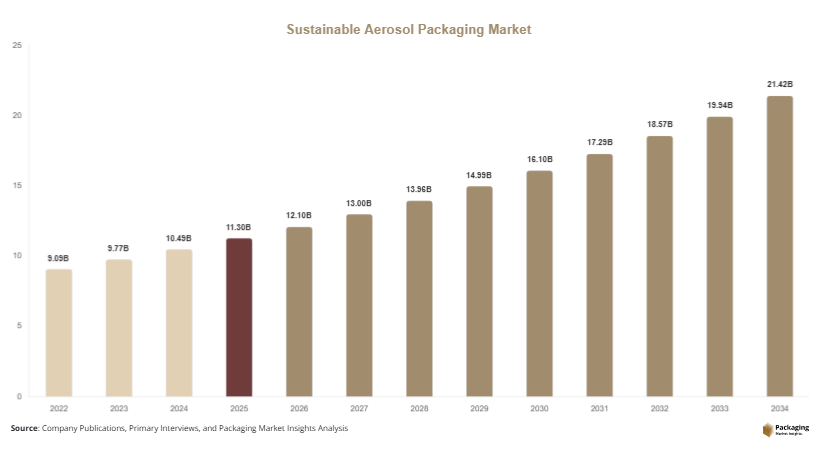
The global stainable aerosol packaging market size is estimated at USD 11.3 billion in 2025, and it is projected to reach USD 12.1 billion in 2026. By 2034, the market is expected to reach approximately USD 21.6 billion, registering a CAGR of 7.4% during 2025–2034. The sustainable aerosol packaging market is evolving rapidly as global industries transition toward low-emission, recyclable, and eco-friendly packaging formats. Aerosol packaging—traditionally associated with propellants and multi-layer metal or plastic structures—is undergoing structural transformation driven by environmental regulations and corporate sustainability commitments.
Growth in the market is primarily driven by increasing regulatory pressure to reduce volatile organic compound (VOC) emissions and transition toward recyclable packaging systems. Governments in Europe and North America are introducing stricter environmental packaging standards, encouraging manufacturers to adopt recyclable aluminum cans, compressed gas alternatives, and refillable aerosol systems. Another key growth factor is the rising demand from personal care and home care industries, where deodorants, hair sprays, disinfectants, and cleaning products are increasingly shifting toward sustainable aerosol formats. Additionally, advancements in bag-on-valve (BOV) technology are enabling product formulations without harmful propellants, improving both safety and environmental compliance.
Key Highlights:
- Asia Pacific dominated the market with a 37.4% share in 2025.
- Latin America is projected to grow at the fastest CAGR of 6.2%.
- Bag-on-valve systems led the type segment with a 29.6% share.
- Aluminum-based packaging dominated with a 52.3% share.
- Personal care applications led the segment with a 43.1% share.
- The US remained the dominant country with a market size of USD 2.1 billion in 2025 and USD 2.3 billion in 2026.
Explore more data points, trends and opportunities Download Free Sample Report
Market Trends
Shift Toward Bag-on-Valve (BOV) Technology in Sustainable Aerosols
One of the most significant trends in the sustainable aerosol packaging market is the rapid adoption of bag-on-valve (BOV) technology. This system separates the product from the propellant, enabling the use of compressed air or nitrogen instead of traditional chemical propellants. It significantly reduces environmental impact while improving product safety and shelf life. For example, skincare brands are increasingly using BOV systems for sprays and foams to ensure contamination-free dispensing. The trend is expected to expand further as regulatory agencies restrict VOC emissions, pushing manufacturers toward propellant-free systems.
Growth of Recyclable Aluminum and Mono-Material Aerosol Packaging
Another key trend is the increasing shift toward recyclable aluminum and mono-material aerosol packaging formats. Traditional aerosol containers often combine multiple materials, making recycling difficult. In response, manufacturers are developing mono-material aluminum cans and lightweight steel containers that can be fully recycled within existing waste streams. For instance, deodorant and shaving foam brands are redesigning packaging using 100% recyclable aluminum. This trend is expected to accelerate as circular economy initiatives become more prominent, improving recycling efficiency and reducing landfill waste.
Market Drivers
Strict Environmental Regulations on Aerosol Emissions
Government regulations aimed at reducing greenhouse gas emissions and harmful propellants are a major driver of the sustainable aerosol packaging market. Regulatory bodies in Europe and North America are enforcing strict limits on volatile organic compounds (VOCs), forcing manufacturers to transition toward eco-friendly alternatives. This has led to increased adoption of compressed gas systems and recyclable aerosol containers. For example, cleaning product manufacturers in the EU are reformulating sprays to comply with eco-label standards. These regulatory pressures are accelerating innovation in sustainable aerosol technologies.
Rising Demand from Personal Care and Home Care Industries
The personal care and home care industries are key growth drivers due to increasing consumption of aerosol-based products such as deodorants, hair sprays, air fresheners, and disinfectants. Consumers are shifting toward eco-friendly versions of these products, prompting brands to adopt sustainable packaging solutions. For instance, leading FMCG companies are launching refillable aerosol deodorants and recyclable spray cleaners. The growing focus on hygiene and cleanliness, especially post-pandemic, has further strengthened demand for aerosol packaging solutions with reduced environmental impact.
Market Restraint
High Cost of Sustainable Aerosol Technologies and Infrastructure Limitations
One of the primary restraints in the sustainable aerosol packaging market is the high cost associated with adopting eco-friendly materials and advanced dispensing systems. Technologies such as bag-on-valve systems and compressed gas formulations require specialized manufacturing infrastructure, increasing production costs. Additionally, recyclable aluminum and mono-material packaging often involve higher raw material expenses compared to conventional plastic-metal hybrid containers. In developing economies, limited recycling infrastructure further restricts adoption, as sustainable packaging benefits depend heavily on efficient waste collection and processing systems. For example, small-scale personal care manufacturers in Asia and Africa may hesitate to adopt BOV systems due to cost constraints and supply chain limitations. This creates a gap between sustainability goals and economic feasibility in certain regions.
Market Opportunities
Expansion of Refillable and Circular Aerosol Packaging Models
The shift toward circular economy models presents a significant opportunity in the sustainable aerosol packaging market. Refillable aerosol systems are gaining traction as brands seek to reduce packaging waste and extend product lifecycle. These systems allow consumers to reuse containers multiple times while replacing only the product cartridge or refill. For example, premium cosmetic brands are introducing refillable deodorant sprays and skincare mists using reusable aluminum containers. This model reduces material consumption and aligns with sustainability goals. In the future, refillable aerosol systems are expected to become more standardized across FMCG categories.
Adoption of Bio-Based Propellants and Green Chemistry Innovations
Another major opportunity lies in the development of bio-based propellants and environmentally friendly chemical formulations. Traditional aerosol products rely on synthetic gases that contribute to emissions. However, advancements in green chemistry are enabling the use of compressed air, nitrogen, and bio-derived gases as safer alternatives. For instance, household cleaning brands are introducing plant-based aerosol disinfectants with reduced environmental impact. As research and innovation in sustainable chemistry continue, bio-based aerosol systems are expected to gain wider commercial adoption across personal care and industrial cleaning sectors.
Report Scope
| Report Metric | Details |
|---|---|
| Market Size in 2025 | USD 11.3 Billion |
| Market Size in 2026 | USD 12.1 Billion |
| Market Size in 2034 | USD 21.6 Billion |
| CAGR | 7.4% (2026-2034) |
| Base Year for Estimation | 2025 |
| Historical Data | 2022-2024 |
| Forecast Period | 2026-2034 |
| Report Coverage | Revenue Forecast, Competitive Landscape, Supply Chain Disruption, Growth Factors, Environment & Regulatory Landscape and Trends |
| Geographies Covered | North America, Europe, APAC, Middle East and Africa, LATAM |
| Countries Covered | U.S., Canada, U.K., Germany, France, Spain, Italy, Russia, Nordic, Benelux, Rest of Europe, China, South Korea, Japan, India, Australia, Singapore, Taiwan, South East Asia, Rest of Asia-Pacific, UAE, Turky, Saudi Arabia, South Africa, Egypt, Nigeria, Rest of MEA, Brazil, Mexico, Argentina, Chile, Colombia, Rest of LATAM |
Explore more data points, trends and opportunities Download Free Sample Report
Segmental Analysis
By Type
Bag-on-valve systems dominated the market in 2024 with a 32.4% share, due to their ability to separate product from propellant and improve sustainability performance. These systems are widely used in personal care, cosmetics, and pharmaceutical sprays. For example, skincare brands use BOV systems for foam cleansers and sunscreens, ensuring contamination-free dispensing and extended shelf life. Their compatibility with eco-friendly compressed gases makes them highly attractive for sustainable packaging strategies.
Compressed gas aerosol systems are the fastest-growing segment with a CAGR of 7.9%, driven by regulatory pressure and demand for low-emission alternatives. These systems use nitrogen or compressed air instead of harmful propellants, reducing environmental impact.
By Material
Aluminum dominated with a 54.1% share in 2024, due to its recyclability, lightweight properties, and compatibility with aerosol systems. Aluminum cans are widely used in deodorants, hair sprays, and cleaning products.
Recycled polymer materials are the fastest-growing segment with a CAGR of 7.3%, driven by innovation in bio-based plastics and sustainability initiatives.
By End-Use
Personal care led the market with a 44.8% share in 2024, driven by deodorants, hair sprays, and skincare mists. These products heavily rely on aerosol formats.
Healthcare and disinfectants are the fastest-growing segment with a CAGR of 8.1%, driven by hygiene awareness and hospital-grade cleaning products.
Sustainable Aerosol Packaging Market Segmentations
By Type
- Bag-on-Valve (BOV) Systems
- Compressed Gas Aerosols
- Mechanical Spray Systems
- Hybrid Aerosol Systems
By Material
- Aluminum
- Steel
- Recycled Plastics
- Bio-based Materials
By End-User
- Personal Care
- Household Care
- Healthcare & Disinfectants
- Industrial Applications
Regional Analysis
North America
North America accounted for approximately 28.9% share in 2025, with a projected CAGR of 7.1% during 2025–2034. The region is a key market for sustainable aerosol packaging due to strong consumer awareness, advanced manufacturing capabilities, and strict environmental regulations. Demand is particularly high in personal care, household cleaning, and healthcare disinfectant segments. Companies are increasingly transitioning toward recyclable aluminum cans and compressed gas systems to meet sustainability targets.
The United States dominates the regional market due to its large FMCG and personal care industries. A key growth driver is the increasing adoption of eco-label certification programs, where brands reformulate aerosol products to meet sustainability standards. For example, U.S.-based cleaning brands are shifting toward VOC-free spray systems to comply with environmental guidelines.
Europe
Europe held a 26.7% share in 2025, and is expected to grow at a CAGR of 7.6%. The region leads in sustainability regulations, driving rapid adoption of recyclable aerosol packaging. Countries like Germany, France, and the UK are at the forefront of circular economy initiatives. Strong regulatory frameworks such as packaging waste directives are pushing manufacturers toward mono-material and refillable aerosol systems.
Germany dominates the European market due to its strong industrial base. A key growth driver is the widespread implementation of closed-loop recycling systems, where aluminum aerosol containers are collected, recycled, and reused efficiently in manufacturing cycles.
Asia Pacific
Asia Pacific dominated the market with a 37.4% share in 2025, and is projected to grow at a CAGR of 8.2%. Rapid urbanization, expanding personal care consumption, and increasing industrial production are driving demand. Countries like China, India, Japan, and South Korea are witnessing strong growth in aerosol-based personal care and cleaning products.
China remains the dominant country due to its massive FMCG manufacturing base. A unique growth driver is the expansion of domestic green manufacturing policies, which encourage companies to shift toward recyclable aerosol packaging and reduce carbon emissions.
Middle East & Africa
The Middle East & Africa accounted for a 4.6% share in 2025, with a projected CAGR of 6.9%. Growth is driven by rising demand for personal care products and increasing urbanization. The region is gradually adopting sustainable packaging due to growing environmental awareness and retail expansion.
The UAE leads the regional market due to strong retail infrastructure. A key growth driver is the expansion of premium personal care imports, where international brands introduce sustainable aerosol packaging to meet consumer expectations.
Latin America
Latin America held a 2.1% share in 2025, and is expected to grow at the fastest CAGR of 8.4%. Growth is supported by increasing FMCG consumption and modernization of packaging industries in Brazil and Mexico. Sustainability awareness is gradually influencing packaging decisions.
Brazil dominates the region due to its large consumer goods market. A key growth driver is the expansion of domestic personal care brands adopting recyclable aerosol packaging to align with global sustainability trends.
Competitive Landscape
The sustainable aerosol packaging market is moderately consolidated, with major players focusing on recyclable materials, propellant innovation, and refillable packaging systems. Key companies include AptarGroup Inc., Ball Corporation, Crown Holdings Inc., Ardagh Group, and Trivium Packaging. Among these, Ball Corporation is a leading player due to its strong aluminum packaging portfolio and sustainability initiatives.
Companies are investing heavily in mono-material packaging solutions and carbon-neutral production processes. AptarGroup is focusing on bag-on-valve dispensing systems, while Crown Holdings is expanding recyclable steel aerosol can production. Strategic partnerships with FMCG and personal care brands are common, enabling co-development of eco-friendly packaging solutions. Recent developments include expansion of recycling facilities and introduction of refillable aerosol product lines.
Key Players List
- Ball Corporation
- AptarGroup Inc.
- Crown Holdings Inc.
- Ardagh Group
- Trivium Packaging
- CCL Industries Inc.
- DS Smith Plc
- Berry Global Inc.
- Silgan Holdings Inc.
- Mauser Packaging Solutions
- Lindal Group
- Precision Valve Corporation
- Montebello Packaging
- Bway Corporation
- Colep Packaging