Stretch Wrap Packaging Market Size and Growth
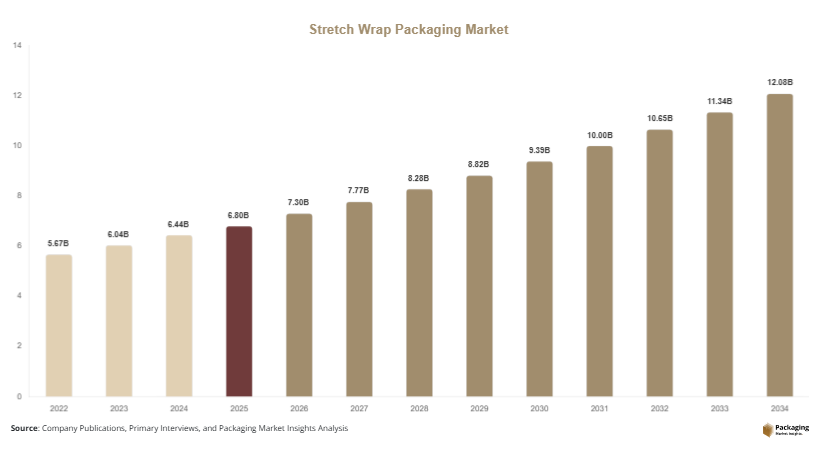
The stretch wrap packaging market is witnessing consistent growth due to rising demand for efficient, cost-effective, and protective packaging solutions across logistics, warehousing, and industrial sectors. The market size was valued at USD 6.8 billion in 2025 and is projected to reach USD 7.3 billion in 2026. Over the forecast period, the market is expected to grow to USD 12.9 billion by 2034, registering a CAGR of 6.5% from 2025 to 2034.
Stretch wrap packaging involves the use of highly stretchable plastic films, primarily made from linear low-density polyethylene (LLDPE), to secure products during storage and transportation. These films provide stability, protection from dust and moisture, and improved load containment. The increasing complexity of global supply chains has made stretch wrap packaging an essential component of modern logistics operations.
Key Highlights:
- Market size reached USD 6.8 billion in 2025
- Expected to grow at a CAGR of 6.5% (2025–2034)
- Forecasted to reach USD 12.9 billion by 2034
- Strong demand from logistics, e-commerce, and manufacturing sectors
- Increasing focus on sustainable and high-performance film solutions
Explore more data points, trends and opportunities Download Free Sample Report
Market Trends
Adoption of High-Performance and Multi-Layer Films
A key trend in the stretch wrap packaging market is the adoption of high-performance and multi-layer films. These advanced films offer improved strength, puncture resistance, and load stability compared to conventional single-layer films. Manufacturers are increasingly using multi-layer extrusion technologies to enhance film performance while reducing material thickness. This approach not only improves efficiency but also lowers costs and environmental impact. High-performance films are particularly suitable for heavy-duty applications in industries such as construction and manufacturing. As companies seek to optimize packaging operations and reduce waste, the adoption of these advanced films is expected to increase steadily.
Growing Emphasis on Sustainable Packaging Solutions
Another significant trend is the growing emphasis on sustainable packaging solutions. Environmental concerns and regulatory pressures are driving manufacturers to develop recyclable and biodegradable stretch wrap films. Companies are investing in research and development to create eco-friendly alternatives that maintain performance standards. The use of recycled content in film production is also gaining traction, helping reduce dependence on virgin plastics. Additionally, initiatives aimed at reducing plastic waste are encouraging businesses to adopt sustainable packaging practices. This trend is shaping product innovation and influencing purchasing decisions across industries.
Market Drivers
Expansion of E-commerce and Logistics Industry
The expansion of the e-commerce and logistics industry is a major driver of the stretch wrap packaging market. The increasing volume of online orders has led to a surge in demand for packaging solutions that ensure product safety during transportation. Stretch wrap packaging is widely used for securing pallets and preventing product damage. The growth of global trade and cross-border shipping is further supporting demand. Logistics companies are focusing on efficient packaging solutions to reduce costs and improve operational efficiency. This trend is expected to continue as e-commerce platforms expand globally.
Rising Demand from Manufacturing and Industrial Sectors
The rising demand from manufacturing and industrial sectors is another key driver. Industries such as food and beverage, pharmaceuticals, and consumer goods rely on stretch wrap packaging for product protection and handling. The need for efficient packaging solutions in production and distribution processes is driving market growth. Additionally, the increasing adoption of automation in packaging operations is boosting demand for machine-grade stretch films. These films are designed for use with automated wrapping machines, improving efficiency and consistency in packaging operations.
Market Restraint
Environmental Concerns and Regulatory Pressures
One of the primary restraints in the stretch wrap packaging market is environmental concerns related to plastic usage. Stretch wrap films are primarily made from plastic materials, which contribute to environmental pollution if not properly managed. Governments and regulatory bodies are implementing strict regulations to reduce plastic waste and promote sustainable alternatives.
For example, several regions have introduced policies to limit single-use plastics, encouraging the adoption of recyclable and biodegradable materials. While these initiatives are beneficial for the environment, they can increase production costs for manufacturers. Developing sustainable alternatives requires significant investment in research and technology. Additionally, the performance of eco-friendly films may not always match that of traditional materials, posing challenges for certain applications. These factors can restrain market growth and require companies to adapt their strategies.
Market Opportunities
Development of Recyclable and Biodegradable Films
The development of recyclable and biodegradable films presents significant opportunities for the stretch wrap packaging market. As environmental concerns continue to grow, there is increasing demand for sustainable packaging solutions. Manufacturers can capitalize on this trend by developing innovative films that reduce environmental impact while maintaining performance. The use of bio-based materials and advanced recycling technologies is gaining traction. Companies that invest in sustainable product development can enhance their market position and meet regulatory requirements.
Growth in Emerging Markets
The growth of emerging markets offers another key opportunity. Rapid industrialization and urbanization in regions such as Asia Pacific and Latin America are driving demand for packaging solutions. The expansion of manufacturing and logistics sectors in these regions is creating new opportunities for market players. Additionally, increasing investments in infrastructure and supply chain development are supporting market growth. Companies can expand their presence in these regions by offering cost-effective and efficient packaging solutions tailored to local needs.
Report Scope
| Report Metric | Details |
|---|---|
| Market Size in 2025 | USD 6.8 Billion |
| Market Size in 2026 | USD 7.3 Billion |
| Market Size in 2034 | USD 12.9 Billion |
| CAGR | 6.5% (2026-2034) |
| Base Year for Estimation | 2025 |
| Historical Data | 2022-2024 |
| Forecast Period | 2026-2034 |
| Report Coverage | Revenue Forecast, Competitive Landscape, Supply Chain Disruption, Growth Factors, Environment & Regulatory Landscape and Trends |
| Geographies Covered | North America, Europe, APAC, Middle East and Africa, LATAM |
| Countries Covered | U.S., Canada, U.K., Germany, France, Spain, Italy, Russia, Nordic, Benelux, Rest of Europe, China, South Korea, Japan, India, Australia, Singapore, Taiwan, South East Asia, Rest of Asia-Pacific, UAE, Turky, Saudi Arabia, South Africa, Egypt, Nigeria, Rest of MEA, Brazil, Mexico, Argentina, Chile, Colombia, Rest of LATAM |
Explore more data points, trends and opportunities Download Free Sample Report
Segmental Analysis
By Type
The hand stretch film segment dominated the market in 2024, accounting for approximately 55% of the total share. This segment is widely used due to its ease of application and cost-effectiveness. Hand stretch films are suitable for small-scale operations and are commonly used in retail and warehousing. The flexibility and convenience of manual application make them a preferred choice for various industries.
The machine stretch film segment is expected to grow at the fastest CAGR of 7.2% during the forecast period. This growth is driven by the increasing adoption of automated packaging systems. Machine stretch films offer consistent performance and improved efficiency, making them suitable for large-scale operations. The demand for automation in packaging processes is supporting the growth of this segment.
By Material
The linear low-density polyethylene (LLDPE) segment held the largest share in 2024, accounting for approximately 68% of the market. LLDPE is widely used due to its excellent stretchability and strength. This material provides high puncture resistance and load stability, making it suitable for various applications. The availability of cost-effective production processes is further supporting segment growth.
The recycled polyethylene segment is projected to grow at the fastest CAGR of 7.5%. The increasing focus on sustainability and environmental regulations is driving demand for recycled materials. Manufacturers are incorporating recycled content into their products to reduce environmental impact and meet regulatory requirements.
By End-Use
The logistics and transportation segment dominated the market in 2024, accounting for approximately 48% of the total share. The demand for efficient packaging solutions in shipping and distribution is driving this segment. Stretch wrap packaging is widely used to secure goods and prevent damage during transit.
The food and beverage segment is expected to grow at the fastest CAGR of 6.9%. The increasing demand for packaged food products is driving the need for effective packaging solutions. Stretch wrap packaging helps maintain product quality and ensures safe transportation, supporting segment growth.
Stretch Wrap Packaging Market Segmentations
Type
- Hand Stretch Film
- Machine Stretch Film
Material
- LLDPE
- Recycled Polyethylene
End-Use
- Logistics & Transportation
- Food & Beverage
- Industrial
Regional Analysis
North America
North America accounted for approximately 27% of the stretch wrap packaging market share in 2025 and is expected to grow at a CAGR of 6.1% during the forecast period. The region benefits from a well-established logistics infrastructure and high demand for packaging solutions. The presence of major e-commerce companies is driving the adoption of stretch wrap packaging across distribution networks.
The United States dominates the regional market due to its large consumer base and advanced industrial sector. A key growth factor is the increasing adoption of automated packaging systems, which require high-performance stretch films for efficient operation.
Europe
Europe held around 24% of the market share in 2025 and is projected to grow at a CAGR of 6.2%. The region is characterized by strong environmental regulations and a focus on sustainability. These factors are driving the adoption of eco-friendly stretch wrap solutions.
Germany is the leading country in the region, supported by its robust manufacturing sector. A unique growth factor is the increasing demand for sustainable packaging in the automotive and industrial sectors.
Asia Pacific
Asia Pacific dominated the market with a share of 32% in 2025 and is expected to grow at the fastest CAGR of 7.4% during the forecast period. The region’s growth is driven by rapid industrialization and expanding logistics networks.
China is the dominant country in the region, supported by its large manufacturing base. A key growth factor is the expansion of e-commerce and retail industries, which require efficient packaging solutions.
Middle East & Africa
The Middle East & Africa region accounted for about 7% of the market share in 2025 and is projected to grow at a CAGR of 5.8%. The market is supported by increasing investments in infrastructure and logistics.
The United Arab Emirates leads the regional market, with a key growth factor being the development of logistics hubs and free trade zones.
Latin America
Latin America held approximately 10% of the market share in 2025 and is expected to grow at a CAGR of 6.0%. The region is witnessing increasing adoption of packaging solutions in industrial and retail sectors.
Brazil is the dominant country in the region, supported by its growing manufacturing industry. A unique growth factor is the expansion of the food and beverage sector, which requires efficient packaging solutions.
Competitive Landscape
The stretch wrap packaging market is characterized by intense competition, with several global and regional players focusing on product innovation and sustainability. Companies are investing in advanced technologies to enhance film performance and reduce environmental impact. Strategic partnerships and acquisitions are common strategies used to expand market presence.
Berry Global Inc. is a leading player in the market, known for its extensive product portfolio and focus on sustainability. A recent development includes the introduction of recyclable stretch films designed to reduce plastic waste.
Other major players such as Amcor plc, Sigma Plastics Group, Intertape Polymer Group, and AEP Industries Inc. are actively investing in research and development. These companies are focusing on expanding their production capacities and improving product quality to meet growing demand.
Key Players List
- Berry Global Inc.
- Amcor plc
- Sigma Plastics Group
- Intertape Polymer Group
- AEP Industries Inc.
- Coveris Holdings S.A.
- Trioplast Industrier AB
- Manuli Stretch S.p.A.
- Paragon Films Inc.
- RKW Group
- Inteplast Group
- Malpack Ltd.
- POLIFILM GmbH
- DUO PLAST AG
- Thong Guan Industries Berhad