Sterile Medical Containers Market Size and Growth
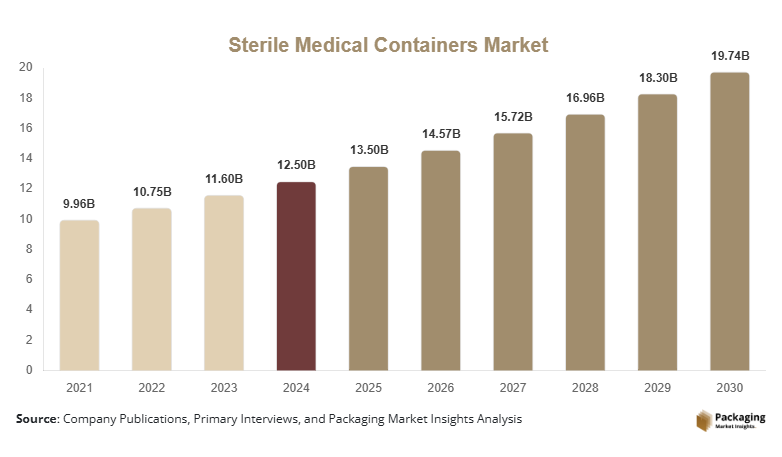
The global Sterile Medical Containers Market was valued at USD 12.5 billion in 2024 and is projected to reach USD 19.8 billion by 2030, exhibiting a compound annual growth rate (CAGR) of 7.9% during the forecast period (2025–2030). A significant global factor supporting this market growth was the increasing demand for sterile medical products, driven by the rising number of surgical procedures and the escalating prevalence of chronic diseases requiring consistent medical care. The imperative for patient safety and infection control across healthcare settings has continually bolstered the adoption of sterile medical containers. This ongoing demand ensures a robust Sterile Medical Containers Market outlook, with innovation in materials and designs further propelling its expansion. Key market participants are focused on meeting the evolving needs of the healthcare industry.
Key Highlights
- North America held a dominant market share of 35% in 2024, while Asia Pacific is anticipated to be the fastest-growing region with a CAGR of 9.2% from 2025 to 2030.
- In the 'By Type' segment, Bags held the leading share, with Vials and Ampoules projected to be the fastest-growing at an 8.5% CAGR.
- For 'By Material', Plastics was dominant, whereas Glass is expected to grow fastest at 7.8% CAGR.
- Within 'By Application', Pharmaceutical Packaging was the dominant subsegment, and Diagnostic Laboratories are forecast to grow fastest at 9.5% CAGR.
- In the 'By End-Use' segment, Hospitals held the largest share, with Ambulatory Surgical Centers (ASCs) showing the fastest growth at 9.0% CAGR.
- The United States was the dominant country, with a market value of USD 4.1 billion in 2024, projected to reach USD 6.7 billion by 2030.
Explore more data points, trends and opportunities Download Free Sample Report
Market Trends
Shift Towards Sustainable and Biocompatible Materials
The Sterile Medical Containers Market is witnessing a notable trend towards the adoption of sustainable and biocompatible materials. Driven by increasing environmental concerns and stricter regulatory guidelines, healthcare providers and manufacturers are actively seeking alternatives to conventional plastics. This shift includes the development of containers made from recycled polymers, biodegradable plastics, and advanced glass formulations. The goal is to minimize environmental impact without compromising the sterility and integrity of medical products, thereby shaping the future of Sterile Medical Containers Market trends.
Integration of Smart Packaging Solutions
Another emerging trend in the Sterile Medical Containers Market is the integration of smart packaging solutions. These innovations include features such as temperature sensors, RFID tags, and QR codes that enable real-time tracking, authentication, and monitoring of sterile medical containers throughout the supply chain. Such technologies enhance supply chain efficiency, reduce errors, and ensure the quality and safety of medical products, ultimately improving patient outcomes. This trend is a key area of focus for Sterile Medical Containers Market analysis.
Market Drivers
Growing Healthcare Expenditure and Infrastructure Development
The escalating global healthcare expenditure, particularly in emerging economies, is a primary driver for the Sterile Medical Containers Market. Governments and private entities are investing significantly in upgrading healthcare infrastructure, including building new hospitals, clinics, and diagnostic centers. This expansion directly translates into increased demand for sterile medical containers used in various procedures, patient care, and laboratory diagnostics. The continuous development in healthcare facilities consistently boosts the Sterile Medical Containers Market growth and market size.
Increasing Prevalence of Chronic Diseases and Surgical Procedures
The rising global prevalence of chronic diseases such as diabetes, cardiovascular conditions, and cancer necessitates frequent medical interventions, diagnostic tests, and surgical procedures. Each of these medical activities requires a vast array of sterile medical containers for drug delivery, sample collection, and instrument sterilization. The demographic shift towards an aging population further contributes to this trend, as older individuals often require more extensive medical care, thereby driving consistent demand within the Sterile Medical Containers Market.
Market Restraints
Stringent Regulatory Landscape and High Compliance Costs
The Sterile Medical Containers Market operates under a highly stringent regulatory environment, with bodies like the FDA in the US and EMA in Europe imposing strict guidelines on material safety, manufacturing processes, and sterilization protocols. Compliance with these regulations requires significant investment in research and development, quality control, and testing, leading to elevated production costs for manufacturers. The complex and evolving regulatory landscape poses a considerable restraint on market entry for new players and can hinder innovation, impacting the overall Sterile Medical Containers Market development.
Market Opportunities
Expansion in Emerging Markets
Emerging economies in Asia Pacific, Latin America, and the Middle East & Africa present significant opportunities for the Sterile Medical Containers Market. These regions are experiencing rapid urbanization, improving healthcare access, and increasing disposable incomes, which collectively fuel the demand for modern healthcare facilities and advanced medical supplies. As healthcare infrastructure develops and patient awareness grows, there is an increasing adoption of sterile practices and products, offering substantial growth avenues for manufacturers of sterile medical containers. This expansion will significantly influence the Sterile Medical Containers Market forecast.
Advancements in Aseptic Packaging Technologies
Ongoing advancements in aseptic packaging technologies represent a key opportunity in the Sterile Medical Containers Market. Innovations in barrier materials, sterile filling processes, and tamper-evident designs are enhancing the safety and shelf-life of sterile medical containers. These technological improvements reduce the risk of contamination, improve product efficacy, and open doors for new applications, particularly in the biopharmaceutical sector where product integrity is paramount. Such developments drive the Sterile Medical Containers Market analysis and offer a competitive edge.
Report Scope
| Report Metric | Details |
|---|---|
| Market Size in 2024 | USD 12.5 Billion |
| Market Size in 2025 | USD 13.5 Billion |
| Market Size in 2030 | USD 19.8 Billion |
| CAGR | 7.9% (2025-2030) |
| Base Year for Estimation | 2024 |
| Historical Data | 2021-2023 |
| Forecast Period | 2025-2030 |
| Report Coverage | Revenue Forecast, Competitive Landscape, Supply Chain Disruption, Growth Factors, Environment & Regulatory Landscape and Trends |
| Geographies Covered | North America, Europe, APAC, Middle East and Africa, LATAM |
| Countries Covered | U.S., Canada, U.K., Germany, France, Spain, Italy, Russia, Nordic, Benelux, Rest of Europe, China, South Korea, Japan, India, Australia, Singapore, Taiwan, South East Asia, Rest of Asia-Pacific, UAE, Turky, Saudi Arabia, South Africa, Egypt, Nigeria, Rest of MEA, Brazil, Mexico, Argentina, Chile, Colombia, Rest of LATAM |
Explore more data points, trends and opportunities Download Free Sample Report
Segmental Analysis
By Type
The Bags subsegment, including IV bags and blood bags, accounted for a dominant 30% share of the Sterile Medical Containers Market by type in 2024. This significant share was primarily due to their extensive use in hospitals and clinics for intravenous fluid administration, blood collection, and parenteral nutrition, driven by the high volume of patient care activities globally. Their flexibility, ease of use, and disposability have made them indispensable in clinical settings.The Vials and Ampoules subsegment is projected to be the fastest-growing, demonstrating a CAGR of 8.5% from 2025 to 2030. This growth will be fueled by the increasing demand for injectable drugs, particularly in the biopharmaceutical and vaccine sectors, which require precise dosage and high sterility. The chemical inertness and protective properties of vials and ampoules make them ideal for sensitive and high-value drug formulations, positioning them for substantial expansion within the Sterile Medical Containers Market.
By Material
The Plastics subsegment, encompassing materials like polypropylene, polyethylene, and polystyrene, held a substantial 45% share of the Sterile Medical Containers Market by material in 2024. This dominance was attributable to the versatility, cost-effectiveness, and excellent barrier properties of plastic materials, which are widely used across various sterile container applications. Their lightweight nature and ease of manufacturing have further cemented their position in the industry.The Glass subsegment is anticipated to grow at the fastest CAGR of 7.8% from 2025 to 2030. This accelerated growth will be driven by the increasing need for high-performance packaging for sensitive biopharmaceuticals, vaccines, and advanced drug delivery systems. Glass offers superior chemical inertness, excellent barrier protection against gases and moisture, and transparency, making it a preferred choice for preserving the integrity and efficacy of high-value sterile medical products.
By Application
The Pharmaceutical Packaging subsegment represented a significant 40% share of the Sterile Medical Containers Market by application in 2024. This leading position was due to the stringent regulatory requirements for drug sterility, the vast global pharmaceutical production volume, and the continuous development of new drug formulations that necessitate robust sterile packaging solutions to ensure patient safety and product efficacy.The Diagnostic Laboratories subsegment is projected to achieve the fastest CAGR of 9.5% from 2025 to 2030. This rapid expansion will be attributed to the global increase in disease testing, medical screening programs, and research activities, which mandate a consistent and high-volume supply of sterile containers for samples, reagents, and diagnostic kits. The growing emphasis on early disease detection and personalized medicine further fuels this demand, propelling Sterile Medical Containers Market growth.
By End-Use
The Hospitals subsegment accounted for a dominant 45% share of the Sterile Medical Containers Market by end-use in 2024. This large share was a direct result of the high volume of surgical procedures performed, extensive inpatient and outpatient care, and the diverse range of medical devices and supplies requiring sterile packaging within hospital environments globally. Hospitals serve as central hubs for various medical interventions, driving consistent demand.The Ambulatory Surgical Centers (ASCs) subsegment is expected to demonstrate the fastest CAGR of 9.0% from 2025 to 2030. This accelerated growth will be driven by the increasing preference for outpatient procedures due to their cost-effectiveness and convenience, leading to a rise in the number of specialized ASCs. As more procedures shift from traditional hospitals to ASCs, the demand for sterile medical containers in these facilities will significantly increase.
Sterile Medical Containers Market Segmentations
By Type
- Vials and Ampoules
- Prefillable Syringes
- Bags
- Trays
- Cartridges
- Bottles
- Others
By Material
-
Plastics
- Polypropylene (PP)
- Polyethylene (PE)
- Polystyrene (PS)
- Polycarbonate (PC)
- Others
-
Glass
- Borosilicate Glass
- Soda-Lime Glass
- Metal
- Others
By Application
- Pharmaceutical Packaging
- Medical Device Packaging
- Diagnostic Packaging
- Laboratory Sample Collection
- Others
By End-Use
- Hospitals
- Clinics
- Ambulatory Surgical Centers (ASCs)
- Diagnostic Laboratories
- Pharmaceutical & Biotechnology Companies
- Research & Academic Institutes
- Others
By Distribution Channel
- Direct Sales
- Distributors
- Online Retail
Regional Analysis
North America
North America held a substantial 35% share of the global Sterile Medical Containers Market in 2024, attributed to its well-established healthcare infrastructure and high adoption rate of advanced medical technologies. The region is poised to grow at a CAGR of 7.5% from 2025 to 2030, driven by continuous innovation in healthcare delivery and a strong focus on patient safety protocols. The mature pharmaceutical and biotechnology industries within the region also contribute significantly to the demand for high-quality sterile containers.The United States emerged as the dominant country within the North American Sterile Medical Containers Market. Its robust healthcare expenditure, coupled with a high volume of surgical procedures and extensive research and development activities, contributed to its leading position. The country's strong regulatory framework for medical devices and pharmaceuticals further ensures the consistent demand for certified sterile medical containers, fostering a stable market environment.
Europe
Europe accounted for a significant 28% share of the Sterile Medical Containers Market in 2024, supported by advanced healthcare systems and a high standard of medical care across its member states. The region is forecast to expand at a CAGR of 7.2% during the 2025–2030 period, driven by an aging population and increasing chronic disease burden which necessitates a steady supply of sterile medical containers. Strict quality control standards and emphasis on product integrity further support market stability.Germany was a leading country in the European Sterile Medical Containers Market. Its strong pharmaceutical industry, coupled with an emphasis on precision engineering and quality manufacturing, has made it a key consumer and producer of sterile medical containers. The country's commitment to healthcare innovation and its large network of research institutions consistently drive demand for advanced sterile packaging solutions for drugs and medical devices.
Asia Pacific
The Asia Pacific Sterile Medical Containers Market secured a 22% share in 2024 and is projected to be the fastest-growing region with an impressive CAGR of 9.2% from 2025 to 2030. This growth is primarily fueled by rapid economic development, increasing healthcare expenditure, and a burgeoning population in countries like China and India. The expansion of medical tourism and improving access to modern healthcare facilities are also pivotal factors.China stood out as a dominant country in the Asia Pacific Sterile Medical Containers Market. Its vast population base, coupled with extensive investments in healthcare infrastructure and a rapidly expanding pharmaceutical manufacturing sector, creates a massive demand for sterile medical containers. Government initiatives aimed at enhancing public health services and domestic production capabilities are further accelerating the country's market trajectory.
Middle East & Africa
The Middle East & Africa region represented an 8% share of the Sterile Medical Containers Market in 2024. The market here is expected to grow at a CAGR of 8.1% from 2025 to 2030, driven by significant government investments in healthcare infrastructure development, particularly in Gulf Cooperation Council (GCC) countries. The rising prevalence of lifestyle diseases and a growing awareness of healthcare quality are also contributing factors to the Sterile Medical Containers Market expansion.Saudi Arabia emerged as a key country in the Middle East & Africa Sterile Medical Containers Market. The country's ambitious Vision 2030 plan includes substantial investments in building world-class medical cities and healthcare facilities. These projects, combined with a focus on medical tourism and specialized treatment centers, are creating a strong demand for advanced sterile medical containers and supplies.
Latin America
Latin America held a 7% share of the Sterile Medical Containers Market in 2024. The region is anticipated to grow at a CAGR of 8.0% from 2025 to 2030, supported by increasing public and private healthcare spending, growing health insurance penetration, and a rising focus on enhancing healthcare access and quality across its diverse economies. The expanding pharmaceutical industry in the region also contributes to this positive outlook for the Sterile Medical Containers Market.Brazil was a dominant country within the Latin American Sterile Medical Containers Market. Its large population, combined with a developing healthcare system and significant investments in both public and private health sectors, ensures a steady demand for sterile medical containers. The country's efforts to expand local manufacturing capabilities for medical supplies further bolster its market position, catering to a broad range of healthcare needs.
Competitive Landscape
The Sterile Medical Containers Market is characterized by the presence of several established players and emerging innovators. The top five companies holding a significant share of the global Sterile Medical Containers Market include Becton, Dickinson and Company (BD), Amcor plc, Gerresheimer AG, West Pharmaceutical Services, Inc., and Schott AG. These companies are actively engaged in strategic initiatives such as product development, capacity expansion, and mergers and acquisitions to strengthen their market presence. Becton, Dickinson and Company (BD) is recognized as a market leader, known for its extensive portfolio of medical devices and sterile solutions. In a recent development, BD focused on enhancing its pre-fillable syringe portfolio with advanced barrier technologies, ensuring extended shelf-life and compatibility for sensitive biopharmaceutical drugs, further cementing its position in the Sterile Medical Containers Market.
Top Key Players in Sterile Medical Containers Market
- Becton, Dickinson and Company (BD)
- Amcor plc
- Gerresheimer AG
- West Pharmaceutical Services, Inc.
- Schott AG
- AptarGroup, Inc.
- DWK Life Sciences
- Thermo Fisher Scientific Inc.
- Corning Incorporated
- SGD Pharma
- Catalent, Inc.
- Baxter International Inc.
- Tekni-Plex
- Nipro Corporation
- Capsa Healthcare
- Helmer Scientific
- Qosina Corp.
- Medline Industries, Inc.
- Cardinal Health