Specialty Shipping Containers Market Size and Growth
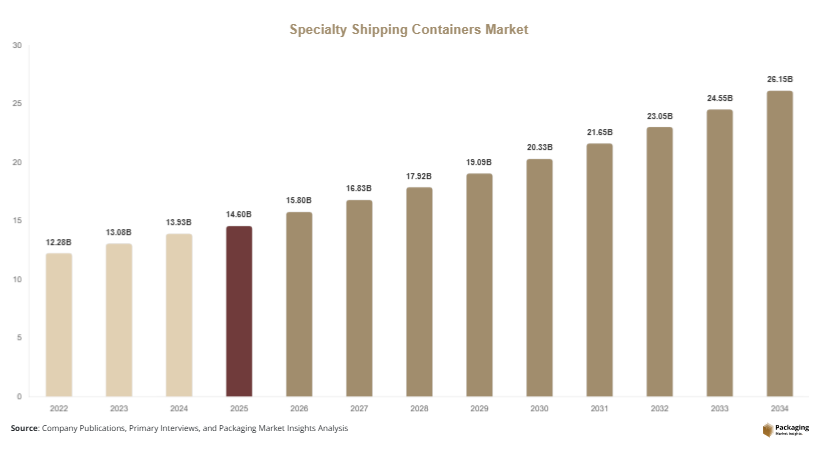
The global specialty shipping containers market size was valued at USD 14.6 billion in 2025 and is projected to reach USD 15.8 billion in 2026. By 2034, the market is expected to reach USD 27.9 billion, growing at a CAGR of 6.5% from 2025 to 2034. This growth reflects increasing demand for customized container solutions designed to transport specialized goods such as pharmaceuticals, chemicals, perishable food items, and hazardous materials. The specialty shipping containers market is expanding steadily as global trade, industrial logistics, and temperature-sensitive transportation requirements continue to evolve.
One of the major growth factors is the rise in global pharmaceutical and healthcare logistics, particularly for temperature-sensitive biologics and vaccines. These products require controlled environments during transit, driving demand for refrigerated and insulated containers. Another key factor is the expansion of global trade and e-commerce, which is increasing the need for efficient and secure shipping solutions. Specialty containers are designed to handle unique cargo requirements, ensuring product safety and reducing losses during transportation. Additionally, growth in the chemical and energy sectors is contributing to demand for tank containers and hazardous material shipping units.
Key Highlights
- Asia Pacific dominated the market with a 36.5% share in 2025, while Latin America is projected to grow at the fastest CAGR of 6.9%.
- Refrigerated containers led the type segment with a 34.7% share, while tank containers are expected to grow at a CAGR of 6.8%.
- Steel containers dominated with a 57.2% share, while composite materials are forecasted to grow at a CAGR of 6.6%.
- Food & beverage applications led the segment with 41.6% share, while pharmaceutical logistics is expected to grow at a CAGR of 7.1%.
- China remained the dominant country with a market size of USD 3.9 billion in 2025 and USD 4.3 billion in 2026.
Explore more data points, trends and opportunities Download Free Sample Report
Market Trends
Integration of smart tracking and monitoring technologies
The specialty shipping containers market is witnessing increased integration of smart technologies such as IoT sensors and GPS tracking systems. These technologies enable real-time monitoring of cargo conditions, including temperature, humidity, and location. This is particularly important for sensitive goods such as pharmaceuticals and perishable food products. Companies are adopting these solutions to improve supply chain visibility and reduce the risk of product damage. Smart containers also provide data analytics that help optimize logistics operations and improve efficiency. As digital transformation continues across industries, the adoption of intelligent shipping containers is expected to grow significantly.
Rising demand for reusable and sustainable container solutions
Sustainability is becoming a key focus in the specialty shipping containers market, with increasing demand for reusable and eco-friendly container solutions. Companies are adopting containers made from recyclable materials and designed for multiple uses to reduce environmental impact. This trend is supported by regulatory frameworks and corporate sustainability initiatives. Reusable containers also offer cost benefits over time by reducing the need for single-use packaging. Additionally, manufacturers are exploring lightweight materials to improve fuel efficiency during transportation. As environmental concerns continue to influence business strategies, sustainable container solutions are expected to gain wider adoption.
Market Drivers
Growth in global trade and logistics networks
The expansion of global trade and logistics networks is a major factor driving the specialty shipping containers market. Increasing cross-border trade has led to higher demand for efficient and secure transportation solutions. Specialty containers are designed to handle unique cargo requirements, making them essential for industries such as chemicals, pharmaceuticals, and food. The development of new trade routes and logistics hubs is further supporting market growth. Additionally, the rise of e-commerce has increased the need for reliable shipping solutions that ensure product safety. As global trade continues to expand, demand for specialized containers is expected to increase.
Increasing demand for temperature-controlled transportation
The growing need for temperature-controlled transportation is another key driver of the specialty shipping containers market. Industries such as pharmaceuticals and food rely on maintaining specific temperature conditions during transit. Refrigerated containers, also known as reefers, are widely used to transport perishable goods. The rise in demand for biologics and vaccines has further increased the need for advanced temperature-controlled solutions. Companies are investing in innovative technologies to improve temperature stability and energy efficiency. This trend is expected to drive continued growth in the market.
Market Restraint
High capital investment and maintenance costs
The specialty shipping containers market faces challenges due to the high cost of manufacturing and maintaining specialized containers. Advanced containers equipped with temperature control systems and smart technologies require significant investment. Additionally, maintenance costs can be high, particularly for refrigerated and tank containers that require regular inspection and servicing. Small and medium-sized enterprises may find it difficult to afford these costs, limiting market participation. For example, maintaining cold chain containers involves continuous monitoring and energy consumption, which increases operational expenses. These financial barriers can slow down adoption and affect overall market growth.
Market Opportunities
Expansion of cold chain logistics infrastructure
The expansion of cold chain logistics presents significant opportunities in the specialty shipping containers market. Governments and private companies are investing in cold storage facilities and transportation networks to support the growing demand for perishable goods. This includes the development of refrigerated containers and advanced cooling technologies. The increasing demand for fresh food and pharmaceutical products is driving the need for reliable cold chain solutions. As infrastructure improves, companies can expand their operations and improve service quality, creating new growth opportunities.
Increasing adoption in emerging economies
Emerging economies offer substantial growth potential for the specialty shipping containers market. Rapid industrialization and increasing trade activities are driving demand for specialized shipping solutions. Governments in these regions are investing in infrastructure development, including ports and logistics networks. This is creating opportunities for container manufacturers and service providers. Additionally, the growth of manufacturing industries in emerging markets is increasing the need for efficient transportation solutions. As these economies continue to develop, the demand for specialty shipping containers is expected to rise.
Report Scope
| Report Metric | Details |
|---|---|
| Market Size in 2025 | USD 14.6 Billion |
| Market Size in 2026 | USD 15.8 Billion |
| Market Size in 2034 | USD 27.9 Billion |
| CAGR | 6.5% (2026-2034) |
| Base Year for Estimation | 2025 |
| Historical Data | 2022-2024 |
| Forecast Period | 2026-2034 |
| Report Coverage | Revenue Forecast, Competitive Landscape, Supply Chain Disruption, Growth Factors, Environment & Regulatory Landscape and Trends |
| Geographies Covered | North America, Europe, APAC, Middle East and Africa, LATAM |
| Countries Covered | U.S., Canada, U.K., Germany, France, Spain, Italy, Russia, Nordic, Benelux, Rest of Europe, China, South Korea, Japan, India, Australia, Singapore, Taiwan, South East Asia, Rest of Asia-Pacific, UAE, Turky, Saudi Arabia, South Africa, Egypt, Nigeria, Rest of MEA, Brazil, Mexico, Argentina, Chile, Colombia, Rest of LATAM |
Explore more data points, trends and opportunities Download Free Sample Report
Segmental Analysis
By Type
Refrigerated containers held the largest share of the specialty shipping containers market in 2024, accounting for approximately 34.7%. These containers are essential for transporting temperature-sensitive goods such as food and pharmaceuticals. The increasing demand for fresh and frozen products is driving growth in this segment. Manufacturers are focusing on improving energy efficiency and temperature control technologies.
Tank containers are expected to grow at a CAGR of 6.8%. These containers are used for transporting liquids and gases, including chemicals and fuels. The growth of the chemical and energy sectors is driving demand for tank containers. Advances in safety features and materials are further supporting growth.
By Material
Steel containers dominated the market in 2024, holding a share of approximately 57.2%. Steel is widely used due to its strength and durability, making it suitable for heavy-duty applications. The demand for robust containers in industries such as chemicals and logistics supports this segment.
Composite materials are expected to grow at a CAGR of 6.6%. These materials offer advantages such as lightweight design and resistance to corrosion. The increasing focus on fuel efficiency and sustainability is driving demand for composite containers.
By Application
Food and beverage applications accounted for the largest share of the market in 2024, with approximately 41.6%. The demand for transporting perishable goods is driving the use of specialty containers. Refrigerated containers are widely used in this segment.
Pharmaceutical logistics is expected to grow at a CAGR of 7.1%. The increasing demand for temperature-sensitive drugs is driving growth in this segment. Advanced containers with precise temperature control are essential for maintaining product quality.
Specialty Shipping Containers Market Segmentations
By Type
- Refrigerated Containers
- Tank Containers
- Open Top Containers
- Flat Rack Containers
By Material
- Steel
- Aluminum
- Composite Materials
By Application
- Food & Beverage
- Pharmaceuticals
- Chemicals
- Oil & Gas
Regional Analysis
North America
North America accounted for approximately 29.1% of the specialty shipping containers market share in 2025 and is projected to grow at a CAGR of 6.1%. The region benefits from advanced logistics infrastructure and strong demand from industries such as pharmaceuticals and food. The presence of established companies and high adoption of technology further support market growth.
The United States dominates the regional market due to its large industrial base and extensive trade networks. A key growth factor is the increasing demand for temperature-controlled containers in pharmaceutical logistics. This demand is supported by the growth of biologics and vaccine distribution.
Europe
Europe held around 25.8% of the market share in 2025 and is expected to grow at a CAGR of 6.2%. The region’s strong regulatory framework and focus on sustainability drive demand for advanced shipping containers. Industries such as chemicals and food processing contribute significantly to market growth.
Germany leads the European market due to its well-developed manufacturing sector. A unique growth factor is the adoption of eco-friendly container solutions, supported by strict environmental regulations. This trend is encouraging innovation in sustainable materials.
Asia Pacific
Asia Pacific dominated the market with a 36.5% share in 2025 and is projected to grow at a CAGR of 6.8%. Rapid industrialization, increasing trade activities, and expanding logistics networks are driving market growth. The region’s large population base also contributes to demand for food and pharmaceutical products.
China is the dominant country in this region due to its strong manufacturing capabilities. Government initiatives to improve logistics infrastructure are a key growth factor. These initiatives are supporting the development of advanced shipping solutions.
Middle East & Africa
The Middle East & Africa region held a market share of approximately 4.6% in 2025 and is expected to grow at a CAGR of 6.3%. Increasing trade activities and infrastructure development are supporting market growth. The region is also witnessing rising demand for specialized containers in the oil and gas industry.
Saudi Arabia is a leading market due to its focus on economic diversification. A unique growth factor is the expansion of logistics hubs and ports, which is increasing demand for specialty shipping containers.
Latin America
Latin America accounted for around 4.0% of the market in 2025 and is projected to grow at a CAGR of 6.9%. The region is experiencing growth in trade and industrial activities, which is driving demand for shipping containers.
Brazil dominates the regional market due to its large economy and growing manufacturing sector. A unique growth factor is the increasing demand for refrigerated containers in the food export industry, particularly for agricultural products.
Competitive Landscape
The specialty shipping containers market is moderately competitive, with several global and regional players focusing on innovation and expansion. Companies are investing in advanced technologies such as smart tracking systems and energy-efficient designs to enhance their product offerings. Strategic partnerships and collaborations are common as firms aim to strengthen their market presence.
CIMC (China International Marine Containers) is a leading player in the market, known for its extensive product portfolio and global presence. The company recently expanded its production capacity to meet increasing demand for specialized containers. Other major players are focusing on sustainability and digital integration to remain competitive.
Key Players List
- China International Marine Containers (CIMC)
- Maersk Container Industry
- Singamas Container Holdings Limited
- CXIC Group Containers Company Limited
- Hoover Ferguson Group
- SeaCube Container Leasing Ltd.
- TLS Offshore Containers International
- Stolt-Nielsen Limited
- Bertschi AG
- Suttons Group
- Textainer Group Holdings Limited
- Florens Container Services Company Limited
- Beacon Intermodal Leasing, LLC
- CARU Containers B.V.
- OEG Offshore Limited