Soy Sauce Packaging Bottles Market Size and Growth
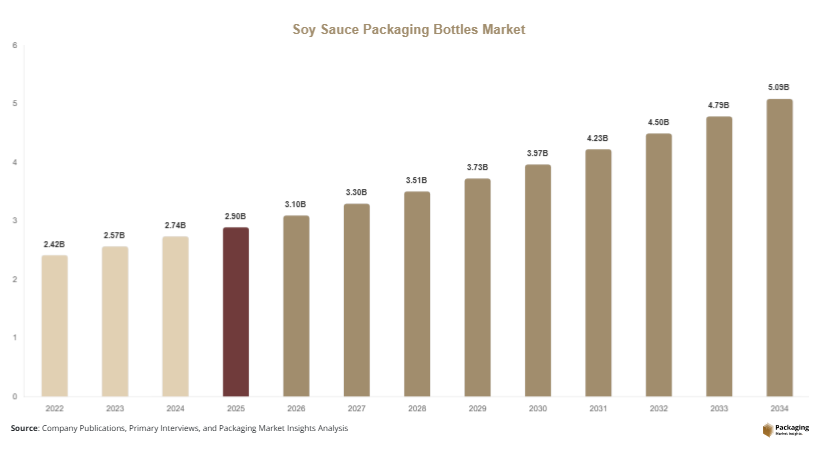
The global soy sauce packaging bottles market size was valued at approximately USD 2.9 billion in 2025 and is projected to reach USD 3.1 billion in 2026. The market is forecasted to attain USD 5.4 billion by 2034, expanding at a CAGR of 6.4% during 2025–2034. The soy sauce packaging bottles market is experiencing stable growth due to rising global consumption of Asian cuisine, expansion of foodservice industries, and increasing demand for sustainable food packaging solutions. Soy sauce packaging bottles are widely used across retail, commercial kitchens, restaurants, and food manufacturing sectors for safe storage, dispensing, and transportation of soy sauce products. These bottles are manufactured using materials such as glass, polyethylene terephthalate (PET), high-density polyethylene (HDPE), and biodegradable plastics to maintain product freshness and improve consumer convenience.
The growing popularity of Asian food products in North America, Europe, and Latin America is one of the primary factors supporting market growth. Soy sauce consumption has increased significantly due to the expansion of Asian restaurant chains, online grocery platforms, and packaged food distribution channels. Another important growth factor is the increasing focus on premium and aesthetically designed packaging. Food manufacturers are investing in customized bottle designs, easy-pour caps, and tamper-proof sealing technologies to improve consumer experience and brand visibility. In addition, sustainability initiatives are encouraging manufacturers to adopt recyclable and lightweight packaging materials, particularly PET and glass alternatives with reduced environmental impact.
Key Highlights
- Asia Pacific dominated the market with a 49.6% share in 2025.
- Latin America is projected to grow at the fastest CAGR of 6.9%.
- PET bottles led the material segment with a 41.8% share.
- Retail packaging applications dominated the market with a 57.3% share.
- Food manufacturers led the end-use segment with 46.1% share.
- The US remained the dominant country with a market size of USD 540 million in 2025 and USD 575 million in 2026.
Explore more data points, trends and opportunities Download Free Sample Report
Market Trends
Rising Demand for Sustainable and Recyclable Packaging Bottles
Sustainability has become a significant trend in the soy sauce packaging bottles market as consumers and regulatory authorities increasingly prioritize environmentally responsible packaging solutions. Manufacturers are shifting from conventional heavy plastic containers toward recyclable PET bottles, lightweight glass bottles, and biodegradable packaging materials. Food companies are also reducing bottle weight and improving recyclability to minimize transportation costs and environmental impact. In addition, several soy sauce brands are introducing refillable packaging formats and reusable glass bottles to strengthen sustainability initiatives. These developments are helping packaging manufacturers align with changing consumer preferences while supporting circular economy practices across the food and beverage packaging industry.
Growth of Premium and Functional Packaging Designs
The market is also witnessing growing demand for premium and functional packaging bottle designs. Consumers increasingly prefer visually appealing soy sauce bottles with ergonomic shapes, easy-pour dispensing systems, and anti-drip closures that improve convenience during food preparation. Manufacturers are investing in digital printing technologies and customized branding solutions to enhance shelf visibility and product differentiation. Premium soy sauce brands are also adopting glass packaging and decorative labeling to attract high-income consumers and gourmet food buyers. These packaging innovations are supporting product positioning in retail stores and online food distribution platforms while improving overall consumer experience.
Market Drivers
Increasing Global Consumption of Asian Cuisine
The increasing global popularity of Asian cuisine is one of the primary drivers supporting the soy sauce packaging bottles market. Asian dishes such as sushi, noodles, stir-fried meals, and fusion recipes are gaining widespread acceptance across North America, Europe, and Latin America. Soy sauce remains a core condiment used in restaurants, packaged meals, and home cooking applications. As international food consumption patterns continue to diversify, food manufacturers and restaurant operators are increasing procurement of soy sauce products and packaging solutions. Retail grocery chains and online food platforms are also expanding their Asian condiment offerings, further supporting demand for durable and visually attractive soy sauce bottles.
Expansion of Foodservice and Ready-to-Eat Food Industries
The expansion of the foodservice sector and ready-to-eat meal industry is significantly contributing to market growth. Restaurants, quick-service chains, catering companies, and packaged meal manufacturers require reliable soy sauce packaging bottles for bulk storage and consumer serving applications. Increasing urbanization and changing consumer lifestyles are driving demand for convenient meal solutions and packaged condiments. Foodservice operators are increasingly adopting lightweight, leak-resistant, and easy-dispensing packaging bottles that improve operational efficiency and reduce product wastage. The growth of cloud kitchens and online food delivery services is also strengthening demand for transport-friendly soy sauce bottle packaging formats.
Market Restraint
Fluctuating Raw Material Costs and Packaging Waste Regulations
One of the key restraints affecting the soy sauce packaging bottles market is the fluctuation in raw material prices and increasing regulatory pressure related to packaging waste. Plastic resins, glass materials, and packaging additives are subject to price volatility influenced by energy costs, supply chain disruptions, and global trade conditions. Rising production costs can impact profit margins for bottle manufacturers and food companies, particularly in price-sensitive markets. In addition, governments across several countries are implementing strict regulations regarding single-use plastics and packaging waste reduction. For example, some regions have introduced taxes on non-recyclable plastic packaging and mandatory recycling targets for food packaging companies. These regulatory requirements are increasing operational costs for manufacturers and encouraging rapid transition toward sustainable packaging alternatives, which may require significant investment in production upgrades and material innovation.
Market Opportunities
Expansion of Eco-Friendly Packaging Solutions
The increasing demand for eco-friendly food packaging presents substantial opportunities for market participants. Consumers are becoming more environmentally conscious and prefer brands that use recyclable, reusable, or biodegradable packaging materials. Soy sauce bottle manufacturers are investing in bio-based plastics, lightweight recyclable PET, and refillable glass packaging systems to address these preferences. Food companies are also promoting sustainability-focused branding strategies to strengthen customer loyalty. As governments continue implementing packaging sustainability regulations, manufacturers offering environmentally responsible bottle solutions are expected to gain competitive advantages across global markets.
Rising E-Commerce Sales of Condiments and Sauces
The growth of e-commerce grocery retailing is creating additional opportunities for the soy sauce packaging bottles market. Online food retail platforms require durable and leak-resistant packaging capable of withstanding transportation and handling processes. Manufacturers are increasingly designing impact-resistant bottles with secure closures and compact packaging formats optimized for e-commerce distribution. In addition, digital retail channels allow soy sauce brands to introduce premium packaging designs and customized bottle formats targeted toward online consumers. The rapid expansion of online grocery shopping across urban markets is expected to support long-term packaging demand.
Report Scope
| Report Metric | Details |
|---|---|
| Market Size in 2025 | USD 2.9 Billion |
| Market Size in 2026 | USD 3.1 Billion |
| Market Size in 2034 | USD 5.4 Billion |
| CAGR | 6.4% (2026-2034) |
| Base Year for Estimation | 2025 |
| Historical Data | 2022-2024 |
| Forecast Period | 2026-2034 |
| Report Coverage | Revenue Forecast, Competitive Landscape, Supply Chain Disruption, Growth Factors, Environment & Regulatory Landscape and Trends |
| Geographies Covered | North America, Europe, APAC, Middle East and Africa, LATAM |
| Countries Covered | U.S., Canada, U.K., Germany, France, Spain, Italy, Russia, Nordic, Benelux, Rest of Europe, China, South Korea, Japan, India, Australia, Singapore, Taiwan, South East Asia, Rest of Asia-Pacific, UAE, Turky, Saudi Arabia, South Africa, Egypt, Nigeria, Rest of MEA, Brazil, Mexico, Argentina, Chile, Colombia, Rest of LATAM |
Explore more data points, trends and opportunities Download Free Sample Report
Segmental Analysis
By Material Type
PET bottles dominated the soy sauce packaging bottles market in 2024 and accounted for approximately 41.8% of total market share. PET materials are widely preferred because they are lightweight, durable, transparent, and cost-efficient for large-scale food packaging applications. Soy sauce manufacturers increasingly use PET bottles for retail packaging because they reduce transportation costs and improve product handling convenience. PET bottles also offer good moisture resistance and product visibility, making them suitable for supermarket shelves and online retail distribution. Advancements in recyclable PET technology and lightweight bottle manufacturing are further supporting demand across global food packaging industries.
Biodegradable plastic bottles are expected to witness the fastest growth, registering a CAGR of 7.4% during the forecast period. Growing environmental awareness and strict regulations regarding single-use plastics are encouraging manufacturers to adopt eco-friendly bottle materials. Biodegradable packaging solutions help reduce environmental impact while supporting sustainability-focused branding strategies. Food companies are increasingly investing in compostable and plant-based bottle materials to meet changing consumer expectations. These innovations are expected to create significant growth opportunities for sustainable soy sauce packaging solutions.
By Application
Retail packaging applications held the dominant market position in 2024 with a share of approximately 57.3%. Supermarkets, convenience stores, and online grocery retailers represent major distribution channels for packaged soy sauce products. Retail consumers prefer compact, leak-resistant, and visually attractive packaging bottles that improve convenience during cooking and storage. Manufacturers are also investing in customized bottle designs and anti-drip dispensing systems to improve consumer experience and strengthen brand identity. The growth of packaged food consumption and home cooking trends is continuing to support strong demand for retail soy sauce packaging bottles.
Foodservice packaging is expected to grow at the fastest CAGR of 6.8% during the forecast period. Restaurants, catering services, and quick-service food chains require bulk soy sauce packaging bottles designed for operational efficiency and high-volume usage. Increasing expansion of Asian restaurant chains and cloud kitchens is contributing to segment growth. Foodservice operators are adopting durable and refillable packaging formats that reduce product wastage and improve storage efficiency. Growing demand for takeaway and food delivery services is also increasing the need for transport-friendly condiment packaging solutions.
By End-Use
Food manufacturers dominated the soy sauce packaging bottles market in 2024 and accounted for approximately 46.1% of total market revenue. Packaged food producers require large-scale soy sauce packaging solutions for retail distribution, export operations, and industrial food processing applications. Manufacturers are increasingly focusing on durable and visually attractive packaging that enhances product visibility and extends shelf life. The expansion of processed food industries and international condiment trade is further strengthening demand for advanced soy sauce bottle packaging solutions across food manufacturing operations.
Restaurant chains are projected to register the fastest CAGR of 7.1% during the forecast period. Expansion of international dining brands, quick-service restaurants, and Asian food franchises is increasing consumption of soy sauce products globally. Restaurant operators require easy-to-use packaging bottles that improve kitchen efficiency and reduce dispensing errors. In addition, customized packaging solutions for branded dining experiences are gaining popularity across premium restaurant chains. Rising investments in hospitality infrastructure and foodservice expansion are expected to support long-term growth in this segment.
Soy Sauce Packaging Bottles Market Segmentations
By Material Type
- PET Bottles
- Glass Bottles
- HDPE Bottles
- Biodegradable Plastic Bottles
By Application
- Retail Packaging
- Foodservice Packaging
- Industrial Packaging
By End-User
- Food Manufacturers
- Restaurant Chains
- Retail Stores
- Hospitality Industry
Regional Analysis
North America
North America accounted for approximately 21.8% of the global soy sauce packaging bottles market share in 2025 and is expected to grow at a CAGR of 5.9% during the forecast period. Rising consumption of Asian cuisine, increasing imports of soy sauce products, and strong growth in packaged food distribution are contributing to regional market expansion. Food manufacturers are also focusing on premium packaging and sustainable bottle materials to meet changing consumer preferences.
The United States dominates the North American market due to strong demand for Asian condiments across restaurants, supermarkets, and online food retail channels. A unique growth factor is the rapid expansion of fusion food culture and international dining trends. Increasing popularity of Japanese, Chinese, and Korean cuisine is supporting steady demand for soy sauce packaging bottles across retail and foodservice applications.
Europe
Europe held nearly 18.9% of the global market share in 2025 and is projected to register a CAGR of 5.8% through 2034. The region is witnessing growing consumer interest in international cuisine, healthier food ingredients, and premium condiments. Packaging manufacturers across Europe are investing in recyclable bottle materials and lightweight packaging solutions to comply with environmental regulations and sustainability goals.
Germany remains the dominant country in the European market because of its strong retail food sector and increasing demand for Asian food products. A unique growth factor is the rapid growth of organic and premium soy sauce consumption. Consumers are increasingly purchasing imported gourmet sauces packaged in high-quality glass and recyclable bottle formats, supporting packaging innovation throughout the country.
Asia Pacific
Asia Pacific dominated the soy sauce packaging bottles market with a 49.6% share in 2025 and is projected to grow at a CAGR of 6.8% during the forecast period. The region benefits from high soy sauce production, large consumer populations, and established food manufacturing industries. Strong demand from household cooking, restaurants, and food processing applications is supporting continued market expansion across Asian economies.
China remains the dominant country in Asia Pacific due to its massive soy sauce production capacity and strong domestic consumption. One unique growth factor is the country’s rapidly expanding packaged food and condiment export industry. Manufacturers are increasingly investing in modern bottle packaging technologies and automated production systems to support growing export demand for soy sauce products.
Middle East & Africa
The Middle East & Africa region accounted for approximately 3.9% of the global market share in 2025 and is forecast to grow at a CAGR of 5.4%. Increasing urbanization, growth in international restaurant chains, and rising demand for packaged condiments are supporting market development. Food importers and retailers are expanding their Asian food product offerings across supermarkets and online grocery channels.
Saudi Arabia dominates the regional market because of strong growth in the hospitality sector and rising demand for international cuisines. A unique growth factor is the expansion of premium dining and food tourism industries. Restaurants and foodservice operators are increasingly using imported soy sauce products packaged in convenient and visually attractive bottle formats.
Latin America
Latin America represented around 5.8% of the global market share in 2025 and is projected to grow at the fastest CAGR of 6.9% during the forecast period. The market is benefiting from increasing adoption of Asian food products, expansion of modern retail infrastructure, and growing online grocery sales. Packaging companies are also introducing lightweight and cost-effective bottle formats to address regional consumer demand.
Brazil leads the Latin American market due to rising popularity of Japanese cuisine and growth in foodservice establishments. A unique growth factor is the strong presence of Japanese cultural influence and Asian food festivals across major urban centers. This trend is increasing consumption of soy sauce products and supporting demand for retail and commercial packaging bottles.
Competitive Landscape
The global soy sauce packaging bottles market is moderately fragmented, with manufacturers focusing on sustainable packaging materials, customized bottle designs, and lightweight production technologies. Companies are expanding production capacity and investing in recyclable packaging innovations to strengthen competitiveness. Strategic partnerships with food manufacturers and condiment brands are also becoming increasingly important for market expansion.
Amcor Plc remains one of the leading companies in the market due to its extensive expertise in food packaging and sustainable bottle manufacturing technologies. In 2024, the company introduced lightweight recyclable PET bottle solutions designed for condiment packaging applications. Other major companies include Berry Global Inc., Gerresheimer AG, Alpha Packaging, and O-I Glass Inc. These firms are emphasizing sustainable material innovation, digital printing technologies, and premium packaging formats to improve product differentiation and customer engagement.
Key Players List
- Amcor Plc
- Berry Global Inc.
- Gerresheimer AG
- Alpha Packaging
- O-I Glass Inc.
- Silgan Holdings Inc.
- Plastipak Holdings Inc.
- Berlin Packaging
- Graham Packaging Company
- Cospak Pty Ltd.
- AptarGroup Inc.
- Alpla Group
- Ardagh Group
- Nampak Ltd.
- Vetropack Holding Ltd.