Snack Packaging Machine Market Size and Growth
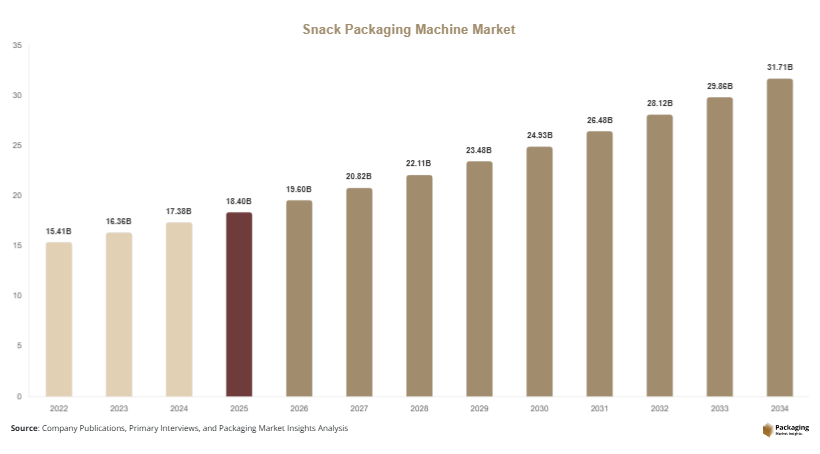
The global snack packaging machine market size was valued at approximately USD 18.4 billion in 2025 and is projected to reach USD 19.6 billion in 2026. With the growing demand for efficient, high-speed, and flexible packaging solutions, the market is forecasted to reach USD 31.8 billion by 2034, expanding at a CAGR of 6.2% during the forecast period (2025–2034). The shift toward convenient, ready-to-eat snack options is significantly influencing packaging technology adoption. The snack packaging machine market is experiencing consistent expansion driven by the rising global consumption of packaged snack products and increasing automation across food processing industries.
One of the major growth factors is the rapid expansion of the global snack food industry, supported by changing consumer lifestyles and increasing urbanization. Consumers are increasingly opting for packaged snacks due to convenience, portability, and longer shelf life. Another key factor is the adoption of automation and smart manufacturing practices, which enhance production efficiency and reduce operational costs. Packaging machines integrated with digital technologies such as IoT and AI are improving productivity and enabling real-time monitoring. Additionally, stringent food safety regulations are encouraging manufacturers to adopt advanced packaging systems that ensure hygiene and compliance.
Key Highlights:
Asia Pacific dominated the market with a 38.2% share in 2025, while Latin America is projected to grow at the fastest CAGR of 6.8%.
Vertical form-fill-seal machines led the type segment with a 34.7% share, while horizontal flow wrap machines are expected to grow at a CAGR of 6.9%.
Flexible packaging dominated with a 56.4% share, while sustainable packaging solutions are forecasted to grow at a CAGR of 6.7%.
Food & beverage applications led the segment with 61.2% share, while bakery snacks are expected to grow at a CAGR of 6.5%.
China remained the dominant country with a market size of USD 4.8 billion in 2025 and USD 5.1 billion in 2026.
Explore more data points, trends and opportunities Download Free Sample Report
Market Trends
Integration of smart and automated packaging technologies
The snack packaging machine market is increasingly influenced by the integration of smart and automated technologies into production lines. Manufacturers are adopting machines equipped with sensors, artificial intelligence, and data analytics capabilities to improve operational efficiency. These advanced systems enable real-time monitoring, predictive maintenance, and process optimization, reducing downtime and enhancing productivity. Automation also ensures consistent packaging quality and minimizes human error, which is critical for maintaining food safety standards. The demand for high-speed packaging solutions is further encouraging the adoption of robotics and automated feeding systems. This trend is particularly prominent among large-scale snack manufacturers aiming to improve throughput and reduce labor dependency.
Rising demand for sustainable and flexible packaging solutions
Another important trend is the growing demand for machines that support sustainable and flexible packaging formats. With increasing environmental concerns, companies are shifting toward biodegradable, recyclable, and compostable materials. Packaging machine manufacturers are developing equipment capable of handling these materials without compromising efficiency. Flexible packaging formats such as pouches and sachets are gaining popularity due to their lightweight nature and cost-effectiveness. This shift is driving innovation in machine design, enabling compatibility with a wide range of materials and packaging styles. The trend is also supported by regulatory policies promoting eco-friendly packaging solutions.
Market Drivers
Expansion of the global snack food industry
The continuous growth of the snack food industry is a major factor driving demand for packaging machines. Increasing urbanization, rising disposable income, and changing dietary habits are contributing to higher consumption of packaged snacks. Products such as chips, nuts, and ready-to-eat items require efficient packaging solutions to maintain freshness and quality. The expansion of retail channels, including supermarkets and online platforms, is further boosting demand for packaged snacks. As manufacturers scale up production to meet consumer demand, the need for advanced packaging machinery is increasing significantly.
Adoption of automation and efficiency-driven manufacturing
The increasing adoption of automation in manufacturing processes is another key driver of the snack packaging machine market. Automated packaging systems offer higher efficiency, reduced labor costs, and improved consistency in packaging quality. Companies are investing in advanced machinery to streamline operations and enhance productivity. Automation also enables manufacturers to meet stringent food safety and hygiene standards. The integration of digital technologies such as IoT and machine learning is further improving machine performance and operational efficiency. These advancements are encouraging manufacturers to upgrade their existing equipment.
Market Restraint
High capital investment and maintenance costs
The high initial cost associated with purchasing and installing advanced snack packaging machines acts as a restraint for market growth. Small and medium-sized enterprises often face financial constraints, limiting their ability to invest in sophisticated equipment. In addition to initial costs, ongoing maintenance and operational expenses can be significant. Advanced machines require skilled personnel for operation and maintenance, adding to overall costs. These factors can discourage adoption, particularly in developing regions where budget limitations are more pronounced. As a result, some manufacturers continue to rely on semi-automated or manual packaging processes.
Market Opportunities
Growth in emerging markets and small-scale manufacturers
Emerging markets present significant opportunities for the snack packaging machine market due to increasing industrialization and urbanization. Countries in Asia Pacific, Latin America, and Africa are witnessing rapid growth in the food processing sector. The rise of small and medium-sized snack manufacturers is creating demand for cost-effective and flexible packaging solutions. Governments are also supporting industrial development through favorable policies and incentives. This environment encourages investment in packaging machinery and creates new growth opportunities for manufacturers.
Technological advancements in machine design and functionality
Continuous advancements in packaging machine technology are creating new opportunities for market growth. Innovations such as modular machine designs, multi-functional systems, and energy-efficient equipment are enhancing performance and flexibility. Manufacturers are focusing on developing machines that can handle multiple packaging formats and materials, reducing the need for separate equipment. Additionally, advancements in automation and digitalization are improving operational efficiency and reducing downtime. These technological improvements are attracting investments and driving the adoption of advanced packaging solutions.
Report Scope
| Report Metric | Details |
|---|---|
| Market Size in 2025 | USD 18.4 Billion |
| Market Size in 2026 | USD 19.6 Billion |
| Market Size in 2034 | USD 31.8 Billion |
| CAGR | 6.2% (2026-2034) |
| Base Year for Estimation | 2025 |
| Historical Data | 2022-2024 |
| Forecast Period | 2026-2034 |
| Report Coverage | Revenue Forecast, Competitive Landscape, Supply Chain Disruption, Growth Factors, Environment & Regulatory Landscape and Trends |
| Geographies Covered | North America, Europe, APAC, Middle East and Africa, LATAM |
| Countries Covered | U.S., Canada, U.K., Germany, France, Spain, Italy, Russia, Nordic, Benelux, Rest of Europe, China, South Korea, Japan, India, Australia, Singapore, Taiwan, South East Asia, Rest of Asia-Pacific, UAE, Turky, Saudi Arabia, South Africa, Egypt, Nigeria, Rest of MEA, Brazil, Mexico, Argentina, Chile, Colombia, Rest of LATAM |
Explore more data points, trends and opportunities Download Free Sample Report
Segmental Analysis
By Machine Type
Vertical form-fill-seal machines dominated the market with a 34.7% share in 2024. These machines are widely used for packaging various snack products such as chips and nuts due to their efficiency and versatility. They offer high-speed operation and are suitable for flexible packaging formats. The ability to handle different product types and packaging materials makes them a preferred choice among manufacturers.
Horizontal flow wrap machines are expected to grow at the fastest CAGR of 6.9% during the forecast period. These machines are gaining popularity due to their ability to package products in attractive and secure formats. The growing demand for individually wrapped snacks is driving adoption. Technological advancements are improving machine performance and efficiency.
By Packaging Type
Flexible packaging held the largest share of 56.4% in 2024 due to its lightweight and cost-effective nature. It is widely used for snack packaging as it provides convenience and extends product shelf life. The increasing demand for portable and easy-to-use packaging formats is driving this segment.
Sustainable packaging solutions are projected to grow at a CAGR of 6.7%. The shift toward eco-friendly materials is encouraging manufacturers to adopt machines capable of handling biodegradable and recyclable packaging. This trend is supported by environmental regulations and consumer preferences.
By Application
Food & beverage applications dominated the market with a 61.2% share in 2024. The high consumption of packaged snacks is driving demand for efficient packaging solutions. The need to maintain product freshness and quality is further supporting growth.
Bakery snacks are expected to grow at a CAGR of 6.5% due to increasing demand for packaged baked products. The expansion of bakery chains and retail outlets is contributing to segment growth. Packaging machines are being designed to handle delicate products efficiently.
Snack Packaging Machine Market Segmentations
By Product Type
- Vertical Form-Fill-Seal Machines
- Horizontal Flow Wrap Machines
- Tray Sealing Machines
- Cartoning Machines
By Application
- Food & Beverage
- Bakery Snacks
- Confectionery
- Savory Snacks
By Distribution Channel
- Direct Sales
- Distributors & Dealers
- Online Sales Channels
- OEM Partnerships
Regional Analysis
North America
North America accounted for approximately 23.5% of the snack packaging machine market share in 2025 and is expected to grow at a CAGR of 5.6% during the forecast period. The region benefits from advanced manufacturing infrastructure and high adoption of automation technologies. The presence of major food processing companies and increasing demand for packaged snacks are driving market growth.
The United States dominates the regional market due to its well-established food processing industry. A key growth factor is the increasing demand for high-speed and automated packaging solutions, which improve efficiency and reduce labor costs. Continuous innovation in packaging technologies is further supporting market expansion.
Europe
Europe held a market share of around 21.8% in 2025 and is projected to grow at a CAGR of 5.4%. The region’s growth is driven by strict food safety regulations and increasing demand for sustainable packaging solutions. Manufacturers are focusing on adopting advanced packaging technologies to meet regulatory requirements.
Germany is the leading country in the European market due to its strong manufacturing base. A major growth factor is the emphasis on eco-friendly packaging solutions, which is encouraging the adoption of machines capable of handling recyclable materials. This trend is driving innovation and market growth.
Asia Pacific
Asia Pacific dominated the market with a 38.2% share in 2025 and is expected to grow at a CAGR of 6.9%. Rapid urbanization, increasing disposable income, and growing demand for packaged snacks are key factors driving growth in this region. The expansion of the food processing industry is also contributing significantly.
China leads the regional market due to its large manufacturing capacity and strong demand for packaged food products. A unique growth factor is the increasing investment in automation technologies, which enhances production efficiency and supports market expansion.
Middle East & Africa
The Middle East & Africa region accounted for approximately 7.6% of the market share in 2025 and is expected to grow at a CAGR of 5.9%. The market is gradually expanding due to increasing demand for packaged food products and improving industrial infrastructure.
The United Arab Emirates is a key market in the region due to its growing food processing industry. A significant growth factor is the increasing adoption of modern packaging technologies, which improve efficiency and product quality.
Latin America
Latin America held a market share of around 8.9% in 2025 and is projected to grow at the fastest CAGR of 6.8%. The region is witnessing increasing demand for packaged snacks due to urbanization and changing consumer preferences.
Brazil dominates the regional market due to its strong food processing sector. A unique growth factor is the expansion of retail distribution channels, which is driving demand for efficient packaging solutions and supporting market growth.
Competitive Landscape
The snack packaging machine market is moderately competitive, with key players focusing on innovation, automation, and sustainability. Companies are investing in research and development to enhance machine efficiency and expand product portfolios. Strategic partnerships and acquisitions are also common to strengthen market presence.
Bosch Packaging Technology is a leading player in the market, known for its advanced packaging solutions. The company recently introduced a new range of automated machines designed to improve efficiency and reduce operational costs. Other major players are also focusing on technological advancements to maintain competitiveness.
Key Players List
- Bosch Packaging Technology
- IMA Group
- Syntegon Technology
- Barry-Wehmiller Companies
- ProMach Inc.
- Coesia Group
- Multivac Group
- Marchesini Group
- GEA Group
- Ilapak International SA
- Ishida Co., Ltd.
- Pakona Engineers Pvt. Ltd.
- Mespack SL
- All-Fill Inc.
- Triangle Package Machinery Co.