Smart Tag Packaging Market Size and Growth
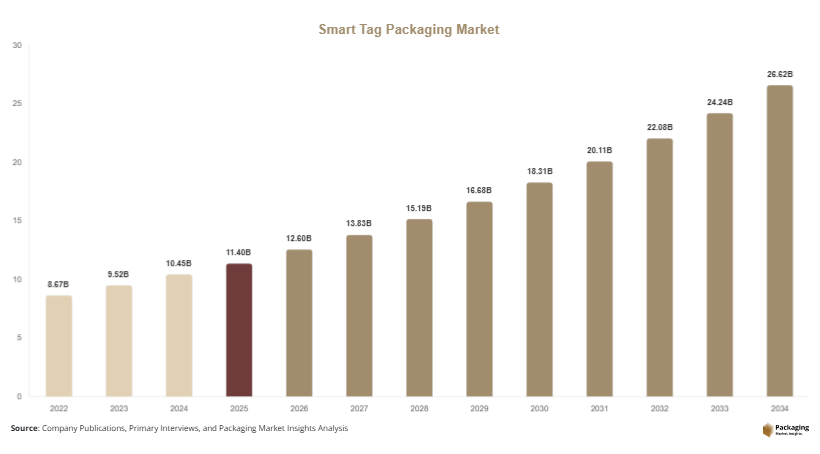
The smart tag packaging market size is estimated at USD 11.4 billion in 2025 and is projected to reach USD 12.6 billion in 2026. By 2034, the market is expected to grow significantly to USD 26.8 billion, registering a CAGR of 9.8% during 2025–2034. This growth refl ects increasing demand for real-time data visibility and traceability across supply chains in sectors such as food, pharmaceuticals, retail, and logistics. The smart tag packaging market is gaining strong traction as industries increasingly adopt intelligent labeling technologies to enhance product tracking, authentication, and consumer engagement.
One of the primary growth factors driving the smart tag packaging market is the rising need for supply chain transparency and product traceability. Companies are increasingly deploying RFID, NFC, and QR code-enabled packaging to track products throughout their lifecycle, ensuring authenticity and reducing counterfeiting risks. Another key factor is the growing adoption of smart packaging in the retail sector, where brands use interactive tags to engage consumers and provide detailed product information.
Key Highlights:
- The Smart Tag Packaging Market reached a market size of USD 11.4 billion in 2025, reflecting growing adoption of intelligent packaging solutions across industries such as retail, logistics, and healthcare. The demand is primarily driven by the need for real-time product tracking and enhanced supply chain visibility.
- The market is projected to grow to USD 12.6 billion in 2026, supported by increasing integration of digital technologies such as RFID, NFC, and QR codes in packaging systems. These technologies are enabling improved inventory management, product authentication, and consumer interaction.
- By 2034, the Smart Tag Packaging Market is expected to reach USD 26.8 billion, expanding at a CAGR of 9.8% during 2025–2034. This growth is fueled by rising adoption of IoT-enabled solutions and increasing investments in smart packaging infrastructure globally.
- There is a rising demand for supply chain transparency and traceability, as companies focus on reducing losses, improving logistics efficiency, and ensuring product authenticity. Smart tags are increasingly used to track products across complex global supply chains.
- The market is witnessing increasing adoption of RFID, NFC, and QR-based packaging, which enhances tracking capabilities and enables real-time data collection. These technologies are widely used in retail, pharmaceuticals, and logistics sectors.
- Additionally, there is strong growth in IoT-enabled smart packaging technologies, allowing continuous monitoring of product conditions such as temperature, humidity, and location. This is particularly important for perishable goods and sensitive pharmaceutical products.
Explore more data points, trends and opportunities Download Free Sample Report
Market Trends
Increasing Integration of IoT and Digital Technologies
A key trend in the smart tag packaging market is the growing integration of IoT and digital technologies into packaging solutions. Smart tags embedded with RFID and NFC capabilities enable real-time tracking and monitoring of products across supply chains. These technologies provide valuable data on location, temperature, and handling conditions, improving logistics efficiency and reducing product losses. Industries such as pharmaceuticals and food are increasingly adopting IoT-enabled smart tags to ensure product quality and compliance with safety standards. This trend is also supported by advancements in cloud computing and data analytics, which allow companies to derive actionable insights from packaging data.
Rising Demand for Anti-Counterfeiting and Brand Protection
Another important trend shaping the smart tag packaging market is the increasing focus on anti-counterfeiting and brand protection. Counterfeit products pose significant challenges for industries such as pharmaceuticals, electronics, and luxury goods. Smart tags, including holographic labels, NFC chips, and serialized QR codes, are being widely used to verify product authenticity. These technologies enable consumers and businesses to authenticate products using smartphones, enhancing trust and brand loyalty. Governments and regulatory bodies are also encouraging the adoption of smart tagging solutions to improve product traceability and reduce illegal trade activities.
Market Drivers
Expansion of E-commerce and Global Supply Chains
The rapid expansion of e-commerce and global supply chains is a major driver of the smart tag packaging market. Online retail platforms require efficient inventory management and real-time tracking of products to ensure timely delivery and minimize losses. Smart tag packaging solutions enable companies to monitor product movement across warehouses, distribution centers, and transportation networks. This improves operational efficiency and reduces the risk of misplaced or damaged goods. The increasing volume of cross-border trade is further driving demand for smart packaging technologies that ensure compliance with international logistics standards.
Growing Demand for Consumer Engagement and Transparency
Another key driver of the smart tag packaging market is the increasing demand for consumer engagement and product transparency. Modern consumers seek detailed information about product origin, ingredients, and usage. Smart tags enable brands to provide interactive experiences through QR codes and NFC-enabled packaging. Consumers can access product details, promotional content, and usage instructions by scanning the tag. This enhances brand engagement and builds trust. The growing focus on personalized marketing strategies is further driving the adoption of smart tag packaging solutions across industries.
Market Restraint
High Implementation Costs and Technical Complexity
A significant restraint in the smart tag packaging market is the high cost associated with implementing smart tagging technologies and the complexity of integrating them into existing packaging systems. RFID chips, NFC tags, and sensor-based packaging solutions require advanced infrastructure, specialized materials, and software integration. These factors increase initial investment costs, particularly for small and medium-sized enterprises. Additionally, the need for technical expertise to manage and analyze data generated by smart tags adds to operational challenges. For example, implementing RFID tracking systems across large-scale logistics networks requires substantial investment in hardware and software, which can limit adoption in cost-sensitive markets.
Market Opportunities
Growth in Smart Packaging for Perishable Goods
The increasing demand for smart packaging solutions in the food and pharmaceutical industries presents a major opportunity for the smart tag packaging market. Perishable goods require constant monitoring to maintain quality and safety during transportation and storage. Smart tags equipped with temperature and humidity sensors can provide real-time data, ensuring that products remain within safe conditions. This reduces spoilage and improves supply chain efficiency. The rising demand for fresh food delivery and temperature-sensitive pharmaceuticals is expected to drive adoption of smart tag packaging solutions.
Expansion in Emerging Markets
Emerging economies in Asia Pacific, Latin America, and Africa offer significant growth opportunities for the smart tag packaging market. Rapid urbanization, increasing internet penetration, and expanding retail sectors are driving demand for advanced packaging solutions. Companies in these regions are investing in digital transformation and adopting smart technologies to improve supply chain efficiency. Government initiatives promoting digitalization and smart infrastructure are also supporting market growth. The rising demand for secure and traceable packaging solutions in these regions is expected to create new opportunities for market players.
Report Scope
| Report Metric | Details |
|---|---|
| Market Size in 2025 | USD 11.4 Billion |
| Market Size in 2026 | USD 12.6 Billion |
| Market Size in 2034 | USD 26.8 Billion |
| CAGR | 9.8% (2026-2034) |
| Base Year for Estimation | 2025 |
| Historical Data | 2022-2024 |
| Forecast Period | 2026-2034 |
| Report Coverage | Revenue Forecast, Competitive Landscape, Supply Chain Disruption, Growth Factors, Environment & Regulatory Landscape and Trends |
| Geographies Covered | North America, Europe, APAC, Middle East and Africa, LATAM |
| Countries Covered | U.S., Canada, U.K., Germany, France, Spain, Italy, Russia, Nordic, Benelux, Rest of Europe, China, South Korea, Japan, India, Australia, Singapore, Taiwan, South East Asia, Rest of Asia-Pacific, UAE, Turky, Saudi Arabia, South Africa, Egypt, Nigeria, Rest of MEA, Brazil, Mexico, Argentina, Chile, Colombia, Rest of LATAM |
Explore more data points, trends and opportunities Download Free Sample Report
Segmental Analysis
By Technology
RFID technology dominates the smart tag packaging market, accounting for approximately 45% share in 2024. RFID tags enable real-time tracking, inventory management, and improved supply chain visibility, making them widely used across retail, logistics, and manufacturing sectors. These tags can store large amounts of data and be scanned without direct line-of-sight, which enhances operational efficiency. The increasing adoption of automated warehouses and digital inventory systems is further supporting the growth of RFID-based smart tag packaging solutions across global markets.
The fastest-growing subsegment is NFC (Near Field Communication), projected to expand at a CAGR of 10.8% during 2025–2034. Growth is driven by rising demand for consumer engagement and interactive packaging solutions. NFC tags allow consumers to access product information, promotions, and authentication details through smartphones. This technology is increasingly used in premium products, pharmaceuticals, and retail packaging, where brand interaction and authenticity verification are critical factors.
By Component
Tags and labels represent the dominant component segment in the smart tag packaging market, accounting for approximately 50% share in 2024. These components are essential for enabling smart packaging functionalities such as tracking, authentication, and data storage. Tags and labels are widely used across industries due to their versatility, ease of integration, and cost-effectiveness. The increasing demand for traceability and anti-counterfeiting solutions is further driving the adoption of smart tags and labels in packaging applications.
The fastest-growing subsegment is sensor-enabled components, expected to grow at a CAGR of 11.2% during 2025–2034. These components enable real-time monitoring of environmental conditions such as temperature, humidity, and pressure. Growth is particularly strong in food and pharmaceutical packaging, where maintaining product quality and safety is critical. Increasing adoption of IoT-based monitoring systems is further accelerating demand for sensor-integrated smart tag packaging solutions.
By End-Use
The retail sector dominates the smart tag packaging market, accounting for approximately 40% share in 2024. Retailers use smart tag packaging solutions to improve inventory management, reduce theft, and enhance customer engagement. RFID and QR code-based tags are widely used in apparel, electronics, and consumer goods packaging to track products and provide detailed information to customers. The rapid growth of e-commerce and omnichannel retailing is further driving demand for smart packaging solutions in this segment.
The fastest-growing subsegment is pharmaceutical and healthcare packaging, projected to grow at a CAGR of 11.5% during 2025–2034. Growth is driven by increasing need for product traceability, anti-counterfeiting measures, and regulatory compliance. Smart tags help ensure the authenticity of drugs and enable real-time monitoring of storage conditions. The expansion of global pharmaceutical supply chains and rising demand for temperature-sensitive drugs are further supporting the growth of this segment.
Smart Tag Packaging Market Segmentations
By Technology
- RFID
- NFC
- QR Codes
- Sensors
By Component
- Tags
- Labels
- Chips
- Readers
By End-Use
- Retail
- Healthcare
- Food & Beverage
- Logistics
Regional Analysis
North America
North America holds approximately 33% market share in 2025 in the smart tag packaging market, with a projected CAGR of 9.2% during 2025–2034. The region benefits from strong technological infrastructure and early adoption of smart packaging solutions across retail, healthcare, and logistics sectors. High penetration of RFID and NFC technologies, combined with advanced supply chain systems, supports steady market growth. Increasing investment in digital transformation and IoT integration is further strengthening the adoption of smart tag packaging solutions across industries.
The United States dominates the regional market due to its strong presence of technology providers and large-scale retail networks. A key growth factor is the increasing implementation of RFID-enabled inventory management systems in large retail chains, which improves operational efficiency and reduces inventory losses. Canada also contributes to growth through rising adoption of traceability solutions in the pharmaceutical and food industries.
Europe
Europe accounts for nearly 26% market share in 2025, with a projected CAGR of 9.0% during 2025–2034 in the smart tag packaging market. Growth is driven by strict regulatory requirements related to product traceability, safety, and anti-counterfeiting measures. The region is witnessing strong adoption of smart labeling technologies in pharmaceuticals, food packaging, and luxury goods. Increasing focus on sustainability and digital packaging solutions is also contributing to market expansion.
Germany leads the European market due to its advanced manufacturing capabilities and strong adoption of Industry 4.0 technologies. A unique growth factor is the integration of smart tags in pharmaceutical packaging for serialization and compliance tracking, which ensures product authenticity and regulatory adherence. Countries such as France and the UK are also expanding the use of NFC-based consumer engagement solutions.
Asia Pacific
Asia Pacific holds around 28% market share in 2025 and is expected to grow at the highest CAGR of 10.5% during 2025–2034 in the smart tag packaging market. Rapid industrialization, expanding e-commerce, and increasing adoption of digital technologies are key drivers in this region. The growing demand for efficient supply chain management and real-time tracking solutions is accelerating the adoption of smart tag packaging across industries such as retail, logistics, and food processing.
China dominates the regional market due to its large manufacturing base and strong investment in digital infrastructure. A key growth factor is the rapid expansion of e-commerce logistics networks integrated with smart tracking technologies, which improves delivery efficiency and reduces losses. India is also emerging as a high-growth market due to increasing adoption of QR-based packaging in retail and pharmaceuticals.
Middle East & Africa
The Middle East & Africa region accounts for approximately 7% market share in 2025, with a projected CAGR of 9.3% during 2025–2034 in the smart tag packaging market. Growth is supported by expanding retail and logistics sectors, along with increasing investment in smart infrastructure. The region is gradually adopting advanced packaging technologies to improve supply chain efficiency and product traceability.
The United Arab Emirates leads the regional market due to its focus on digital transformation and smart logistics systems. A unique growth factor is the increasing use of smart tag packaging in luxury retail and high-value goods tracking, which enhances product security and brand protection. Saudi Arabia is also contributing through investments in healthcare and pharmaceutical packaging systems.
Latin America
Latin America holds around 6% market share in 2025, with a projected CAGR of 9.1% during 2025–2034 in the smart tag packaging market. Growth in this region is driven by rising e-commerce penetration, improving logistics infrastructure, and increasing awareness of product traceability. Retailers and manufacturers are gradually adopting smart packaging solutions to improve inventory management and reduce counterfeit risks.
Brazil dominates the regional market due to its large consumer base and expanding retail sector. A key growth factor is the increasing adoption of QR code-based smart packaging for consumer engagement and product authentication, which helps brands enhance transparency and customer trust. Mexico and Argentina are also contributing to market growth through digitalization initiatives.
Competitive Landscape
The smart tag packaging market is competitive, with companies focusing on innovation and digital integration. Key players include Avery Dennison Corporation, Zebra Technologies Corporation, CCL Industries, Checkpoint Systems, and Smartrac N.V.
Among these, Avery Dennison Corporation is a leading player due to its strong portfolio of RFID and smart labeling solutions. The company recently expanded its production capacity for RFID inlays to meet growing demand.
Key Players List
- Avery Dennison Corporation
- Zebra Technologies Corporation
- CCL Industries
- Checkpoint Systems
- Smartrac N.V.
- Thin Film Electronics ASA
- Identiv Inc.
- Honeywell International Inc.
- Sato Holdings Corporation
- Alien Technology LLC
- Invengo Technology
- William Frick & Company
- UPM Raflatac
- HID Global
- PragmatIC Semiconductor