Smart Medication Packaging Market Size and Growth
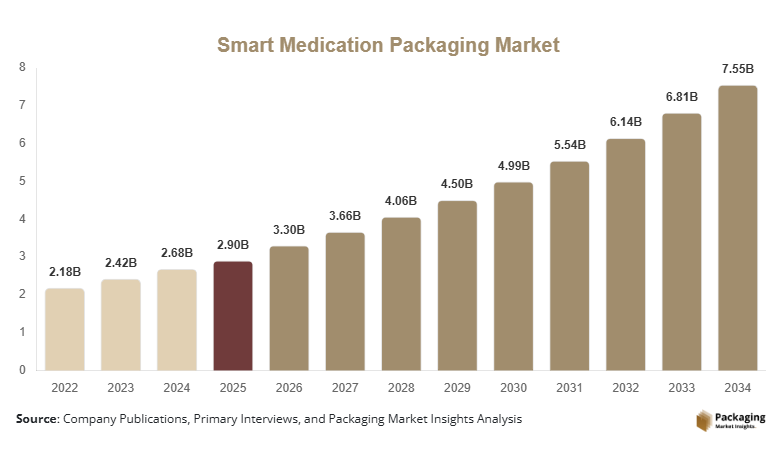
The global smart medication packaging market size was estimated at approximately USD 2.9 billion in 2025 and is projected to reach USD 3.3 billion in 2026. By 2034, the market is forecasted to attain nearly USD 8.4 billion, registering a CAGR of 10.9% during 2025–2034. Smart medication packaging includes connected pill bottles, electronic blister packs, RFID-enabled containers, sensor-based labels, and reminder-enabled packaging systems designed to improve medication management and patient compliance. The smart medication packaging market is experiencing significant expansion due to increasing demand for medication adherence solutions, advancements in connected healthcare technologies, and the growing prevalence of chronic diseases worldwide.
One of the major growth factors supporting market expansion is the increasing aging population globally. Elderly patients often manage multiple prescriptions, creating strong demand for packaging solutions that provide reminders, dosage tracking, and digital monitoring features. Another significant factor is the rising prevalence of chronic diseases such as diabetes, cardiovascular disorders, and neurological conditions that require long-term medication adherence. Healthcare providers and pharmaceutical companies are increasingly investing in smart packaging technologies to improve treatment outcomes and reduce hospital readmission rates. Additionally, the rapid digital transformation within healthcare systems is accelerating integration of smart medication packaging with mobile applications, cloud-based monitoring platforms, and telehealth systems.
Key Highlights
- North America dominated the market with a 36.7% share in 2025.
- Asia Pacific is projected to grow at the fastest CAGR of 11.8%.
- Smart blister packaging led the product segment with a 41.3% share.
- RFID-enabled technology dominated the technology segment with a 38.9% share.
- Pharmaceutical applications led the market with 48.6% share.
- The US remained the dominant country with a market size of USD 940 million in 2025 and USD 1.05 billion in 2026.
Explore more data points, trends and opportunities Download Free Sample Report
Market Trends
Integration of IoT and Mobile Health Platforms
The integration of Internet of Things (IoT) technologies with smart medication packaging is becoming a major trend across the healthcare industry. Smart blister packs, connected pill bottles, and sensor-enabled containers are increasingly linked with mobile applications and cloud-based healthcare systems to improve patient monitoring and medication adherence. These systems provide automated reminders, dosage tracking, and real-time alerts for caregivers and healthcare providers. Pharmaceutical companies are investing in connected packaging solutions to support remote healthcare management and personalized treatment plans. Additionally, IoT integration helps collect medication usage data, enabling healthcare providers to identify adherence issues and improve patient outcomes through data-driven interventions.
Rising Adoption of Anti-Counterfeit Smart Packaging
The increasing focus on pharmaceutical safety and product authentication is driving adoption of anti-counterfeit smart medication packaging solutions. Pharmaceutical manufacturers are integrating RFID tags, QR codes, NFC chips, and serialization technologies into packaging systems to improve traceability and prevent counterfeit drug distribution. Counterfeit medicines continue to create financial and healthcare risks across global pharmaceutical supply chains, encouraging companies to adopt advanced smart packaging technologies. Consumers and healthcare providers can verify product authenticity using smartphone-based scanning systems. This trend is also supporting regulatory compliance and supply chain transparency, particularly in developed pharmaceutical markets where drug safety regulations are becoming increasingly stringent.
Market Drivers
Growing Prevalence of Chronic Diseases
The rising prevalence of chronic diseases is one of the major drivers supporting the smart medication packaging market. Conditions such as diabetes, hypertension, cardiovascular diseases, and respiratory disorders often require long-term medication schedules and strict adherence to prescribed treatments. Smart packaging systems help patients manage complex medication routines by providing reminders, dosage monitoring, and real-time alerts. Healthcare providers are increasingly using these technologies to improve treatment outcomes and reduce medication errors. Additionally, growing healthcare costs associated with non-adherence are encouraging hospitals and pharmaceutical companies to invest in connected packaging solutions that enhance patient compliance and reduce avoidable hospitalizations.
Expansion of Home Healthcare Services
The rapid expansion of home healthcare services is another significant driver fueling market growth. Patients increasingly prefer home-based treatment and remote monitoring solutions due to convenience and lower healthcare costs. Smart medication packaging supports home healthcare by enabling automated medication tracking and digital communication between patients, caregivers, and healthcare providers. Connected packaging systems can provide reminders, monitor medication usage patterns, and generate adherence reports for medical professionals. This functionality is particularly valuable for elderly patients and individuals with chronic illnesses who require continuous medication management outside traditional healthcare facilities.
Market Restraint
High Implementation Costs and Data Security Concerns
One of the major restraints affecting the smart medication packaging market is the high cost associated with advanced connected packaging technologies. Smart packaging systems often require integration of electronic sensors, RFID chips, NFC modules, wireless connectivity components, and software platforms, increasing overall production and implementation expenses. Smaller pharmaceutical manufacturers and healthcare providers may face challenges in adopting these technologies because of limited financial resources. In addition, the need for system integration with hospital databases and digital healthcare infrastructure can further increase deployment complexity and operational costs.
Data privacy and cybersecurity concerns also present significant challenges for market growth. Smart medication packaging systems collect and transmit sensitive patient information, including medication schedules and adherence records. Healthcare providers and patients may hesitate to adopt connected packaging solutions if they perceive risks related to unauthorized data access or cybersecurity breaches. For example, a compromised medication monitoring system could expose confidential patient health information or disrupt treatment tracking functions. These concerns are encouraging regulatory authorities and technology providers to strengthen cybersecurity standards and data protection frameworks across connected healthcare systems.
Market Opportunities
Expansion of Personalized Medicine Solutions
The growing adoption of personalized medicine is creating strong opportunities within the smart medication packaging market. Healthcare providers are increasingly focusing on individualized treatment plans based on patient-specific conditions, genetics, and medication requirements. Smart medication packaging systems can support personalized healthcare by providing customized dosage reminders, adherence tracking, and patient engagement features. Pharmaceutical companies are also exploring connected packaging technologies that integrate with digital health platforms to monitor treatment effectiveness and patient behavior. This opportunity is expected to increase demand for advanced packaging solutions designed for personalized medication management.
Increasing Demand in Emerging Healthcare Markets
Emerging economies present significant growth opportunities for smart medication packaging manufacturers due to expanding healthcare infrastructure and rising digital healthcare adoption. Countries across Asia Pacific, Latin America, and the Middle East are investing in healthcare modernization programs and remote patient monitoring systems. Increasing smartphone penetration and improving internet connectivity are also supporting adoption of connected healthcare technologies. Pharmaceutical companies operating in these regions are increasingly implementing smart packaging solutions to improve medication adherence and supply chain visibility. These developments are expected to create substantial long-term growth opportunities for market participants.
Report Scope
| Report Metric | Details |
|---|---|
| Market Size in 2025 | USD 2.9 Billion |
| Market Size in 2026 | USD 3.3 Billion |
| Market Size in 2034 | USD 8.4 Billion |
| CAGR | 10.9% (2026-2034) |
| Base Year for Estimation | 2025 |
| Historical Data | 2022-2024 |
| Forecast Period | 2026-2034 |
| Report Coverage | Revenue Forecast, Competitive Landscape, Supply Chain Disruption, Growth Factors, Environment & Regulatory Landscape and Trends |
| Geographies Covered | North America, Europe, APAC, Middle East and Africa, LATAM |
| Countries Covered | U.S., Canada, U.K., Germany, France, Spain, Italy, Russia, Nordic, Benelux, Rest of Europe, China, South Korea, Japan, India, Australia, Singapore, Taiwan, South East Asia, Rest of Asia-Pacific, UAE, Turky, Saudi Arabia, South Africa, Egypt, Nigeria, Rest of MEA, Brazil, Mexico, Argentina, Chile, Colombia, Rest of LATAM |
Explore more data points, trends and opportunities Download Free Sample Report
Segmental Analysis
By Product Type
Smart blister packaging dominated the smart medication packaging market in 2024 and accounted for approximately 41.3% of the global market share. Smart blister packs are widely used because they provide precise dosage organization, electronic reminder functions, and medication tracking capabilities. Pharmaceutical companies increasingly prefer blister-based smart packaging for chronic disease medications and elderly patient care applications. These packaging systems can record opening times, monitor adherence patterns, and generate digital alerts for missed doses. The segment benefits from increasing adoption in hospitals, pharmacies, and home healthcare environments where medication compliance remains a major healthcare concern. Additionally, smart blister packaging supports anti-counterfeit protection and improved product traceability within pharmaceutical supply chains.
Connected pill bottles are projected to be the fastest-growing subsegment, registering a CAGR of 12.2% during the forecast period. These systems are equipped with wireless connectivity, audio reminders, LED notifications, and smartphone integration features that improve medication management. Connected pill bottles are gaining popularity among elderly patients and individuals managing multiple prescriptions because they simplify adherence monitoring and remote patient communication. Healthcare providers are increasingly using connected pill bottles in home healthcare programs to improve treatment compliance and reduce avoidable hospital visits. Growing adoption of digital healthcare platforms and remote patient monitoring technologies is expected to accelerate segment growth globally.
By Technology
RFID-enabled technology dominated the market in 2024 with a share of approximately 38.9%. RFID systems are widely used in smart medication packaging because they support real-time product tracking, inventory management, and anti-counterfeit protection. Pharmaceutical manufacturers use RFID-enabled packaging to improve supply chain transparency and ensure medication authenticity throughout distribution channels. RFID technology also allows healthcare providers to monitor medication dispensing and patient adherence more efficiently. The segment benefits from increasing regulatory requirements related to pharmaceutical serialization and product traceability. Additionally, RFID systems can improve operational efficiency within hospitals, pharmacies, and pharmaceutical manufacturing facilities by enabling automated tracking and inventory control processes.
NFC-enabled packaging is anticipated to witness the fastest growth, expanding at a CAGR of 12.5% during the forecast period. Near Field Communication technology allows patients and healthcare providers to access medication information, dosage instructions, and product authentication features using smartphones. NFC-enabled smart packaging systems support improved patient engagement and personalized healthcare management. Pharmaceutical companies are increasingly integrating NFC chips into medication packaging to enhance digital communication and brand interaction. The growing adoption of smartphones and mobile healthcare applications is expected to significantly support segment growth. Additionally, NFC technology improves supply chain security and patient education capabilities within connected healthcare ecosystems.
By Application
Pharmaceutical applications represented the dominant segment in 2024 and captured approximately 48.6% of the total market share. Pharmaceutical companies are increasingly adopting smart medication packaging systems to improve patient adherence, strengthen anti-counterfeit protection, and support digital healthcare initiatives. Smart packaging technologies are widely used for chronic disease medications, specialty pharmaceuticals, and prescription drug management. Regulatory authorities are also encouraging pharmaceutical manufacturers to implement serialization and traceability solutions to improve drug safety and supply chain visibility. The growing prevalence of chronic diseases and increasing focus on medication compliance continue to support strong demand within this segment globally.
Home healthcare applications are expected to grow at the fastest CAGR of 11.9% during the forecast period. Rising demand for remote patient monitoring and home-based treatment solutions is significantly contributing to segment expansion. Smart medication packaging systems help patients manage medications independently by providing reminders, dosage tracking, and digital adherence reporting features. Healthcare providers are increasingly integrating connected packaging technologies into home healthcare programs to reduce hospitalization rates and improve treatment outcomes. The aging population and increasing preference for home-based healthcare services are expected to create substantial growth opportunities for this segment over the forecast period.
Smart Medication Packaging Market Segmentations
By Product Type
- Smart Blister Packaging
- Connected Pill Bottles
- Smart Labels
- Intelligent Containers
By Technology
- RFID-Enabled Packaging
- NFC-Enabled Packaging
- QR Code Integration
- Sensor-Based Packaging
By Application
- Pharmaceutical Applications
- Home Healthcare
- Hospital Applications
- Clinical Trial Management
Regional Analysis
North America
North America accounted for approximately 36.7% of the global smart medication packaging market share in 2025 and is projected to expand at a CAGR of 10.1% during the forecast period. The region benefits from advanced healthcare infrastructure, high healthcare spending, and rapid adoption of connected healthcare technologies. Pharmaceutical companies and healthcare providers in the United States and Canada are increasingly investing in smart medication adherence solutions to reduce hospital readmissions and improve patient outcomes. Growing demand for remote healthcare management is also supporting market expansion.
The United States dominates the North American market due to its large pharmaceutical industry and widespread digital healthcare adoption. One unique growth factor is the increasing integration of smart medication packaging with telehealth platforms and electronic health record systems. Healthcare providers are using connected packaging solutions to remotely monitor patient adherence and improve chronic disease management. This trend is encouraging continuous investment in IoT-enabled healthcare packaging technologies across the country.
Europe
Europe represented approximately 27.1% of the market share in 2025 and is expected to grow at a CAGR of 9.7% during the forecast period. The region is witnessing increasing adoption of medication adherence technologies due to rising elderly populations and strong regulatory focus on patient safety. Pharmaceutical manufacturers are integrating smart packaging features such as RFID tracking and electronic reminders to improve healthcare efficiency. Additionally, government initiatives supporting digital healthcare transformation are accelerating implementation of connected medication packaging systems across European healthcare networks.
Germany remains the dominant country within the European market because of its advanced pharmaceutical manufacturing industry and strong healthcare infrastructure. One unique growth factor is the increasing use of smart blister packaging for elderly care management within assisted living facilities. Healthcare providers are adopting digital medication tracking systems to improve treatment compliance among aging populations. This trend is contributing to steady market growth across the country.
Asia Pacific
Asia Pacific held approximately 24.6% of the global market share in 2025 and is projected to register the fastest CAGR of 11.8% during the forecast period. Rapid healthcare digitalization, expanding pharmaceutical production, and increasing chronic disease prevalence are major factors supporting market growth in the region. Governments are investing in healthcare modernization programs and connected healthcare infrastructure to improve patient management efficiency. The rising adoption of mobile health applications is also supporting demand for smart medication packaging technologies.
China dominates the Asia Pacific market due to its large pharmaceutical manufacturing sector and growing healthcare technology investments. One unique growth factor is the rapid expansion of remote healthcare monitoring services in urban and semi-urban regions. Pharmaceutical companies and healthcare providers are increasingly adopting connected medication packaging systems to support digital healthcare delivery. This trend is expected to strengthen demand for IoT-enabled packaging technologies across the country.
Middle East & Africa
The Middle East & Africa region accounted for approximately 5.1% of the global market share in 2025 and is anticipated to grow at a CAGR of 9.4% during the forecast period. Increasing healthcare investments and rising awareness regarding medication adherence are supporting gradual market expansion across the region. Governments are modernizing healthcare systems and promoting adoption of digital healthcare technologies to improve treatment outcomes. The growing prevalence of chronic diseases is also increasing demand for medication monitoring solutions.
The United Arab Emirates dominates the regional market because of its advanced healthcare infrastructure and growing digital health initiatives. One unique growth factor is the increasing implementation of smart pharmacy systems integrated with connected medication packaging technologies. Hospitals and healthcare providers are adopting digital dispensing and medication monitoring solutions to improve patient care efficiency. This trend is encouraging adoption of smart medication packaging products across the healthcare sector.
Latin America
Latin America represented approximately 6.5% of the market share in 2025 and is expected to expand at a CAGR of 10.8% during the forecast period. The region is witnessing increasing healthcare digitalization and rising demand for remote patient monitoring solutions. Governments and private healthcare organizations are investing in healthcare technology infrastructure to improve medication adherence and chronic disease management. Expanding pharmaceutical production activities are also supporting demand for smart packaging systems across regional healthcare markets.
Brazil remains the leading country within the Latin American market due to its large healthcare industry and expanding pharmaceutical sector. One unique growth factor is the increasing adoption of connected healthcare applications among urban populations. Healthcare providers are integrating smart medication packaging systems with digital patient monitoring platforms to improve treatment compliance and reduce medication errors. This trend is expected to support continued market growth across the country.
Competitive Landscape
The smart medication packaging market is highly competitive, with technology companies, pharmaceutical packaging manufacturers, and healthcare solution providers focusing on connected healthcare innovation and digital adherence technologies. Companies are investing in IoT-enabled packaging systems, anti-counterfeit technologies, and mobile health integration platforms to strengthen market presence. Strategic collaborations between pharmaceutical companies and digital healthcare providers are becoming increasingly common across the industry.
WestRock Company remains one of the leading participants in the market due to its strong healthcare packaging portfolio and investment in connected packaging technologies. In 2024, the company introduced an advanced RFID-enabled pharmaceutical packaging solution designed to improve medication traceability and patient monitoring capabilities. Other key companies operating in the market include Amcor plc, AptarGroup Inc., Jones Healthcare Group, and Keystone Folding Box Co. These companies are focusing on smart blister technologies, connected pill bottle systems, and sustainable electronic packaging materials to meet evolving healthcare industry requirements.
Key Players List
- WestRock Company
- Amcor plc
- AptarGroup Inc.
- Jones Healthcare Group
- Keystone Folding Box Co.
- Schreiner Group
- Stora Enso Oyj
- Avery Dennison Corporation
- Bayer AG
- AdhereTech Inc.
- Omnicell Inc.
- Information Mediary Corp.
- Constantia Flexibles
- NXP Semiconductors
- CCL Industries Inc.
- 3M Company
- Gerresheimer AG