Smart Containers Market Size and Growth
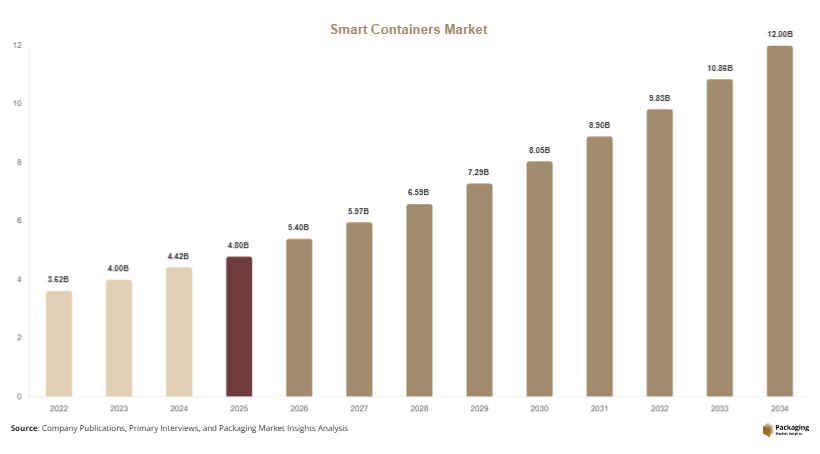
The global smart containers market size is estimated at approximately USD 4.8 billion in 2025. The market is projected to expand to USD 5.4 billion in 2026 and is expected to reach around USD 13.2 billion by 2034, registering a compound annual growth rate (CAGR) of about 10.5% between 2025 and 2034. This growth reflects increasing adoption of Internet of Things (IoT) technology in supply chain operations and the growing importance of real-time cargo monitoring in global trade.
The smart containers market is gaining traction as global logistics networks become more data-driven and efficiency-focused. Smart containers integrate sensors, connectivity technologies, and monitoring systems to track cargo conditions such as temperature, humidity, location, and shock exposure during transportation. These solutions enable logistics providers, shipping companies, and supply chain managers to improve cargo visibility, reduce losses, and maintain product quality across long international shipping routes.
Key Highlights
- The Smart Containers Market is projected to grow from USD 4.8 billion in 2025 to USD 13.2 billion by 2034, registering a CAGR of around 10.5% during 2025–2034.
- Rising demand for real-time cargo monitoring and supply chain transparency is accelerating the adoption of smart container technologies across global logistics networks.
- Expansion of temperature-controlled logistics and integration of IoT sensors with cloud analytics is improving container tracking, operational visibility, and cargo safety.
Explore more data points, trends and opportunities Download Free Sample Report
Market Trends
Increasing Integration of IoT and Cloud-Based Monitoring
One of the prominent smart containers market trends is the growing integration of Internet of Things technologies with cloud-based monitoring platforms. Smart containers are increasingly equipped with sensors that collect data on temperature, humidity, location, vibration, and door status. This information is transmitted through wireless connectivity technologies such as satellite, cellular, or LPWAN networks to centralized cloud platforms. Logistics operators can access this data in real time through dashboards and analytics tools.
Cloud-based monitoring systems provide improved cargo visibility and predictive insights. Companies can detect potential disruptions such as temperature deviations or route delays and take corrective actions quickly. This trend is particularly important in industries such as pharmaceuticals and food logistics, where maintaining specific environmental conditions is critical for product quality and regulatory compliance. As connectivity infrastructure improves globally, cloud-integrated smart containers are becoming a standard component of modern shipping operations.
Rising Adoption in Cold Chain Logistics
Another significant trend shaping the smart containers market is the rapid adoption of smart containers in cold chain logistics. Temperature-sensitive products such as vaccines, biologics, fresh produce, and seafood require strict environmental control throughout transportation. Smart containers provide continuous monitoring of temperature and humidity levels, ensuring that products remain within safe limits during shipping.
Cold chain logistics providers are adopting sensor-enabled containers to minimize spoilage and reduce financial losses. The ability to generate real-time alerts when conditions deviate from acceptable ranges helps logistics managers respond quickly to prevent product damage. In addition, regulatory authorities increasingly require detailed shipment data to ensure compliance with pharmaceutical and food safety standards. Smart containers enable automated documentation and traceability, which supports regulatory reporting and quality assurance in cold chain supply chains.
Market Drivers
Growing Demand for Supply Chain Visibility
One of the primary drivers of the smart containers market is the increasing demand for enhanced supply chain visibility. Global logistics networks involve multiple transportation modes, ports, and intermediaries, which can create information gaps during shipment movement. Traditional containers offer limited monitoring capabilities, making it difficult for logistics operators to track cargo conditions and location in real time.
Smart containers address this challenge by integrating sensors and communication technologies that provide continuous updates about cargo status. Shipping companies and logistics providers can monitor shipments remotely and identify disruptions early. This improved transparency reduces operational uncertainty and supports better decision-making. As businesses aim to improve efficiency and reliability in global trade, the adoption of smart container solutions is expected to continue increasing.
Expansion of Global Trade and E-Commerce Logistics
The rapid expansion of international trade and cross-border e-commerce is another key driver influencing the smart containers market growth. Global shipping volumes have increased significantly as manufacturers and retailers rely on international supply chains to meet consumer demand. This expansion has created pressure on logistics providers to improve shipment tracking and operational efficiency.
Smart containers help shipping companies manage large volumes of cargo more effectively by providing detailed data on container location and status. Real-time monitoring helps reduce delays, improve asset utilization, and enhance fleet management. Additionally, e-commerce companies require reliable logistics infrastructure to maintain delivery timelines and product quality. The increasing importance of logistics performance in competitive markets is encouraging investments in smart container technologies across the shipping industry.
Market Restraint
High Implementation and Infrastructure Costs
Despite the growing demand for advanced cargo monitoring solutions, high implementation costs remain a key restraint in the smart containers market . Smart containers require integrated hardware components such as sensors, connectivity modules, power systems, and tracking devices. In addition, companies must invest in supporting infrastructure including software platforms, data management systems, and communication networks. These investments can significantly increase the overall cost of container deployment compared with conventional shipping containers.
Small and medium-sized logistics companies may face challenges in adopting smart container technologies due to budget constraints. The cost of installing and maintaining sensors, replacing batteries, and managing data systems can affect profitability in highly competitive shipping markets. For example, regional logistics operators handling short shipping routes may find limited economic benefit from investing in advanced monitoring systems.
Furthermore, interoperability challenges between different container management platforms can increase integration complexity. Shipping companies operating across multiple logistics networks may need to maintain compatibility with different tracking systems and communication standards. These challenges can slow adoption, particularly in developing regions where digital logistics infrastructure is still evolving. However, as sensor technology costs decline and connectivity networks expand, the affordability of smart containers is expected to improve over time.
Market Opportunities
Integration with Predictive Analytics and AI
The integration of predictive analytics and artificial intelligence technologies represents a major opportunity for the smart containers market . Data generated by sensors in smart containers provides valuable insights into shipping conditions, equipment performance, and route efficiency. By applying advanced analytics tools, logistics companies can analyze historical and real-time data to predict potential disruptions such as equipment failure or cargo damage.
Predictive analytics can help shipping operators optimize container utilization, improve route planning, and reduce maintenance costs. AI-driven algorithms can identify patterns in cargo temperature variations, enabling proactive interventions before product spoilage occurs. As digital transformation accelerates across the logistics sector, the combination of smart container technology with advanced analytics platforms is expected to create new value-added services for supply chain operators.
Growth of Pharmaceutical and Healthcare Logistics
Another important opportunity in the smart containers market lies in the growing demand for pharmaceutical and healthcare logistics. The transportation of vaccines, biologics, and specialized medical products requires strict temperature and environmental control. Smart containers equipped with monitoring sensors help ensure that these products remain within required temperature ranges during long shipping routes.
The expansion of global pharmaceutical manufacturing and distribution networks is increasing the need for reliable cold chain infrastructure. Regulatory authorities also require detailed shipment records to verify compliance with storage and transportation guidelines. Smart containers provide automated data logging and real-time monitoring, making them an effective solution for pharmaceutical supply chains. As healthcare logistics expands globally, the demand for intelligent container technologies is expected to rise steadily.
Report Scope
| Report Metric | Details |
|---|---|
| Market Size in 2025 | USD 4.8 Billion |
| Market Size in 2026 | USD 5.4 Billion |
| Market Size in 2034 | USD 13.2 Billion |
| CAGR | 10.5% (2026-2034) |
| Base Year for Estimation | 2025 |
| Historical Data | 2022-2024 |
| Forecast Period | 2026-2034 |
| Report Coverage | Revenue Forecast, Competitive Landscape, Supply Chain Disruption, Growth Factors, Environment & Regulatory Landscape and Trends |
| Geographies Covered | North America, Europe, APAC, Middle East and Africa, LATAM |
| Countries Covered | U.S., Canada, U.K., Germany, France, Spain, Italy, Russia, Nordic, Benelux, Rest of Europe, China, South Korea, Japan, India, Australia, Singapore, Taiwan, South East Asia, Rest of Asia-Pacific, UAE, Turky, Saudi Arabia, South Africa, Egypt, Nigeria, Rest of MEA, Brazil, Mexico, Argentina, Chile, Colombia, Rest of LATAM |
Explore more data points, trends and opportunities Download Free Sample Report
Segmental Analysis
By Technology
In 2024, the sensor-based monitoring systems segment accounted for the largest share of the smart containers market , representing approximately 46% of total revenue. Sensors play a central role in enabling container intelligence by collecting data on environmental conditions such as temperature, humidity, pressure, and vibration. These systems allow logistics operators to detect changes in cargo conditions during transportation. The widespread adoption of sensor technologies across shipping fleets is driven by the need for real-time data visibility and cargo safety monitoring. Additionally, advancements in miniaturized sensors and energy-efficient hardware are making sensor integration more practical for large container fleets. As shipping companies prioritize operational transparency, sensor-based solutions are expected to remain the dominant technology segment.
The connectivity platforms segment is projected to be the fastest-growing technology category in the smart containers market , registering a CAGR of approximately 12.8% during the forecast period. Connectivity technologies enable communication between smart containers and cloud-based monitoring platforms using satellite, cellular, or wireless networks. These systems allow logistics providers to receive continuous updates about container location and environmental conditions. The increasing deployment of global connectivity infrastructure and low-power communication networks is supporting the growth of this segment. Additionally, the development of integrated logistics management platforms is encouraging shipping companies to adopt connectivity solutions that support centralized monitoring and predictive analytics.
By Container Type
The dry freight containers segment held the largest share of the smart containers market in 2024, accounting for around 41% of total revenue. Dry freight containers are widely used for transporting manufactured goods, consumer products, and industrial equipment across international trade routes. The adoption of smart monitoring systems in these containers is driven by the need to track shipment location and prevent cargo theft. Logistics operators are integrating tracking devices and security sensors into dry freight containers to improve shipment transparency. These technologies enable real-time monitoring of container movements and help detect unauthorized access. As global trade volumes continue to expand, the demand for intelligent dry freight containers is expected to remain strong.
The refrigerated containers segment is expected to register the fastest CAGR of about 13.2% during the forecast period. Refrigerated containers, also known as reefer containers, are essential for transporting temperature-sensitive goods such as pharmaceuticals, seafood, dairy products, and fresh produce. The growth of cold chain logistics is increasing the demand for smart monitoring solutions that can maintain strict temperature control. Smart refrigerated containers provide continuous monitoring of temperature levels and generate alerts when deviations occur. This capability helps logistics providers prevent product spoilage and maintain compliance with food and pharmaceutical safety regulations.
By End-Use Industry
In 2024, the food and beverage industry segment accounted for the largest share of the smart containers market , representing approximately 38% of total revenue. The transportation of perishable food products requires careful monitoring of temperature and humidity conditions throughout the supply chain. Smart containers enable food exporters and distributors to track environmental conditions during long shipping journeys. These systems help reduce spoilage, improve product quality, and enhance supply chain transparency. Additionally, rising global demand for fresh and frozen food products is increasing the importance of reliable cold chain logistics. As food trade continues to expand internationally, the adoption of smart container technologies in this sector is expected to remain strong.
The pharmaceutical industry segment is projected to grow at the fastest rate, with a CAGR of around 13.5% during the forecast period. Pharmaceutical shipments often involve sensitive biological products that require strict temperature control during transportation. Smart containers provide detailed monitoring data that helps maintain compliance with pharmaceutical storage guidelines. The expansion of global vaccine distribution networks and biologic drug manufacturing is increasing the demand for advanced container monitoring solutions. In addition, pharmaceutical companies are prioritizing supply chain transparency and product safety, which is encouraging logistics providers to adopt intelligent container technologies.
Smart Containers Market Segmentations
Technology
- Sensor Monitoring Systems
- Connectivity Platforms
- Data Analytics Platforms
Container Type
- Dry Freight Containers
- Refrigerated Containers
- Tank Containers
End-Use Industry
- Food & Beverage
- Pharmaceuticals
- Chemicals
- Consumer Goods
- Industrial Products
Regional Analysis
North America
North America accounted for a significant share of the smart containers market in 2025, representing approximately 32% of the global market. The region is expected to grow at a CAGR of around 9.5% through 2034. The presence of advanced logistics infrastructure, strong digital connectivity networks, and high adoption of IoT technologies is supporting market growth across the United States and Canada.
The United States dominates the regional market due to its extensive shipping and logistics industry. One major growth factor is the increasing demand for pharmaceutical cold chain logistics. The country has a large pharmaceutical manufacturing base and strong regulatory requirements for shipment monitoring. These factors are encouraging logistics providers to invest in smart containers to maintain compliance and improve cargo tracking efficiency.
Europe
Europe represented approximately 27% of the global smart containers market share in 2025 and is projected to expand at a CAGR of about 9.2% during the forecast period. The region’s well-established maritime trade routes and strong regulatory environment for cargo safety are contributing to the adoption of intelligent container technologies.
Germany is a leading market within Europe due to its advanced manufacturing sector and strong logistics infrastructure. A key growth factor is the increasing emphasis on sustainable shipping operations. Logistics companies in the country are adopting smart container systems to improve route optimization and reduce fuel consumption. These initiatives align with broader European goals for reducing carbon emissions in transportation.
Asia Pacific
Asia Pacific held approximately 24% of the smart containers market in 2025 and is expected to register the fastest CAGR of around 12.1% through 2034. Rapid industrialization, expanding export industries, and growing maritime trade activities are driving the adoption of advanced shipping technologies in the region.
China dominates the regional market due to its large manufacturing base and extensive port infrastructure. One major growth factor is the expansion of global export activities, which requires improved cargo monitoring and logistics efficiency. Chinese shipping companies are increasingly investing in smart container technologies to enhance tracking capabilities and reduce cargo losses during international shipments.
Middle East & Africa
The Middle East & Africa accounted for approximately 9% of the smart containers market in 2025 and is expected to grow at a CAGR of around 10.2% during the forecast period. Investments in port infrastructure and logistics hubs are supporting the adoption of digital container monitoring technologies across the region.
The United Arab Emirates leads the regional market due to its strategic location as a global shipping hub. A key growth factor is the expansion of smart port initiatives in major maritime terminals. These projects aim to integrate digital technologies into port operations, including container tracking systems that improve cargo management efficiency and reduce operational delays.
Latin America
Latin America represented approximately 8% of the smart containers market share in 2025 and is projected to grow at a CAGR of about 9.8% through 2034. The region’s increasing participation in international trade and agricultural exports is contributing to the demand for advanced container monitoring solutions.
Brazil dominates the regional market due to its strong agricultural export industry. A unique growth factor is the increasing transportation of perishable food products such as meat, fruits, and seafood. These shipments require temperature-controlled logistics solutions, encouraging exporters and shipping companies to adopt smart containers that provide real-time monitoring of environmental conditions.
Competitive Landscape
The smart containers market is moderately competitive, with several technology providers and logistics solution companies offering container monitoring systems and connectivity platforms. Companies compete based on technological innovation, sensor integration capabilities, and software platform development. Many vendors are focusing on expanding their digital logistics ecosystems by integrating data analytics and cloud monitoring solutions.
Leading companies in the market include ORBCOMM, Traxens, Globe Tracker, ZillionSource, and Nexxiot. Among these, ORBCOMM is considered one of the market leaders due to its extensive portfolio of IoT-based tracking solutions for maritime logistics. The company provides satellite and cellular connectivity systems that enable real-time container monitoring across global shipping routes.
Strategic partnerships between technology providers and shipping companies are common in the market. These collaborations allow logistics operators to deploy smart container systems across large fleets while enabling technology vendors to expand their market reach. Companies are also investing in research and development to improve sensor performance, battery life, and connectivity efficiency. Continuous innovation in digital logistics technologies is expected to shape competitive dynamics in the coming years.