Smart Bottle Market Size and Growth
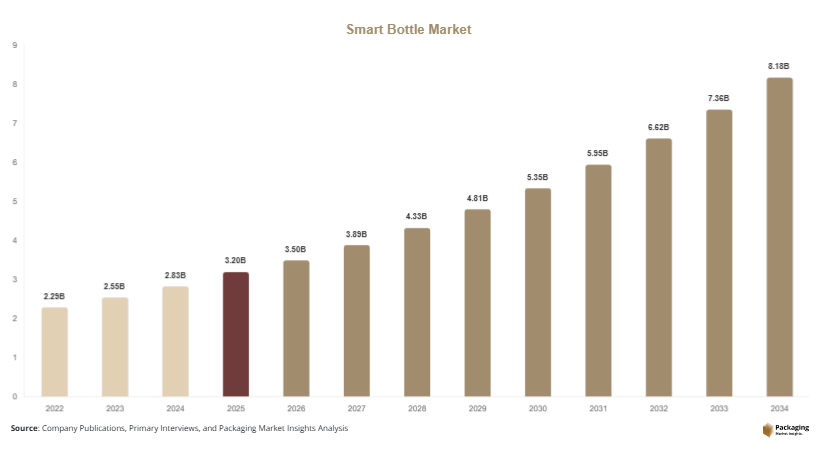
The global smart bottle market size is estimated at USD 3.2 billion in 2025, and it is projected to reach USD 3.5 billion in 2026. By 2034, the market is forecasted to expand to USD 8.1 billion, registering a CAGR of 11.2% (2025–2034). Between 2025 and 2034, the market is expected to witness significant transformation driven by rising health consciousness, increasing smartphone penetration, and rapid advancements in low-power sensor technologies.
The smart bottle market is experiencing steady expansion as consumers increasingly adopt connected hydration solutions that integrate health tracking, IoT connectivity, and personalized wellness features. Smart bottles are no longer limited to fitness enthusiasts; they are gradually entering mainstream consumer lifestyles, corporate wellness programs, and healthcare monitoring ecosystems. These bottles typically include sensors for hydration tracking, temperature monitoring, and mobile app integration, enabling users to maintain optimal hydration habits.
Key Market Highlights
- North America dominated the market with a 35.8% share in 2025.
- Asia Pacific is projected to grow at the fastest CAGR of 12.4%.
- Bluetooth-enabled smart bottles led the connectivity segment with a 41.2% share.
- Plastic-based smart bottles dominated with a 54.6% share.
- Fitness & sports applications led with a 46.3% share.
- The US remained the dominant country with a market size of USD 1.05 billion in 2025 and USD 1.15 billion in 2026.
Explore more data points, trends and opportunities Download Free Sample Report
Market Trends
Integration of AI and Behavioral Hydration Tracking
One of the most influential trends in the smart bottle market is the integration of artificial intelligence for behavioral hydration tracking. Modern smart bottles are increasingly equipped with AI algorithms that analyze user drinking patterns, body weight, activity levels, and environmental conditions to recommend optimal water intake. For example, brands like HidrateSpark and Thermos Smart Lid are introducing systems that sync with mobile apps and fitness trackers such as Fitbit and Apple Health. This integration enables real-time hydration feedback and long-term health insights. In the future, AI-powered smart bottles are expected to evolve into predictive wellness devices that adjust hydration reminders based on weather forecasts, workout intensity, and sleep cycles, improving user health outcomes significantly.
Rise of Sustainable and Reusable Smart Materials
Sustainability is becoming a central trend shaping the smart bottle market. Manufacturers are increasingly focusing on reusable, BPA-free plastics, stainless steel composites, and recyclable electronic components. For instance, several European startups are designing modular smart bottles where electronic components can be detached and reused, reducing electronic waste. This trend aligns with global environmental regulations and consumer demand for eco-friendly products. Additionally, companies are exploring biodegradable outer shells combined with reusable sensor units. In the future, sustainability-driven innovation is expected to dominate product development strategies, particularly in regions like Europe and North America where regulatory pressure on single-use plastics is increasing.
Market Drivers
Growing Health and Fitness Awareness
The increasing global focus on health and fitness is a major driver of the smart bottle market. Consumers are becoming more aware of hydration’s role in cognitive performance, energy levels, and physical health. This awareness is driving demand for devices that provide real-time hydration tracking and reminders. For example, fitness communities and gyms in the United States and India are increasingly incorporating smart bottles into wellness programs. Corporate wellness initiatives are also contributing to demand, as employers aim to reduce fatigue and improve productivity among employees. As chronic conditions like kidney disorders and obesity rise, smart hydration monitoring is becoming an essential preventive health tool.
Expansion of IoT and Wearable Ecosystems
The rapid expansion of IoT-enabled ecosystems is significantly fueling smart bottle adoption. Smart bottles are now integrated with smartphones, smartwatches, and fitness trackers, creating a connected health monitoring environment. For instance, Apple Health and Google Fit ecosystems allow seamless data synchronization from hydration devices. This interconnectedness enhances user engagement and data accuracy. The proliferation of Bluetooth Low Energy (BLE) technology has also reduced battery consumption, making smart bottles more efficient and affordable. As IoT adoption increases globally, especially in emerging markets, smart bottles are expected to become standard accessories in digital health ecosystems.
Market Restraint
High Product Cost and Limited Price Accessibility
Despite strong growth potential, the smart bottle market faces significant challenges related to high product costs and limited affordability in price-sensitive regions. Smart bottles typically integrate sensors, wireless connectivity modules, rechargeable batteries, and mobile application support, all of which increase production costs. As a result, retail prices remain significantly higher than traditional reusable bottles, limiting adoption among middle- and lower-income consumers.
For example, premium smart bottles in North America and Europe can cost between USD 60 and USD 150, which is considerably higher than conventional alternatives priced under USD 10. This price gap restricts mass-market penetration, particularly in developing economies across Africa, South Asia, and parts of Latin America. Additionally, recurring costs such as app subscriptions and replacement parts further discourage adoption.
Another challenge is the perceived value proposition. Many consumers still view smart bottles as non-essential lifestyle gadgets rather than necessary health tools. This perception slows down adoption outside fitness-focused user groups. In rural and semi-urban areas, limited awareness of IoT-based health devices further restricts market expansion. Unless manufacturers achieve significant cost optimization through economies of scale and simplified designs, affordability will remain a key restraint for global market growth.
Market Opportunities
Expansion in Healthcare Monitoring Applications
The healthcare sector presents a major growth opportunity for smart bottles. Hospitals, elderly care facilities, and home healthcare providers are increasingly adopting hydration monitoring solutions to prevent dehydration-related complications. Smart bottles can help monitor fluid intake in patients with kidney disorders, diabetes, and post-surgery recovery needs. For example, pilot programs in Japan and Germany are testing smart hydration systems in elderly care homes to reduce hospitalization risks. In the future, integration with electronic health records (EHR) systems could allow doctors to monitor patient hydration remotely, making smart bottles a valuable tool in preventive healthcare.
Corporate Wellness and Workplace Productivity Solutions
Corporate wellness programs are emerging as a strong opportunity segment for smart bottle manufacturers. Companies are increasingly investing in employee health technologies to reduce absenteeism and improve productivity. Smart bottles can be integrated into workplace wellness platforms, providing hydration reminders during working hours. For example, tech companies in the United States and India are introducing smart hydration devices as part of employee wellness kits. These devices help reduce fatigue, improve focus, and support long working hours in desk-based environments. In the future, integration with corporate wellness dashboards could enable employers to track overall hydration trends across teams, further expanding adoption.
Report Scope
| Report Metric | Details |
|---|---|
| Market Size in 2025 | USD 3.2 Billion |
| Market Size in 2026 | USD 3.5 Billion |
| Market Size in 2034 | USD 8.1 Billion |
| CAGR | 11.2% (2026-2034) |
| Base Year for Estimation | 2025 |
| Historical Data | 2022-2024 |
| Forecast Period | 2026-2034 |
| Report Coverage | Revenue Forecast, Competitive Landscape, Supply Chain Disruption, Growth Factors, Environment & Regulatory Landscape and Trends |
| Geographies Covered | North America, Europe, APAC, Middle East and Africa, LATAM |
| Countries Covered | U.S., Canada, U.K., Germany, France, Spain, Italy, Russia, Nordic, Benelux, Rest of Europe, China, South Korea, Japan, India, Australia, Singapore, Taiwan, South East Asia, Rest of Asia-Pacific, UAE, Turky, Saudi Arabia, South Africa, Egypt, Nigeria, Rest of MEA, Brazil, Mexico, Argentina, Chile, Colombia, Rest of LATAM |
Explore more data points, trends and opportunities Download Free Sample Report
Segmental Analysis
By Type
Bluetooth-enabled smart bottles dominated the market with a 2024 share of 41.2%, driven by widespread smartphone compatibility and ease of use. These bottles connect directly to mobile apps, enabling hydration tracking, reminders, and behavioral analytics. Their dominance is supported by strong adoption in fitness and lifestyle segments. For example, brands like HidrateSpark have successfully integrated Bluetooth connectivity with fitness ecosystems such as Apple Health, making them popular among urban consumers.
The fastest-growing subsegment is AI-integrated smart bottles, expected to grow at a CAGR of 13.1%. These bottles go beyond basic tracking and provide predictive hydration recommendations. Growth is driven by increasing demand for personalized health insights and integration with wearable devices. In the future, AI-based smart bottles are expected to incorporate biometric sensors, further enhancing health monitoring capabilities.
By Material
Plastic-based smart bottles held a 2024 market share of 54.6%, primarily due to low cost, lightweight design, and design flexibility. These bottles are widely used in fitness and everyday consumer applications. For instance, many entry-level smart bottles in Asia Pacific use BPA-free plastic to maintain affordability while offering smart features.
Stainless steel smart bottles are the fastest-growing segment, with a CAGR of 10.8%. Growth is driven by durability, premium positioning, and rising demand for sustainable products. Consumers increasingly prefer long-lasting materials, especially in Europe and North America. Future innovations include hybrid materials combining insulation with embedded sensors.
By End-Use
The fitness & sports segment dominated with a 46.3% share in 2024, driven by strong adoption among athletes, gym users, and outdoor enthusiasts. Smart bottles help monitor hydration during workouts, improving performance and recovery. Sports teams in the U.S. and Europe are increasingly adopting these devices for training optimization.
Healthcare applications are the fastest-growing segment, with a CAGR of 12.7%. Growth is driven by increasing use in patient monitoring, elderly care, and chronic disease management. Hospitals are beginning to test smart bottles for dehydration prevention, especially in post-operative care units.
Smart Bottle Market Segmentations
By Type
- Bluetooth-enabled Smart Bottles
- Wi-Fi Enabled Smart Bottles
- AI-integrated Smart Bottles
- Sensor-based Hydration Tracking Bottles
By Material
- Plastic Smart Bottles
- Stainless Steel Smart Bottles
- Glass-based Smart Bottles
- Hybrid Composite Smart Bottles
By End-User
- Fitness & Sports
- Healthcare & Elderly Care
- Corporate Wellness Programs
- Household Use
- Outdoor & Adventure Activities
Regional Analysis
North America
North America accounted for approximately 35.8% market share in 2025, and it is expected to grow at a CAGR of around 10.5% during 2025–2034. The region remains a mature yet innovation-driven market for smart bottles, supported by high consumer spending power and strong adoption of wearable health technologies. Increasing awareness of hydration’s role in preventive healthcare is a major growth driver, especially among fitness enthusiasts and corporate employees. The presence of leading technology firms and startups also accelerates product innovation and distribution.
The United States dominates the regional market, driven by widespread adoption of fitness apps and IoT-enabled health devices. A key growth driver is the integration of smart bottles with wellness insurance programs, where insurers incentivize healthy hydration habits. For example, wellness-focused insurance providers in the U.S. are experimenting with hydration-linked reward systems. Additionally, partnerships between beverage brands and tech companies are strengthening product visibility in retail and e-commerce channels.
Europe
Europe held nearly 27.1% market share in 2025, with a projected CAGR of 9.8%. The region benefits from strong environmental regulations and high demand for sustainable consumer products. Smart bottles in Europe are increasingly designed with recyclable materials and energy-efficient electronics. Rising health consciousness and government-backed wellness initiatives are supporting adoption across urban populations.
Germany leads the European market, driven by advanced manufacturing capabilities and strong fitness culture. A key growth factor is the integration of smart hydration devices in corporate wellness programs across German industrial firms. For instance, companies in the automotive and IT sectors are providing smart bottles as part of employee health initiatives. Additionally, European universities are adopting smart hydration solutions for student wellness programs.
Asia Pacific
Asia Pacific dominated with 37.4% market share in 2025 and is expected to register the fastest CAGR of 12.4%. Rapid urbanization, rising disposable income, and growing smartphone penetration are key drivers. Countries like China, Japan, and India are witnessing increasing adoption of health monitoring devices.
China leads the regional market, driven by strong domestic electronics manufacturing and high consumer adoption of smart lifestyle products. A key growth driver is the integration of smart bottles into digital fitness ecosystems like WeChat Health platforms. For example, Chinese fitness influencers are promoting hydration tracking devices as part of lifestyle management trends. Additionally, rising gym memberships and e-commerce penetration further boost sales.
Middle East & Africa
The Middle East & Africa accounted for around 5.6% market share in 2025, with a CAGR of 9.2%. The region is gradually adopting smart health technologies, primarily in urban centers such as the UAE and Saudi Arabia. Increasing awareness of fitness and hydration in extreme climates supports demand.
The UAE dominates the region due to strong investment in smart city initiatives. A unique growth driver is the adoption of smart bottles in luxury fitness centers and corporate wellness programs in Dubai. For example, premium gyms are offering smart hydration solutions as part of personalized fitness packages for high-income consumers.
Latin America
Latin America held around 9.5% market share in 2025, with a projected CAGR of 12.0%, making it one of the fastest-growing regions. Rising fitness culture and increasing digital adoption are key drivers. Brazil and Mexico are leading markets.
Brazil dominates due to strong sports culture and expanding gym networks. A key growth factor is the adoption of affordable smart hydration devices in fitness communities. For instance, sports clubs in São Paulo are introducing smart bottles to track athlete hydration during training sessions, improving performance monitoring.
Competitive Landscape
The smart bottle market is moderately fragmented, with key players focusing on innovation, partnerships, and ecosystem integration. The top companies include Hidrate Inc., Thermos LLC, MyHydrate, Caktus, Inc., and HYDRA Smart Tech. Among these, Hidrate Inc. is considered a leading player due to its strong product portfolio and integration with major fitness platforms.
Companies are adopting strategies such as AI integration, subscription-based hydration analytics, and partnerships with wearable tech providers. Recent developments include the launch of voice-assisted smart bottles and expansion into corporate wellness programs. Competitive intensity is increasing as startups introduce cost-effective alternatives targeting emerging markets.
Key Players List
- Hidrate Inc.
- Thermos LLC
- MyHydrate
- Caktus, Inc.
- HYDRA Smart Tech
- LifeFuels
- Gatorade Smart Bottle Division
- Ozmo Active Water
- Moikit
- Keego Smart Hydration
- Xiaomi Smart Bottle Series
- Ulla Labs
- Equa Smart Bottle
- Icewater Tech
- BevBot Technologies