Skincare Primary Packaging Market Size and Growth
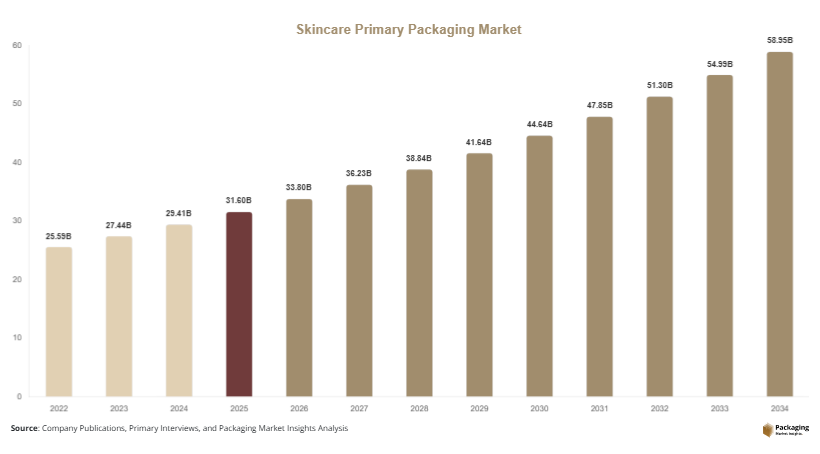
The global skincare primary packaging market size was valued at USD 31.6 billion in 2025 and is projected to reach USD 33.8 billion in 2026, further expanding to approximately USD 58.9 billion by 2034, registering a CAGR of 7.2% during 2025–2034. Primary packaging in skincare includes bottles, jars, tubes, pumps, and airless containers that directly hold the product and ensure safety, usability, and shelf appeal. The skincare primary packaging market is witnessing consistent growth driven by rising consumer demand for personal care products, evolving beauty trends, and increasing focus on product differentiation.
One of the key growth factors is the increasing consumption of skincare products across both developed and emerging markets. Rising disposable income, growing awareness of personal grooming, and expanding urban populations are contributing to higher product usage. This surge in demand directly translates into increased need for innovative and functional packaging solutions.
Key Highlights:
- Asia Pacific dominated the market with a 37.2% share in 2025, while Latin America is projected to grow at the fastest CAGR of 8.4%.
- Plastic packaging led the type segment with a 52.6% share, while glass packaging is expected to grow at a CAGR of 7.9%.
- Bottles and jars dominated the product type segment with a 46.8% share, while airless packaging is forecasted to grow at a CAGR of 8.6%.
- Facial care applications led the segment with 41.5% share, while anti-aging products are expected to grow at a CAGR of 8.1%.
- China remained the dominant country with a market size of USD 5.4 billion in 2025 and USD 5.9 billion in 2026.
Explore more data points, trends and opportunities Download Free Sample Report
Market Trends
Rising Demand for Sustainable and Refillable Packaging Solutions
Sustainability has become a central trend in the skincare primary packaging market as consumers increasingly prefer environmentally responsible products. Brands are shifting towards recyclable, reusable, and refillable packaging formats to reduce plastic waste and carbon footprint. Refillable packaging systems, where consumers can reuse outer containers and purchase refill pods, are gaining popularity in premium skincare segments. Manufacturers are also exploring bio-based plastics, glass alternatives, and paper-based packaging solutions. Regulatory frameworks promoting circular economy practices are further accelerating the adoption of sustainable packaging, making it a key trend shaping future market dynamics.
Increasing Adoption of Airless and Smart Dispensing Packaging
The demand for advanced dispensing systems is growing rapidly, particularly in high-value skincare products. Airless packaging solutions prevent product contamination and oxidation, extending shelf life and ensuring consistent product quality. Smart dispensing technologies, including pumps with precise dosage control, are being widely adopted to enhance user convenience. Additionally, digital integration such as QR codes and NFC-enabled packaging is enabling brands to engage with consumers and provide product information. These innovations are improving product performance and differentiation, contributing to the overall growth of the skincare primary packaging market.
Market Drivers
Growth in Global Skincare Product Consumption
The rising demand for skincare products is a major driver of the skincare primary packaging market. Increasing awareness of skin health, coupled with changing lifestyle patterns, has led to higher consumption of skincare products across various demographics. The expansion of product categories such as serums, moisturizers, and sunscreens is further driving packaging demand. Emerging markets are witnessing rapid growth due to rising disposable income and urbanization. This increase in product consumption requires efficient, attractive, and functional packaging solutions, thereby boosting market growth.
Expansion of E-commerce and Direct-to-Consumer Channels
The rapid growth of e-commerce platforms is significantly influencing the skincare primary packaging market. Online sales channels require packaging that can withstand transportation stress while maintaining product integrity. This has led to increased demand for durable and leak-proof packaging solutions. Direct-to-consumer brands are also focusing on unique and visually appealing packaging to enhance brand identity and customer experience. The convenience of online shopping and the rise of digital marketing are further driving the demand for innovative packaging solutions.
Market Restraint
High Cost of Sustainable Packaging Materials
The adoption of sustainable packaging materials presents a significant challenge due to higher costs compared to conventional materials. Biodegradable plastics, recycled materials, and glass alternatives often require advanced manufacturing processes, increasing production costs. This can impact profit margins, particularly for small and medium-sized companies. Additionally, the limited availability of sustainable materials in certain regions can create supply chain challenges. For example, a skincare brand transitioning to refillable packaging may face increased initial costs for redesigning packaging systems and establishing refill infrastructure. These factors can slow the adoption of sustainable packaging solutions in the market.
Market Opportunities
Growth of Premium and Luxury Skincare Segments
The increasing demand for premium and luxury skincare products presents significant opportunities for the skincare primary packaging market. High-end products require sophisticated packaging solutions that enhance product appeal and user experience. Features such as airless pumps, glass containers, and customized designs are becoming essential in premium segments. The willingness of consumers to pay higher prices for quality and aesthetics is encouraging manufacturers to develop innovative packaging solutions.
Innovation in Lightweight and Customizable Packaging Designs
Advancements in packaging technology are enabling the development of lightweight and customizable solutions. These innovations help reduce material usage and transportation costs while maintaining product protection. Customizable packaging designs allow brands to differentiate their products and enhance brand identity. Digital printing and modular packaging systems are further supporting customization, creating new opportunities for market growth.
Report Scope
| Report Metric | Details |
|---|---|
| Market Size in 2025 | USD 31.6 Billion |
| Market Size in 2026 | USD 33.8 Billion |
| Market Size in 2034 | USD 58.9 Billion |
| CAGR | 7.2% (2026-2034) |
| Base Year for Estimation | 2025 |
| Historical Data | 2022-2024 |
| Forecast Period | 2026-2034 |
| Report Coverage | Revenue Forecast, Competitive Landscape, Supply Chain Disruption, Growth Factors, Environment & Regulatory Landscape and Trends |
| Geographies Covered | North America, Europe, APAC, Middle East and Africa, LATAM |
| Countries Covered | U.S., Canada, U.K., Germany, France, Spain, Italy, Russia, Nordic, Benelux, Rest of Europe, China, South Korea, Japan, India, Australia, Singapore, Taiwan, South East Asia, Rest of Asia-Pacific, UAE, Turky, Saudi Arabia, South Africa, Egypt, Nigeria, Rest of MEA, Brazil, Mexico, Argentina, Chile, Colombia, Rest of LATAM |
Explore more data points, trends and opportunities Download Free Sample Report
Segmental Analysis
By Material Type
Plastic packaging dominated the market, accounting for 52.6% share in 2024. It is widely used due to its cost-effectiveness, durability, and flexibility. Plastic materials such as PET and HDPE are commonly used in skincare packaging.
Glass packaging is expected to be the fastest-growing segment, with a CAGR of 7.9%. Glass is preferred for premium products due to its aesthetic appeal and recyclability. The demand for sustainable packaging is driving the growth of this segment.
By Product Type
Bottles and jars dominated the market, accounting for 46.8% share in 2024. These formats are widely used for creams, lotions, and serums due to their convenience and versatility.
Airless packaging is expected to be the fastest-growing segment, with a CAGR of 8.6%. It offers better product protection and controlled dispensing, making it suitable for high-value skincare products.
By Application
Facial care products dominated the market, accounting for 41.5% share in 2024. The increasing use of skincare products such as moisturizers and serums is driving demand for packaging solutions.
Anti-aging products are expected to be the fastest-growing segment, with a CAGR of 8.1%. The rising aging population and demand for advanced skincare solutions are contributing to segment growth.
Skincare Primary Packaging Market Segmentations
By Material Type
- Plastic
- Glass
- Metal
By Product Type
- Bottles
- Jars
- Tubes
- Airless Packaging
By Application
- Facial Care
- Body Care
- Sun Care
- Anti-aging
Regional Analysis
North America
North America accounted for approximately 28.4% of the market share in 2025 and is expected to grow at a CAGR of 6.8%. The region has a mature skincare market with high consumer awareness and strong demand for premium products. Packaging innovation and sustainability initiatives are key factors driving market growth.
The United States dominates the regional market due to its large consumer base and advanced retail infrastructure. A unique growth factor is the increasing demand for clean beauty products, which require eco-friendly packaging solutions.
Europe
Europe held a market share of 24.6% in 2025 and is projected to grow at a CAGR of 7.0%. The region is characterized by strict environmental regulations and a strong focus on sustainability. The demand for recyclable and biodegradable packaging is increasing.
Germany is the leading country in the European market, supported by its strong manufacturing base. A unique growth factor is the adoption of circular economy practices, which promote the use of reusable packaging.
Asia Pacific
Asia Pacific accounted for 37.2% of the market share in 2025 and is expected to grow at a CAGR of 7.8%. Rapid urbanization, rising disposable income, and increasing beauty consciousness are driving market growth.
China is the dominant country in the region, driven by its large population and expanding skincare market. A key growth factor is the rise of domestic skincare brands, which are investing in innovative packaging solutions.
Middle East & Africa
The Middle East & Africa region accounted for a 5.8% share in 2025 and is expected to grow at a CAGR of 7.5%. The market is expanding due to increasing demand for personal care products and improving retail infrastructure.
The United Arab Emirates leads the regional market, supported by its growing luxury skincare segment. A unique growth factor is the increasing influence of international beauty brands.
Latin America
Latin America held a market share of 4.0% in 2025 and is projected to grow at a CAGR of 8.4%. The region is witnessing increasing demand for skincare products and packaging solutions.
Brazil is the dominant country in the region, supported by its large population and growing beauty industry. A key growth factor is the rising popularity of natural and organic skincare products.
Competitive Landscape
The skincare primary packaging market is highly competitive, with companies focusing on innovation, sustainability, and product differentiation. Key players are investing in advanced materials and packaging technologies to meet evolving consumer demands.
AptarGroup, Inc. is a leading player in the market, known for its innovative dispensing solutions. The company recently introduced sustainable packaging designs to reduce environmental impact. Other major players such as Albéa Group, Amcor plc, HCP Packaging, and Quadpack Industries are expanding their product portfolios and strengthening their market presence through strategic partnerships and product innovations.
Key Players List
- AptarGroup, Inc.
- Albéa Group
- Amcor plc
- HCP Packaging
- Quadpack Industries
- Berry Global Inc.
- Gerresheimer AG
- Silgan Holdings Inc.
- Cosmopak Ltd.
- Libo Cosmetics Company Ltd.
- Fusion Packaging
- Raepak Ltd.
- Lumson S.p.A.
- RPC Group plc
- Alpla Werke Alwin Lehner GmbH & Co KG