Skin Packaging Market Report Size and Growth
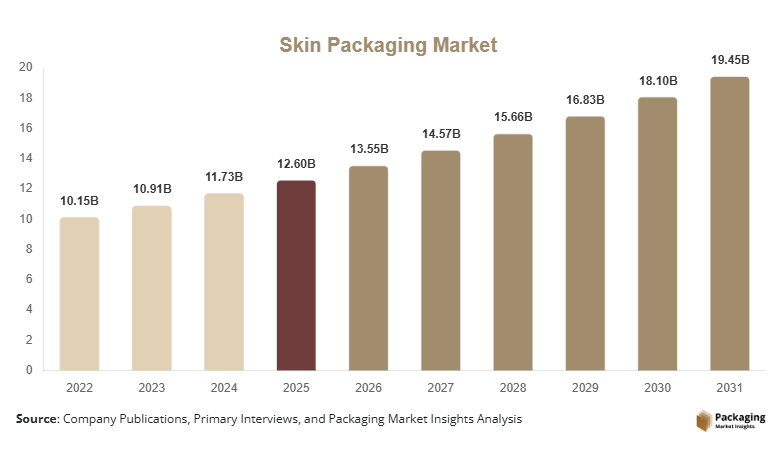
The Skin Packaging Market was valued at USD 12.6 billion in 2025 and is projected to reach USD 19.4 billion by 2030, expanding at a compound annual growth rate (CAGR) of 7.5% during 2025–2031. Skin packaging is a form of vacuum packaging where a transparent film tightly wraps around a product and seals onto a substrate such as paperboard or plastic. The technique is widely used for retail products, industrial components, and food items because it enhances product visibility, improves shelf appeal, and offers protective packaging.
One global factor supporting market growth has been the rising demand for retail-ready packaging solutions across supermarkets and e-commerce channels. Skin packaging offers strong product protection, tamper resistance, and visual presentation, which are critical features for modern retail environments. As brands seek packaging formats that balance aesthetics with durability, the adoption of skin packaging formats has increased across consumer goods, electronics, and food sectors.
Additionally, advancements in packaging materials and thermoforming technologies have improved sealing efficiency, material strength, and recyclability. Manufacturers are introducing new polymer films and biodegradable substrates designed to reduce environmental impact while maintaining product protection. These innovations are helping companies meet sustainability targets while supporting the expansion of the skin packaging industry.
Key Highlights
- North America dominated the Skin Packaging Market with approximately 34% share in 2025, supported by established retail infrastructure and advanced packaging technologies.
- Asia Pacific is expected to register the fastest growth with a CAGR of 9.1% during the forecast period.
- By material, plastic films represented the leading subsegment with around 52% share, while biodegradable materials are projected to grow at 10.2% CAGR.
- By application, food packaging accounted for the largest share at 46%, whereas consumer electronics packaging is anticipated to expand at 8.9% CAGR.
- The United States, the dominant country, recorded a market value of USD 3.4 billion in 2025 and is estimated to reach USD 3.7 billion in 2026.
Explore more data points, trends and opportunities Download Free Sample Report
Market Trends
Adoption of Sustainable Packaging Materials
Sustainability has become an important trend influencing the Skin Packaging Market. Packaging manufacturers are increasingly introducing recyclable, biodegradable, and bio-based materials to address environmental concerns. Traditional skin packaging often uses petroleum-based plastic films; however, regulatory pressure and corporate sustainability commitments have encouraged the development of alternatives such as recyclable PET films and compostable substrates.
Retailers and brand owners are seeking packaging solutions that reduce material consumption while maintaining product visibility and protection. Skin packaging already uses thinner film layers compared to conventional blister packaging, making it attractive for companies pursuing lightweight packaging strategies. As sustainability targets become stricter, the integration of recyclable and bio-based materials will continue shaping product development and packaging design.
Expansion of Automated Packaging Systems
Automation has emerged as another notable trend influencing the Skin Packaging Market outlook. Packaging facilities are increasingly deploying automated skin packaging machines that improve production efficiency and reduce manual handling. Automated systems enable faster sealing cycles, precise temperature control, and consistent packaging quality.
Industries such as electronics, food processing, and hardware manufacturing are adopting automated packaging lines to handle large volumes of products. Automated skin packaging equipment can integrate with existing production lines, enabling seamless operations and reducing operational costs. As companies prioritize operational efficiency and scalability, automated packaging technologies will continue driving advancements within the market.
Market Drivers
Increasing Demand for Retail-Ready Packaging
Retail-ready packaging has become a major driver supporting Skin Packaging Market growth. Modern retail environments require packaging formats that offer clear product visibility, easy shelf placement, and efficient inventory management. Skin packaging provides a transparent film layer that tightly conforms to the product, allowing consumers to inspect the item without opening the package.
Retailers also benefit from the structural strength of skin packaging, which protects products during transportation and shelf storage. The format minimizes product movement within the package, reducing the risk of damage. As global retail chains expand and merchandising standards evolve, demand for retail-friendly packaging formats such as skin packaging is expected to rise steadily.
Rising Demand for Protective Packaging in Consumer Goods
Protective packaging requirements across consumer goods industries are another factor driving the Skin Packaging Market size. Products such as tools, electronics accessories, and hardware components require packaging that prevents physical damage during transportation and storage.
Skin packaging creates a secure seal around products, holding them firmly against the backing material. This feature helps prevent product shifting, breakage, and contamination. Manufacturers prefer skin packaging because it offers both protection and display advantages compared to traditional blister packaging. As consumer goods industries expand globally, demand for protective packaging formats will continue contributing to market growth
Market Restraint
Environmental Concerns Associated with Plastic Materials
Environmental concerns related to plastic packaging have emerged as a restraint affecting the Skin Packaging Market analysis. Many skin packaging formats rely on polymer films such as PVC or PET, which contribute to plastic waste if not properly recycled. Governments and regulatory bodies across multiple regions have introduced restrictions on single-use plastics and packaging waste.
These regulations are encouraging companies to reassess packaging materials and adopt recyclable alternatives. However, the transition to sustainable materials often requires new manufacturing processes and investments in research and development. Some biodegradable materials may also have higher costs or limited availability.
While sustainability initiatives are creating opportunities for innovation, regulatory pressures on plastic materials remain a challenge for traditional skin packaging formats.
Market Opportunities
Growth of E-commerce Packaging Solutions
The rapid expansion of online retail platforms is creating new opportunities for the Skin Packaging Market forecast. E-commerce businesses require packaging that protects products during long-distance transportation while maintaining compact dimensions for efficient logistics.
Skin packaging provides secure product containment and reduces the need for additional protective materials such as foam or fillers. This helps online retailers optimize shipping costs and improve packaging efficiency. As global e-commerce sales continue to expand, demand for durable and lightweight packaging formats will increase.
Development of Recyclable and Bio-Based Films
Advancements in material science are creating opportunities within the Skin Packaging Market industry. Packaging manufacturers are investing in recyclable films, biodegradable polymers, and bio-based materials that reduce environmental impact.
Innovative film technologies are enabling manufacturers to maintain clarity, strength, and sealing performance while improving recyclability. Companies that develop sustainable packaging materials can meet regulatory requirements and attract environmentally conscious brands. As sustainability becomes a strategic priority across industries, demand for eco-friendly skin packaging solutions is expected to grow
Report Scope
| Report Metric | Details |
|---|---|
| Market Size in 2025 | USD 12.6 Billion |
| Market Size in 2026 | USD 13.55 Billion |
| Market Size in 2031 | USD 19.49 Billion |
| CAGR | 7.5% (2026-2031) |
| Base Year for Estimation | 2025 |
| Historical Data | 2022-2024 |
| Forecast Period | 2026-2031 |
| Report Coverage | Revenue Forecast, Competitive Landscape, Supply Chain Disruption, Growth Factors, Environment & Regulatory Landscape and Trends |
| Geographies Covered | North America, Europe, APAC, Middle East and Africa, LATAM |
| Countries Covered | U.S., Canada, U.K., Germany, France, Spain, Italy, Russia, Nordic, Benelux, Rest of Europe, China, South Korea, Japan, India, Australia, Singapore, Taiwan, South East Asia, Rest of Asia-Pacific, UAE, Turky, Saudi Arabia, South Africa, Egypt, Nigeria, Rest of MEA, Brazil, Mexico, Argentina, Chile, Colombia, Rest of LATAM |
Explore more data points, trends and opportunities Download Free Sample Report
Segmental Analysis
By Material
Plastic films represented the dominant subsegment in 2024 with approximately 52% share of the Skin Packaging Market. Materials such as PVC, PET, and polyethylene are widely used in skin packaging due to their transparency, flexibility, and sealing performance. These materials enable manufacturers to produce packaging that tightly conforms to the shape of products while maintaining visual clarity. Plastic films are commonly used across food packaging, consumer electronics, and industrial products because they provide strong product protection and durability.
Biodegradable materials are projected to become the fastest-growing subsegment with a CAGR of 10.2% during the forecast period. The growth will be supported by increasing research into plant-based polymers and compostable packaging films. These materials will enable manufacturers to produce environmentally responsible packaging solutions while maintaining similar functional performance to conventional plastics.
By Type
Carded skin packaging accounted for the largest share of around 48% in 2024. This packaging format involves sealing a plastic film over a product placed on a paperboard backing. Carded skin packaging is widely used for hardware tools, electronic accessories, and industrial components because it provides strong product visibility and secure packaging.
Blister skin packaging is expected to become the fastest-growing subsegment with a projected CAGR of 8.6%. This packaging type will gain traction as manufacturers introduce hybrid packaging formats that combine blister packaging features with skin packaging technology. The format will provide additional structural protection while maintaining transparency.
By Application
Food packaging represented the leading application segment with approximately 46% share in 2024. Skin packaging is used to package fresh meat, seafood, and ready-to-cook products because it extends product shelf life and improves product presentation. The tight sealing film helps prevent contamination while maintaining product freshness during storage and transportation.
Consumer electronics packaging will be the fastest-growing application with a CAGR of 8.9%. Growth will be supported by increasing demand for compact packaging solutions for small electronic accessories such as cables, connectors, and adapters. Skin packaging will provide secure containment and improved product visibility for retail distribution.
By End-Use Industry
The consumer goods industry held the largest share of about 44% in 2024. Skin packaging is widely used for packaging tools, household items, and small hardware components sold through retail channels. The packaging format allows consumers to clearly view the product before purchase, improving merchandising effectiveness.
The electronics industry will register the fastest growth with a CAGR of 9.3%. The expansion will be driven by increasing production of electronic accessories and components that require protective packaging during shipping and retail display.
Skin Packaging Market Segmentations
By Material
- Plastic Films
- Paper & Paperboard
- Biodegradable Materials
By Type
- Carded Skin Packaging
- Blister Skin Packaging
- Plastic Tray Skin Packaging
By Application
- Food Packaging
- Consumer Electronics
- Industrial Goods
- Automotive Components
By End-Use Industry
- Consumer Goods
- Electronics
- Food & Beverage
- Industrial Manufacturing
Regional Analysis
North America
North America accounted for 34% of the Skin Packaging Market share in 2025, reflecting strong adoption across retail, consumer goods, and industrial sectors. The region has a well-established packaging industry supported by advanced manufacturing technologies and integrated supply chains. The presence of major packaging companies and high demand for visually appealing retail packaging contributed to the region’s dominant position. Over the forecast period, the regional market will grow at a CAGR of 6.8% between 2025 and 2033, driven by ongoing technological improvements and packaging innovation.
The United States represented the dominant country in the regional market. One distinct factor supporting growth in the country has been the expansion of advanced packaging machinery manufacturing. U.S.-based equipment manufacturers produce automated skin packaging systems used by food processors and consumer goods manufacturers. The availability of specialized machinery has enabled packaging companies to improve production efficiency and adopt modern packaging formats.
Europe
Europe represented approximately 26% of the Skin Packaging Market size in 2025. The region has a mature packaging industry characterized by advanced regulatory frameworks and strong emphasis on packaging efficiency. Skin packaging solutions gained traction across retail packaging for hardware tools, electronics accessories, and small industrial components. The European market will expand at a CAGR of 6.5% during 2025–2033 as companies continue to invest in packaging technologies that enhance product visibility and shelf presentation.
Germany remained the dominant country in the European market. The country's growth has been influenced by its strong industrial manufacturing sector. German manufacturers produce a wide range of mechanical components, tools, and industrial equipment that require protective packaging. Skin packaging has become a practical solution for packaging small industrial components while maintaining product visibility for distributors and retailers.
Asia Pacific
Asia Pacific accounted for 24% of the Skin Packaging Market share in 2025. Rapid industrialization and expanding manufacturing activities across emerging economies contributed to the growth of packaging demand in the region. Skin packaging solutions have been increasingly used for packaging electronics accessories, tools, and consumer goods products. The regional market will grow at the fastest CAGR of 9.1% during 2025–2033, reflecting strong economic development and rising manufacturing output.
China represented the leading country in the Asia Pacific region. One important growth factor in the Chinese market has been the expansion of domestic electronics manufacturing. China produces a wide range of electronic accessories such as cables, adapters, and small components that require compact retail packaging. Skin packaging provides a secure and visually appealing packaging format suitable for high-volume production.
Middle East & Africa
The Middle East & Africa accounted for 9% of the global Skin Packaging Market in 2025. The regional market has gradually expanded as retail infrastructure and manufacturing activities developed across major economies. Skin packaging solutions have gained adoption in industrial product packaging and consumer goods distribution. The regional market will expand at a CAGR of 7.2% between 2025 and 2033 as packaging companies increase their presence across emerging markets.
Saudi Arabia remained the dominant country in the regional market. A distinct factor contributing to market growth has been the expansion of organized retail and distribution networks. The development of modern retail chains and shopping centers has increased demand for packaged consumer goods that require protective and visually appealing packaging formats.
Latin America
Latin America represented 7% of the Skin Packaging Market share in 2025. The region has experienced gradual growth in packaging demand driven by industrial production and expanding retail channels. Skin packaging has been increasingly used for packaging consumer tools, automotive accessories, and household products. The regional market will grow at a CAGR of 6.9% during 2025–2033, reflecting steady expansion of packaging industries across emerging economies.
Brazil dominated the regional market due to its large consumer goods manufacturing base. The country produces a wide range of hardware tools, automotive components, and household products that require protective packaging for retail distribution. Skin packaging offers manufacturers a cost-effective packaging format that provides both protection and product display advantages.
Competitive Landscape
The Skin Packaging Market industry features a mix of global packaging companies and specialized packaging solution providers. Companies compete through material innovation, packaging machinery development, and sustainable packaging solutions.
Sealed Air Corporation is considered one of the leading companies in the market. The company has developed advanced vacuum skin packaging technologies designed for food and industrial applications. Recently, the company introduced new recyclable skin packaging materials aimed at improving sustainability.
Other major players include packaging manufacturers that provide specialized films, equipment, and packaging services for consumer goods and industrial sectors. Many companies are focusing on research and development to improve material performance and packaging efficiency.
Key Players in the Skin Packaging Market
- Sealed Air Corporation
- Berry Global Inc.
- Amcor plc
- Sonoco Products Company
- WestRock Company
- Coveris Holdings S.A.
- Clondalkin Group
- LINPAC Packaging
- Display Pack Inc.
- G. Mondini SpA
- Ampac Holdings LLC
- Bemis Company Inc.
- Multivac Group
- Flexopack S.A.
- Placon Corporation