Single Wall Corrugated Boxes Market Size and Growth
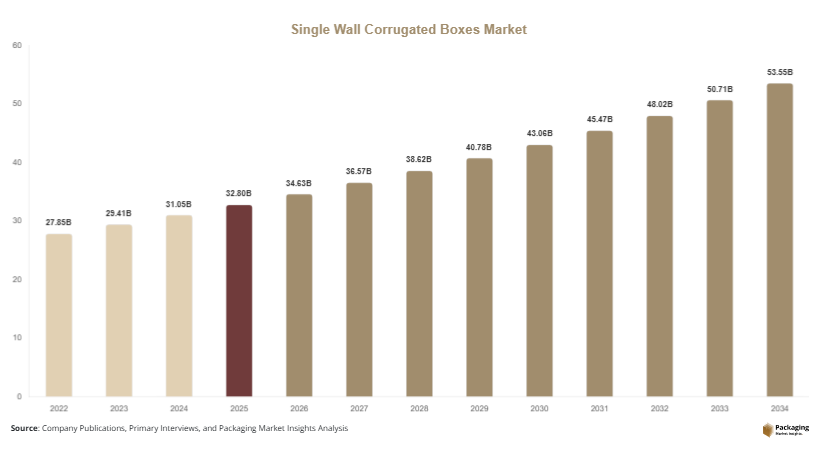
The global Single Wall Corrugated Boxes Market is projected to reach approximately USD 55.6 billion by 2034, growing from an estimated USD 32.8 billion in 2025 at a CAGR of 5.6% during the forecast period. The market’s growth is primarily driven by increasing demand for sustainable and recyclable packaging solutions, expansion of e-commerce and retail sectors, and rising consumer preference for lightweight and protective packaging. Single wall corrugated boxes offer a balance of strength, flexibility, and affordability, making them a preferred choice across industries such as food & beverage, electronics, pharmaceuticals, and logistics.
The market has witnessed a shift toward eco-friendly alternatives due to global regulatory pressure on reducing single-use plastics. Manufacturers are investing in innovative designs, material optimization, and automated production systems to enhance product efficiency while meeting sustainability standards. Additionally, the rise of direct-to-consumer (DTC) business models has further fueled demand for versatile packaging that ensures product protection during transit. As digital commerce continues to expand, single wall corrugated boxes have become integral to efficient supply chain management, providing durability and cost-effectiveness for shipping operations.
Key Highlights:
- Market size projected at USD 32.8 billion in 2025 and expected to reach USD 55.6 billion by 2034.
- CAGR of 5.6% from 2025–2034.
- Growth fueled by e-commerce expansion, demand for sustainable packaging, and lightweight protective solutions.
- Increasing adoption of recycled and eco-friendly materials.
- Rising focus on automation and digital printing technologies in packaging production.
Explore more data points, trends and opportunities Download Free Sample Report
Market Trends
Adoption of Eco-Friendly Corrugated Materials
The single wall corrugated boxes market has witnessed significant adoption of environmentally sustainable materials. Manufacturers are increasingly focusing on recycled paper, biodegradable coatings, and water-based adhesives to reduce environmental impact. This trend is driven by regulatory frameworks in regions such as North America and Europe, where strict guidelines regarding packaging waste encourage businesses to opt for recyclable and sustainable materials. The shift toward green packaging not only helps brands meet consumer expectations but also positions them competitively in the global market. Additionally, innovations in lightweight corrugated materials are minimizing resource usage while maintaining structural integrity.
Integration of Digital Printing and Customization
Customization and digital printing have emerged as key trends in the single wall corrugated boxes market. Brands are leveraging high-quality printed designs to improve visual appeal, enhance branding, and deliver targeted marketing messages directly on packaging. Digital printing also allows for short production runs with reduced lead times, enabling rapid adaptation to changing consumer preferences. This trend is particularly relevant in e-commerce and retail sectors, where personalized packaging can influence customer perception and repeat purchases. Combined with automated manufacturing systems, digital printing provides scalability, cost efficiency, and increased flexibility for producers and retailers alike.
Market Drivers
E-Commerce Expansion
The rapid growth of e-commerce globally has been a significant driver for the single wall corrugated boxes market. Online retail requires robust and lightweight packaging to ensure safe transportation of products. Single wall corrugated boxes offer the perfect combination of durability and cost-effectiveness, allowing businesses to ship products efficiently while minimizing damages. The increasing volume of direct-to-consumer shipments, particularly in electronics, clothing, and consumer goods, is further boosting market demand. Companies are increasingly investing in automation to manage high order volumes, which reinforces the adoption of standardized corrugated solutions for packaging.
Growing Demand for Sustainable Packaging
Sustainability is emerging as a key driver in the packaging industry. Consumers and businesses alike are prioritizing eco-friendly solutions, creating a substantial demand for recyclable and biodegradable packaging materials. Single wall corrugated boxes, produced from paperboard and recycled content, align with this demand, making them a preferred choice for industries such as food & beverage, pharmaceuticals, and retail. Regulatory pressures and corporate social responsibility initiatives are motivating manufacturers to adopt greener production processes. This trend not only supports environmental goals but also strengthens brand reputation, creating long-term growth opportunities in global markets.
Market Restraint
Rising Raw Material Costs and Supply Chain Challenges
The single wall corrugated boxes market faces challenges due to fluctuations in raw material prices, particularly paperboard and recycled fiber. Increases in material costs can significantly impact manufacturing expenses and profit margins, especially for small and medium-sized producers. Supply chain disruptions, including transportation bottlenecks and shortages of raw materials, further constrain market growth. For example, during periods of high global demand, manufacturers may struggle to maintain consistent quality while meeting delivery schedules. Additionally, regional regulatory differences in waste management and import/export tariffs can complicate sourcing strategies, limiting flexibility and increasing operational costs for global players.
Market Opportunities
Advanced Automation and Smart Packaging
The integration of advanced automation in packaging production presents a significant growth opportunity. Automated folding, cutting, and printing systems improve efficiency, reduce errors, and allow for high-volume production at lower operational costs. Smart packaging solutions, incorporating QR codes and RFID technology, enable enhanced tracking, inventory management, and customer engagement. These innovations create value-added services for end-users and differentiate manufacturers in a competitive landscape.
Expansion into Emerging Markets
Emerging markets in Asia Pacific, Latin America, and Africa present significant opportunities for growth. Rising industrialization, urbanization, and e-commerce adoption in these regions are increasing demand for affordable, sustainable packaging. Companies can capitalize on rising disposable incomes, growing retail sectors, and infrastructure development to establish local production facilities. Tailored solutions for regional logistics and consumer preferences enhance market penetration and long-term growth potential.
Report Scope
| Report Metric | Details |
|---|---|
| Market Size in 2025 | USD 32.8 Billion |
| Market Size in 2026 | USD 34.63 Billion |
| Market Size in 2034 | USD 55.6 Billion |
| CAGR | 5.6% (2026-2034) |
| Base Year for Estimation | 2025 |
| Historical Data | 2022-2024 |
| Forecast Period | 2026-2034 |
| Report Coverage | Revenue Forecast, Competitive Landscape, Supply Chain Disruption, Growth Factors, Environment & Regulatory Landscape and Trends |
| Geographies Covered | North America, Europe, APAC, Middle East and Africa, LATAM |
| Countries Covered | U.S., Canada, U.K., Germany, France, Spain, Italy, Russia, Nordic, Benelux, Rest of Europe, China, South Korea, Japan, India, Australia, Singapore, Taiwan, South East Asia, Rest of Asia-Pacific, UAE, Turky, Saudi Arabia, South Africa, Egypt, Nigeria, Rest of MEA, Brazil, Mexico, Argentina, Chile, Colombia, Rest of LATAM |
Explore more data points, trends and opportunities Download Free Sample Report
Segmental Analysis
Type Segment
The dominant subsegment within type is regular slotted single wall corrugated boxes, accounting for approximately 55% share in 2024. These boxes are widely used due to their versatility, ease of handling, and cost-effectiveness. Their structural design allows efficient stacking, protection during transport, and compatibility with automated packaging lines, making them suitable across industries like food, electronics, and consumer goods.
The fastest-growing subsegment is die-cut single wall corrugated boxes, projected to grow at a CAGR of 6.7%. Die-cut boxes offer customized shapes, sizes, and structural features, supporting branding, product visibility, and protection for delicate items. Growth is fueled by demand for personalized packaging in e-commerce and retail sectors, where aesthetics and differentiation play a crucial role.
Application Segment
Within applications, shipping and logistics dominate, with a 2024 share of approximately 60%. Single wall corrugated boxes provide cost-effective, lightweight, and durable solutions for transporting goods over long distances, minimizing damage and losses. Their compatibility with automated warehouse systems and protective properties make them ideal for bulk shipments and e-commerce operations.
The fastest-growing application is retail and promotional packaging, projected to achieve a CAGR of 7.2%. Businesses increasingly rely on branded, visually appealing packaging to enhance consumer experience. Corrugated boxes with digital printing, special coatings, and unique designs cater to marketing needs, stimulating adoption in premium retail and consumer goods sectors.
End-Use Segment
In end-use, food & beverage accounts for the largest share, roughly 35% in 2024. Single wall corrugated boxes are used for transporting packaged food, beverages, and perishable items due to their lightweight, protective, and recyclable properties. Adoption is further driven by regulatory compliance for hygiene and sustainability in packaging.
The fastest-growing end-use is pharmaceuticals and healthcare, with a projected CAGR of 7.5%. The increasing volume of e-pharma shipments, medical equipment, and temperature-sensitive products requires reliable, protective packaging. Corrugated boxes with tamper-evident features, cushioning inserts, and printed instructions support safe handling and regulatory compliance, driving growth in this segment.
Single Wall Corrugated Boxes Market Segmentations
Type
- Regular Slotted Boxes
- Die-Cut Boxes
- Half-Slotted Boxes
- Full Overlap Boxes
Application
- Shipping & Logistics
- Retail & Promotional Packaging
- Food & Beverage
- Industrial Packaging
End-Use
- Food & Beverage
- Pharmaceuticals & Healthcare
- Electronics & Appliances
- Personal Care & Cosmetics
Regional Analysis
North America
In 2025, North America accounts for approximately 28% of the global single wall corrugated boxes market, with a CAGR forecast of 4.9% through 2034. The region benefits from high consumer demand for e-commerce, retail, and food delivery services. Robust logistics infrastructure and stringent sustainability regulations contribute to steady growth, encouraging manufacturers to adopt recycled and eco-friendly materials in production.
The United States dominates the North American market, driven by growing online retail, innovative packaging designs, and increased awareness of environmental responsibility. Companies are investing in automated production facilities to reduce costs, improve speed, and meet evolving consumer expectations. Partnerships with e-commerce giants for optimized packaging solutions further fuel growth in the region.
Europe
Europe holds approximately 25% of the global market share in 2025, with a projected CAGR of 5.2% over the forecast period. The market growth is supported by regulatory mandates on reducing packaging waste, promoting sustainable materials, and encouraging circular economy practices. Consumer preferences for eco-conscious packaging and advanced logistics solutions also drive demand.
Germany leads the European market due to strong industrialization, high retail penetration, and widespread e-commerce adoption. Innovative packaging solutions, such as digitally printed corrugated boxes, enable companies to differentiate brands and enhance customer experience. Government incentives for sustainable packaging adoption further stimulate growth.
Asia Pacific
Asia Pacific is anticipated to hold around 30% market share in 2025, exhibiting a CAGR of 6.8% through 2034. Rapid industrialization, e-commerce expansion, and urbanization in countries like China, India, and Southeast Asia are major contributors. The increasing volume of domestic and cross-border trade fuels the demand for cost-effective packaging solutions.
China is the dominant country in this region, driven by its massive manufacturing sector, rising online retail, and focus on eco-friendly solutions. Localized production of single wall corrugated boxes reduces lead times, supports supply chain efficiency, and meets the growing consumer demand for sustainable and protective packaging.
Middle East & Africa
The Middle East & Africa region accounts for roughly 7% of global market share in 2025, with a CAGR of 5.5%. Growth is influenced by increasing industrialization, investment in logistics, and expanding retail and e-commerce sectors. Companies are adopting advanced packaging solutions to meet regional demand for reliable and cost-effective shipping solutions.
Saudi Arabia leads the regional market due to government initiatives supporting industrial diversification, retail expansion, and modern logistics infrastructure. Growing awareness of sustainable packaging and adoption of recyclable materials encourage manufacturers to innovate and invest in eco-friendly corrugated solutions.
Latin America
Latin America contributes around 10% of global market share in 2025, with a projected CAGR of 5.9% through 2034. The market growth is supported by retail expansion, e-commerce growth, and the need for protective packaging solutions in logistics. Infrastructure development in key economies supports efficient supply chains and reduces packaging costs.
Brazil dominates the market in Latin America due to its strong retail and e-commerce sectors. Rising demand for environmentally sustainable packaging, coupled with government policies promoting recycling and waste reduction, creates favorable conditions for market expansion. Local production facilities help meet demand cost-effectively.
Competitive Landscape
The Single Wall Corrugated Boxes Market is moderately consolidated, with top players focusing on innovation, capacity expansion, and sustainability initiatives. Key players include International Paper Company, WestRock Company, Smurfit Kappa Group, DS Smith Plc, and Oji Holdings Corporation. International Paper leads the market, with recent investments in eco-friendly corrugated solutions and automated manufacturing to enhance operational efficiency and meet the growing demand from e-commerce and retail sectors. Companies are emphasizing partnerships, mergers, and digital printing adoption to strengthen their competitive positions globally.
Key Players List
- International Paper Company
- WestRock Company
- Smurfit Kappa Group
- DS Smith Plc
- Oji Holdings Corporation
- Packaging Corporation of America
- Mondi Group
- Pratt Industries
- Georgia-Pacific LLC
- Huhtamaki Oyj
- Sonoco Products Company
- Cascades Inc.
- Mayr-Melnhof Karton AG
- UPM-Kymmene Corporation
- International Carton Group