Shipping Container Market Size and Growth
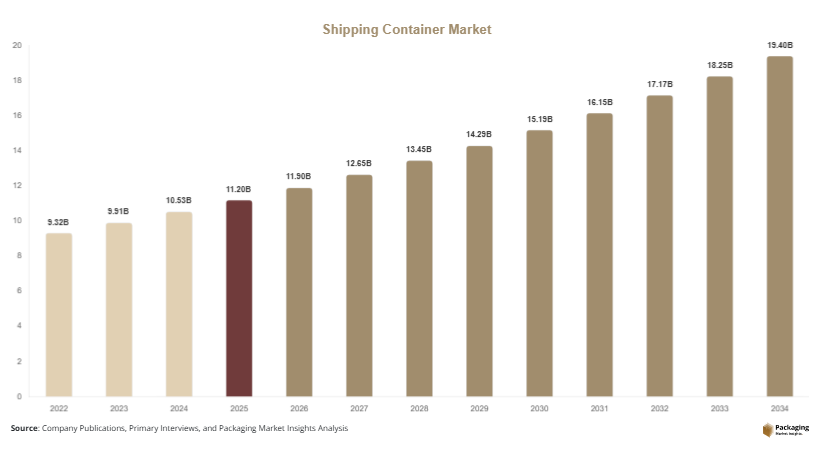
The global shipping container market size was estimated at USD 11.2 billion in 2025 and is projected to reach USD 11.9 billion in 2026. Over the forecast period from 2025 to 2034, the market is expected to grow steadily and reach USD 19.4 billion by 2034, expanding at a compound annual growth rate (CAGR) of 6.3%. Growth is primarily supported by increasing maritime trade, expansion of global manufacturing hubs, and rising demand for cost-efficient logistics solutions.
The shipping container market plays a fundamental role in global logistics, enabling the efficient transport of goods across oceans, railways, and highways. Shipping containers support standardized freight handling, reduce cargo damage, and enhance supply chain efficiency. The market has expanded alongside global trade volumes, the growth of e-commerce, and increasing investments in port infrastructure. Containers are widely used across industries including consumer goods, automotive, electronics, chemicals, and agriculture, making them an essential component of international trade.
Key Highlights
- The shipping container market is projected to reach USD 19.4 billion by 2034, growing at a CAGR of 6.3% during 2025–2034.
- Market growth is supported by the expansion of global trade, modernization of logistics infrastructure, and rising containerized cargo volumes across international supply chains.
- Increasing demand for specialized containers such as refrigerated units and the adoption of smart container tracking technologies is further contributing to market development.
Explore more data points, trends and opportunities Download Free Sample Report
Market Trends
Adoption of Smart and IoT-Enabled Containers
One of the most noticeable shipping container market trends is the adoption of smart containers equipped with sensors, GPS modules, and IoT connectivity. These containers provide real-time data on location, temperature, humidity, and cargo conditions. Logistics companies use these technologies to improve cargo visibility and reduce operational risks during long-distance shipping. Smart containers also support predictive maintenance and improve container fleet management by providing usage analytics. As supply chains become more complex and globalized, companies seek greater transparency in logistics operations. Digital tracking systems allow businesses to monitor shipments continuously and respond quickly to disruptions. The demand for smart containers is particularly strong in sectors such as pharmaceuticals, food logistics, and electronics, where product quality and shipment conditions are critical.
Rising Demand for Refrigerated Containers
Another significant trend in the shipping container market is the growing demand for refrigerated containers, also known as reefer containers. These containers are designed to transport temperature-sensitive products including fresh food, pharmaceuticals, and chemicals. Global trade in perishable goods has increased significantly due to rising consumption of fresh produce and frozen foods in international markets. As a result, logistics companies are expanding their fleets of temperature-controlled containers. Advanced reefer containers now feature automated temperature control systems, energy-efficient refrigeration units, and remote monitoring capabilities. These improvements enhance cargo safety and reduce spoilage during long transit times. The pharmaceutical industry has also increased demand for temperature-controlled logistics, particularly for vaccines and biologic medicines, which further strengthens the market outlook for refrigerated container technologies.
Market Drivers
Growth of Global Trade and Maritime Logistics
The continuous growth of international trade remains one of the most significant drivers of the shipping container market. Global trade relies heavily on maritime transportation due to its cost efficiency and ability to move large cargo volumes. Shipping containers provide standardized packaging that allows goods to be transferred easily between ships, trucks, and railways. As manufacturing activities expand across regions, the demand for efficient transport solutions increases. Emerging economies are becoming important manufacturing hubs for electronics, textiles, and automotive components. These industries depend on containerized shipping to distribute goods worldwide. Increasing cargo throughput at major ports further drives container demand. In addition, trade agreements and economic partnerships between countries encourage cross-border commerce, which strengthens long-term demand for container fleets.
Expansion of Intermodal Transportation Networks
Another major driver of the shipping container market growth is the expansion of intermodal transportation systems. Intermodal logistics combines shipping, rail, and road transport to create efficient cargo distribution networks. Containers are specifically designed to be transferred seamlessly across these transport modes without unloading cargo. This capability significantly reduces handling time and transportation costs. Governments and logistics companies are investing in rail corridors, inland container depots, and intermodal terminals to improve freight efficiency. These developments enable containers to move more quickly from ports to inland distribution centers. The integration of logistics infrastructure increases container utilization rates and supports higher freight volumes. As companies seek faster and more reliable supply chains, the demand for intermodal container transport solutions continues to increase.
Market Restraint
High Volatility in Steel Prices and Manufacturing Costs
A key restraint affecting the shipping container market is the volatility in steel prices and rising container manufacturing costs. Shipping containers are primarily made from corten steel, which provides durability and resistance to corrosion during long ocean voyages. However, fluctuations in steel prices can significantly affect container production costs and profitability for manufacturers. When raw material costs increase, container prices rise, which can discourage fleet expansion by shipping companies and logistics providers.
Supply chain disruptions can also contribute to raw material shortages and price instability. For example, changes in global steel production capacity or trade restrictions may limit the availability of container-grade steel. Manufacturers must absorb higher input costs or pass them on to customers, which reduces market competitiveness.
Another challenge arises from container oversupply cycles. When global trade slows down, container demand may decline temporarily, leading to excess inventory. This imbalance can create price pressure in the market and delay new container orders.
For instance, during periods of economic slowdown or trade disruption, shipping companies often postpone investments in new container fleets and instead rely on existing inventory. This behavior can limit short-term market expansion despite long-term trade growth trends.
Market Opportunities
Growth of Containerized Trade in Emerging Economies
Emerging economies present substantial opportunities for the shipping container market. Countries in Asia, Africa, and Latin America are expanding their manufacturing sectors and integrating more actively into global trade networks. These regions are experiencing rapid industrialization and increased export activity across industries such as electronics, textiles, agricultural products, and automotive components. As exports rise, the demand for containerized shipping increases correspondingly. Governments in emerging markets are investing in port infrastructure, logistics corridors, and container terminals to support export growth. These improvements strengthen cargo handling capacity and facilitate faster shipping operations. As international companies expand production facilities in developing regions, container demand is expected to grow steadily throughout the forecast period.
Expansion of Container Leasing Services
Another promising opportunity in the shipping container market lies in the expansion of container leasing services. Many shipping companies prefer leasing containers instead of purchasing them outright due to lower upfront investment and greater operational flexibility. Leasing companies maintain large fleets of containers and rent them to logistics operators based on demand fluctuations. This model allows shipping companies to scale their container capacity without significant capital expenditure. The leasing segment is gaining popularity among small and medium shipping operators that require flexible fleet management. In addition, leasing firms are investing in modern container designs and smart tracking technologies, which improve operational efficiency. The growing adoption of leasing solutions is expected to support consistent market growth across the global logistics industry.
Report Scope
| Report Metric | Details |
|---|---|
| Market Size in 2025 | USD 11.2 Billion |
| Market Size in 2026 | USD 11.9 Billion |
| Market Size in 2034 | USD 19.4 Billion |
| CAGR | 6.3% (2026-2034) |
| Base Year for Estimation | 2025 |
| Historical Data | 2022-2024 |
| Forecast Period | 2026-2034 |
| Report Coverage | Revenue Forecast, Competitive Landscape, Supply Chain Disruption, Growth Factors, Environment & Regulatory Landscape and Trends |
| Geographies Covered | North America, Europe, APAC, Middle East and Africa, LATAM |
| Countries Covered | U.S., Canada, U.K., Germany, France, Spain, Italy, Russia, Nordic, Benelux, Rest of Europe, China, South Korea, Japan, India, Australia, Singapore, Taiwan, South East Asia, Rest of Asia-Pacific, UAE, Turky, Saudi Arabia, South Africa, Egypt, Nigeria, Rest of MEA, Brazil, Mexico, Argentina, Chile, Colombia, Rest of LATAM |
Explore more data points, trends and opportunities Download Free Sample Report
Segmental Analysis
By Type
The dry storage container segment dominated the shipping container market in 2024, accounting for approximately 58% of total market share. Dry storage containers are widely used for transporting general cargo such as textiles, machinery, electronics, and packaged consumer goods. Their versatility and cost efficiency make them the most commonly used container type in global trade. Logistics companies prefer dry containers due to their standardized dimensions, ease of stacking, and compatibility with multiple transport modes. These containers are also relatively inexpensive to manufacture and maintain compared with specialized containers. As international trade continues to expand, demand for dry containers remains steady across major shipping routes. Their ability to accommodate a wide range of cargo types ensures consistent usage across multiple industries.
The refrigerated container segment is expected to be the fastest-growing type, expanding at a CAGR of approximately 7.4% during the forecast period. Growth is largely driven by the increasing global trade of perishable goods, including fruits, vegetables, seafood, and pharmaceutical products. Refrigerated containers are equipped with temperature control systems that maintain consistent conditions during long-distance transportation. As consumer demand for fresh food products rises worldwide, food exporters increasingly rely on reefer containers to maintain product quality. Pharmaceutical companies also require controlled environments for transporting temperature-sensitive medicines and vaccines. Technological advancements in refrigeration efficiency and remote temperature monitoring are further supporting the growth of this segment.
By Size
The 40-foot container segment held the largest share of the shipping container market in 2024, accounting for nearly 52% of the total market. These containers provide greater cargo capacity compared with smaller containers while maintaining compatibility with global transport standards. Logistics operators prefer 40-foot containers for shipping large volumes of goods in a single shipment. They are widely used for transporting industrial equipment, bulk consumer goods, and large manufacturing components. Shipping companies also benefit from improved cost efficiency per unit of cargo when using larger containers. As global freight volumes increase, the demand for high-capacity container solutions continues to grow.
The high-cube container segment is projected to be the fastest-growing size category, registering a CAGR of approximately 6.9% over the forecast period. High-cube containers offer additional vertical space compared with standard containers, allowing companies to transport taller or higher-volume cargo. Industries such as automotive, furniture, and machinery benefit significantly from this additional storage capacity. The growing demand for lightweight but bulky goods, including packaged consumer products and industrial equipment, is contributing to the expansion of high-cube container usage. Shipping companies also prefer these containers because they improve cargo density and optimize transport efficiency.
By End-Use Industry
The consumer goods industry accounted for the largest share of the shipping container market in 2024, representing nearly 36% of global demand. The rise of global retail networks and cross-border e-commerce has significantly increased container shipments of consumer products such as electronics, clothing, and household goods. Retailers rely on containerized shipping to transport goods from manufacturing hubs to distribution centers across different continents. The standardization of containers allows companies to streamline logistics operations and reduce cargo handling costs. As international trade in consumer goods continues to expand, this segment remains a key contributor to overall market growth.
The food and beverage industry is projected to be the fastest-growing end-use segment, with an estimated CAGR of 7.1% during the forecast period. Rising global demand for fresh produce, frozen foods, and processed beverages is increasing the need for refrigerated and temperature-controlled containers. International food supply chains require reliable transportation systems that maintain product quality throughout long shipping routes. Export-oriented agricultural economies are investing in cold chain logistics to improve food distribution. As food trade becomes increasingly globalized, containerized transportation solutions are expected to play a crucial role in maintaining supply chain efficiency.
Shipping Container Market Segmentations
Type
- Dry Storage Containers
- Refrigerated Containers
- Tank Containers
- Open Top Containers
- Flat Rack Containers
Size
- 20-Foot Containers
- 40-Foot Containers
- High Cube Containers
End-Use Industry
- Consumer Goods
- Automotive
- Food & Beverage
- Pharmaceuticals
- Industrial Goods
Regional Analysis
North America
North America accounted for approximately 18% of the global shipping container market share in 2025 and is expected to grow at a CAGR of around 5.4% during the forecast period. The region benefits from strong logistics infrastructure, advanced port operations, and high trade volumes with Asia and Europe. Major ports across the United States and Canada handle large volumes of containerized cargo, supporting steady demand for container fleets.
The United States dominates the regional market due to its extensive maritime trade networks and large consumer economy. One unique growth factor is the increasing modernization of port infrastructure along the West Coast and Gulf Coast. Investments in automated terminals, expanded port capacity, and improved rail connectivity are increasing container throughput and supporting market expansion.
Europe
Europe represented nearly 21% of the global shipping container market in 2025, with a projected CAGR of 5.7% through 2034. The region has a well-established shipping network connecting major ports across Northern and Southern Europe. Trade flows between Europe and Asia continue to drive demand for containerized transport, particularly for industrial goods and consumer products.
Germany plays a dominant role in the regional market due to its strong export-oriented manufacturing sector. A unique growth factor is the expansion of inland container transport via rail networks. Efficient rail freight systems allow containers to move quickly between major ports and inland distribution centers, improving logistics efficiency.
Asia Pacific
Asia Pacific held the largest shipping container market share of around 41% in 2025 and is expected to grow at a CAGR of approximately 7.2% during the forecast period. The region serves as a major manufacturing hub for global supply chains, particularly in electronics, automotive components, and consumer goods.
China dominates the regional market due to its extensive manufacturing base and leading container production capacity. A unique growth factor is the country's large-scale port infrastructure development and export-driven economy. Major Chinese ports handle millions of containers annually, making the country a central hub in global container logistics.
Middle East & Africa
The Middle East & Africa region accounted for roughly 9% of the global shipping container market in 2025 and is projected to grow at a CAGR of 6.1% over the forecast period. Strategic geographic positioning between Europe, Asia, and Africa makes the region an important transit hub for international trade routes.
The United Arab Emirates leads the regional market due to its advanced port infrastructure and role as a global logistics hub. A unique growth factor is the expansion of free trade zones and logistics parks, which attract international companies and increase container traffic through regional ports.
Latin America
Latin America captured nearly 11% of the global shipping container market share in 2025, with an anticipated CAGR of 5.8% during the forecast period. The region is experiencing increasing containerized trade due to growing exports of agricultural products, minerals, and manufactured goods.
Brazil is the dominant country in the regional market due to its strong export activity in commodities and agricultural products. A unique growth factor is the modernization of port facilities and expansion of container terminals to accommodate rising export volumes and improve cargo handling efficiency.
Competitive Landscape
The shipping container market is moderately consolidated, with several established manufacturers and leasing companies competing across global markets. Leading companies focus on expanding container production capacity, developing advanced container technologies, and strengthening partnerships with shipping lines and logistics providers. Manufacturers are also investing in research and development to improve container durability, reduce manufacturing costs, and incorporate smart tracking features.
One of the leading companies in the market is China International Marine Containers (CIMC), which holds a strong position due to its extensive production capacity and global distribution network. The company continues to invest in innovative container designs and digital monitoring solutions to enhance cargo management.
Other major companies are focusing on strategic collaborations and expansion initiatives. For example, container leasing firms are increasing their fleets to meet rising demand from shipping companies that prefer leasing models over direct container purchases. Manufacturers are also establishing new production facilities in Asia and other emerging markets to reduce logistics costs and strengthen supply chain efficiency.
Competitive strategies commonly include product innovation, geographic expansion, and partnerships with logistics operators. These initiatives allow companies to maintain market presence and capture new opportunities as global containerized trade continues to expand.
Key Players List
- China International Marine Containers (CIMC)
- Singamas Container Holdings
- CXIC Group Containers Company
- Maersk Container Industry
- Dong Fang International Container
- Sea Box Inc.
- Hoover Container Solutions
- W&K Container Inc.
- TLS Offshore Containers
- YMC Container Solutions
- Florens Container Leasing
- Triton International Limited
- Textainer Group Holdings
- CAI International Inc.
- Beacon Intermodal Leasing