Semiconductor Packaging Market Size and Growth
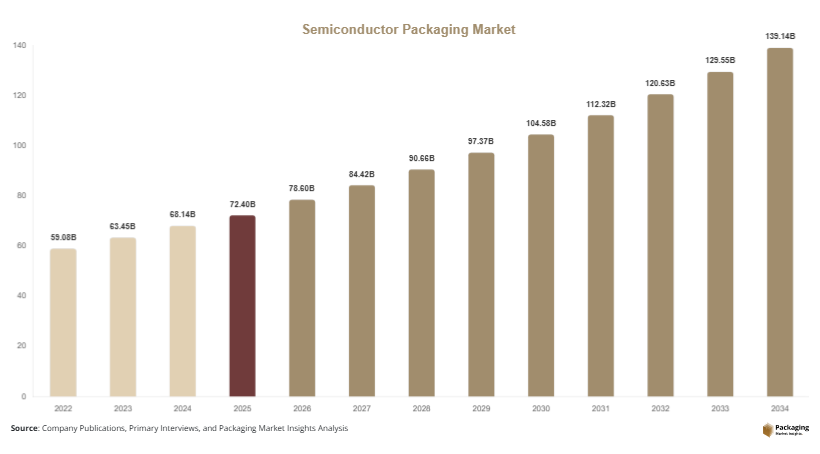
The semiconductor packaging market is witnessing sustained growth, driven by increasing demand for advanced electronics, rapid digital transformation, and the proliferation of high-performance computing devices. In 2025, the global market size is estimated at USD 72.4 billion, and it is projected to reach approximately USD 78.6 billion in 2026. By 2034, the market is expected to grow significantly to USD 148.9 billion, expanding at a compound annual growth rate (CAGR) of 7.4% from 2025 to 2034.
Semiconductor packaging plays a critical role in protecting integrated circuits while ensuring electrical connectivity and heat dissipation. As chip architectures become more complex, packaging technologies have evolved from traditional formats to advanced solutions such as system-in-package (SiP), 3D packaging, and wafer-level packaging. These innovations are enabling higher performance, smaller form factors, and improved reliability across applications.
Key Highlights:
- Market size valued at USD 72.4 billion in 2025
- Expected to reach USD 148.9 billion by 2034
- CAGR of 7.4% during 2025–2034
- Growth driven by consumer electronics and automotive applications
- Increasing adoption of advanced packaging technologies
Explore more data points, trends and opportunities Download Free Sample Report
Market Trends
Shift Toward Advanced Packaging Technologies
The semiconductor packaging market is experiencing a shift toward advanced packaging technologies such as 2.5D and 3D integration, system-in-package (SiP), and fan-out wafer-level packaging. These technologies enable higher performance and improved power efficiency by integrating multiple chips into a single package. As device miniaturization continues, traditional packaging methods are becoming less effective, prompting manufacturers to adopt more advanced solutions.
This trend is particularly evident in high-performance computing and artificial intelligence applications, where data processing speed and efficiency are critical. Advanced packaging allows for shorter interconnect distances and improved thermal management, which enhances overall system performance. As semiconductor companies invest in innovation, the adoption of advanced packaging technologies is expected to increase significantly across multiple industries.
Growing Demand for Heterogeneous Integration
Heterogeneous integration is emerging as a key trend in the market, allowing different types of chips to be combined within a single package. This approach enables the integration of logic, memory, sensors, and analog components, resulting in more efficient and compact devices. It is gaining traction in applications such as IoT devices, automotive systems, and telecommunications infrastructure.
The demand for heterogeneous integration is driven by the need for multifunctional devices that can perform complex tasks while maintaining a small footprint. This trend is also supported by advancements in interconnect technologies and materials. As industries move toward more integrated and efficient systems, heterogeneous integration is expected to play a crucial role in shaping the future of semiconductor packaging.
Market Drivers
Rising Demand for Consumer Electronics
The increasing demand for consumer electronics is a major driver of the semiconductor packaging market. Devices such as smartphones, tablets, laptops, and wearable technologies require compact and efficient semiconductor components. Packaging plays a crucial role in ensuring the performance and durability of these components.
As consumers demand more advanced features and higher performance, manufacturers are focusing on developing innovative packaging solutions. The growing popularity of 5G-enabled devices and smart home technologies is further boosting demand. Additionally, shorter product life cycles are encouraging continuous innovation in packaging technologies, contributing to market growth.
Expansion of Automotive Electronics
The expansion of automotive electronics is another key driver of the market. Modern vehicles are equipped with advanced electronic systems, including infotainment, navigation, and safety features. Electric vehicles and autonomous driving technologies are further increasing the demand for high-performance semiconductor components.
Semiconductor packaging is essential for ensuring the reliability and efficiency of these components, particularly in harsh operating conditions. The need for thermal management and durability is driving the adoption of advanced packaging solutions in the automotive sector. As the automotive industry continues to evolve, the demand for semiconductor packaging is expected to grow steadily.
Market Restraint
High Cost of Advanced Packaging Technologies
The high cost associated with advanced semiconductor packaging technologies is a significant restraint for market growth. Developing and implementing advanced packaging solutions such as 3D integration and wafer-level packaging requires substantial investment in research, equipment, and skilled labor. These costs can be a barrier for small and medium-sized companies.
Additionally, the complexity of advanced packaging processes increases production costs and requires strict quality control measures. For example, implementing 3D packaging involves multiple layers and precise alignment, which can lead to higher manufacturing expenses. These factors may limit the adoption of advanced packaging technologies, particularly in cost-sensitive markets, thereby affecting overall market growth.
Market Opportunities
Growth of Artificial Intelligence and High-Performance Computing
The rapid growth of artificial intelligence and high-performance computing presents significant opportunities for the semiconductor packaging market. These applications require advanced semiconductor solutions capable of handling large volumes of data and complex computations. Packaging technologies play a crucial role in enabling these capabilities.
As AI applications expand across industries such as healthcare, finance, and manufacturing, the demand for high-performance chips is increasing. This, in turn, is driving the need for advanced packaging solutions that can support high-speed data processing and efficient power management. Companies that invest in innovative packaging technologies are well-positioned to capitalize on this opportunity.
Increasing Adoption of Internet of Things (IoT) Devices
The growing adoption of IoT devices is creating new opportunities for semiconductor packaging. IoT applications require compact, energy-efficient, and reliable semiconductor components. Packaging solutions that support these requirements are essential for the successful deployment of IoT devices.
The expansion of smart cities, industrial automation, and connected healthcare systems is driving the demand for IoT devices. This trend is encouraging the development of new packaging technologies that can meet the specific needs of IoT applications. As the IoT ecosystem continues to grow, the demand for semiconductor packaging solutions is expected to increase significantly.
Report Scope
| Report Metric | Details |
|---|---|
| Market Size in 2025 | USD 72.4 Billion |
| Market Size in 2026 | USD 78.6 Billion |
| Market Size in 2034 | USD 148.9 Billion |
| CAGR | 7.4% (2026-2034) |
| Base Year for Estimation | 2025 |
| Historical Data | 2022-2024 |
| Forecast Period | 2026-2034 |
| Report Coverage | Revenue Forecast, Competitive Landscape, Supply Chain Disruption, Growth Factors, Environment & Regulatory Landscape and Trends |
| Geographies Covered | North America, Europe, APAC, Middle East and Africa, LATAM |
| Countries Covered | U.S., Canada, U.K., Germany, France, Spain, Italy, Russia, Nordic, Benelux, Rest of Europe, China, South Korea, Japan, India, Australia, Singapore, Taiwan, South East Asia, Rest of Asia-Pacific, UAE, Turky, Saudi Arabia, South Africa, Egypt, Nigeria, Rest of MEA, Brazil, Mexico, Argentina, Chile, Colombia, Rest of LATAM |
Explore more data points, trends and opportunities Download Free Sample Report
Segmental Analysis
By Type
The grid array packages segment dominated the market in 2024, accounting for approximately 35% of the total share. These packages are widely used in high-performance applications due to their ability to support a large number of connections and efficient heat dissipation. Their reliability and compatibility with advanced integrated circuits make them a preferred choice among manufacturers.
Fan-out wafer-level packaging is expected to be the fastest-growing subsegment, with a CAGR of 9.1%. The growth is driven by its ability to provide high performance in a compact form factor. This packaging type is increasingly used in smartphones and wearable devices. Its advantages, including improved electrical performance and reduced power consumption, are supporting its adoption.
By Application
The consumer electronics segment held the largest share in 2024, accounting for around 40% of the market. The widespread use of semiconductor components in devices such as smartphones and laptops is driving demand for packaging solutions. Continuous innovation in electronics is further supporting growth.
The automotive segment is the fastest-growing application, with a CAGR of 8.8%. The increasing adoption of electric vehicles and advanced safety systems is driving demand for semiconductor components. Packaging solutions that ensure durability and thermal efficiency are essential in this segment.
By End-Use
Integrated device manufacturers (IDMs) accounted for the largest share in 2024, representing approximately 50% of the market. These companies have in-house capabilities for semiconductor design and manufacturing, which drives demand for packaging solutions.
Outsourced semiconductor assembly and test (OSAT) providers are the fastest-growing segment, with a CAGR of 8.6%. The trend toward outsourcing is driving demand for specialized packaging services. OSAT providers offer cost-effective solutions and advanced technologies, supporting market growth.
Semiconductor Packaging Market Segmentations
Type
- Flip-Chip Packaging
- Wafer-Level Packaging
- System-in-Package (SiP)
- Wire Bond Packaging
Application
- Consumer Electronics
- Automotive
- Industrial
- Healthcare
End-Use
- Integrated Device Manufacturers (IDMs)
- Outsourced Semiconductor Assembly and Test (OSAT)
Regional Analysis
North America
North America held approximately 25% of the semiconductor packaging market share in 2025 and is expected to grow at a CAGR of 6.5% during the forecast period. The region benefits from strong technological infrastructure and significant investments in semiconductor research and development. The presence of major technology companies and advanced manufacturing facilities supports market growth.
The United States dominates the regional market, driven by its leadership in innovation and semiconductor design. A unique growth factor is the increasing investment in domestic semiconductor manufacturing to strengthen supply chain resilience. Government initiatives aimed at boosting local production are further supporting the adoption of advanced packaging technologies.
Europe
Europe accounted for around 20% of the market share in 2025 and is projected to grow at a CAGR of 6.2%. The region emphasizes high-quality manufacturing and regulatory compliance, which supports the adoption of advanced semiconductor packaging solutions. The automotive and industrial sectors play a key role in driving demand.
Germany leads the European market due to its strong automotive industry and engineering capabilities. A unique growth factor is the increasing integration of semiconductor technologies in electric vehicles. This is driving demand for reliable and thermally efficient packaging solutions in the region.
Asia Pacific
Asia Pacific is the largest market, holding approximately 40% of the global share in 2025 and growing at a CAGR of 8.5%. The region is a major hub for semiconductor manufacturing and packaging, supported by strong supply chains and cost advantages. Countries such as China, Taiwan, South Korea, and Japan are key contributors.
China dominates the regional market due to its large-scale manufacturing capabilities. A unique growth factor is government support for semiconductor self-sufficiency, which is encouraging investments in packaging technologies. The growing demand for consumer electronics and industrial automation further supports market growth.
Middle East & Africa
The Middle East & Africa region accounted for about 8% of the market share in 2025 and is expected to grow at a CAGR of 7.0%. The region is gradually developing its semiconductor industry, supported by investments in technology and infrastructure.
The United Arab Emirates is a leading country in the region, driven by its focus on digital transformation. A unique growth factor is the increasing adoption of smart technologies in urban development projects. This is creating demand for semiconductor components and packaging solutions.
Latin America
Latin America held approximately 7% of the market share in 2025 and is projected to grow at a CAGR of 6.8%. The region is experiencing steady growth due to increasing demand for consumer electronics and industrial applications. Investments in manufacturing infrastructure are supporting market expansion.
Brazil dominates the regional market due to its large industrial base. A unique growth factor is the growing adoption of automation technologies in manufacturing processes. This is driving demand for semiconductor components and packaging solutions in the region.
Competitive Landscape
The semiconductor packaging market is highly competitive, with key players focusing on innovation and capacity expansion. Companies are investing in advanced technologies to improve performance and reduce costs. Strategic partnerships and acquisitions are common in the market.
Taiwan Semiconductor Manufacturing Company (TSMC) is a leading player, known for its advanced packaging solutions. The company recently expanded its capabilities in 3D packaging to support high-performance computing applications. Other major players are also investing in research and development to enhance their product offerings and maintain a competitive edge.
Key Players List
- Taiwan Semiconductor Manufacturing Company (TSMC)
- Intel Corporation
- Samsung Electronics Co., Ltd.
- ASE Technology Holding Co., Ltd.
- Amkor Technology, Inc.
- JCET Group Co., Ltd.
- Powertech Technology Inc.
- Tongfu Microelectronics Co., Ltd.
- ChipMOS Technologies Inc.
- UTAC Holdings Ltd.
- Texas Instruments Incorporated
- Broadcom Inc.
- Qualcomm Incorporated
- Micron Technology, Inc.
- SK Hynix Inc.