Semiconductor Assembly And Packaging Equipment Market Size and Growth
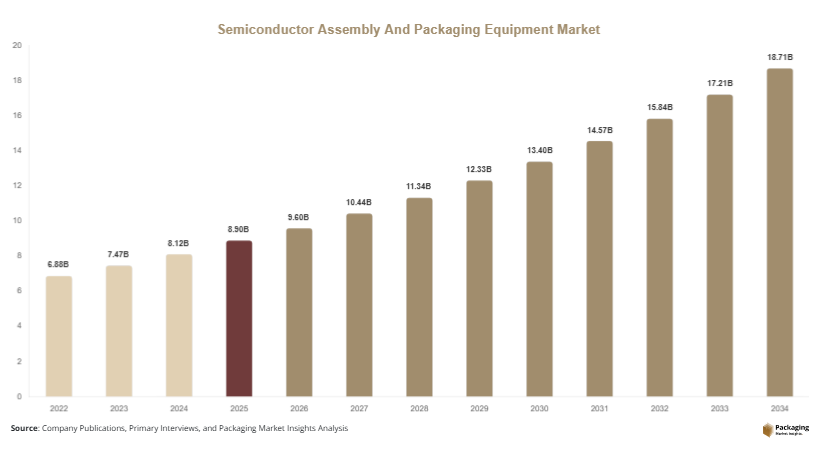
The global semiconductor assembly and packaging equipment market was valued at approximately USD 8.9 billion in 2025 and is expected to reach around USD 9.6 billion in 2026. By 2034, the market is projected to attain nearly USD 18.7 billion, registering a CAGR of 8.7% during 2025–2034. Semiconductor assembly and packaging equipment plays a critical role in chip manufacturing by enabling precise die bonding, wire bonding, encapsulation, testing, and advanced packaging integration for semiconductor devices used across consumer electronics, automotive, industrial automation, telecommunications, and healthcare sectors. The semiconductor assembly and packaging equipment market is witnessing strong expansion due to rising semiconductor production, increasing demand for advanced chip packaging technologies, and growing investments in electronics manufacturing infrastructure.
One of the major growth factors driving the market is the increasing demand for high-performance chips in artificial intelligence, cloud computing, and 5G infrastructure. Semiconductor manufacturers are investing heavily in advanced packaging equipment to support miniaturized chip architectures and improved power efficiency. Another important growth factor is the rapid expansion of electric vehicles and advanced driver assistance systems, which require sophisticated semiconductor components with reliable packaging and thermal management capabilities. Growing semiconductor content in automobiles is accelerating demand for assembly and packaging technologies globally.
Key Highlights
- Asia Pacific dominated the market with a 46.8% share in 2025.
- North America is projected to grow at the fastest CAGR of 9.1%.
- Die bonding equipment led the equipment type segment with a 31.4% share.
- Consumer electronics applications dominated with a 38.9% share.
- Automated packaging systems accounted for 42.6% share.
- The US remained the dominant country with a market size of USD 1.9 billion in 2025 and USD 2.1 billion in 2026.
Explore more data points, trends and opportunities Download Free Sample Report
Market Trends
Increasing Adoption of Advanced Packaging Technologies
Advanced packaging technologies are becoming a major trend in the semiconductor assembly and packaging equipment market. Semiconductor manufacturers are increasingly adopting fan-out wafer-level packaging, 2.5D integration, and 3D packaging solutions to improve chip performance, reduce power consumption, and support compact device designs. These technologies enable higher interconnect density and better thermal management for high-performance processors used in artificial intelligence, data centers, and mobile electronics. Equipment manufacturers are responding by developing high-precision assembly systems capable of handling ultra-thin wafers and complex package structures. Growing demand for miniaturized and multifunctional semiconductor devices continues to accelerate adoption of advanced packaging equipment globally.
Growing Integration of Automation and Artificial Intelligence
Automation and artificial intelligence are transforming semiconductor assembly and packaging operations across manufacturing facilities. Companies are increasingly implementing robotic systems, machine vision technologies, and AI-based quality inspection systems to improve production efficiency and reduce operational errors. Automated packaging equipment helps semiconductor manufacturers achieve consistent precision, lower defect rates, and higher production throughput. AI-enabled systems can also predict equipment maintenance requirements and optimize packaging workflows in real time. As semiconductor devices become more complex, manufacturers are focusing on intelligent packaging solutions that support high-volume production and improve process reliability across advanced semiconductor manufacturing environments.
Market Drivers
Rising Demand for Semiconductor Devices in Consumer Electronics
The increasing use of semiconductor devices in smartphones, laptops, wearable devices, gaming consoles, and smart home products is a key driver for the semiconductor assembly and packaging equipment market. Consumer electronics manufacturers require compact, high-performance chips with advanced packaging configurations to support faster processing and improved energy efficiency. Semiconductor companies are investing in modern assembly equipment to meet rising production volumes and evolving chip designs. Rapid growth in connected devices and internet-enabled consumer products is also increasing demand for efficient semiconductor packaging technologies. Continuous innovation in electronics manufacturing is expected to maintain strong market demand during the forecast period.
Expansion of Automotive Semiconductor Applications
The automotive industry is becoming a major growth driver for semiconductor assembly and packaging equipment. Electric vehicles, autonomous driving systems, infotainment systems, and battery management technologies require advanced semiconductor components with reliable packaging structures. Automotive semiconductors must withstand extreme operating conditions, including high temperatures and vibration exposure, increasing the importance of advanced assembly and packaging processes. Semiconductor manufacturers are investing in specialized packaging equipment designed for automotive-grade chip production. Growing investments in electric mobility and vehicle electrification are expected to significantly support market growth over the coming years.
Market Restraint
High Capital Investment and Equipment Complexity
One of the major restraints affecting the semiconductor assembly and packaging equipment market is the high capital investment required for advanced manufacturing systems. Semiconductor packaging equipment involves sophisticated robotics, precision engineering, cleanroom integration, and automated inspection technologies, resulting in substantial upfront costs for manufacturers. Small and medium-sized semiconductor companies may face financial challenges when upgrading existing production lines or adopting advanced packaging technologies.
For example, implementing wafer-level packaging systems or AI-enabled inspection equipment requires not only equipment investment but also workforce training, facility upgrades, and process optimization. Long equipment installation timelines and high maintenance expenses can further impact operational efficiency. In addition, rapidly changing semiconductor technologies may increase the risk of equipment obsolescence, forcing manufacturers to continuously invest in new systems to remain competitive. These cost-related challenges may limit adoption rates among smaller manufacturers and create barriers for new market entrants.
Market Opportunities
Growth of Artificial Intelligence and High-Performance Computing
The expansion of artificial intelligence, machine learning, and high-performance computing applications presents significant opportunities for the semiconductor assembly and packaging equipment market. AI processors and advanced computing chips require sophisticated packaging technologies capable of supporting high processing speeds, efficient thermal management, and increased interconnect density. Semiconductor manufacturers are investing in advanced packaging equipment to meet growing demand for AI accelerators, graphics processing units, and data center processors. Increasing adoption of cloud computing and edge computing infrastructure is expected to create long-term opportunities for advanced semiconductor packaging equipment providers.
Government Investments in Domestic Semiconductor Manufacturing
Government initiatives supporting domestic semiconductor manufacturing are creating new opportunities for equipment suppliers worldwide. Countries such as the United States, China, South Korea, Japan, and India are investing heavily in semiconductor fabrication and packaging facilities to strengthen supply chain resilience and reduce dependency on imports. Financial incentives, subsidies, and infrastructure development programs are encouraging semiconductor companies to expand manufacturing operations. As new semiconductor plants are established, demand for assembly and packaging equipment is expected to increase significantly. Equipment manufacturers that provide automated and energy-efficient solutions are likely to benefit from these expanding investment activities.
Report Scope
| Report Metric | Details |
|---|---|
| Market Size in 2025 | USD 8.9 Billion |
| Market Size in 2026 | USD 9.6 Billion |
| Market Size in 2034 | USD 18.7 Billion |
| CAGR | 8.7% (2026-2034) |
| Base Year for Estimation | 2025 |
| Historical Data | 2022-2024 |
| Forecast Period | 2026-2034 |
| Report Coverage | Revenue Forecast, Competitive Landscape, Supply Chain Disruption, Growth Factors, Environment & Regulatory Landscape and Trends |
| Geographies Covered | North America, Europe, APAC, Middle East and Africa, LATAM |
| Countries Covered | U.S., Canada, U.K., Germany, France, Spain, Italy, Russia, Nordic, Benelux, Rest of Europe, China, South Korea, Japan, India, Australia, Singapore, Taiwan, South East Asia, Rest of Asia-Pacific, UAE, Turky, Saudi Arabia, South Africa, Egypt, Nigeria, Rest of MEA, Brazil, Mexico, Argentina, Chile, Colombia, Rest of LATAM |
Explore more data points, trends and opportunities Download Free Sample Report
Segmental Analysis
By Equipment Type
Die bonding equipment dominated the semiconductor assembly and packaging equipment market in 2024, accounting for approximately 31.4% of total market share. Die bonding systems are essential for attaching semiconductor chips to substrates or lead frames with high precision and reliability. These systems are widely used across consumer electronics, automotive semiconductors, and industrial applications. Increasing production of compact and high-performance semiconductor devices is supporting demand for advanced die bonding technologies. Manufacturers are also integrating automation and machine vision systems into die bonding equipment to improve production speed, accuracy, and quality control across semiconductor packaging facilities.
Advanced wafer-level packaging equipment is projected to register the fastest CAGR of 9.8% during the forecast period. Wafer-level packaging technologies enable smaller package sizes, improved electrical performance, and enhanced thermal efficiency for advanced semiconductor devices. Growing demand for AI processors, mobile chipsets, and high-density integrated circuits is accelerating adoption of wafer-level packaging systems. Semiconductor manufacturers are increasingly investing in automated wafer handling and precision packaging technologies to improve manufacturing efficiency. Rising demand for miniaturized electronic products and advanced computing systems is expected to support long-term segment growth.
By Application
Consumer electronics applications held the dominant market share of 38.9% in 2024 due to strong global demand for smartphones, laptops, wearable devices, gaming systems, and smart appliances. Semiconductor assembly and packaging equipment is essential for manufacturing compact, energy-efficient chips used in modern electronic products. Continuous innovation in mobile devices and connected electronics is encouraging semiconductor manufacturers to upgrade packaging technologies and improve production efficiency. Increasing adoption of IoT devices and smart consumer products is also contributing to growing demand for semiconductor packaging equipment globally.
Automotive semiconductor applications are expected to witness the fastest growth, registering a CAGR of 10.2% during the forecast period. Electric vehicles, advanced driver assistance systems, infotainment platforms, and battery management systems require sophisticated semiconductor packaging technologies with improved reliability and thermal management. Automotive manufacturers are increasingly integrating high-performance chips into vehicles to support electrification and autonomous driving functions. Semiconductor companies are investing in specialized packaging equipment designed for automotive-grade semiconductor production. Growing investments in electric mobility and intelligent transportation systems are expected to accelerate segment expansion.
By Automation Level
Automated packaging systems accounted for approximately 42.6% of total market share in 2024 due to increasing demand for high-volume semiconductor production with minimal operational errors. Automated systems improve manufacturing precision, reduce labor dependency, and enhance throughput across semiconductor packaging facilities. Companies are increasingly integrating robotics, automated material handling, and machine vision technologies into packaging equipment to improve efficiency and quality control. Rising complexity of semiconductor devices and increasing demand for compact packaging structures continue to support widespread adoption of automated packaging systems.
AI-enabled packaging equipment is projected to grow at the fastest CAGR of 10.5% during the forecast period. Artificial intelligence technologies are being integrated into semiconductor packaging equipment for predictive maintenance, real-time defect detection, and workflow optimization. AI-driven systems improve operational efficiency by reducing downtime and enhancing packaging accuracy. Semiconductor manufacturers are adopting intelligent equipment solutions to manage increasing chip complexity and high production volumes. Growing investment in smart manufacturing technologies and Industry 4.0 initiatives is expected to accelerate adoption of AI-enabled semiconductor packaging systems globally.
Semiconductor Assembly And Packaging Equipment Market Segmentations
By Equipment Type
- Die Bonding Equipment
- Wire Bonding Equipment
- Wafer-Level Packaging Equipment
- Encapsulation Equipment
- Inspection & Testing Equipment
By Application
- Consumer Electronics
- Automotive
- Industrial Electronics
- Telecommunications
- Healthcare Electronics
By Automation Level
- Manual Systems
- Semi-Automated Systems
- Automated Packaging Systems
- AI-Enabled Packaging Equipment
Regional Analysis
North America
North America accounted for approximately 22.6% of the global semiconductor assembly and packaging equipment market share in 2025 and is projected to grow at a CAGR of 9.1% during the forecast period. The region benefits from strong semiconductor research capabilities, advanced manufacturing infrastructure, and rising investments in domestic chip production. Increasing demand for AI processors, cloud computing systems, and advanced automotive semiconductors is supporting market growth. Government funding programs for semiconductor supply chain development are also encouraging equipment investments across the region.
The United States dominates the North American market due to its strong semiconductor technology ecosystem and extensive research activities. A unique growth factor is the expansion of domestic semiconductor fabrication plants supported by federal manufacturing incentives. These investments are increasing demand for advanced assembly and packaging equipment throughout the country.
Europe
Europe held approximately 18.9% of the global market share in 2025 and is expected to grow at a CAGR of 7.8% during the forecast period. The region is witnessing increasing demand for automotive semiconductors, industrial automation chips, and energy-efficient electronics. European semiconductor manufacturers are investing in advanced packaging technologies to support electric vehicles and industrial IoT applications. The presence of established automotive and industrial manufacturing sectors contributes significantly to regional market growth.
Germany remains the dominant country within Europe due to its strong automotive electronics industry and advanced industrial manufacturing capabilities. A unique growth factor is the increasing integration of semiconductor technologies into electric mobility systems and industrial automation equipment, driving demand for high-precision packaging solutions.
Asia Pacific
Asia Pacific dominated the global market with a 46.8% share in 2025 and is forecasted to register substantial growth during the forecast period. The region serves as a major semiconductor manufacturing hub, supported by strong electronics production, favorable government policies, and extensive packaging and testing facilities. Rising demand for smartphones, consumer electronics, and telecommunications infrastructure continues to accelerate equipment investments throughout the region.
China dominates the Asia Pacific market due to its large semiconductor manufacturing base and growing investments in domestic chip production. A unique growth factor is the rapid expansion of local semiconductor packaging and testing facilities aimed at strengthening supply chain independence and supporting growing electronics exports.
Middle East & Africa
The Middle East & Africa region accounted for approximately 3.7% of the global semiconductor assembly and packaging equipment market share in 2025 and is projected to grow at a CAGR of 6.9% during the forecast period. Increasing digital transformation initiatives, expanding telecommunications infrastructure, and rising electronics demand are supporting gradual market growth. Governments in the region are also investing in technology parks and advanced manufacturing capabilities to diversify industrial sectors.
The United Arab Emirates dominates the regional market due to increasing investments in advanced technology infrastructure and electronics manufacturing initiatives. A unique growth factor is the development of smart city projects and digital infrastructure programs that are increasing demand for semiconductor technologies and related manufacturing equipment.
Latin America
Latin America represented approximately 8.0% of the global market share in 2025 and is expected to grow at a CAGR of 7.2% during the forecast period. Growth in consumer electronics manufacturing, automotive production, and telecommunications infrastructure is contributing to rising semiconductor demand across the region. Semiconductor packaging service providers are also expanding regional operations to support local electronics assembly activities.
Brazil remains the dominant market in Latin America due to its expanding electronics manufacturing industry and growing automotive production sector. A unique growth factor is the increasing localization of electronics assembly operations, which is driving demand for semiconductor packaging and testing equipment within the country.
Competitive Landscape
The semiconductor assembly and packaging equipment market is highly competitive, with leading companies focusing on technological innovation, automation integration, and strategic manufacturing expansions. Equipment manufacturers are investing in advanced packaging technologies such as wafer-level packaging, AI-enabled inspection systems, and precision robotics to strengthen market position. Partnerships with semiconductor foundries and electronics manufacturers are also increasing as companies seek to improve supply chain capabilities and expand global operations.
ASMPT Limited remains one of the leading players in the market due to its strong portfolio of semiconductor assembly solutions and advanced packaging systems. In 2024, the company introduced a next-generation AI-integrated die bonding platform designed to improve production accuracy and reduce operational downtime for advanced semiconductor packaging applications.
Other major companies operating in the market include Tokyo Electron Limited, Kulicke & Soffa Industries, BE Semiconductor Industries N.V., and Hanmi Semiconductor Co., Ltd. These companies continue investing in research and development activities to improve packaging efficiency, automation, and semiconductor manufacturing precision.
Key Players List
- ASMPT Limited
- Tokyo Electron Limited
- Kulicke & Soffa Industries
- BE Semiconductor Industries N.V.
- Hanmi Semiconductor Co., Ltd.
- Applied Materials Inc.
- Advantest Corporation
- DISCO Corporation
- Towa Corporation
- Hitachi High-Tech Corporation
- Shinkawa Ltd.
- Yamaha Motor Robotics Holdings
- Canon Machinery Inc.
- Fasford Technology Co., Ltd.
- Nordson Corporation