Self Storage Market Size and Growth
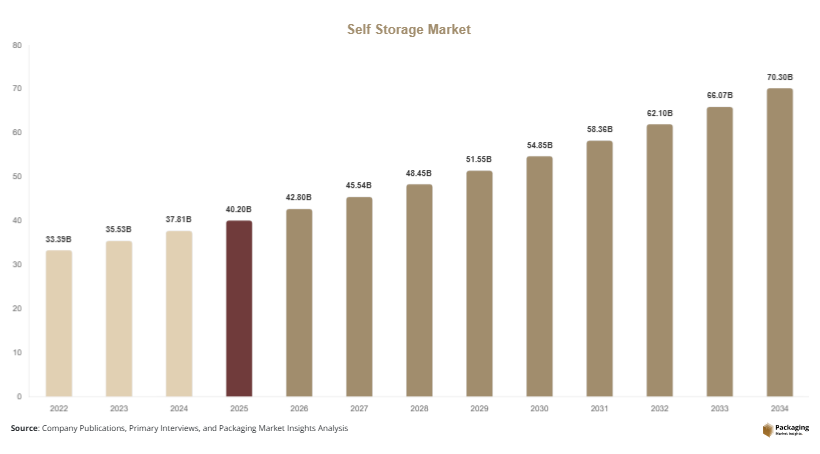
The global self storage market is projected to witness steady expansion over the forecast period 2025–2034. The market was valued at approximately USD 40.2 billion in 2025 and is expected to reach USD 70.8 billion by 2034, growing at a CAGR of 6.4% during 2025–2034. The growth of the market is primarily driven by increasing urbanization, rising residential and commercial real estate activities, and growing demand for flexible storage solutions for individuals and businesses. With urban populations surging, space constraints in residential apartments and commercial offices have made self storage solutions an essential component of modern living and operations.
Additionally, the growing popularity of e-commerce and online retail has increased the need for storage facilities to manage inventory efficiently. Small and medium enterprises (SMEs) also contribute to market growth as they prefer outsourcing storage solutions rather than investing in their own warehousing infrastructure. Technological innovations, including IoT-enabled security systems, automated lockers, and mobile apps for access management, have enhanced the convenience and security of self-storage services, further boosting market adoption.
Key Highlights:
- Increasing urbanization and residential space constraints driving demand
- Growth in e-commerce and SME inventory management solutions
- Technological innovations including IoT-enabled security and automated systems
- Flexible rental models and on-demand storage boosting adoption
- Rising awareness of organized storage among households and businesses
Explore more data points, trends and opportunities Download Free Sample Report
Market Trends
Rise of Technology-Enabled Self Storage Solutions
The self storage market is witnessing significant adoption of technology-driven solutions to enhance operational efficiency and customer convenience. Smart access systems, mobile apps, and IoT-enabled security cameras are increasingly integrated into modern self-storage facilities. These technological advancements allow users to remotely monitor and manage their storage units, offering flexibility and peace of mind. Moreover, automated check-in/check-out systems reduce the need for on-site staff, lowering operational costs for providers. Facilities with climate-controlled units and smart energy management systems are gaining traction, particularly in urban areas where consumer expectations for premium services are higher. The trend toward tech-enabled self-storage solutions is likely to continue, driven by the demand for convenience, security, and operational efficiency.
Growing Popularity of Mini and Portable Storage Units
Another prominent trend in the self storage market is the increasing demand for mini and portable storage units. Consumers, especially urban dwellers with limited residential space, are favoring smaller units that are affordable and easily accessible. Portable storage solutions that can be delivered to a location and later transported to storage facilities are becoming popular for temporary storage needs. Businesses are also adopting modular units to store seasonal inventory or equipment, providing flexibility without long-term commitments. This trend aligns with the broader shift toward on-demand and subscription-based services across multiple industries, highlighting the market’s responsiveness to convenience-focused consumer behavior.
Market Drivers
Urbanization and Space Constraints
Rapid urbanization is one of the primary drivers of the self storage market. Growing population density in cities has increased the demand for alternative storage solutions due to limited living and office space. Urban residents often face challenges in accommodating household items, seasonal belongings, or business inventory within their compact apartments or commercial offices. Self-storage facilities provide a practical and flexible solution, allowing individuals and businesses to efficiently store excess items. Urban planning initiatives also increasingly consider storage facilities as an extension of residential and commercial spaces, further supporting market growth.
Expansion of E-Commerce and SME Growth
The surge of e-commerce platforms has created a substantial demand for secure and scalable storage solutions. Retailers and SMEs prefer self-storage facilities to manage inventory efficiently, minimizing the need for large warehouses. Seasonal fluctuations in product demand require flexible storage options that can be adjusted according to business cycles. The growing trend of home-based businesses also contributes to the market, as entrepreneurs seek storage solutions for equipment, materials, and stock. The combination of e-commerce expansion and SME growth directly translates into increased utilization of self-storage units.
Market Restraint
Regulatory and Zoning Challenges
Despite strong growth, the self storage market faces regulatory and zoning challenges that may limit expansion in certain urban areas. Many municipalities impose strict land-use regulations and building codes that can delay the establishment of new facilities. In some regions, local governments prioritize residential or commercial development over storage facilities, resulting in higher permitting costs and lengthy approval processes. These restrictions can impede rapid deployment of new units in high-demand areas, affecting market accessibility.
For instance, in densely populated cities like New York and London, zoning regulations limit available land for self-storage facilities, resulting in higher property costs for developers. Moreover, compliance with safety and fire regulations increases construction and operational expenses, impacting profitability. While technological innovations and efficient space utilization mitigate some limitations, regulatory constraints remain a critical barrier that market players must navigate carefully.
Market Opportunities
Expansion in Tier-2 and Tier-3 Cities
The self storage market presents significant opportunities in tier-2 and tier-3 cities. While metro cities are saturated, smaller cities are increasingly experiencing residential and commercial growth. Rising urbanization and middle-class expansion in these regions create demand for storage solutions that were previously underutilized. Companies can capitalize on these emerging markets by offering affordable, flexible, and technologically enabled storage solutions that cater to local consumer needs.
Integration of Value-Added Services
Another growth opportunity lies in offering value-added services alongside traditional storage. Services such as inventory management, logistics support, and climate-controlled units for sensitive items can differentiate providers from competitors. Packaging, pickup, and delivery services for personal or business inventory also create additional revenue streams. By integrating these services, companies can attract both residential and commercial clients, enhancing market penetration and customer retention. The trend toward full-service self-storage solutions aligns with broader consumer expectations for convenience and operational efficiency.
Report Scope
| Report Metric | Details |
|---|---|
| Market Size in 2025 | USD 40.2 Billion |
| Market Size in 2026 | USD 42.8 Billion |
| Market Size in 2034 | USD 70.8 Billion |
| CAGR | 6.4% (2026-2034) |
| Base Year for Estimation | 2025 |
| Historical Data | 2022-2024 |
| Forecast Period | 2026-2034 |
| Report Coverage | Revenue Forecast, Competitive Landscape, Supply Chain Disruption, Growth Factors, Environment & Regulatory Landscape and Trends |
| Geographies Covered | North America, Europe, APAC, Middle East and Africa, LATAM |
| Countries Covered | U.S., Canada, U.K., Germany, France, Spain, Italy, Russia, Nordic, Benelux, Rest of Europe, China, South Korea, Japan, India, Australia, Singapore, Taiwan, South East Asia, Rest of Asia-Pacific, UAE, Turky, Saudi Arabia, South Africa, Egypt, Nigeria, Rest of MEA, Brazil, Mexico, Argentina, Chile, Colombia, Rest of LATAM |
Explore more data points, trends and opportunities Download Free Sample Report
Segmental Analysis
Type Segment
The dominant type segment in 2024 was standard self-storage units, accounting for around 65% of the market share. These units cater to general storage needs for households and businesses, offering secure and convenient space at competitive rates. Standard units are widely adopted due to versatility, ease of access, and availability across urban and suburban areas.
The fastest-growing type subsegment is climate-controlled storage, with a CAGR of 7.3%. Increasing consumer awareness about temperature-sensitive storage for items such as electronics, artwork, and documents drives adoption. Businesses and individuals in regions with extreme temperatures are increasingly opting for climate-controlled solutions, creating high growth potential.
Application Segment
The dominant application segment is residential storage, contributing approximately 60% of the market in 2024. Urban residents frequently rent storage units for household items, seasonal belongings, and personal archives. The convenience, security, and flexibility offered by residential storage make it a preferred choice for urban dwellers and expatriates.
The fastest-growing application segment is commercial storage, with a CAGR of 6.9%. SMEs, e-commerce businesses, and offices are leveraging storage units for inventory, equipment, and document management. Flexible rental terms and scalable unit sizes enable businesses to optimize costs while maintaining operational efficiency, fueling growth in this segment.
End-Use Segment
The dominant end-use segment is individual consumers, accounting for roughly 62% of the market in 2024. Individuals often utilize self-storage for household belongings, vehicles, and recreational items. Urban space limitations and lifestyle changes, including frequent relocations, contribute to consistent demand from this segment.
The fastest-growing end-use segment is small and medium enterprises, with a CAGR of 7.2%. SMEs seek cost-efficient, flexible, and secure storage solutions to manage inventory, seasonal stock, and business equipment. Self-storage providers offering digital access management and value-added logistics services are particularly appealing to this segment.
Self Storage Market Segmentations
Type
- Standard Storage Units
- Climate-Controlled Units
- Mobile/Portable Storage
Application
- Residential Storage
- Commercial Storage
- Industrial Storage
End-Use
- Individual Consumers
- Small & Medium Enterprises
- Large Enterprises
Region
- North America
- Europe
- Asia Pacific
- Middle East & Africa
- Latin America
Regional Analysis
North America
In 2025, North America accounted for approximately 45% of the global self storage market, growing at a CAGR of 5.8% during 2025–2034. High urbanization, growing household wealth, and widespread adoption of technology-driven solutions contribute to regional dominance. The United States and Canada are leading markets, with well-established storage infrastructures and a culture of renting space for personal and business needs.
The United States is the dominant country in North America, driven by rising e-commerce activity and urban population density. Innovative facility designs with climate-controlled and smart security units attract consumers seeking convenience and safety. Large-scale operators are increasingly acquiring smaller regional facilities to expand footprints, fueling market growth.
Europe
Europe contributed around 28% of the global market in 2025, with a projected CAGR of 6.2%. Growth is supported by increasing urban living constraints, rising household incomes, and awareness of organized storage solutions. Developed economies in Western Europe show a high adoption rate for premium storage facilities, including climate-controlled and automated units.
The United Kingdom leads the European market, where urban apartments and commercial offices require additional storage space. The growing e-commerce sector and increased relocation activities across cities drive the demand for self-storage units. Sustainable storage solutions with energy-efficient designs are also gaining traction, reflecting the regional focus on environmentally responsible practices.
Asia Pacific
Asia Pacific held roughly 18% of the market in 2025, projected to grow at a CAGR of 7.1% due to rapid urbanization, increasing disposable income, and expansion of commercial real estate. Countries like China, India, and Japan are witnessing heightened demand for personal and business storage services.
China dominates the region, with urban population density and limited residential space driving growth. The rise of e-commerce and small businesses seeking secure inventory management solutions has accelerated the adoption of self-storage facilities. Government incentives for commercial development in urban hubs further encourage market expansion.
Middle East & Africa
The region contributed about 5% to the global market in 2025, with a CAGR of 6.5%. Urbanization in cities such as Dubai, Abu Dhabi, and Johannesburg, combined with increasing expatriate populations, fuels demand for flexible storage solutions.
The UAE is the leading country, with high per capita income and rapid real estate development supporting self-storage adoption. High-density urban projects and commercial infrastructure growth create a requirement for secure and accessible storage solutions. Integration of climate-controlled units addresses demand for sensitive goods storage in harsh climates.
Latin America
Latin America accounted for approximately 4% of the global market in 2025, with a CAGR of 5.9%. Emerging urban centers, increasing small business activities, and growth in e-commerce contribute to market expansion.
Brazil is the dominant country, driven by urban population growth and demand from SMEs for scalable storage solutions. Flexible rental plans, modular storage facilities, and technology-enabled access systems are being increasingly adopted to attract residential and commercial clients.
Competitive Landscape
The global self storage market is competitive and moderately fragmented, with several key players focusing on strategic acquisitions, technology adoption, and service differentiation. Top players include Public Storage, Extra Space Storage, CubeSmart, U-Haul International, and Safestore Holdings Plc.
Public Storage is the market leader, with extensive operations in North America and Europe. The company recently expanded its portfolio by acquiring several regional facilities in the U.S., enhancing its market share and operational efficiency. Other players such as Extra Space Storage and CubeSmart are investing in smart access systems and climate-controlled units to meet growing consumer expectations. Strategic partnerships with e-commerce and logistics companies are emerging as a key strategy to increase adoption among SMEs and commercial clients.
Key Players List
- Public Storage
- Extra Space Storage
- CubeSmart
- U-Haul International
- Safestore Holdings Plc
- Life Storage Inc.
- StorageMart
- Big Yellow Group Plc
- National Storage Affiliates
- PODS Enterprises, Inc.
- Simply Self Storage
- 1-800-Self-Storage
- Guardian Storage
- SmartStop Self Storage
- Storage King