Self Sealing Ziplock Bags Market Size
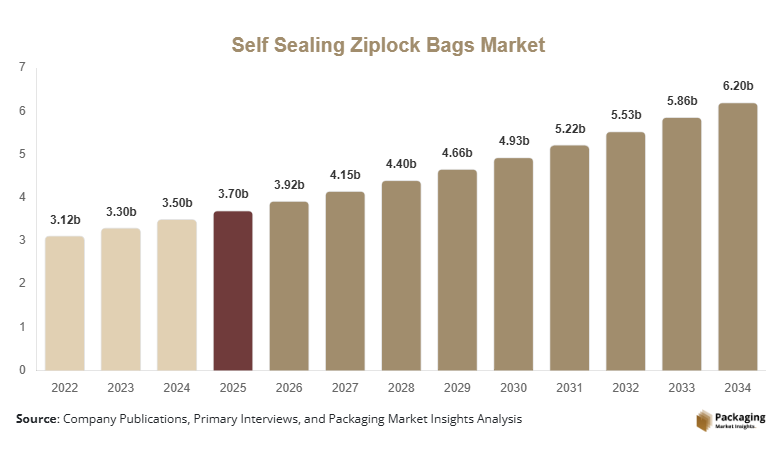
Self Sealing Ziplock Bags market size is projected at USD 3.92 billion in 2026 and is expected to hit USD 6.21 billion by 2034 with a CAGR of 5.9%. The market expansion is driven by increasing demand for convenient packaging formats, food preservation solutions, and reusable storage products across residential and commercial sectors. Detailed segmentation analysis, competitive landscape evaluation, and demand assessment provide insights into emerging opportunities across manufacturers and end-user industries.
The Self Sealing Ziplock Bags Market includes flexible packaging products equipped with airtight closure mechanisms designed for storage, protection, and preservation applications. Global production exceeded 118 billion bags in 2025, with plastic ziplock bags accounting for approximately 72% of total volume. Food packaging applications contributed nearly 56% of demand, while household storage represented 31% and industrial applications accounted for 13%. Growing adoption of recyclable and reusable materials has increased penetration by nearly 28% among environmentally conscious consumers, strengthening the Self Sealing Ziplock Bags Market.
Explore more data points, trends and opportunities Download Free Sample Report
Self Sealing Ziplock Bags Market Trends
Rising Demand for Sustainable and Reusable Storage Solutions
Manufacturers are increasingly introducing biodegradable films, recycled plastics, and compostable ziplock bag solutions to meet sustainability requirements. Production of eco-friendly self-sealing bags exceeded 24 billion units in 2025, representing nearly 20% of global output. More than 41% of packaging companies have incorporated recycled materials into flexible packaging portfolios, reducing plastic consumption by approximately 15–18%, supporting the Self Sealing Ziplock Bags Market Trend.
Technological advancements in multilayer films, improved zipper mechanisms, and leak-resistant designs are transforming product performance. Global production of premium ziplock bags surpassed 36 billion units in 2025, while demand from food storage and e-commerce packaging sectors increased by 13.7%. Nearly 52% of large retailers now offer reusable storage bag options, accelerating innovation across the Self Sealing Ziplock Bags Market.
Self Sealing Ziplock Bags Market Drivers
Increasing Demand for Convenient Food Storage Packaging
Growing urbanization and changing consumer lifestyles are increasing demand for easy-to-use food storage solutions. Global packaged food consumption exceeded USD 2.9 trillion in 2025, while flexible packaging usage increased by 7.4% annually. More than 65% of households in developed markets use resealable storage bags regularly, reducing food waste by nearly 20% and driving Self Sealing Ziplock Bags Market Growth.
Self Sealing Ziplock Bags Market Restraints
Environmental Concerns Associated with Plastic Packaging
Plastic waste concerns and regulatory restrictions on single-use plastics remain major challenges. Approximately 38% of conventional plastic packaging waste requires improved recycling systems, while raw material prices increased by nearly 12% during 2025. Compliance requirements related to sustainable packaging have increased production costs by 8–14%, affecting manufacturers across the Self Sealing Ziplock Bags Market.
Self Sealing Ziplock Bags Market Opportunities
Expansion of Biodegradable and Smart Packaging Solutions
Increasing investments in sustainable packaging technologies create significant opportunities. Production of biodegradable ziplock bags increased by 22% in 2025, exceeding 24 billion units globally. Demand from premium food brands, healthcare storage, and e-commerce packaging sectors is encouraging manufacturers to develop advanced materials with improved durability and environmental performance, creating new opportunities in the Self Sealing Ziplock Bags Market.
Challenges in Self Sealing Ziplock Bags Market
Competition from Alternative Storage Packaging Formats
The availability of reusable containers, vacuum packaging systems, and paper-based alternatives creates competitive pressure. Nearly 34% of consumers are exploring alternative storage solutions due to sustainability concerns. Manufacturers face challenges balancing product affordability, durability, and environmental compliance while maintaining market competitiveness in the Self Sealing Ziplock Bags Market.
Report Scope
| Report Metric | Details |
|---|---|
| Market Size in 2025 | USD 3.70 billion |
| Market Size in 2026 | USD 3.92 billion |
| Market Size in 2034 | USD 6.21 billion |
| CAGR | 5.9% (2026-2034) |
| Base Year for Estimation | 2025 |
| Historical Data | 2022-2024 |
| Forecast Period | 2026-2034 |
| Report Coverage | Revenue Forecast, Competitive Landscape, Supply Chain Disruption, Growth Factors, Environment & Regulatory Landscape and Trends |
| Geographies Covered | North America, Europe, APAC, Middle East and Africa, LATAM |
| Countries Covered | U.S., Canada, U.K., Germany, France, Spain, Italy, Russia, Nordic, Benelux, Rest of Europe, China, South Korea, Japan, India, Australia, Singapore, Taiwan, South East Asia, Rest of Asia-Pacific, UAE, Turky, Saudi Arabia, South Africa, Egypt, Nigeria, Rest of MEA, Brazil, Mexico, Argentina, Chile, Colombia, Rest of LATAM |
Explore more data points, trends and opportunities Download Free Sample Report
Self Sealing Ziplock Bags Market Segmentation
The market is segmented based on type and application to address different consumer and industrial storage requirements. Plastic ziplock bags dominate with approximately 72% market share due to affordability and availability, while food packaging remains the leading application segment with nearly 56% of total demand.
By Type
Plastic Ziplock Bags
Plastic ziplock bags account for approximately 72% of market volume. Global production exceeded 85 billion units in 2025, supported by low manufacturing costs, flexibility, and moisture resistance. These bags typically use polyethylene materials with thickness ranges between 30 and 150 microns, making them suitable for food storage, household organization, and retail packaging.
Biodegradable Ziplock Bags
Biodegradable ziplock bags represent nearly 15% of market demand. Production exceeded 18 billion units in 2025 due to increasing sustainability initiatives. These bags use PLA, starch-based polymers, and recycled materials while maintaining sealing strength and barrier properties required for food and consumer goods applications.
Heavy-Duty Ziplock Bags
Heavy-duty ziplock bags contribute approximately 13% of market share. Annual production surpassed 15 billion units in 2025. These products feature reinforced films, thicker structures above 150 microns, and enhanced durability for industrial storage, transportation, and specialized packaging applications.
By Application
Food Packaging
Food packaging dominates with approximately 56% market share. More than 66 billion bags were consumed globally in 2025 for snacks, frozen foods, fresh produce, and meal storage. Adoption exceeds 70% among modern grocery retailers due to improved freshness preservation and contamination protection.
Household Storage
Household storage represents nearly 31% of demand. Approximately 37 billion units were used in 2025 for organization, travel storage, and kitchen applications. Consumer penetration exceeds 62% in developed markets due to convenience, affordability, and reusable features.
Industrial Packaging
Industrial packaging contributes around 13% of total consumption. More than 15 billion units supported applications including component storage, electronics protection, and logistics packaging. Industrial users increasingly prefer heavy-duty ziplock bags due to durability and moisture protection capabilities.
Self Sealing Ziplock Bags Market Segmentations
Type
- Plastic Ziplock Bags
- Biodegradable Ziplock Bags
- Heavy-Duty Ziplock Bags
Application
- Food Packaging
- Household Storage
- Industrial Packaging
Self Sealing Ziplock Bags Regional Outlook
North America
North America holds approximately 34% of global market share. The United States contributes nearly 83% of regional demand due to high household adoption and advanced food packaging industries. Regional consumption exceeded 40 billion bags in 2025, with food storage accounting for nearly 61% of usage.
Europe
Europe represents approximately 27% of market revenue. Germany, France, the United Kingdom, and Italy collectively contribute over 75% of regional consumption. Sustainable bag adoption exceeds 45%, supported by strict environmental regulations and increasing demand for recyclable packaging solutions.
Asia-Pacific
Asia-Pacific accounts for nearly 31% of global demand. China, India, Japan, and Southeast Asian countries produced more than 38 billion units in 2025. Food processing, retail expansion, and e-commerce growth contributed nearly 64% of regional consumption.
Middle East & Africa
The Middle East & Africa contribute approximately 8% of global demand. Regional production exceeded 9 billion units in 2025, supported by food packaging growth, retail expansion, and increasing consumer preference for convenient storage solutions.
Top players in Self Sealing Ziplock Bags Market
- SC Johnson & Son Inc.
- Amcor plc
- Berry Global Inc.
- Sealed Air Corporation
- Interplast Group
- The Dow Chemical Company
- Coveris Group
- Inteplast Group
- Glad Products Company
- Reynolds Consumer Products Inc.
SC Johnson & Son Inc.
-
Estimated market share: 12–15%
-
SC Johnson maintains a strong position through its globally recognized storage bag brands and extensive consumer distribution network.
-
The company focuses on resealable packaging innovation, sustainable material development, and improved product convenience.
-
Its strong presence in household storage and food preservation segments enables significant market penetration across North America and international markets.
Amcor plc
-
Estimated market share: 10–12%
-
Amcor is a leading flexible packaging manufacturer offering advanced film and closure technologies.
-
The company focuses on recyclable materials, lightweight packaging solutions, and sustainable product development.
-
Strong investments in research and manufacturing capabilities support its position across food packaging, industrial storage, and consumer goods applications globally.