Self Adhesive Labels Market Size and Growth
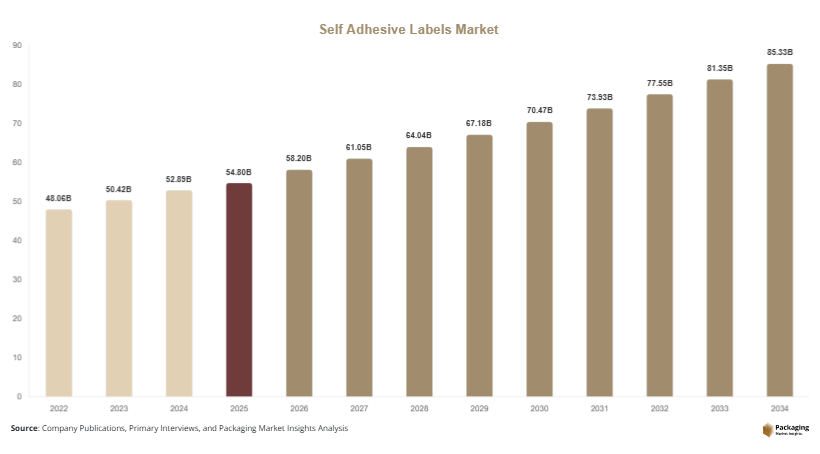
The global Self Adhesive Labels Market size was valued at USD 54.8 billion in 2025 and is expected to reach USD 58.2 billion in 2026. Over the forecast period, the market is projected to grow to USD 86.5 billion by 2034, registering a CAGR of 4.9% from 2025 to 2034.
Self-adhesive labels, also known as pressure-sensitive labels, consist of a face material, adhesive, and backing liner. These labels are widely used for product identification, branding, barcoding, and compliance labeling. Their ease of application, cost efficiency, and versatility make them a preferred choice across industries. The market continues to evolve with advancements in materials, adhesives, and printing technologies.
Key Highlights:
- Market size reached USD 54.8 billion in 2025, supported by rising demand from packaging, retail, and logistics sectors. The market continues to expand with increasing need for efficient labeling solutions.
- Expected to grow at a CAGR of 4.9% (2025–2034), driven by advancements in digital printing and growing adoption of smart labeling technologies. Demand is also supported by regulatory requirements across industries.
- Forecast value projected at USD 86.5 billion by 2034, reflecting steady growth across developed and emerging markets. Expansion of e-commerce and packaged goods industries will continue to drive demand.
- Packaging applications account for over 42% of total demand, as labels play a critical role in product identification and branding. Growth in FMCG and e-commerce sectors is a key contributing factor.
- Paper-based labels hold nearly 55% of market share, due to their cost-effectiveness and wide applicability. Their recyclability and compatibility with various printing technologies further support their dominance.
Explore more data points, trends and opportunities Download Free Sample Report
Market Trends
Rising Adoption of Smart and Interactive Labels
The self adhesive labels market is witnessing growing adoption of smart and interactive labeling solutions. Technologies such as QR codes, NFC tags, and RFID are being integrated into labels to enhance product traceability and consumer engagement. These smart labels allow brands to provide additional information, including product origin, usage instructions, and promotional content. The adoption of smart labels has increased by nearly 18% over the past few years, particularly in retail and pharmaceutical sectors. Businesses are leveraging these technologies to improve supply chain visibility and strengthen customer interaction, making this trend a key driver of innovation in the market.
Shift Toward Sustainable and Linerless Labels
Sustainability is becoming a significant trend in the self adhesive labels market, with companies focusing on reducing environmental impact. The adoption of linerless labels and recyclable materials is increasing as businesses aim to minimize waste and comply with environmental regulations. Linerless labels eliminate the need for backing liners, reducing material usage and waste generation. Additionally, manufacturers are developing adhesives and face materials that are biodegradable or recyclable. Over 50% of label manufacturers have implemented sustainability initiatives, reflecting the growing importance of eco-friendly solutions in the market.
Market Drivers
Growth of E-Commerce and Logistics Industry
The rapid growth of the e-commerce sector is a major driver for the self adhesive labels market. With billions of packages shipped annually, the demand for labeling solutions that support tracking, identification, and branding is increasing. Self-adhesive labels are widely used for shipping labels, barcodes, and product identification. The rise of same-day and next-day delivery services is further increasing the need for efficient labeling solutions. Additionally, logistics companies are adopting advanced labeling technologies to improve operational efficiency and reduce errors. This growing demand from the e-commerce and logistics sectors is expected to drive market growth over the forecast period.
Increasing Demand from Food and Beverage Industry
The food and beverage industry is a significant contributor to the self adhesive labels market. Labels are essential for providing product information, including ingredients, nutritional values, and expiration dates. The increasing demand for packaged and processed foods is driving the need for high-quality labeling solutions. Additionally, stringent regulations related to food safety and labeling are encouraging manufacturers to adopt reliable and compliant labeling systems. Self-adhesive labels offer durability, resistance to moisture, and compatibility with various packaging materials, making them ideal for food and beverage applications.
Market Restraint
Volatility in Raw Material Prices
One of the key restraints in the self adhesive labels market is the volatility in raw material prices, particularly for adhesives, paper, and plastic films. Fluctuations in the prices of petroleum-based materials and pulp can significantly impact production costs. For example, a sudden increase in resin prices can raise the cost of film-based labels, affecting profit margins for manufacturers. Small and medium-sized enterprises are particularly vulnerable to these fluctuations, as they may lack the financial resources to absorb cost increases. Additionally, price volatility can lead to supply chain disruptions and affect pricing strategies. This challenge may hinder market growth, especially in price-sensitive regions where cost competitiveness is critical.
Market Opportunities
Expansion of Pharmaceutical and Healthcare Applications
The pharmaceutical and healthcare sectors present significant growth opportunities for the self adhesive labels market. The increasing demand for accurate and compliant labeling solutions is driving adoption in these industries. Labels are used for product identification, dosage instructions, and regulatory compliance. The rise of personalized medicine and increasing pharmaceutical production are further boosting demand. Additionally, the adoption of tamper-evident and security labels is increasing to prevent counterfeit products. These factors are expected to create substantial growth opportunities for market players.
Growth of Digital Printing in Label Production
The adoption of digital printing technologies in label production is creating new opportunities for the market. Digital printing allows for short-run production, customization, and faster turnaround times. This is particularly beneficial for industries that require frequent design changes and personalized labeling solutions. The digital label printing segment is expected to grow at a CAGR of over 6% during the forecast period. The ability to produce high-quality labels with minimal setup costs is encouraging businesses to adopt digital printing solutions, driving market growth.
Report Scope
| Report Metric | Details |
|---|---|
| Market Size in 2025 | USD 54.8 Billion |
| Market Size in 2026 | USD 58.2 Billion |
| Market Size in 2034 | USD 86.5 Billion |
| CAGR | 4.9% (2026-2034) |
| Base Year for Estimation | 2025 |
| Historical Data | 2022-2024 |
| Forecast Period | 2026-2034 |
| Report Coverage | Revenue Forecast, Competitive Landscape, Supply Chain Disruption, Growth Factors, Environment & Regulatory Landscape and Trends |
| Geographies Covered | North America, Europe, APAC, Middle East and Africa, LATAM |
| Countries Covered | U.S., Canada, U.K., Germany, France, Spain, Italy, Russia, Nordic, Benelux, Rest of Europe, China, South Korea, Japan, India, Australia, Singapore, Taiwan, South East Asia, Rest of Asia-Pacific, UAE, Turky, Saudi Arabia, South Africa, Egypt, Nigeria, Rest of MEA, Brazil, Mexico, Argentina, Chile, Colombia, Rest of LATAM |
Explore more data points, trends and opportunities Download Free Sample Report
Segmental Analysis
By Type
The release liner labels segment dominated the self adhesive labels market, accounting for approximately 62% of the market share in 2024. These labels are widely used due to their ease of application and compatibility with automated labeling systems. Release liner labels provide consistent adhesive performance and are suitable for various applications, including packaging and logistics. Their widespread adoption across industries supports their dominance in the market.
Linerless labels are the fastest-growing segment, with a projected CAGR of 6.5% during the forecast period. The growth of this segment is driven by increasing demand for sustainable labeling solutions. Linerless labels reduce waste and improve efficiency by eliminating the need for backing liners. Their compatibility with high-speed labeling systems further supports market growth.
By Composition
Paper-based labels held the largest share of the market, accounting for around 55% in 2024. Paper labels are widely used due to their cost-effectiveness and versatility. They are suitable for various applications, including food packaging and retail labeling. The availability of recyclable paper materials further supports their adoption.
Film-based labels are expected to grow at the fastest CAGR of 5.7% during the forecast period. The growth of this segment is driven by the need for durable and high-performance labeling solutions. Film labels offer resistance to moisture, chemicals, and temperature variations, making them suitable for demanding applications.
By Application
The packaging segment dominated the market, accounting for approximately 42% of the market share in 2024. Labels play a crucial role in product identification, branding, and compliance. The growth of the packaging industry is driving demand for labeling solutions.
The healthcare segment is expected to grow at the fastest CAGR of 5.9% during the forecast period. The increasing demand for accurate and compliant labeling solutions is driving growth in this segment. Strict regulatory requirements and the need for product traceability are contributing to market expansion.
Self Adhesive Labels Market Segmentations
By Type
- Release Liner Labels
- Linerless Labels
By Composition
- Paper
- Film
By Application
- Packaging
- Healthcare
- Retail
- Logistics
- Others
Regional Analysis
North America
North America accounted for approximately 27% of the self adhesive labels market share in 2025, with a projected CAGR of 4.2% through 2034. The region benefits from advanced packaging technologies and strong demand from the food, pharmaceutical, and logistics sectors. The presence of established market players and high adoption of digital printing technologies contribute to steady market growth.
The United States dominates the North American market due to its large consumer base and strong industrial infrastructure. A unique growth factor is the increasing use of smart labeling technologies, such as RFID and QR codes, to enhance supply chain efficiency. This trend is expected to drive continued demand for self-adhesive labels.
Europe
Europe held around 25% market share in 2025 and is expected to grow at a CAGR of 4.0% during the forecast period. The region’s market is driven by strict regulatory standards and strong demand for sustainable labeling solutions. Industries are increasingly adopting eco-friendly labels to comply with environmental regulations.
Germany is the leading country in the European market, supported by its strong manufacturing and packaging industries. A unique growth factor is the region’s focus on sustainable packaging initiatives, which promote the use of recyclable and biodegradable materials. This approach is driving innovation in labeling solutions.
Asia Pacific
Asia Pacific dominated the market with a 34% share in 2025 and is projected to grow at the highest CAGR of 5.8% through 2034. Rapid industrialization, urbanization, and the expansion of e-commerce are key factors driving market growth. The region is also witnessing increased investments in packaging and labeling technologies.
China leads the Asia Pacific market due to its large manufacturing base and growing consumer market. A unique growth factor is the rapid expansion of e-commerce platforms, which is increasing demand for labeling solutions. This trend is expected to drive sustained market growth.
Middle East & Africa
The Middle East & Africa region accounted for approximately 7% of the market share in 2025, with a CAGR of 4.5% during the forecast period. The market is driven by growing demand for packaged goods and increasing industrial activities.
The United Arab Emirates is a key market in this region, benefiting from its strategic location and strong logistics infrastructure. A unique growth factor is the increasing demand for premium packaging solutions in the retail and luxury goods sectors, supporting market expansion.
Latin America
Latin America held about 7% market share in 2025 and is expected to grow at a CAGR of 4.6% through 2034. The region’s market is supported by the growth of the retail and food industries.
Brazil dominates the Latin American market due to its large population and expanding consumer base. A unique growth factor is the rise of organized retail and packaged food consumption, which is increasing demand for labeling solutions.
Competitive Landscape
The self adhesive labels market is moderately fragmented, with several global and regional players competing based on product quality, innovation, and pricing strategies. Companies are focusing on developing advanced labeling solutions and expanding their product portfolios to meet evolving customer demands.
Avery Dennison Corporation is a leading player in the market, known for its innovative labeling solutions and strong global presence. The company recently introduced sustainable label materials designed to reduce environmental impact. Other major players are also investing in digital printing technologies and smart labeling solutions to strengthen their market position.
Key Players List
- Avery Dennison Corporation
- CCL Industries Inc.
- UPM Raflatac
- 3M Company
- Multi-Color Corporation
- Constantia Flexibles Group
- Fuji Seal International Inc.
- LINTEC Corporation
- Coveris Holdings S.A.
- Huhtamaki Oyj
- Mondi Group
- Sato Holdings Corporation
- Brady Corporation
- Weber Packaging Solutions
- Resource Label Group