Screw-Top Jar Market Size
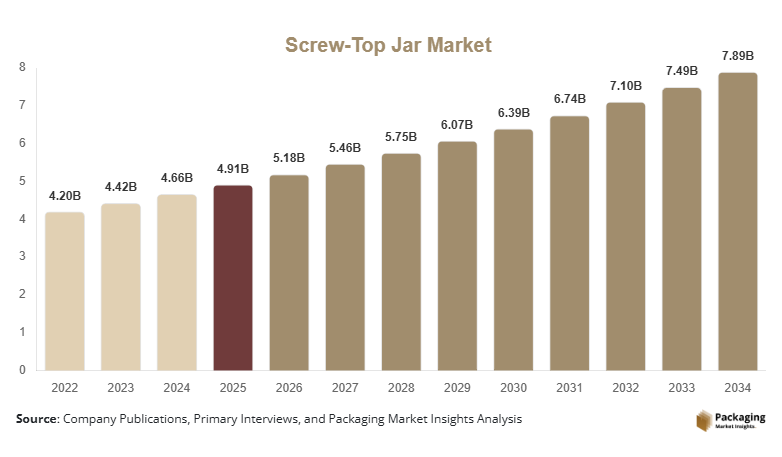
The screw-top jar market size is projected at USD 5.18 billion in 2026 and is expected to hit USD 7.91 billion by 2034 with a CAGR of 5.4%. The report analyzes historical trends from 2022–2024, considers 2025 as the base year, and evaluates market performance across material types, end-use industries, regional demand, production capacity, pricing trends, and the competitive landscape to support strategic decision-making.
Screw-top jars are reusable rigid packaging containers equipped with threaded closures designed to provide airtight sealing for food products, cosmetics, pharmaceuticals, and household goods. Global production exceeded 68 billion jars in 2025, while packaged food applications accounted for nearly 61% of total consumption. Glass jars contributed approximately 49% of worldwide shipments, plastic jars represented 39%, and metal jars accounted for 12%, reinforcing long-term market expansion.
Explore more data points, trends and opportunities Download Free Sample Report
Screw Top Jar Trends
Increasing Demand for Sustainable and Premium Packaging
Manufacturers are increasingly adopting recyclable glass, post-consumer recycled plastics, and lightweight packaging technologies to improve sustainability. Production of eco-friendly screw-top jars exceeded 27 billion units during 2025, reflecting annual growth of 10.5%. Lightweight glass manufacturing reduced material usage by approximately 14%, while recycled-content packaging adoption surpassed 42%, strengthening industry competitiveness.
The growing popularity of premium food, cosmetics, and nutraceutical products continues driving demand for high-quality screw-top jars featuring improved sealing systems and customized decoration. Digital printing adoption exceeded 55% among organized packaging manufacturers, while automated inspection systems improved manufacturing efficiency by nearly 17%. Premium packaging requirements continue supporting screw-top jar market development.
Screw-Top Jar Drivers
Growing Consumption of Packaged Food and Personal Care Products
The expansion of packaged food, ready-to-eat meals, cosmetics, and healthcare products continues to stimulate demand for screw-top jars worldwide. Global packaged food production exceeded 980 million metric tons during 2025, while personal care product sales increased by approximately 8% year-over-year. Manufacturers produced more than 71 billion screw-top jars, supported by rising urbanization and changing consumer lifestyles, driving screw-top jar market performance.
Screw-Top Jar Restraints
Fluctuating Raw Material and Energy Costs
Volatility in glass, polymer resin, and metal prices continues to affect packaging manufacturing costs. Glass manufacturing energy expenses increased by approximately 11%, while plastic resin prices fluctuated by more than 13% during recent years. Rising logistics and transportation costs further increased overall production expenditure by nearly 7–9%, limiting profit margins for manufacturers.
Screw-Top Jar Opportunities
Expansion of Recyclable and Reusable Packaging
Growing consumer preference for reusable packaging creates attractive opportunities for manufacturers developing durable screw-top jars. Global investments in sustainable rigid packaging exceeded USD 640 million during 2025, while reusable packaging demand increased by approximately 12% annually. Advanced barrier coatings, decorative finishes, and smart labeling technologies continue expanding commercial opportunities across premium packaging applications.
Challenges in the Screw-Top Jar Market
Balancing Lightweight Design with Product Protection
Manufacturers face challenges in reducing packaging weight while maintaining durability, sealing performance, and shelf-life protection. Lightweight glass containers reduce material consumption by nearly 12% but require improved strengthening technologies to prevent breakage. Maintaining production speeds exceeding 700 jars per minute while ensuring consistent quality remains a significant challenge for Screw Top Jar market participants.
Report Scope
| Report Metric | Details |
|---|---|
| Market Size in 2025 | USD 4.91 Billion |
| Market Size in 2026 | USD 5.18 Billion |
| Market Size in 2034 | USD 7.91 Billion |
| CAGR | 5.4% (2026-2034) |
| Base Year for Estimation | 2025 |
| Historical Data | 2022-2024 |
| Forecast Period | 2026-2034 |
| Report Coverage | Revenue Forecast, Competitive Landscape, Supply Chain Disruption, Growth Factors, Environment & Regulatory Landscape and Trends |
| Geographies Covered | North America, Europe, APAC, Middle East and Africa, LATAM |
| Countries Covered | U.S., Canada, U.K., Germany, France, Spain, Italy, Russia, Nordic, Benelux, Rest of Europe, China, South Korea, Japan, India, Australia, Singapore, Taiwan, South East Asia, Rest of Asia-Pacific, UAE, Turkey, Saudi Arabia, South Africa, Egypt, Nigeria, Rest of MEA, Brazil, Mexico, Argentina, Chile, Colombia, Rest of LATAM |
Explore more data points, trends and opportunities Download Free Sample Report
Screw Top Jar Market Segmentation
The market is segmented by material and end use to evaluate consumption patterns across packaging applications. Glass jars account for approximately 49% of worldwide demand, followed by plastic at 39% and metal at 12%. Food & beverage remains the largest end-use segment, contributing nearly 61% of global consumption.
By Material
Glass screw-top jars dominate the market due to excellent barrier properties, recyclability, and premium product appearance. Production exceeded 33 billion units during 2025, while lightweight manufacturing technologies improved production efficiency by approximately 15%. These jars are extensively used for sauces, jams, beverages, baby food, and specialty foods.
Plastic screw-top jars remain widely adopted because of their lightweight construction, cost-effectiveness, and design flexibility. Annual production surpassed 27 billion units, while recycled polymer utilization exceeded 30%. Major applications include confectionery, nutritional supplements, household products, and cosmetics.
Metal screw-top jars represent a specialized packaging segment for premium food products, industrial applications, and specialty chemicals. Production exceeded 8 billion units, supported by improved corrosion-resistant coatings and enhanced sealing technologies.
By End Use
Food & beverage accounts for approximately 61% of global demand, consuming more than 41 billion jars annually. Packaged sauces, honey, pickles, dairy products, spreads, beverages, and processed foods continue driving demand, with packaging automation penetration exceeding 74% among large manufacturers.
Personal care & cosmetics contribute nearly 23% of total market consumption. Production exceeded 16 billion jars, supported by skincare creams, lotions, hair care products, and premium cosmetic packaging requiring airtight sealing and attractive presentation.
Pharmaceutical applications account for approximately 16% of market demand. Manufacturers produced over 11 billion pharmaceutical jars during 2025, driven by vitamins, dietary supplements, ointments, powders, and healthcare packaging requiring contamination-resistant storage.
Screw-Top Jar Market Segmentations
Material
- Glass
- Plastic
- Metal
End Use
- Food & Beverage
- Personal Care & Cosmetics
- Pharmaceuticals
Screw-Top Jar Regional Outlook
North America
North America accounts for approximately 26% of global revenue, supported by strong packaged food production and premium personal care markets. The United States contributes nearly 83% of regional demand, while Canada continues expanding sustainable rigid packaging manufacturing.
Europe
Europe represents approximately 29% of global consumption. Germany, France, Italy, and the United Kingdom collectively contribute more than 71% of regional production, driven by premium food exports, pharmaceutical manufacturing, and stringent recycling regulations.
Asia-Pacific
Asia-Pacific leads the global market with approximately 35% market share. China, India, Japan, and South Korea account for more than 68% of regional production capacity. Rising disposable income, expanding packaged food industries, and increasing cosmetic product demand continue supporting regional growth.
Latin America
Latin America contributes approximately 6% of worldwide demand, led by Brazil and Mexico. Growth is supported by expanding food processing industries and increasing consumer packaged goods production.
Middle East & Africa
The Middle East & Africa account for nearly 4% of global consumption. Saudi Arabia, the UAE, South Africa, and Egypt remain key contributors, supported by investments in food processing, pharmaceuticals, and consumer goods manufacturing.
Top Players in the Screw-Top Jar Market
- O-I Glass, Inc.
- Berlin Packaging
- Ardagh Glass Packaging
- Gerresheimer AG,
- Berry Global Inc.
- Amcor plc,
- Silgan Holdings Inc.
- Verallia SA
- Vetropack Holding Ltd.
- Stoelzle Glass Group
- Plastipak Holdings, Inc.
- Alpha Packaging
O-I Glass, Inc. Estimated global market presence of approximately 12–14%. Leading producer of glass packaging serving food, beverage, pharmaceutical, and consumer goods industries. Operates an extensive global manufacturing network across North America, Europe, Asia-Pacific, and Latin America, ensuring consistent product availability. Continuous investments in lightweight glass technology, recycled glass utilization, and sustainable manufacturing strengthen its competitive position while supporting premium packaging applications worldwide. Berlin Packaging's estimated market presence is approximately 8–10%. Recognized as a major supplier of rigid packaging solutions, including screw-top jars for food, cosmetics, healthcare, and household products. Broad global distribution capabilities enable efficient customer service across multiple industries and regions. Ongoing investments in customized packaging design, sustainable materials, and digital supply chain management reinforce its leadership within the global screw-top jar industry.