Sanitizer Packaging Market Size
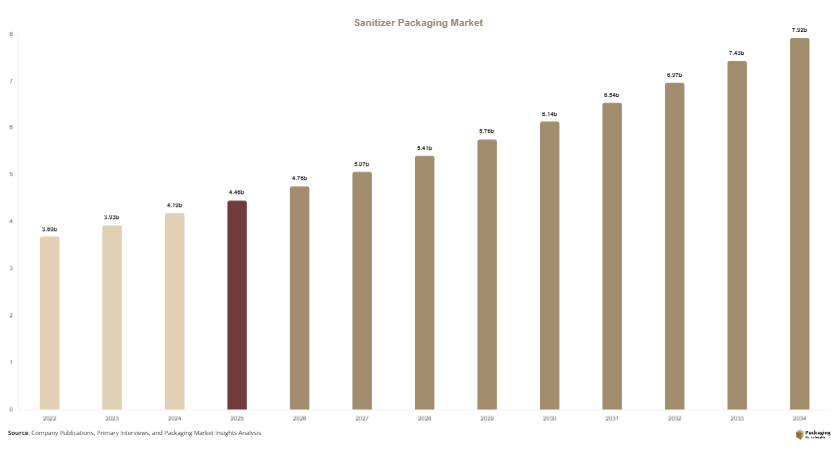
Sanitizer Packaging market size is projected at USD 4.76 billion in 2026 and is expected to hit USD 7.92 billion by 2034 with a CAGR of 6.57%. The report provides detailed analysis of packaging formats, material innovations, production capacity, pricing trends, regulatory requirements, and competitive strategies. The study evaluates market segmentation, regional performance, supply chain developments, and key manufacturers to deliver comprehensive competitive landscape insights.
The Sanitizer Packaging Market includes bottles, dispensers, tubes, pouches, and other packaging formats designed for storing, dispensing, and protecting sanitizing products. Global production exceeded 18.6 billion sanitizer packaging units in 2025, with bottles and dispensers accounting for approximately 56% of total demand, pouches contributing 27%, and tubes representing nearly 17%. Hand sanitizer applications dominated with around 62% market contribution, followed by surface sanitizers at 25% and industrial sanitizers at 13%, strengthening the Sanitizer Packaging Market.
Explore more data points, trends and opportunities Download Free Sample Report
Sanitizer Packaging Market Trends
Growing Demand for Convenient and Sustainable Sanitizer Packaging
Manufacturers are increasingly focusing on lightweight, recyclable, and user-friendly sanitizer packaging solutions. Global sanitizer packaging production exceeded 19 billion units annually, while adoption of recyclable plastic packaging increased by approximately 34% among consumer product companies. Airless dispensers, pump-based bottles, and refillable formats have improved product efficiency by nearly 21%, supporting the Sanitizer Packaging Market.
The shift toward sustainable packaging materials is accelerating across personal care and healthcare sectors. More than 68% of brands are exploring recycled polymers and biodegradable packaging alternatives, while refill packaging adoption increased by approximately 18% between 2024 and 2025. Investments exceeding USD 620 million in packaging innovation are supporting advanced designs and expanding the Sanitizer Packaging Market.
Sanitizer Packaging Market Drivers
Increasing Hygiene Awareness and Personal Care Product Consumption
Rising awareness regarding hygiene and infection prevention continues driving sanitizer packaging demand globally. Hand hygiene product consumption increased by approximately 9.6% in 2025, while sanitizer manufacturers expanded production capacity by more than 12%. Over 72% of households in developed markets regularly use packaged sanitizing products, creating continuous demand for bottles, dispensers, and refill solutions within the Sanitizer Packaging Market.
Sanitizer Packaging Market Restraints
Fluctuating Raw Material Prices and Plastic Regulation
Increasing polymer costs and regulatory restrictions on single-use plastics are limiting market expansion. Packaging-grade plastic prices fluctuated by nearly 14%, while compliance costs increased by approximately 9% for manufacturers adopting sustainable materials. More than 45% of packaging producers are transitioning toward alternative materials, creating cost pressures across the Sanitizer Packaging Market.
Sanitizer Packaging Market Opportunities
Expansion of Refillable and Eco-Friendly Packaging Solutions
Growing preference for sustainable and reusable packaging creates significant opportunities. Refillable sanitizer packaging demand increased by approximately 26%, while eco-friendly packaging adoption among personal care brands exceeded 38%. Production of recyclable sanitizer packaging units is expected to surpass 25 billion units by 2030, providing strong opportunities for innovation within the Sanitizer Packaging Market.
Challenges in Sanitizer Packaging Market
Maintaining Product Safety and Packaging Compatibility
Manufacturers face challenges related to chemical compatibility, leakage prevention, and durability requirements. More than 61% of producers invest in advanced testing technologies to ensure packaging integrity, while maintaining resistance against alcohol-based formulations requires specialized materials. Compliance with packaging safety standards across 50+ countries remains a key challenge for the Sanitizer Packaging Market.
Report Scope
| Report Metric | Details |
|---|---|
| Market Size in 2025 | USD 4.46 billion |
| Market Size in 2026 | USD 4.76 billion |
| Market Size in 2034 | USD 7.92 billion |
| CAGR | 6.57% (2026-2034) |
| Base Year for Estimation | 2025 |
| Historical Data | 2022-2024 |
| Forecast Period | 2026-2034 |
| Report Coverage | Revenue Forecast, Competitive Landscape, Supply Chain Disruption, Growth Factors, Environment & Regulatory Landscape and Trends |
| Geographies Covered | North America, Europe, APAC, Middle East and Africa, LATAM |
| Countries Covered | U.S., Canada, U.K., Germany, France, Spain, Italy, Russia, Nordic, Benelux, Rest of Europe, China, South Korea, Japan, India, Australia, Singapore, Taiwan, South East Asia, Rest of Asia-Pacific, UAE, Turky, Saudi Arabia, South Africa, Egypt, Nigeria, Rest of MEA, Brazil, Mexico, Argentina, Chile, Colombia, Rest of LATAM |
Explore more data points, trends and opportunities Download Free Sample Report
Sanitizer Packaging Market Segmentation
The market is segmented by type and application, with bottles and dispensers representing approximately 56% of total revenue due to convenience and widespread adoption. Hand sanitizer applications dominate with nearly 62% share as consumer and healthcare demand continues expanding.
By Type
Bottles & Dispensers
Bottles and dispensers account for approximately 56% of global demand with annual production exceeding 10 billion units. These formats provide accurate dispensing, contamination control, and compatibility with alcohol-based formulations. Pump bottles, spray dispensers, and automatic dispensing systems are increasingly adopted across households, healthcare facilities, and commercial environments.
Pouches & Sachets
Pouches and sachets contribute nearly 27% of market demand with production exceeding 5 billion units annually. These lightweight packaging formats reduce material consumption by approximately 30% compared with traditional containers and are widely used for refill packs, travel-size sanitizers, and institutional applications.
Tubes
Tubes represent approximately 17% of total consumption with annual production exceeding 3 billion units. They provide portability, controlled dispensing, and improved user convenience for gel-based sanitizers and personal care formulations.
By Application
Hand Sanitizer
Hand sanitizer applications dominate the market with approximately 62% share and consumption exceeding 11 billion packaging units annually. Rising workplace hygiene requirements, healthcare adoption, and consumer awareness continue driving demand for pump bottles, squeeze bottles, and refill packaging solutions.
Surface Sanitizer
Surface sanitizer applications contribute around 25% of market demand with production exceeding 4.5 billion units annually. These products require durable packaging solutions capable of handling larger volumes, chemical exposure, and repeated commercial usage.
Industrial Sanitizer
Industrial sanitizer applications account for nearly 13% of demand with more than 2 billion units consumed annually. Food processing, manufacturing facilities, and laboratories increasingly utilize specialized sanitizer packaging with improved chemical resistance and storage capabilities.
Sanitizer Packaging Market Segmentations
Type
- Bottles & Dispensers
- Pouches & Sachets
- Tubes
Application
- Hand Sanitizer
- Surface Sanitizer
- Industrial Sanitizer
Sanitizer Packaging Regional Outlook
North America
North America accounts for approximately 34% of global demand. The United States contributes nearly 82% of regional consumption due to strong personal care, healthcare, and commercial hygiene sectors. Annual production exceeds 6 billion sanitizer packaging units, with hand sanitizer packaging representing nearly 65% of regional demand.
Europe
Europe represents approximately 28% of the global market. Germany, France, the United Kingdom, and Italy contribute more than 73% of regional demand. Sustainable packaging adoption exceeds 58% among major personal care companies, supporting recyclable bottle and refill packaging growth.
Asia-Pacific
Asia-Pacific holds approximately 30% of worldwide demand and remains the fastest-growing region. China contributes nearly 45% of regional production, followed by India at 20%, Japan at 15%, and South Korea at 9%. Annual regional production exceeds 5.5 billion units, supported by expanding hygiene product manufacturing.
Latin America
Latin America contributes approximately 5% of global demand. Brazil represents nearly 46% of regional consumption, while Mexico contributes around 29% due to increasing healthcare and consumer product demand.
Middle East & Africa
The Middle East & Africa account for approximately 3% of global demand. Growing healthcare investments and rising hygiene awareness continue supporting sanitizer packaging adoption.
Top players in Sanitizer Packaging Market
- Berry Global Inc.
- Amcor plc
- Alpla Group
- Silgan Holdings Inc.
- AptarGroup, Inc.
- Gerresheimer AG
- Huhtamaki Oyj
- CCL Industries Inc.
- Sonoco Products Company
- Graham Packaging Company
- Berlin Packaging
- RPC Group
Berry Global Inc.
-
Holds an estimated 14–16% global market share.
-
Maintains a strong position in plastic sanitizer bottles and dispensing solutions.
-
Operates manufacturing facilities across North America, Europe, and Asia.
-
The company focuses on lightweight packaging designs, recycled polymer solutions, and sustainable dispensing technologies. Continuous investments in material innovation and healthcare packaging capabilities strengthen its presence across consumer, industrial, and healthcare sanitizer applications.
Amcor plc
-
Accounts for approximately 11–13% global market share.
-
Recognized for advanced flexible and rigid packaging solutions.
-
Provides recyclable and high-performance packaging formats for personal care and healthcare industries.
-
The company continues expanding sustainable packaging capabilities through recycled materials, lightweight designs, and innovative manufacturing technologies to support increasing global demand for environmentally responsible sanitizer packaging solutions.