Market Overview
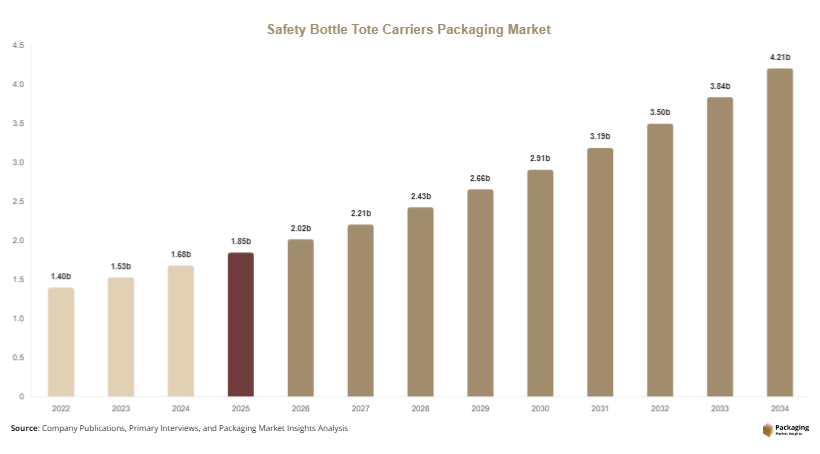
The Safety Bottle Tote Carriers Packaging Market is experiencing steady expansion driven by increasing demand for secure liquid transport solutions across industrial, commercial, and household applications. In 2025, the global market size is estimated at USD 1.85 billion, and it is projected to reach USD 2.02 billion in 2026. By 2034, the market is expected to attain a value of USD 4.15 billion, registering a CAGR of 9.6% during the forecast period (2025–2034). The growth trajectory is strongly influenced by rising safety regulations in chemical handling, expansion of e-commerce logistics, and growing pharmaceutical distribution requirements.
One of the major growth factors is the increasing emphasis on safe transportation of fragile and hazardous liquid containers, particularly in chemicals and laboratory environments. Another key driver is the rapid growth of pharmaceutical exports, where secure bottle handling and contamination-free packaging are essential. Additionally, sustainability trends are encouraging manufacturers to develop reusable and recyclable tote carriers, further accelerating adoption across industries.
Key Highlights:
- Market size projected to grow from USD 1.85 billion (2025) to USD 4.15 billion (2034)
- CAGR of 9.6% driven by logistics safety compliance and industrial expansion
- Increasing adoption in pharmaceutical, chemical, and food-grade transport applications
- Rising demand for reusable and recyclable tote carrier systems
- Strong integration of automated warehouse packaging systems
Explore more data points, trends and opportunities Download Free Sample Report
Market Trends
Shift Toward Sustainable and Reusable Tote Packaging Systems
The Safety Bottle Tote Carriers Packaging Market is witnessing a strong shift toward sustainable and reusable packaging systems. Industries are increasingly replacing single-use plastic containers with durable tote carriers designed for multiple cycles of use. This trend is primarily driven by regulatory pressure on plastic waste reduction and corporate sustainability initiatives. Manufacturers are focusing on recyclable HDPE and polypropylene materials that maintain structural integrity while minimizing environmental impact. Additionally, closed-loop logistics systems are being adopted, allowing tote carriers to be returned, cleaned, and reused efficiently. This approach reduces operational costs over time and enhances supply chain efficiency. Pharmaceutical and chemical companies are particularly investing in reusable safety bottle totes to ensure compliance with environmental standards while improving transport safety and reducing packaging waste.
Integration of Smart Tracking and RFID-Enabled Tote Systems
Another significant trend in the Safety Bottle Tote Carriers Packaging Market is the integration of smart tracking technologies such as RFID tags and IoT-enabled sensors. These technologies allow real-time monitoring of bottle location, temperature, and handling conditions during transit. Logistics companies are increasingly adopting smart tote systems to reduce loss, theft, and contamination risks. RFID-enabled carriers improve inventory visibility and streamline warehouse operations, enabling automated tracking across supply chains. Pharmaceutical and specialty chemical industries are early adopters due to strict regulatory requirements. This trend is also supported by the growing digitalization of logistics infrastructure and warehouse management systems, which enhance operational transparency and reduce human error in handling sensitive liquid containers.
Market Drivers
Expansion of Pharmaceutical and Chemical Distribution Networks
The rapid expansion of pharmaceutical and chemical distribution networks is a major driver of the Safety Bottle Tote Carriers Packaging Market. Increasing global demand for medicines, vaccines, and laboratory chemicals requires secure and contamination-free transportation solutions. Safety bottle tote carriers provide structural protection and reduce the risk of breakage during transit. The rise of global trade in pharmaceutical products has further intensified the need for standardized packaging solutions that comply with international safety regulations. Additionally, growing investments in life sciences infrastructure, including research laboratories and production facilities, are increasing the adoption of durable tote carriers. This trend is particularly strong in emerging economies where healthcare expansion is accelerating.
Growth in Industrial Automation and Modern Logistics Systems
Industrial automation and modernization of logistics systems are significantly driving market growth. Warehouses and distribution centers are increasingly adopting automated handling systems that require standardized, stackable, and durable packaging solutions. Safety bottle tote carriers are well-suited for automated conveyor systems and robotic handling due to their uniform structure and strength. This reduces operational inefficiencies and minimizes product damage during transport. Furthermore, the expansion of e-commerce logistics and B2B supply chains is increasing the demand for efficient packaging systems that optimize storage space and handling speed. The integration of smart warehousing technologies is further reinforcing the need for advanced tote carrier solutions.
Market Restraint
High Initial Cost and Material Standardization Challenges
One of the key restraints in the Safety Bottle Tote Carriers Packaging Market is the relatively high initial cost associated with durable and specialized tote carrier systems. While reusable carriers offer long-term cost efficiency, the upfront investment required for high-quality materials such as reinforced polypropylene or engineered HDPE can be significant for small and medium-sized enterprises. Additionally, customization requirements for different bottle sizes and industrial applications further increase production complexity and cost. Another challenge lies in the lack of global standardization in tote carrier dimensions and compatibility, which limits interoperability across supply chains. This results in inefficiencies when companies operate across multiple regions with varying packaging requirements. As a result, some end users continue to rely on traditional single-use packaging solutions, slowing the adoption rate of advanced safety bottle tote carriers in price-sensitive markets.
Market Opportunities
Expansion in Emerging Economies and Industrial Zones
Emerging economies present a significant growth opportunity for the Safety Bottle Tote Carriers Packaging Market. Rapid industrialization in regions such as Asia Pacific, Latin America, and parts of Africa is driving demand for secure logistics and packaging solutions. Manufacturing sectors in these regions are expanding their chemical, pharmaceutical, and food processing capabilities, which require safe liquid transport systems. Government initiatives supporting industrial safety standards are further encouraging the adoption of advanced tote carriers. Additionally, the development of special economic zones and industrial corridors is creating new demand for standardized packaging infrastructure, offering long-term market expansion opportunities for manufacturers.
Development of Lightweight and High-Strength Composite Materials
The development of lightweight yet high-strength composite materials presents another major opportunity in the market. Manufacturers are investing in advanced polymer blends and hybrid materials that enhance durability while reducing weight, improving transportation efficiency and lowering logistics costs. These innovations are particularly valuable for industries requiring frequent movement of liquid containers across long distances. Lightweight tote carriers also contribute to reduced carbon emissions in logistics operations, aligning with global sustainability goals. Continuous material innovation is expected to create new product categories and open additional revenue streams for packaging manufacturers.
Report Scope
| Report Metric | Details |
|---|---|
| Market Size in 2025 | USD 1.85 billion |
| Market Size in 2026 | USD 2.02 billion |
| Market Size in 2034 | USD 4.15 billion |
| CAGR | 9.6% (2026-2034) |
| Base Year for Estimation | 2025 |
| Historical Data | 2022-2024 |
| Forecast Period | 2026-2034 |
| Report Coverage | Revenue Forecast, Competitive Landscape, Supply Chain Disruption, Growth Factors, Environment & Regulatory Landscape and Trends |
| Geographies Covered | North America, Europe, APAC, Middle East and Africa, LATAM |
| Countries Covered | U.S., Canada, U.K., Germany, France, Spain, Italy, Russia, Nordic, Benelux, Rest of Europe, China, South Korea, Japan, India, Australia, Singapore, Taiwan, South East Asia, Rest of Asia-Pacific, UAE, Turky, Saudi Arabia, South Africa, Egypt, Nigeria, Rest of MEA, Brazil, Mexico, Argentina, Chile, Colombia, Rest of LATAM |
Explore more data points, trends and opportunities Download Free Sample Report
Segmental Analysis
By Material Type
Plastic-based safety bottle tote carriers dominated the market in 2024, accounting for approximately 52.3% share, due to their durability, cost efficiency, and chemical resistance. These materials are widely used across pharmaceutical and chemical logistics. Their lightweight nature and compatibility with automation systems further strengthen adoption.
The fastest-growing subsegment is composite polymer-based tote carriers, projected to grow at a CAGR of 10.8%, driven by demand for enhanced strength-to-weight ratios and improved sustainability performance. Increasing R&D in advanced materials is accelerating innovation in this category.
By End-Use Industry
The chemical industry dominated the segment in 2024 with a share of 45.6%, due to high demand for safe liquid handling systems. Strict transportation regulations also contribute to adoption across this sector.
The pharmaceutical industry is the fastest-growing subsegment with a CAGR of 11.5%, driven by global expansion of drug distribution networks and increasing vaccine logistics requirements.
By Distribution Channel
Direct sales dominated the market in 2024 with a share of 48.9%, as large enterprises prefer customized tote carrier solutions. This channel ensures better pricing and product customization.
Online distribution channels are the fastest-growing, with a CAGR of 12.1%, driven by digital procurement platforms and increasing SME adoption of standardized packaging solutions.
Safety Bottle Tote Carriers Packaging Market Segmentations
Material Type
- High-Density Polyethylene (HDPE) Safety Tote Carriers
- Polypropylene (PP) Safety Bottle Tote Carriers
- Composite Polymer Reinforced Carriers
- Metal Reinforced Industrial Tote Systems
End-Use Industry
- Chemical Industry Packaging
- Pharmaceutical Logistics Packaging
- Food & Beverage Liquid Transport
- Industrial Manufacturing Applications
- Logistics & Warehousing Systems
Distribution Channel
- Direct Sales (B2B Contracts)
- Distributors & Wholesalers
- Online Industrial Supply Platforms
- Retail Industrial Supply Chains
Regional Analysis
North America
North America accounted for approximately 34.2% market share in 2025, with a projected CAGR of 9.1% through 2034. The region’s strong industrial base and advanced logistics infrastructure contribute significantly to market dominance.
The United States leads the region due to high demand from pharmaceutical, chemical, and food processing industries. A key growth factor is the widespread adoption of automated warehouse systems that require standardized safety bottle tote carriers for efficient operations.
Europe
Europe held around 27.5% market share in 2025, with a forecast CAGR of 8.7% during 2025–2034. Strict regulatory frameworks regarding chemical transportation safety support steady market growth.
Germany dominates the region due to its strong manufacturing sector and chemical industry. A unique growth factor is the increasing adoption of circular economy practices promoting reusable packaging systems.
Asia Pacific
Asia Pacific captured 25.8% market share in 2025 and is expected to grow at the highest CAGR of 11.2%. Rapid industrialization and export-oriented manufacturing drive demand.
China leads the region due to its large-scale pharmaceutical and chemical production base. A key growth factor is the expansion of e-commerce-driven logistics infrastructure.
Middle East & Africa
The region accounted for 6.1% market share in 2025, with a CAGR of 8.4%. Growth is supported by industrial diversification initiatives.
Saudi Arabia dominates due to expanding chemical manufacturing sectors. A key factor is investment in industrial logistics modernization projects.
Latin America
Latin America held 6.4% market share in 2025, with a CAGR of 8.9%. Growth is driven by pharmaceutical imports and industrial expansion.
Brazil leads the region due to its growing chemical and healthcare industries. A major growth factor is increasing adoption of standardized packaging systems in export logistics.
Competitive Landscape
The Safety Bottle Tote Carriers Packaging Market is moderately fragmented with several global and regional players competing on material innovation, product durability, and customization capabilities. Key companies include Berry Global Inc., Greif Inc., Schütz GmbH & Co. KGaA, Mauser Packaging Solutions, and DS Smith Plc. These companies focus on expanding reusable packaging portfolios and enhancing logistics efficiency.
Berry Global Inc. remains a leading player due to its extensive polymer packaging solutions and global distribution network. Recently, the company expanded its reusable container line to support pharmaceutical logistics optimization. Other players are investing in automation-compatible tote designs and smart tracking integration to strengthen market position.
Key Players List
- Berry Global Inc.
- Greif Inc.
- Schütz GmbH & Co. KGaA
- Mauser Packaging Solutions
- DS Smith Plc
- Nampak Ltd.
- Orbis Corporation
- Schoeller Allibert
- IPL Plastics
- Time Technoplast Ltd.
- Bulk Handling Australia
- Polymer Logistics
- Rehrig Pacific Company
- Corplex
- Nilkamal Ltd.