Sachet Packaging Market Size and Growth
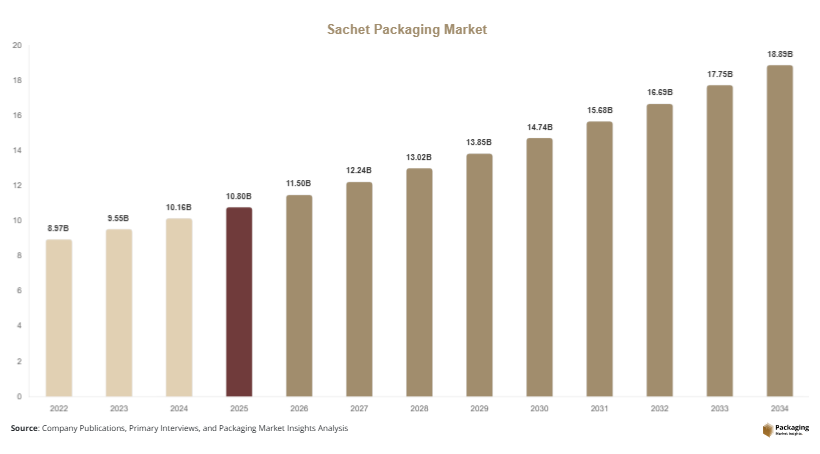
The global sachet packaging market size is estimated to reach USD 10.8 billion, increasing to approximately USD 11.5 billion in 2026. Over the forecast period from 2025 to 2034, the market is projected to grow steadily and reach USD 18.9 billion by 2034, registering a compound annual growth rate (CAGR) of around 6.4%. Growth is driven by rising demand for single-use products, expanding retail distribution networks, and the increasing penetration of consumer goods in emerging economies.
The sachet packaging market has experienced consistent growth in recent years as brands increasingly adopt compact and cost-efficient packaging formats. Sachet packaging refers to small sealed flexible packets designed to hold single-use or limited-quantity products. These packets are widely used in industries such as personal care, food and beverages, pharmaceuticals, and household products. Their convenience, affordability, and ability to support small portion sizes have made them a practical packaging solution in both developed and emerging markets.
Key Highlights
- Global market size estimated at USD 10.8 billion in 2025
- Market projected to reach USD 18.9 billion by 2034
- CAGR of 6.4% during 2025–2034
- Personal care and food products represent major application areas
- Asia Pacific accounts for the largest regional market share
Explore more data points, trends and opportunities Download Free Sample Report
Market Trends
Rising Adoption of Sustainable Sachet Materials
Environmental concerns surrounding plastic waste are influencing packaging strategies across industries. As a result, companies operating in the sachet packaging market are shifting toward recyclable, biodegradable, and mono-material packaging solutions. Traditional multilayer plastic laminates are difficult to recycle, which has prompted packaging manufacturers to develop alternative materials that maintain barrier performance while improving recyclability.
Several consumer goods companies are testing paper-based laminates, compostable films, and polyethylene-based mono-structures. These materials reduce environmental impact while preserving product quality and shelf life. Regulatory pressure in regions such as Europe and North America is accelerating this shift, as governments introduce stricter packaging waste regulations. Sustainable sachet solutions are therefore becoming a strategic priority for manufacturers seeking to maintain compliance and strengthen brand reputation.
Expansion of Single-Use Consumer Products
Another notable trend shaping the sachet packaging market is the increasing demand for single-use consumer products. Busy lifestyles and changing purchasing behaviors have led consumers to prefer convenient and portable product formats. Sachets offer easy handling, precise portion control, and minimal product wastage, which makes them suitable for travel, hospitality, and on-the-go consumption.
In the food sector, condiments, sauces, and beverage powders are increasingly distributed in sachet formats. Similarly, the personal care industry uses sachets to package shampoo, conditioner, facial creams, and hair treatments. The pharmaceutical sector also uses sachets for powdered supplements and oral rehydration salts. As brands expand product sampling and trial marketing strategies, sachets provide a cost-effective packaging solution that supports consumer engagement and product accessibility.
Market Drivers
Growth of Consumer Goods Distribution in Emerging Economies
One of the primary drivers of the sachet packaging market is the rapid expansion of consumer goods distribution across emerging economies. Countries in Asia, Africa, and Latin America have experienced rising urbanization and increasing disposable income levels. However, many consumers still prefer purchasing products in small quantities due to budget constraints or storage limitations.
Sachet packaging allows companies to provide affordable product units while maintaining brand presence in these markets. Multinational consumer goods companies frequently use sachet strategies to penetrate rural and semi-urban areas where retail outlets are smaller and purchasing power varies. The low production cost and compact size of sachets enable efficient transportation and distribution, which further strengthens their role in expanding product accessibility.
Technological Advancements in Flexible Packaging
Technological improvements in flexible packaging manufacturing have significantly enhanced the performance of sachet packaging solutions. Modern production equipment allows high-speed sealing, precise filling, and improved material compatibility. These innovations enable manufacturers to produce sachets that provide stronger barrier protection against moisture, oxygen, and contaminants.
Advanced printing technologies also allow brands to display detailed product information and attractive graphics on small packaging surfaces. This capability improves marketing effectiveness and enhances brand recognition in retail environments. Furthermore, innovations such as laser scoring, easy-tear openings, and multi-compartment sachets have improved consumer convenience. These technological developments continue to expand the range of products that can be packaged in sachet formats.
Market Restraints
Environmental Concerns Related to Plastic Waste
Despite its benefits, the sachet packaging market faces challenges related to environmental sustainability. Traditional sachets are commonly made from multilayer plastic laminates that combine materials such as polyethylene, polypropylene, and aluminum foil. While these structures provide excellent barrier properties, they are difficult to recycle using conventional recycling systems.
The accumulation of small plastic packaging waste has raised concerns among environmental organizations and regulatory bodies. Governments in several countries have introduced regulations aimed at reducing single-use plastic packaging. These policies may restrict the use of certain plastic materials or require manufacturers to implement recycling programs.
The environmental impact of sachets is particularly visible in densely populated regions where waste management infrastructure is limited. Small packets are often discarded after use, contributing to litter and landfill accumulation. As a result, brands operating in the sachet packaging market are under increasing pressure to redesign packaging structures using recyclable or biodegradable materials.
Companies are responding by investing in research and development to create eco-friendly alternatives. However, transitioning to sustainable materials can increase production costs and require modifications to manufacturing processes. These factors may temporarily limit market growth in price-sensitive segments.
Market Opportunities
Development of Recyclable and Biodegradable Sachets
The growing focus on environmental sustainability presents a significant opportunity for innovation in the sachet packaging market. Packaging manufacturers are actively developing recyclable films and biodegradable materials that can replace traditional multilayer laminates. These solutions aim to maintain the protective properties required for product preservation while reducing environmental impact.
Biodegradable polymers and paper-based laminates are emerging as viable alternatives in certain applications. In addition, mono-material polyethylene sachets allow easier recycling within existing waste management systems. Companies that successfully commercialize sustainable sachet materials can gain competitive advantages by meeting regulatory requirements and appealing to environmentally conscious consumers.
Growth of Product Sampling and Trial Marketing
Another opportunity in the sachet packaging market lies in the expansion of product sampling campaigns. Consumer goods companies frequently distribute small product samples to encourage trial purchases and build brand awareness. Sachets provide an efficient packaging format for these marketing strategies due to their low production cost and compact design.
Sampling campaigns are widely used in the cosmetics, food, and pharmaceutical sectors. For example, beauty brands often distribute sachets containing shampoo, skincare products, or hair treatments through retail stores and promotional events. These initiatives allow consumers to test products before purchasing full-size packages. As companies continue to prioritize experiential marketing strategies, the demand for sachet packaging for promotional distribution is expected to increase.
Report Scope
| Report Metric | Details |
|---|---|
| Market Size in 2025 | USD 10.8 Billion |
| Market Size in 2026 | USD 11.5 Billion |
| Market Size in 2034 | USD 18.9 Billion |
| CAGR | 6.4% (2026-2034) |
| Base Year for Estimation | 2025 |
| Historical Data | 2022-2024 |
| Forecast Period | 2026-2034 |
| Report Coverage | Revenue Forecast, Competitive Landscape, Supply Chain Disruption, Growth Factors, Environment & Regulatory Landscape and Trends |
| Geographies Covered | North America, Europe, APAC, Middle East and Africa, LATAM |
| Countries Covered | U.S., Canada, U.K., Germany, France, Spain, Italy, Russia, Nordic, Benelux, Rest of Europe, China, South Korea, Japan, India, Australia, Singapore, Taiwan, South East Asia, Rest of Asia-Pacific, UAE, Turky, Saudi Arabia, South Africa, Egypt, Nigeria, Rest of MEA, Brazil, Mexico, Argentina, Chile, Colombia, Rest of LATAM |
Explore more data points, trends and opportunities Download Free Sample Report
Segmental Analysis
By Material Type
The plastic material segment dominated the sachet packaging market in 2024, accounting for approximately 64% of total market share. Plastic films such as polyethylene and polypropylene are widely used due to their flexibility, durability, and strong barrier properties. These materials help protect products from moisture, oxygen, and contamination, which is essential for food and personal care applications. Plastic sachets are also lightweight and cost-efficient, allowing manufacturers to reduce transportation expenses. Additionally, plastic materials support high-speed packaging processes, making them suitable for mass production environments. These advantages continue to sustain the widespread use of plastic films in sachet manufacturing despite growing environmental concerns.
The paper-based material segment is expected to emerge as the fastest-growing category during the forecast period, with a projected CAGR of around 7.2% from 2025 to 2034. Growth in this segment is largely driven by increasing demand for sustainable packaging solutions. Paper-based laminates combined with thin barrier coatings offer improved recyclability compared to traditional plastic laminates. Many consumer goods companies are experimenting with paper-based sachets for dry products such as coffee powder, sugar, and seasoning mixes. As sustainability regulations become stricter and consumer awareness increases, the adoption of paper-based sachet packaging is expected to accelerate.
By Application
The food and beverage segment held the largest share of the sachet packaging market in 2024, accounting for approximately 41% of global demand. Sachets are commonly used for packaging condiments, sauces, instant beverages, sugar, and seasoning powders. The popularity of takeaway food services and quick-service restaurants has increased demand for portion-controlled packaging formats. Sachets allow restaurants and food manufacturers to provide hygienic single-use servings while minimizing product wastage. Additionally, sachets offer a practical solution for packaging powdered beverages and instant drink mixes, which require protection against moisture and air exposure.
The pharmaceutical application segment is projected to grow at the fastest rate, registering a CAGR of approximately 6.9% during the forecast period. Pharmaceutical sachets are widely used for packaging oral powders, nutritional supplements, and rehydration salts. The small packet format allows accurate dosage and convenient consumption. Furthermore, sachet packaging offers extended shelf life due to its protective barrier properties. Increasing demand for nutraceutical products and health supplements is expected to drive the adoption of sachet packaging within the pharmaceutical sector over the coming years.
By End-Use Industry
The personal care and cosmetics industry represented the dominant end-use segment in 2024, capturing around 38% of the global sachet packaging market share. Cosmetic brands widely use sachets for packaging products such as shampoo, conditioner, facial masks, and skincare creams. These packets allow companies to distribute small product quantities at affordable prices while promoting brand awareness through trial purchases. Sachets are also commonly used in hotels and travel kits where compact packaging is preferred. The widespread use of sachets in emerging markets has enabled cosmetic brands to reach consumers with limited purchasing power.
The household products segment is anticipated to grow at the fastest pace, with a projected CAGR of about 6.7% during the forecast period. This segment includes products such as detergents, cleaning liquids, and fabric conditioners. Sachet packaging enables manufacturers to sell low-cost single-use quantities of these products. The increasing penetration of household cleaning products in developing economies is a major factor supporting this segment’s growth. In addition, small packaging formats simplify distribution through local retail outlets and small convenience stores.
Sachet Packaging Market Segmentations
Material Type
- Plastic
- Paper
- Aluminum Foil
- Biodegradable Materials
Application
- Food & Beverages
- Pharmaceuticals
- Personal Care Products
- Household Products
End-Use Industry
- Personal Care & Cosmetics
- Food Industry
- Pharmaceutical Industry
- Household Cleaning Industry
Regional Analysis
North America
North America accounted for approximately 21% of the global sachet packaging market share in 2025, supported by strong demand from the food, beverage, and personal care sectors. The region is projected to grow at a CAGR of around 5.1% between 2025 and 2034. Although sachets are less common in everyday retail compared to developing markets, they remain widely used in foodservice applications such as condiments, sauces, and beverage additives.
The United States represents the dominant country within the regional market. A major growth factor in the country is the increasing adoption of portion-controlled packaging across restaurants and quick-service chains. Sachets help maintain hygiene standards while minimizing product wastage. Additionally, the growth of travel-size consumer products and e-commerce product samples has supported the expansion of sachet packaging in North America.
Europe
Europe held nearly 19% of the global sachet packaging market share in 2025 and is expected to grow at a CAGR of about 5.3% during the forecast period. The market in Europe is influenced by strict environmental regulations and the growing emphasis on sustainable packaging practices. Manufacturers in the region are actively developing recyclable sachet materials to comply with packaging waste directives.
Germany represents one of the leading markets in Europe due to its strong packaging manufacturing industry and technological capabilities. A unique growth factor in the country is the increasing adoption of sustainable flexible packaging solutions by food and cosmetic brands. German packaging companies are investing in recyclable mono-material laminates that meet both regulatory requirements and consumer expectations.
Asia Pacific
Asia Pacific accounted for the largest share of the sachet packaging market in 2025, representing approximately 42% of global revenue. The region is projected to expand at a CAGR of nearly 7.5% between 2025 and 2034, driven by rapid population growth, expanding retail networks, and strong demand for affordable consumer goods.
India stands out as a dominant country within the regional market. One unique growth factor in the country is the widespread adoption of sachet packaging for everyday consumer products such as shampoo, detergent, and condiments. The sachet strategy enables companies to reach rural and low-income consumers who prefer small, low-cost product units. This distribution model has played a key role in expanding brand penetration across the country.
Middle East & Africa
The Middle East & Africa region accounted for roughly 9% of the global sachet packaging market share in 2025 and is expected to grow at a CAGR of approximately 6.2% through 2034. Growth in the region is supported by increasing urbanization, rising consumer spending, and expanding distribution networks for consumer goods.
South Africa is one of the leading markets in the region. A notable growth factor in the country is the rising demand for affordable packaged food products and household goods. Sachets provide an accessible packaging format for price-sensitive consumers, particularly in lower-income communities. This affordability factor continues to support the expansion of sachet packaging across the region.
Latin America
Latin America represented around 9% of the global sachet packaging market in 2025 and is forecast to grow at a CAGR of about 6.0% between 2025 and 2034. The market benefits from increasing consumption of packaged foods and personal care products. Sachets are commonly used for condiments, powdered beverages, and cosmetic products.
Brazil dominates the regional market due to its large consumer base and strong food processing industry. One unique growth factor in the country is the widespread use of sachets in the hospitality and quick-service restaurant sectors. Restaurants and food chains frequently use sachet packaging for sauces and seasonings, which has supported consistent demand for small flexible packaging formats.
Competitive Landscape
The competitive landscape of the sachet packaging market is moderately fragmented, with several global packaging manufacturers competing alongside regional flexible packaging producers. Leading companies focus on expanding production capacity, developing sustainable packaging materials, and forming strategic partnerships with consumer goods brands.
Among industry participants, Amcor plc is considered a market leader due to its extensive portfolio of flexible packaging solutions and strong global presence. The company has invested in recyclable flexible packaging technologies designed to reduce plastic waste while maintaining performance standards.
Other major companies include Mondi Group, Berry Global Inc., Huhtamaki Oyj, and Constantia Flexibles. These companies compete by introducing innovative film materials, improving sealing technologies, and offering customized packaging solutions for food and personal care brands.
Recent developments in the market have focused on sustainability initiatives, including the introduction of recyclable mono-material sachets and compostable flexible films. Companies are also expanding production facilities in emerging markets to support rising demand from consumer goods manufacturers.
Key Players List
- Amcor plc
- Mondi Group
- Berry Global Inc.
- Huhtamaki Oyj
- Constantia Flexibles
- ProAmpac
- UFlex Ltd.
- Sealed Air Corporation
- Winpak Ltd.
- Sonoco Products Company
- Glenroy Inc.
- Clondalkin Group
- Coveris
- TC Transcontinental Packaging
- Printpack Inc.