Roof Shape Aseptic Packaging Material Market Size and Growth
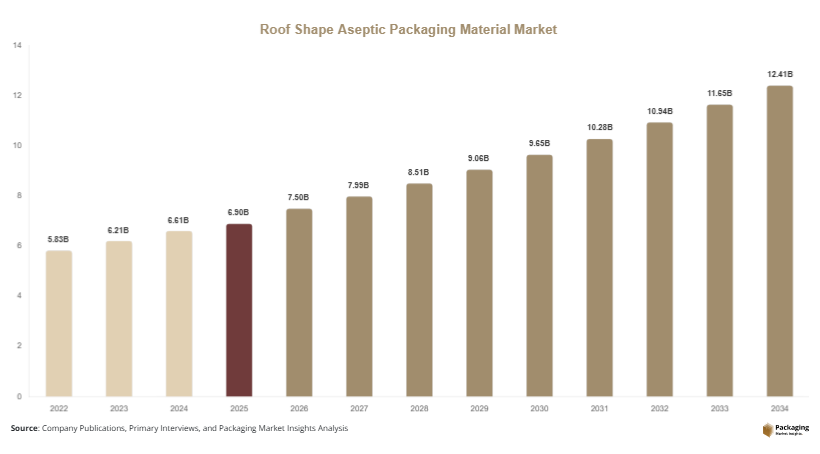
The global roof shape aseptic packaging material market size was valued at approximately USD 6.9 billion in 2025 and is expected to reach USD 7.5 billion in 2026. Driven by demand for extended shelf-life dairy products, plant-based beverages, and ready-to-drink liquids, the market is projected to reach USD 13.2 billion by 2034, expanding at a CAGR of 6.5% during the forecast period (2025–2034). Roof-shaped cartons, commonly used for milk, juices, and liquid foods, are preferred for their functional design, easy pouring, and cost efficiency. The roof shape aseptic packaging material market is gaining traction as food and beverage manufacturers increasingly adopt packaging formats that enhance shelf life, maintain product quality, and support efficient distribution.
The market is supported by several growth factors. Rising consumption of packaged dairy and non-dairy beverages is a primary driver, particularly in urban areas where convenience and hygiene are priorities. In addition, increasing awareness of food safety and the need to reduce food waste are encouraging the adoption of aseptic packaging technologies. Another significant factor is the growth of organized retail and cold chain infrastructure, which supports distribution of packaged liquid products in both developed and emerging economies.
Key Highlights:
Asia Pacific dominated the market with a 38.2% share in 2025, while Latin America is projected to grow at the fastest CAGR of 6.9%.
Paperboard-based materials led the type segment with a 61.5% share, while bio-based barrier materials are expected to grow at a CAGR of 7.2%.
Plastic coatings dominated with a 48.6% share, while eco-friendly coatings are forecasted to grow at a CAGR of 7.0%.
Food & beverage applications led the segment with 82.3% share, while liquid nutrition products are expected to grow at a CAGR of 6.7%.
China remained the dominant country with a market size of USD 1.9 billion in 2025 and USD 2.1 billion in 2026.
Explore more data points, trends and opportunities Download Free Sample Report
Market Trends
Increasing shift toward sustainable and recyclable packaging materials
The roof shape aseptic packaging material market is witnessing a growing emphasis on sustainability, driven by environmental concerns and regulatory pressures. Manufacturers are focusing on reducing plastic content and increasing the use of renewable materials such as paperboard derived from responsibly managed forests. Innovations in barrier coatings are enabling the development of fully recyclable packaging structures without compromising performance. Companies are also investing in water-based coatings and biodegradable layers to improve environmental outcomes. This trend is gaining momentum among consumers who prefer eco-friendly packaging solutions, particularly in developed markets. As sustainability becomes a key purchasing factor, brands are aligning their packaging strategies with environmental goals.
Rising demand for plant-based and functional beverages
Another significant trend is the increasing demand for plant-based and functional beverages, which is driving the adoption of roof shape aseptic packaging. Products such as almond milk, soy milk, and fortified drinks require packaging that ensures long shelf life and maintains nutritional value. Roof-shaped cartons provide an effective solution due to their ability to preserve product quality without refrigeration. This trend is supported by changing consumer preferences toward healthier lifestyles and dietary choices. Manufacturers are expanding their product portfolios to include a wide range of beverages, further boosting demand for aseptic packaging materials.
Market Drivers
Growth in packaged dairy and beverage consumption
The increasing consumption of packaged dairy products and beverages is a major driver of the roof shape aseptic packaging material market. Urbanization and busy lifestyles are leading consumers to prefer ready-to-use and convenient products. Aseptic packaging allows products to be stored for longer periods without refrigeration, making it suitable for distribution in regions with limited cold chain infrastructure. The demand for flavored milk, juices, and ready-to-drink beverages is particularly strong, contributing to market growth. Manufacturers are responding by expanding production capacity and investing in innovative packaging solutions to meet consumer needs.
Advancements in aseptic packaging technology
Technological advancements in aseptic packaging are another key factor driving market growth. Innovations in multi-layer materials and sterilization processes are improving the efficiency and performance of packaging solutions. These advancements enable manufacturers to maintain product quality while reducing material usage. Automation and digitalization in packaging lines are also enhancing production efficiency and reducing costs. The ability to produce high-quality packaging at scale is encouraging adoption across various industries, including food, beverage, and healthcare.
Market Restraint
High initial investment and production complexity
The high initial investment required for aseptic packaging systems is a significant restraint for the market. Setting up production facilities involves substantial capital expenditure on specialized equipment and technology. Additionally, the complexity of manufacturing multi-layer packaging materials can increase operational costs. Small and medium-sized enterprises may find it challenging to adopt these technologies, limiting market penetration. For example, installing aseptic filling lines requires strict compliance with hygiene standards and regular maintenance, which can be resource-intensive. These factors can hinder market growth, particularly in price-sensitive regions.
Market Opportunities
Expansion in emerging markets with growing dairy industries
Emerging markets present significant growth opportunities for the roof shape aseptic packaging material market. Countries in Asia Pacific, Latin America, and Africa are experiencing rapid growth in dairy production and consumption. Increasing urbanization and rising disposable incomes are driving demand for packaged food and beverages. Governments are also supporting the development of the dairy sector through favorable policies and infrastructure investments. This creates a strong demand for aseptic packaging solutions that can ensure product safety and quality.
Development of innovative barrier materials and coatings
The development of advanced barrier materials and coatings offers promising opportunities for market growth. Manufacturers are focusing on improving the performance of packaging materials by enhancing their resistance to oxygen, moisture, and light. Innovations such as bio-based coatings and recyclable barrier layers are gaining attention. These materials can reduce environmental impact while maintaining product integrity. As research and development efforts continue, the adoption of innovative materials is expected to increase, creating new growth avenues for the market.
Report Scope
| Report Metric | Details |
|---|---|
| Market Size in 2025 | USD 6.9 Billion |
| Market Size in 2026 | USD 7.5 Billion |
| Market Size in 2034 | USD 13.2 Billion |
| CAGR | 6.5% (2026-2034) |
| Base Year for Estimation | 2025 |
| Historical Data | 2022-2024 |
| Forecast Period | 2026-2034 |
| Report Coverage | Revenue Forecast, Competitive Landscape, Supply Chain Disruption, Growth Factors, Environment & Regulatory Landscape and Trends |
| Geographies Covered | North America, Europe, APAC, Middle East and Africa, LATAM |
| Countries Covered | U.S., Canada, U.K., Germany, France, Spain, Italy, Russia, Nordic, Benelux, Rest of Europe, China, South Korea, Japan, India, Australia, Singapore, Taiwan, South East Asia, Rest of Asia-Pacific, UAE, Turky, Saudi Arabia, South Africa, Egypt, Nigeria, Rest of MEA, Brazil, Mexico, Argentina, Chile, Colombia, Rest of LATAM |
Explore more data points, trends and opportunities Download Free Sample Report
Segmental Analysis
By Material Type
Paperboard-based materials dominated the market with a 61.5% share in 2024. These materials are widely used due to their sustainability, cost-effectiveness, and ability to provide structural strength. Paperboard forms the primary component of roof-shaped cartons, offering a renewable and recyclable packaging solution. Manufacturers are enhancing paperboard quality with improved barrier properties to meet evolving industry requirements.
Bio-based barrier materials are expected to grow at the fastest CAGR of 7.2% during the forecast period. These materials are gaining popularity due to their environmental benefits and compatibility with sustainable packaging initiatives. Innovations in bio-based coatings are improving performance while reducing reliance on traditional plastics.
By Coating Type
Plastic coatings accounted for the largest share of 48.6% in 2024 due to their effectiveness in providing moisture and oxygen barriers. These coatings are essential for maintaining product quality and extending shelf life. Manufacturers are continuously improving coating technologies to enhance performance and reduce material usage.
Eco-friendly coatings are projected to grow at a CAGR of 7.0% due to increasing demand for sustainable packaging solutions. These coatings are designed to reduce environmental impact while maintaining functionality. The shift toward water-based and biodegradable coatings is supporting segment growth.
By Application
Food & beverage applications dominated the market with a share of 82.3% in 2024. Roof shape aseptic packaging is widely used for milk, juices, and other liquid foods due to its convenience and efficiency. The growing demand for packaged beverages is driving the adoption of these packaging solutions.
Liquid nutrition products are expected to grow at a CAGR of 6.7% due to increasing demand for health-focused beverages. Packaging plays a critical role in preserving nutritional value and ensuring product safety. Innovations in packaging design are supporting growth in this segment.
Roof Shape Aseptic Packaging Material Market Segmentations
By Material Type
- Paperboard-Based Materials
- Plastic Layers
- Aluminum Foil Layers
- Bio-Based Materials
By Coating Type
- Plastic Coatings
- Eco-Friendly Coatings
By Application
- Food & Beverage
- Liquid Nutrition
- Dairy Products
- Plant-Based Beverages
Regional Analysis
North America
North America accounted for approximately 22.8% of the roof shape aseptic packaging material market share in 2025 and is projected to grow at a CAGR of 6.0% during the forecast period. The region benefits from high consumption of packaged beverages and advanced packaging infrastructure. Increasing demand for sustainable packaging solutions is also driving market growth.
The United States dominates the regional market due to its strong food and beverage industry. A key growth factor is the adoption of eco-friendly packaging materials, which align with consumer preferences and regulatory requirements. Continuous innovation in packaging technologies is supporting market expansion.
Europe
Europe held a market share of around 21.6% in 2025 and is expected to grow at a CAGR of 5.8%. The region’s growth is driven by strict environmental regulations and high demand for sustainable packaging solutions. Manufacturers are focusing on reducing plastic usage and improving recyclability.
Germany is the leading country in the European market due to its strong industrial base. A major growth factor is the emphasis on circular economy practices, which is encouraging the adoption of recyclable packaging materials.
Asia Pacific
Asia Pacific dominated the market with a 38.2% share in 2025 and is projected to grow at a CAGR of 7.0%. Rapid urbanization, increasing population, and rising demand for packaged beverages are driving growth in this region. The expansion of the dairy industry is also contributing significantly.
China is the dominant country in the region, supported by large-scale production capabilities. A unique growth factor is the increasing consumption of plant-based beverages, which is boosting demand for aseptic packaging materials.
Middle East & Africa
The Middle East & Africa region accounted for approximately 7.1% of the market share in 2025 and is expected to grow at a CAGR of 6.3%. The market is gradually expanding due to improving economic conditions and increasing demand for packaged food products.
The United Arab Emirates is a key contributor to regional growth due to its strong retail sector. A significant growth factor is the rising demand for convenient and hygienic packaging solutions.
Latin America
Latin America held a market share of around 10.3% in 2025 and is projected to grow at the fastest CAGR of 6.9%. Increasing urbanization and rising demand for dairy products are driving market growth. The expansion of retail and distribution networks is also contributing to demand.
Brazil dominates the regional market due to its large dairy industry. A unique growth factor is the increasing adoption of aseptic packaging technologies to improve product shelf life and reduce waste.
Competitive Landscape
The roof shape aseptic packaging material market is moderately competitive, with several global and regional players focusing on innovation and sustainability. Companies are investing in advanced materials and technologies to enhance packaging performance and meet regulatory requirements. Strategic collaborations and product innovations are common strategies used to strengthen market position.
Tetra Pak International S.A. is a leading player in the market, known for its expertise in aseptic packaging solutions. The company recently introduced new sustainable packaging materials with reduced carbon footprint. Other players are also focusing on expanding their product portfolios and improving manufacturing capabilities to remain competitive.
Key Players List
- Tetra Pak International S.A.
- Elopak AS
- SIG Combibloc Group AG
- Greatview Aseptic Packaging Co., Ltd.
- UFlex Limited
- Amcor plc
- Stora Enso Oyj
- WestRock Company
- DS Smith Plc
- Smurfit Kappa Group
- Mondi Group
- International Paper Company
- Huhtamaki Oyj
- Sealed Air Corporation
- Berry Global Inc.