Robotic Palletizers And De-palletizers Market Size and Growth
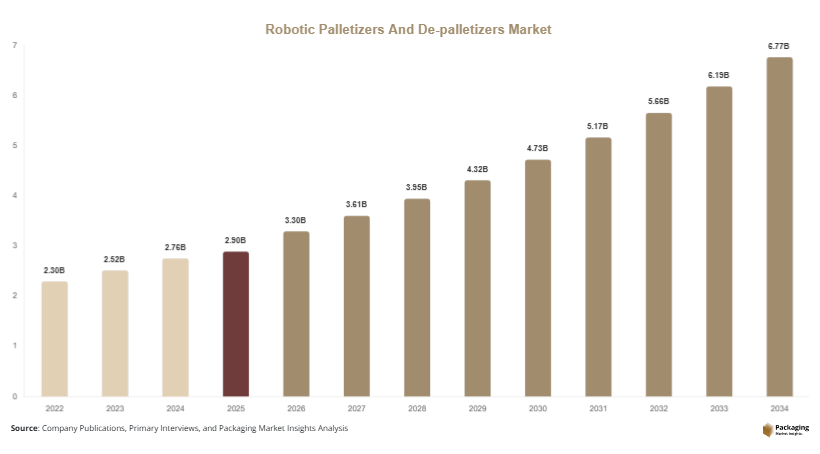
The global robotic palletizers and De-palletizers market size was valued at approximately USD 2.9 billion in 2025 and is expected to reach USD 3.3 billion in 2026, with projections indicating growth to nearly USD 7.4 billion by 2034, registering a CAGR of 9.4% from 2025 to 2034. These systems are widely used across manufacturing, food and beverage, pharmaceuticals, and logistics sectors for stacking and unstacking products efficiently. The robotic palletizers and De-palletizers market is experiencing consistent expansion as industries adopt automation to improve operational efficiency, reduce labor dependency, and enhance workplace safety.
One of the primary growth factors is the increasing demand for automation in industrial operations. Companies are investing in robotic palletizing solutions to improve throughput and reduce manual handling errors. Another significant factor is the rising labor costs and shortage of skilled workforce, which is encouraging industries to adopt robotic systems. Additionally, advancements in robotics technology, including artificial intelligence and machine vision, are enhancing the capabilities of palletizers and de palletizers, enabling them to handle complex tasks with precision.
Key Highlights:
- Asia Pacific dominated the market with a 39.2% share in 2025, while Latin America is projected to grow at the fastest CAGR of 10.1%.
- Conventional robotic palletizers led the type segment with a 46.8% share, while collaborative robots are expected to grow at a CAGR of 11.3%.
- Food & beverage applications dominated with a 42.7% share, while pharmaceutical applications are forecasted to grow at a CAGR of 10.5%.
- Manufacturing end-use led the segment with 35.9% share, while logistics and warehousing is expected to grow at a CAGR of 10.8%.
- China remained the dominant country with a market size of USD 0.9 billion in 2025 and USD 1.0 billion in 2026.
Explore more data points, trends and opportunities Download Free Sample Report
Market Trends
Integration of artificial intelligence and smart automation technologies
The integration of artificial intelligence and smart automation technologies is shaping the robotic palletizers and De-palletizers market. Modern systems are equipped with machine vision, sensors, and AI-driven algorithms that enable them to identify products, optimize stacking patterns, and adapt to changing production requirements. These advancements improve efficiency and reduce operational errors. Additionally, predictive maintenance capabilities are being incorporated to minimize downtime and enhance system reliability. The adoption of Industry 4.0 practices is further supporting the integration of smart technologies, allowing seamless communication between machines and centralized control systems.
Increasing adoption of collaborative robots in palletizing operations
Collaborative robots, or cobots, are gaining popularity in palletizing and de palletizing applications due to their flexibility and ease of use. Unlike traditional industrial robots, cobots can work alongside human operators without requiring extensive safety barriers. This feature makes them suitable for small and medium-sized enterprises that require cost-effective automation solutions. Cobots are designed to handle repetitive tasks while allowing human workers to focus on more complex activities. Their ability to be quickly deployed and reprogrammed is driving their adoption across various industries.
Market Drivers
Rising demand for automation in manufacturing and logistics
The growing need for automation in manufacturing and logistics is a major driver of the robotic palletizers and De-palletizers market. Companies are focusing on improving productivity and reducing operational costs through automation. Robotic palletizing systems enable faster and more accurate handling of products, reducing the risk of damage and improving efficiency. The expansion of global supply chains and the increasing volume of goods being transported are further driving the demand for automated solutions.
Labor shortages and increasing operational costs
Labor shortages and rising wages are encouraging industries to adopt robotic solutions. Manual palletizing operations can be labor-intensive and prone to errors, leading to inefficiencies. Robotic systems provide a reliable alternative by performing repetitive tasks with consistency and precision. Additionally, automation reduces dependency on human labor, helping companies manage workforce challenges. These factors are contributing to the steady growth of the market.
Market Restraint
High initial investment and integration challenges
The adoption of robotic palletizers and de palletizers requires significant initial investment, which can be a barrier for small and medium-sized enterprises. The cost of purchasing and installing robotic systems, along with integration into existing production lines, can be substantial. Additionally, companies may face challenges related to system compatibility and workforce training. For example, integrating robotic systems into legacy manufacturing setups may require additional modifications and technical expertise. These factors can limit market growth, particularly in regions with limited access to capital and technical resources.
Market Opportunities
Expansion of e-commerce and warehouse automation
The rapid growth of e-commerce is creating opportunities for the robotic palletizers and De-palletizers market. Warehouses and distribution centers are increasingly adopting automation to handle high volumes of orders efficiently. Robotic palletizing systems help streamline operations, reduce processing time, and improve accuracy. The need for scalable and flexible automation solutions is driving the adoption of robotic systems in logistics and warehousing.
Technological advancements and customization capabilities
Technological advancements in robotics are opening new opportunities for market growth. Innovations such as modular designs, advanced sensors, and improved software are enhancing the performance of robotic palletizers. Customization capabilities allow companies to design systems tailored to specific applications, improving efficiency and productivity. These advancements are enabling the adoption of robotic systems across a wider range of industries.
Report Scope
| Report Metric | Details |
|---|---|
| Market Size in 2025 | USD 2.9 Billion |
| Market Size in 2026 | USD 3.3 Billion |
| Market Size in 2034 | USD 7.4 Billion |
| CAGR | 9.4% (2026-2034) |
| Base Year for Estimation | 2025 |
| Historical Data | 2022-2024 |
| Forecast Period | 2026-2034 |
| Report Coverage | Revenue Forecast, Competitive Landscape, Supply Chain Disruption, Growth Factors, Environment & Regulatory Landscape and Trends |
| Geographies Covered | North America, Europe, APAC, Middle East and Africa, LATAM |
| Countries Covered | U.S., Canada, U.K., Germany, France, Spain, Italy, Russia, Nordic, Benelux, Rest of Europe, China, South Korea, Japan, India, Australia, Singapore, Taiwan, South East Asia, Rest of Asia-Pacific, UAE, Turky, Saudi Arabia, South Africa, Egypt, Nigeria, Rest of MEA, Brazil, Mexico, Argentina, Chile, Colombia, Rest of LATAM |
Explore more data points, trends and opportunities Download Free Sample Report
Segmental Analysis
By Type
Conventional robotic palletizers dominated the segment with a market share of 46.8% in 2024, driven by their widespread adoption in large-scale industrial operations. These systems are known for their high speed and efficiency, making them suitable for handling large volumes of products. The increasing demand for automation in manufacturing is supporting the growth of this segment. Additionally, advancements in robotics technology are improving performance and reliability.
Collaborative robots are expected to grow at a CAGR of 11.3% during the forecast period. The increasing demand for flexible and cost-effective automation solutions is driving the adoption of cobots. These robots are easy to deploy and can work alongside human operators, making them suitable for small and medium-sized enterprises. Their ability to handle diverse tasks is supporting segment growth.
By Application
Food and beverage applications accounted for the largest share of 42.7% in 2024, driven by the high demand for packaged food products. Robotic palletizing systems are widely used in this sector to improve efficiency and ensure product safety. The increasing demand for automation in food processing and packaging is supporting the growth of this segment. Additionally, strict hygiene standards are encouraging the adoption of robotic systems.
Pharmaceutical applications are expected to grow at a CAGR of 10.5% during the forecast period. The increasing demand for healthcare products and regulatory requirements are driving the need for automated solutions. Robotic palletizing systems provide precision and reliability, making them suitable for pharmaceutical applications. This trend is supporting segment growth.
By End-Use
Manufacturing dominated the segment with a share of 35.9% in 2024, driven by the widespread adoption of automation in production processes. Robotic palletizing systems help improve efficiency and reduce operational costs. The increasing demand for high-speed production is supporting the growth of this segment. Additionally, the integration of advanced technologies is enhancing system performance.
Logistics and warehousing is expected to be the fastest-growing subsegment, registering a CAGR of 10.8% during the forecast period. The growth of e-commerce is driving demand for automated solutions in warehouses. Robotic palletizing systems help streamline operations and improve accuracy. This trend is supporting segment growth.
Robotic Palletizers And De-palletizers Market Segmentations
By Product Type
- Conventional Robotic Palletizers
- Collaborative Robots
- Hybrid Systems
By Application
- Food & Beverage
- Pharmaceutical
- Consumer Goods
- Industrial Products
By End-Use
- Manufacturing
- Logistics & Warehousing
- Retail
Regional Analysis
North America
North America accounted for approximately 25.3% of the market share in 2025 and is expected to grow at a CAGR of 8.7% during the forecast period. The region’s advanced industrial infrastructure and high adoption of automation technologies are key growth drivers. The presence of major robotics manufacturers and increasing investment in smart manufacturing are supporting market expansion. Additionally, the growing e-commerce sector is driving demand for automated palletizing solutions.
The United States dominates the regional market due to its strong manufacturing base and technological advancements. A unique growth factor is the increasing adoption of Industry 4.0 practices, which promote automation and data-driven decision-making. Companies are investing in robotic systems to enhance productivity and competitiveness, supporting market growth.
Europe
Europe held a market share of around 24.1% in 2025 and is projected to grow at a CAGR of 8.9%. The region’s focus on industrial automation and sustainability is driving demand for robotic palletizing solutions. The food and beverage and pharmaceutical industries are major contributors to market growth. Additionally, government initiatives promoting automation are supporting the adoption of robotic systems.
Germany leads the European market due to its strong industrial base and technological expertise. A key growth factor is the increasing adoption of advanced manufacturing technologies. Companies are investing in robotics to improve efficiency and reduce operational costs, supporting market growth.
Asia Pacific
Asia Pacific dominated the market with a share of 39.2% in 2025 and is expected to grow at a CAGR of 10.2%. Rapid industrialization, population growth, and increasing demand for consumer goods are driving market growth. The expansion of manufacturing and logistics sectors is further supporting the adoption of robotic palletizing systems. Additionally, the availability of cost-effective labor is gradually shifting toward automation due to rising wages.
China is the leading country in the region, supported by its large manufacturing capacity. A major growth factor is the government’s focus on industrial automation and smart manufacturing. These initiatives are encouraging companies to adopt robotic systems, contributing to market expansion.
Middle East & Africa
The Middle East & Africa region accounted for a market share of 5.9% in 2025 and is projected to grow at a CAGR of 9.3%. Increasing industrialization and investment in infrastructure are driving demand for automation solutions. The region is also witnessing growth in logistics and warehousing sectors. Improvements in supply chain networks are further contributing to market growth.
Saudi Arabia is a dominant country in this region, driven by its economic diversification initiatives. A unique growth factor is the increasing investment in industrial automation. These investments are enhancing production capabilities and supporting the adoption of robotic palletizing systems.
Latin America
Latin America held a market share of 5.5% in 2025 and is expected to grow at the fastest CAGR of 10.1%. The region’s growing industrial base and increasing demand for automation are key drivers of market growth. The expansion of logistics and warehousing sectors is also contributing to market development. Additionally, the adoption of advanced technologies is supporting market growth.
Brazil is the leading country in Latin America, supported by its large industrial sector. A key growth factor is the increasing demand for efficient supply chain solutions. This trend is driving the adoption of robotic palletizing systems, supporting market growth.
Competitive Landscape
The robotic palletizers and De-palletizers market is characterized by intense competition, with key players focusing on innovation, automation, and strategic partnerships. Companies are investing in advanced robotics technologies to enhance product performance and expand their market presence. Mergers and acquisitions are common strategies to strengthen capabilities and reach new markets.
ABB Ltd. is considered a leading player in the market due to its strong global presence and advanced robotics solutions. The company recently introduced AI-enabled palletizing systems to improve efficiency and flexibility. Other major players are focusing on collaborative robots and smart automation technologies to enhance their product offerings. Sustainability and energy efficiency are also key focus areas for market participants.
Key Players List
- ABB Ltd.
- FANUC Corporation
- KUKA AG
- Yaskawa Electric Corporation
- Mitsubishi Electric Corporation
- Kawasaki Heavy Industries Ltd.
- Honeywell International Inc.
- Schneider Electric SE
- Rockwell Automation Inc.
- Siemens AG
- Universal Robots A/S
- Omron Corporation
- Toshiba Machine Co., Ltd.
- BEUMER Group GmbH & Co. KG
- Columbia Machine Inc.