Rigid Polyolefin Market Size and Growth
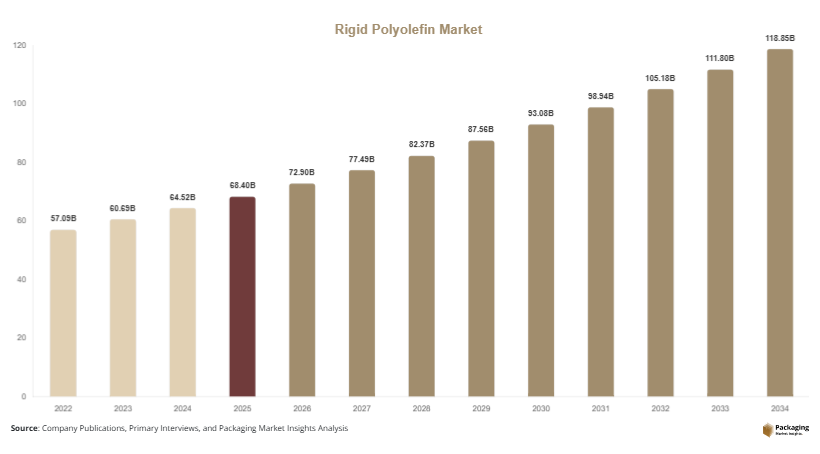
The global rigid polyolefin market size was valued at USD 68.4 billion in 2025 and is projected to reach USD 72.9 billion in 2026. Over the forecast period, the market is expected to reach approximately USD 126.3 billion by 2034, growing at a CAGR of 6.3% from 2025 to 2034. Rigid polyolefins, primarily including polyethylene (PE) and polypropylene (PP), are widely used in packaging, automotive, construction, and consumer goods due to their strength, chemical resistance, and versatility. The rigid polyolefin market is experiencing steady expansion due to increasing demand for durable, lightweight, and cost-efficient plastic materials across multiple industries.
One of the major growth factors is the rising demand for sustainable and recyclable materials. Polyolefins are increasingly preferred due to their recyclability and compatibility with circular economy initiatives. Manufacturers are focusing on developing advanced grades of rigid polyolefins that offer improved performance while reducing environmental impact. This shift aligns with global sustainability goals and regulatory requirements.
Key Highlights:
- Asia Pacific dominated the market with a 38.7% share in 2025, while Latin America is projected to grow at the fastest CAGR of 6.8%.
- Polypropylene led the type segment with a 45.6% share, while high-density polyethylene is expected to grow at a CAGR of 6.5%.
- Plastic packaging dominated with a 54.2% share, while construction applications are forecasted to grow at a CAGR of 6.1%.
- Food & beverage applications led the segment with 41.8% share, while automotive applications are expected to grow at a CAGR of 6.4%.
- China remained the dominant country with a market size of USD 18.5 billion in 2025 and USD 19.7 billion in 2026.
Explore more data points, trends and opportunities Download Free Sample Report
Market Trends
Increasing Adoption of Recyclable and Circular Polyolefin Materials
The rigid polyolefin market is increasingly influenced by sustainability trends, particularly the shift toward recyclable and circular materials. Manufacturers are focusing on developing polyolefin products that can be easily recycled and reused without compromising performance. This includes the use of mono-material packaging solutions that simplify recycling processes. Companies are also investing in advanced recycling technologies, such as chemical recycling, to improve material recovery rates. The demand for environmentally friendly materials is driving innovation in polyolefin production and processing. As regulatory pressure and consumer awareness continue to rise, the adoption of circular polyolefin materials is expected to accelerate.
Integration of Advanced Manufacturing and Lightweight Design
The integration of advanced manufacturing technologies is transforming the production of rigid polyolefins. Techniques such as injection molding, blow molding, and extrusion are being optimized to produce lightweight yet durable products. Lightweight design reduces material usage and transportation costs while maintaining structural integrity. This trend is particularly important in industries such as automotive and packaging, where efficiency and performance are critical. Manufacturers are also using simulation tools and automation to improve production efficiency and product consistency. The adoption of advanced manufacturing processes is expected to drive innovation and growth in the market.
Market Drivers
Growth of Packaging Industry and E-commerce Expansion
The rapid expansion of the packaging industry is a key driver of the rigid polyolefin market. Rigid polyolefins are widely used in packaging applications due to their strength, durability, and resistance to moisture and chemicals. The growth of e-commerce has increased the demand for reliable packaging solutions that can protect products during transportation. Companies are focusing on developing packaging materials that are both efficient and sustainable. This trend is expected to continue as online retail continues to grow globally.
Increasing Demand from Automotive and Construction Sectors
The automotive and construction industries are significant consumers of rigid polyolefins, driving market growth. In the automotive sector, polyolefins are used for interior and exterior components due to their lightweight properties and resistance to impact. This helps improve fuel efficiency and reduce emissions. In the construction industry, polyolefins are used in pipes, insulation, and structural components due to their durability and cost-effectiveness. The growth of these industries is expected to drive demand for rigid polyolefins.
Market Restraint
Environmental Concerns and Regulatory Challenges
The rigid polyolefin market faces challenges related to environmental concerns and regulatory restrictions on plastic usage. Governments and environmental organizations are implementing policies to reduce plastic waste and promote sustainable alternatives. This has led to increased scrutiny of polyolefin materials, particularly in single-use applications. Companies are required to invest in recycling infrastructure and develop eco-friendly materials to comply with regulations. For example, bans on certain plastic products in various regions have impacted demand for rigid polyolefins. These challenges can slow market growth and increase operational costs for manufacturers.
Market Opportunities
Development of Bio-Based and Recycled Polyolefins
The development of bio-based and recycled polyolefins presents significant opportunities for market growth. Manufacturers are exploring the use of renewable feedstocks to produce polyolefins with reduced environmental impact. Recycled polyolefins are also gaining traction as companies aim to meet sustainability targets. These materials offer similar performance characteristics to conventional polyolefins while reducing carbon footprint. The increasing demand for sustainable materials is expected to drive innovation and create new growth opportunities.
Expansion in Emerging Markets and Infrastructure Development
Emerging markets offer substantial growth opportunities for the rigid polyolefin market. Rapid urbanization and infrastructure development in regions such as Asia Pacific and Latin America are driving demand for construction materials and consumer goods. Rigid polyolefins are widely used in these applications due to their cost-effectiveness and durability. The growing middle-class population and increasing consumer spending are also contributing to market expansion. Companies that focus on these regions are likely to benefit from strong growth prospects.
Report Scope
| Report Metric | Details |
|---|---|
| Market Size in 2025 | USD 68.4 Billion |
| Market Size in 2026 | USD 72.9 Billion |
| Market Size in 2034 | USD 126.3 Billion |
| CAGR | 6.3% (2026-2034) |
| Base Year for Estimation | 2025 |
| Historical Data | 2022-2024 |
| Forecast Period | 2026-2034 |
| Report Coverage | Revenue Forecast, Competitive Landscape, Supply Chain Disruption, Growth Factors, Environment & Regulatory Landscape and Trends |
| Geographies Covered | North America, Europe, APAC, Middle East and Africa, LATAM |
| Countries Covered | U.S., Canada, U.K., Germany, France, Spain, Italy, Russia, Nordic, Benelux, Rest of Europe, China, South Korea, Japan, India, Australia, Singapore, Taiwan, South East Asia, Rest of Asia-Pacific, UAE, Turky, Saudi Arabia, South Africa, Egypt, Nigeria, Rest of MEA, Brazil, Mexico, Argentina, Chile, Colombia, Rest of LATAM |
Explore more data points, trends and opportunities Download Free Sample Report
Segmental Analysis
By Type
Polypropylene accounted for the largest share of 45.6% in 2024, driven by its versatility and wide range of applications. It is widely used in packaging, automotive components, and consumer goods due to its lightweight nature and resistance to chemicals and heat. The ability to be easily molded into various shapes makes it suitable for diverse applications. Continuous advancements in polypropylene grades are improving performance and expanding its use in high-value applications.
High-density polyethylene is expected to grow at a CAGR of 6.5%, driven by its strength and durability. It is commonly used in containers, pipes, and industrial applications. The increasing demand for robust and long-lasting materials is supporting segment growth. Additionally, advancements in processing technologies are enhancing the performance of HDPE products.
By Application
Packaging applications accounted for the largest share of 54.2% in 2024, driven by high demand for durable and lightweight materials. Rigid polyolefins are widely used in containers, bottles, and caps due to their ability to protect products and extend shelf life. The growth of e-commerce and food delivery services is further increasing demand for packaging materials.
Construction applications are expected to grow at a CAGR of 6.1%, supported by increasing infrastructure development. Polyolefins are used in pipes, insulation, and structural components due to their durability and cost-effectiveness. The expansion of construction activities is driving demand in this segment.
By End-Use
Food & beverage end-use accounted for the largest share of 41.8% in 2024, driven by high demand for packaged food products. Rigid polyolefins are used to ensure product safety and extend shelf life. The increasing demand for convenience foods is supporting segment growth.
Automotive end-use is expected to grow at a CAGR of 6.4%, driven by the need for lightweight materials. Polyolefins are used in vehicle components to reduce weight and improve fuel efficiency. The growth of the automotive industry is expected to drive demand in this segment.
Rigid Polyolefin Market Segmentations
By Product Type
- Polypropylene
- High-Density Polyethylene
- Low-Density Polyethylene
- Polyolefin Blends
By Application
- Packaging
- Construction
- Automotive
- Consumer Goods
By Distribution Channel
- Direct Sales (B2B)
- Distributors & Wholesalers
- Online Industrial Platforms
- Specialty Chemical Suppliers
- Retail Industrial Stores
Regional Analysis
North America
North America accounted for 26.9% of the rigid polyolefin market share in 2025 and is projected to grow at a CAGR of 5.9% during the forecast period. The region benefits from advanced manufacturing capabilities and strong demand from packaging and automotive industries. The presence of established polymer manufacturers and technological advancements is supporting market growth. Additionally, increasing focus on sustainability is encouraging the adoption of recyclable polyolefin materials.
The United States dominates the regional market due to its large industrial base and high demand for packaging materials. A key growth factor is the expansion of e-commerce, which is driving demand for durable packaging solutions. Companies are investing in advanced manufacturing technologies to improve efficiency and meet market demands.
Europe
Europe held a market share of 23.7% in 2025 and is expected to grow at a CAGR of 6.0%. The region is characterized by strict environmental regulations and a strong focus on sustainability. European countries are promoting the use of recyclable materials and reducing plastic waste, which is influencing the development of advanced polyolefin products. The presence of leading packaging and automotive companies also supports market growth.
Germany is the leading country in the European market, driven by its strong industrial base and focus on innovation. A unique growth factor is the country’s emphasis on circular economy practices, which is driving the adoption of recycled polyolefin materials. This trend is expected to support market expansion.
Asia Pacific
Asia Pacific dominated the market with a 38.7% share in 2025 and is projected to grow at a CAGR of 6.9%. The region’s growth is driven by rapid industrialization, urbanization, and increasing consumer demand. Countries such as China, India, and Japan are witnessing significant growth in packaging, automotive, and construction industries. The availability of cost-effective raw materials and labor also contributes to market growth.
China is the dominant country in the region, supported by its large manufacturing base and growing consumer market. A key growth factor is the expansion of infrastructure and construction activities, which is driving demand for rigid polyolefins. This trend is expected to continue during the forecast period.
Middle East & Africa
The Middle East & Africa region accounted for 5.4% of the market share in 2025 and is expected to grow at a CAGR of 6.2%. The region is experiencing growth in industrial activities and infrastructure development, which is supporting the demand for polyolefin materials. Governments are investing in construction and manufacturing sectors, driving market growth.
Saudi Arabia is a key market in the region due to its strong petrochemical industry. A unique growth factor is the availability of raw materials for polyolefin production, which supports local manufacturing and reduces costs. This is expected to drive market growth.
Latin America
Latin America held a 5.3% share in 2025 and is projected to grow at a CAGR of 6.8%. The region’s growth is driven by increasing consumer demand and expanding industrial sectors. The rise of e-commerce and improving infrastructure are also contributing to market expansion. Companies are focusing on cost-effective solutions to meet market demands.
Brazil dominates the regional market, supported by its large population and growing economy. A key growth factor is the increasing demand for packaging materials in the food and beverage industry. This trend is expected to drive market growth.
Competitive Landscape
The rigid polyolefin market is moderately competitive, with key players focusing on innovation and sustainability. Companies are investing in research and development to improve product performance and reduce environmental impact. Strategic partnerships and acquisitions are common strategies used to expand market presence.
ExxonMobil is recognized as a leading player in the market, offering a wide range of polyolefin products. The company recently introduced advanced recyclable polyolefin materials to support sustainability initiatives. Other major players are also focusing on expanding their product portfolios and enhancing their technological capabilities.
Key Players List
- ExxonMobil Corporation
- LyondellBasell Industries N.V.
- SABIC
- Dow Inc.
- INEOS Group
- Borealis AG
- Braskem S.A.
- Formosa Plastics Corporation
- TotalEnergies SE
- Reliance Industries Limited
- Chevron Phillips Chemical Company
- Mitsui Chemicals Inc.
- LG Chem Ltd.
- Sinopec Corporation
- PetroChina Company Limited