Rigid Plastic Packaging Market Size and Growth
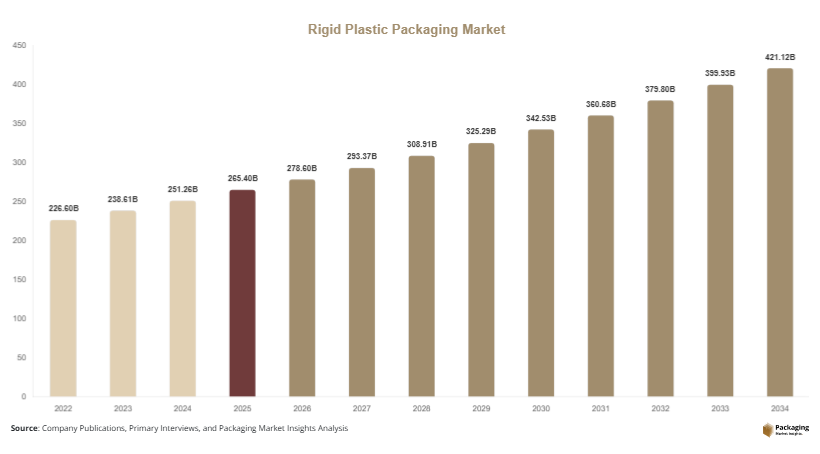
The rigid plastic packaging market size continues to play a central role in global packaging supply chains due to its durability, lightweight structure, and cost efficiency across industries. Rigid plastic formats such as bottles, containers, trays, and caps are widely used in food and beverage, pharmaceuticals, personal care, and industrial packaging. In 2025, the global rigid plastic packaging market size is estimated at USD 265.4 billion. The market is projected to grow to approximately USD 278.6 billion in 2026 and is expected to reach nearly USD 421.7 billion by 2034, registering a compound annual growth rate (CAGR) of 5.3% from 2025 to 2034.
The market growth is driven by several structural factors across industries. One of the primary growth factors is the rapid expansion of the global food and beverage industry. Rigid plastic containers offer strong barrier protection and longer shelf life, making them suitable for packaged foods, dairy products, and ready-to-eat meals. Rising urbanization and the growing demand for convenience packaging are accelerating adoption across emerging economies.
Key Highlights
- Global market size expected to reach USD 421.7 billion by 2034
- Estimated CAGR of 5.3% during 2025–2034
- Strong demand from food, beverage, pharmaceutical, and personal care industries
- Technological improvements supporting recyclable and lightweight packaging materials
- Expanding e-commerce distribution networks increasing packaging demand
Explore more data points, trends and opportunities Download Free Sample Report
Market Trends
Rising Adoption of Recyclable and Sustainable Plastic Packaging
One of the most visible trends shaping the rigid plastic packaging market is the growing shift toward recyclable and sustainable materials. Environmental concerns and regulatory pressure are pushing manufacturers to develop packaging solutions that minimize environmental impact. Companies are increasingly adopting recyclable polymers such as PET and HDPE while investing in closed-loop recycling systems that allow packaging materials to be reused.
Brand owners in food, beverage, and personal care sectors are also introducing packaging designs that reduce plastic usage without compromising product protection. Lightweight bottles, thinner walls, and mono-material packaging structures are gaining traction across global supply chains. These design innovations allow companies to lower material consumption and transportation emissions while maintaining functional performance.
Consumer awareness regarding sustainability is also influencing purchasing decisions. Many consumers prefer products packaged in recyclable materials, which encourages brands to adopt eco-friendly rigid packaging formats. As sustainability goals become central to corporate strategies, recyclable rigid plastic packaging solutions are expected to expand across multiple industries.
Increasing Demand for Smart and Functional Packaging
Another key trend in the rigid plastic packaging market is the development of smart and functional packaging technologies. Manufacturers are integrating advanced features such as tamper-evident closures, freshness indicators, and traceability technologies to enhance packaging performance and product safety.
Smart packaging solutions are particularly relevant in the pharmaceutical and food sectors where product authenticity and shelf-life monitoring are critical. Technologies such as QR codes, digital labeling, and sensor-based indicators allow manufacturers and consumers to monitor product conditions throughout the supply chain.
Rigid plastic packaging also enables the integration of ergonomic designs, improved dispensing systems, and reclosable lids. These features enhance convenience and usability for consumers while supporting product differentiation for brands. As product innovation becomes a competitive strategy for consumer goods companies, the demand for functional rigid packaging solutions is expected to grow steadily.
Market Drivers
Growth of Packaged Food and Beverage Consumption
The expansion of the packaged food and beverage industry is a major driver of the rigid plastic packaging market. Changing consumer lifestyles, urbanization, and increasing demand for convenience foods are fueling the need for durable and reliable packaging solutions. Rigid plastic containers offer high resistance to physical damage, moisture, and contamination, making them suitable for a wide range of food products.
Food manufacturers rely on rigid packaging formats such as bottles, jars, trays, and tubs to maintain product quality during storage and transportation. Ready-to-eat meals, dairy products, sauces, and beverages often require rigid packaging to maintain shape and provide sealing protection. Additionally, rigid containers allow efficient stacking and logistics management, which reduces transportation costs.
The rise of modern retail formats and online grocery delivery services further supports demand for rigid packaging. As consumers increasingly purchase packaged food products through supermarkets and digital platforms, the need for robust packaging formats continues to expand globally.
Expanding Pharmaceutical and Healthcare Industry
The rapid growth of the global pharmaceutical and healthcare industry is another important driver of rigid plastic packaging demand. Pharmaceutical companies require packaging materials that meet strict safety and hygiene standards while ensuring product stability and extended shelf life.
Rigid plastic bottles, vials, and containers are widely used for tablets, capsules, liquid medications, and medical supplements. Materials such as PET and HDPE offer chemical resistance and excellent barrier properties, which protect pharmaceutical products from contamination and degradation.
In addition, the increasing prevalence of chronic diseases and aging populations in many countries is driving higher pharmaceutical consumption. Governments are expanding healthcare infrastructure and improving access to medicines, which increases demand for medical packaging solutions. As healthcare services expand globally, rigid plastic packaging manufacturers are likely to experience stable demand from pharmaceutical supply chains.
Market Restraint
Environmental Concerns and Plastic Waste Regulations
Environmental concerns related to plastic waste represent a key restraint for the rigid plastic packaging market. Governments and environmental organizations worldwide are introducing stricter regulations aimed at reducing plastic pollution and encouraging sustainable packaging alternatives. These regulations include restrictions on single-use plastics, recycling mandates, and extended producer responsibility programs.
Rigid plastic packaging, although durable and recyclable in many cases, is often criticized for contributing to environmental waste when not properly recycled. Many developing countries lack efficient waste management systems, which results in plastic packaging accumulating in landfills or natural ecosystems.
As a result, packaging manufacturers face increasing pressure to develop environmentally responsible solutions. Companies are investing in biodegradable materials, recyclable plastics, and advanced recycling technologies. However, these innovations often require significant capital investment and technological adaptation, which can increase production costs.
For example, some beverage companies are transitioning to alternative materials such as aluminum or glass packaging to meet sustainability goals. While these materials have their own advantages, they also introduce competition for rigid plastic packaging solutions. Consequently, environmental regulations and sustainability concerns may limit market expansion if manufacturers fail to adapt to evolving environmental expectations.
Market Opportunities
Growth in Emerging Markets
Emerging economies present significant opportunities for the rigid plastic packaging market. Rapid urbanization, expanding middle-class populations, and increasing consumption of packaged goods are driving demand for packaging solutions across Asia, Latin America, and parts of Africa.
As retail infrastructure improves and modern distribution networks expand, manufacturers are increasing production of packaged foods, beverages, and personal care products. These products require durable packaging formats that ensure safe transportation and long shelf life. Rigid plastic containers provide an efficient and cost-effective solution for manufacturers targeting growing consumer markets.
Local manufacturing investments and infrastructure development in emerging economies are also encouraging packaging companies to establish regional production facilities. These investments reduce logistics costs and improve supply chain efficiency, creating favorable conditions for long-term market expansion.
Development of Advanced Recycling Technologies
Advancements in recycling technologies create new opportunities for the rigid plastic packaging industry. Chemical recycling, improved mechanical recycling systems, and closed-loop manufacturing processes allow plastic materials to be reused multiple times without losing quality.
These technologies enable manufacturers to produce high-quality recycled plastic suitable for food and pharmaceutical packaging applications. As regulatory authorities encourage the use of recycled materials, packaging companies are adopting recycled PET and other sustainable polymers.
The integration of recycling infrastructure also helps companies achieve sustainability goals and reduce environmental impact. Brands are increasingly committing to packaging made from recycled materials, which encourages innovation within the rigid plastic packaging market. Continued development of recycling systems is expected to support long-term industry growth.
Report Scope
| Report Metric | Details |
|---|---|
| Market Size in 2025 | USD 265.4 Billion |
| Market Size in 2026 | USD 278.6 Billion |
| Market Size in 2034 | USD 421.7 Billion |
| CAGR | 5.3% (2026-2034) |
| Base Year for Estimation | 2025 |
| Historical Data | 2022-2024 |
| Forecast Period | 2026-2034 |
| Report Coverage | Revenue Forecast, Competitive Landscape, Supply Chain Disruption, Growth Factors, Environment & Regulatory Landscape and Trends |
| Geographies Covered | North America, Europe, APAC, Middle East and Africa, LATAM |
| Countries Covered | U.S., Canada, U.K., Germany, France, Spain, Italy, Russia, Nordic, Benelux, Rest of Europe, China, South Korea, Japan, India, Australia, Singapore, Taiwan, South East Asia, Rest of Asia-Pacific, UAE, Turky, Saudi Arabia, South Africa, Egypt, Nigeria, Rest of MEA, Brazil, Mexico, Argentina, Chile, Colombia, Rest of LATAM |
Explore more data points, trends and opportunities Download Free Sample Report
Segmental Analysis
By Type
The bottles and containers segment dominated the rigid plastic packaging market with a 2024 share of approximately 46.8%. These packaging formats are widely used across food and beverage, pharmaceutical, and personal care industries due to their durability and convenience. Plastic bottles are commonly produced using PET and HDPE materials, which provide strong barrier properties and chemical resistance. Beverage manufacturers rely heavily on rigid plastic bottles for water, soft drinks, and juices. Similarly, personal care products such as shampoos, lotions, and household cleaning liquids use rigid containers to ensure product safety and ease of use. The dominance of this segment is supported by large-scale manufacturing capacity and established distribution networks that rely on standardized bottle formats.
The rigid plastic trays segment is projected to be the fastest-growing category, expanding at a CAGR of approximately 6.4% during the forecast period. Growth in this segment is driven by increasing demand for ready-to-eat meals and packaged fresh food products. Plastic trays are widely used in supermarkets and food delivery services because they provide structural support and maintain product presentation. Advances in thermoforming technology allow manufacturers to produce lightweight trays with strong durability and recyclable materials. As convenience food consumption increases globally, rigid plastic trays are expected to experience significant demand across retail and food service industries.
By Material
The polyethylene terephthalate (PET) segment accounted for the largest share of the rigid plastic packaging market in 2024 at approximately 39.2%. PET is widely used due to its clarity, strength, and recyclability. Beverage companies prefer PET bottles because they are lightweight, resistant to impact, and capable of preserving carbonation. The material also offers excellent barrier properties against moisture and oxygen, which helps maintain product freshness. PET packaging is commonly used for bottled water, carbonated beverages, edible oils, and personal care products. Its widespread availability and established recycling systems make it one of the most preferred materials in rigid packaging manufacturing.
The polypropylene (PP) segment is expected to grow at the fastest rate, with an estimated CAGR of 6.1% through 2034. Polypropylene offers strong heat resistance and chemical stability, which makes it suitable for food containers and microwaveable packaging. The growth of ready-to-eat meals and takeaway food services is driving demand for polypropylene containers. Additionally, PP materials are increasingly used in pharmaceutical packaging applications where sterilization resistance is essential. As manufacturers focus on developing lightweight and recyclable materials, polypropylene is gaining traction as a versatile solution for rigid plastic packaging.
By End-Use Industry
The food and beverage industry dominated the rigid plastic packaging market in 2024, accounting for approximately 48.5% of total demand. The sector relies heavily on rigid packaging formats such as bottles, jars, and trays to preserve product quality and extend shelf life. Rising demand for packaged snacks, dairy products, beverages, and frozen foods continues to support this segment. Retail chains and online grocery services also require durable packaging to ensure safe distribution. As global food consumption increases, manufacturers are expanding production capacities for rigid plastic packaging used in food storage and transportation.
The pharmaceutical industry is expected to be the fastest-growing end-use segment, registering a CAGR of about 6.3% during the forecast period. Pharmaceutical companies require secure packaging that protects medicines from contamination and environmental exposure. Rigid plastic bottles and containers offer tamper-evident features and reliable sealing systems. Increasing healthcare access, expanding pharmaceutical production, and growing demand for over-the-counter medications are driving the adoption of rigid plastic packaging in this sector.
Rigid Plastic Packaging Market Segmentations
Type
- Bottles and Containers
- Trays
- Jars
- Caps and Closures
- Others
Material
- Polyethylene Terephthalate (PET)
- Polypropylene (PP)
- High-Density Polyethylene (HDPE)
- Polystyrene (PS)
- Others
End-Use Industry
- Food and Beverage
- Pharmaceutical
- Personal Care and Cosmetics
- Household Products
- Industrial
Regional Analysis
North America
North America accounted for approximately 28.6% of the global rigid plastic packaging market share in 2025. The region is projected to expand at a CAGR of around 4.6% during the forecast period. Demand is supported by well-established food processing industries, strong pharmaceutical manufacturing capacity, and high consumption of packaged consumer goods. Companies in the region continue to invest in advanced packaging technologies and automation, which improves production efficiency and supports steady market expansion.
The United States dominates the North American market due to its large food, beverage, and healthcare sectors. A unique growth factor in the country is the strong presence of e-commerce logistics networks that require durable packaging formats. Online grocery deliveries, subscription food services, and pharmaceutical distribution channels rely on rigid containers to protect products during shipping, which supports steady demand across the region.
Europe
Europe held approximately 24.1% market share in 2025 within the global rigid plastic packaging market. The region is expected to register a CAGR of about 4.3% through 2034. Growth is influenced by increasing consumption of packaged food products, strong pharmaceutical manufacturing capabilities, and ongoing innovation in sustainable packaging technologies.
Germany represents the dominant country in the European market due to its advanced manufacturing base and strong recycling infrastructure. A unique growth factor supporting the German market is the development of circular economy initiatives. Government policies promoting recyclable packaging materials encourage manufacturers to produce rigid plastic containers made from recycled polymers.
Asia Pacific
Asia Pacific accounted for roughly 33.4% of global market share in 2025, making it the largest regional market. The region is forecast to grow at a CAGR of approximately 6.5% between 2025 and 2034, driven by rapid industrialization and expanding consumer markets. The rising demand for packaged food, beverages, and personal care products across urban populations contributes significantly to regional growth.
China dominates the Asia Pacific rigid plastic packaging market due to its extensive manufacturing ecosystem and large consumer base. A key growth factor is the rapid expansion of domestic e-commerce platforms that require efficient packaging solutions. Increasing online retail activity creates consistent demand for durable packaging formats capable of protecting products during transportation.
Middle East & Africa
The Middle East & Africa region held about 6.2% of the rigid plastic packaging market share in 2025. The market is expected to grow at a CAGR of nearly 5.1% through 2034. Demand is influenced by rising food imports, expanding retail sectors, and improving healthcare infrastructure across several countries.
Saudi Arabia represents the dominant country in the region due to its growing food processing and petrochemical industries. A unique growth factor supporting the Saudi market is the availability of raw materials derived from petrochemical production, which enables cost-efficient plastic manufacturing and strengthens local packaging supply chains.
Latin America
Latin America accounted for approximately 7.7% of the global market share in 2025. The region is projected to expand at a CAGR of about 5.0% during the forecast period. Increasing urbanization and rising consumption of packaged goods contribute to steady demand for rigid plastic packaging across multiple industries.
Brazil dominates the regional market due to its large food processing industry and expanding beverage sector. A key growth factor in the Brazilian market is the growing demand for packaged dairy products and beverages. Manufacturers increasingly rely on rigid plastic containers and bottles to maintain product freshness and ensure safe distribution.
Competitive Landscape
The rigid plastic packaging market is moderately consolidated with the presence of several global and regional manufacturers. Leading companies focus on expanding production capacity, developing sustainable materials, and strengthening supply chain networks to maintain market competitiveness.
One of the leading companies in the market is Amcor Plc, which holds a strong global presence in rigid packaging solutions for food, beverage, and healthcare applications. The company continues to invest in recyclable packaging technologies and lightweight material development to align with sustainability goals.
Other major companies such as Berry Global Group, Silgan Holdings, Alpla Group, and Plastipak Holdings play significant roles in the global rigid plastic packaging industry. These companies focus on product innovation, strategic partnerships, and geographic expansion to strengthen their market position.
Recent industry developments include investments in recycling infrastructure and partnerships with consumer goods companies to produce packaging made from recycled plastics. Competitive strategies are increasingly centered on sustainability initiatives and advanced manufacturing technologies that improve packaging performance while reducing environmental impact.
Key Players List
- Amcor Plc
- Berry Global Group
- Silgan Holdings Inc.
- Alpla Group
- Plastipak Holdings Inc.
- Graham Packaging Company
- AptarGroup Inc.
- RPC Group Plc
- Sonoco Products Company
- Gerresheimer AG
- CCL Industries Inc.
- Alpha Packaging
- Consolidated Container Company
- Mold-Rite Plastics
- Greiner Packaging International