RFID Smart Packaging Market Size and Growth
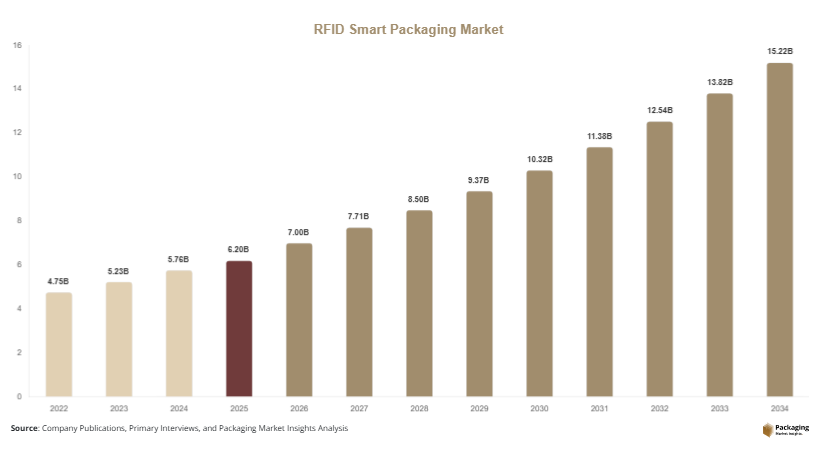
The RFID smart packaging market is experiencing steady expansion as industries increasingly adopt intelligent packaging solutions to enhance supply chain visibility and product tracking. The market size was valued at approximately USD 6.2 billion in 2025 and is expected to reach USD 7.0 billion in 2026. With the growing integration of digital technologies in packaging systems, the market is projected to reach USD 16.8 billion by 2034, registering a CAGR of 10.2% during 2025–2034. This growth reflects the rising demand for real-time data monitoring and improved inventory management across industries.
RFID smart packaging integrates radio-frequency identification technology into packaging materials to enable wireless tracking, authentication, and data storage. These systems are widely used in retail, logistics, pharmaceuticals, and food industries to monitor product movement, ensure authenticity, and enhance operational efficiency. The increasing complexity of global supply chains is encouraging companies to adopt RFID-enabled packaging solutions for better transparency and control.
Key Highlights:
- The RFID Smart Packaging Market is projected to reach USD 16.8 billion by 2034, growing at a CAGR of 10.2% during 2025–2034.
- Growth is driven by increasing adoption in retail and logistics sectors along with rising demand for anti-counterfeiting solutions.
- Additionally, the rapid expansion of e-commerce is further accelerating the adoption of RFID-enabled smart packaging technologies.
Explore more data points, trends and opportunities Download Free Sample Report
Market Trends
Integration of IoT with RFID Packaging Solutions
The RFID smart packaging market is witnessing a growing trend toward the integration of Internet of Things (IoT) technologies with RFID systems. This integration enables real-time data collection and analysis, allowing companies to monitor product conditions such as temperature, humidity, and location throughout the supply chain. The combination of RFID and IoT enhances visibility and provides actionable insights, improving decision-making processes. Industries such as pharmaceuticals and food are adopting these solutions to ensure product quality and safety. This trend is expected to continue as companies seek to leverage digital technologies for supply chain optimization.
Adoption of Smart Packaging in Retail Automation
Another key trend is the increasing adoption of RFID smart packaging in retail automation. Retailers are using RFID-enabled packaging to streamline inventory management, reduce stock discrepancies, and improve customer experience. Automated checkout systems and smart shelves are becoming more common, driven by the need for efficiency and convenience. RFID technology allows for accurate tracking of products, reducing losses due to theft or misplacement. This trend is particularly strong in large retail chains, where managing inventory efficiently is critical to business success.
Market Drivers
Rising Demand for Supply Chain Transparency
The need for greater transparency in supply chains is a major driver of the RFID smart packaging market. Companies are increasingly focusing on improving visibility to enhance efficiency and reduce operational risks. RFID technology provides real-time tracking and monitoring, enabling businesses to identify bottlenecks and optimize processes. This capability is particularly important in industries such as logistics and retail, where timely delivery and inventory accuracy are critical. As supply chains become more complex, the demand for RFID-enabled packaging solutions is expected to increase.
Growing Need for Anti-Counterfeiting Measures
The increasing prevalence of counterfeit products is driving the adoption of RFID smart packaging. Industries such as pharmaceuticals, electronics, and luxury goods are particularly vulnerable to counterfeiting, which can result in significant financial losses and damage to brand reputation. RFID technology enables product authentication and tracking, helping companies prevent the distribution of counterfeit goods. This driver is expected to play a significant role in market growth, as companies prioritize product security and consumer trust.
Market Restraint
High Implementation Costs and Infrastructure Requirements
One of the primary restraints in the RFID smart packaging market is the high cost associated with implementation and infrastructure development. Integrating RFID technology into packaging requires investment in tags, readers, software systems, and training. These costs can be significant, particularly for small and medium-sized enterprises, limiting adoption in cost-sensitive markets.
For example, deploying RFID systems across a large retail network involves installing readers at multiple locations and integrating data management systems. This process can be complex and time-consuming, requiring specialized expertise. Additionally, the cost of RFID tags, although decreasing, still adds to overall packaging expenses. These factors can hinder market growth, especially in regions where cost constraints are a major concern. Addressing these challenges will require continued innovation to reduce costs and simplify implementation processes.
Market Opportunities
Expansion in Pharmaceutical and Healthcare Applications
The pharmaceutical and healthcare sectors present significant opportunities for the RFID smart packaging market. The need for secure and traceable packaging solutions is increasing due to stringent regulations and the risk of counterfeit drugs. RFID technology enables real-time tracking and authentication, ensuring product safety and compliance. The adoption of RFID smart packaging in healthcare is expected to grow as companies seek to enhance supply chain efficiency and patient safety.
Growth in E-commerce and Logistics Sectors
The rapid expansion of e-commerce and logistics is creating new opportunities for RFID smart packaging. As online retail continues to grow, companies require efficient tracking systems to manage large volumes of shipments. RFID technology provides accurate and real-time tracking, improving delivery efficiency and customer satisfaction. The increasing demand for automated logistics solutions is expected to drive the adoption of RFID smart packaging in this sector.
Report Scope
| Report Metric | Details |
|---|---|
| Market Size in 2025 | USD 6.2 Billion |
| Market Size in 2026 | USD 7.0 Billion |
| Market Size in 2034 | USD 16.8 Billion |
| CAGR | 10.2% (2026-2034) |
| Base Year for Estimation | 2025 |
| Historical Data | 2022-2024 |
| Forecast Period | 2026-2034 |
| Report Coverage | Revenue Forecast, Competitive Landscape, Supply Chain Disruption, Growth Factors, Environment & Regulatory Landscape and Trends |
| Geographies Covered | North America, Europe, APAC, Middle East and Africa, LATAM |
| Countries Covered | U.S., Canada, U.K., Germany, France, Spain, Italy, Russia, Nordic, Benelux, Rest of Europe, China, South Korea, Japan, India, Australia, Singapore, Taiwan, South East Asia, Rest of Asia-Pacific, UAE, Turky, Saudi Arabia, South Africa, Egypt, Nigeria, Rest of MEA, Brazil, Mexico, Argentina, Chile, Colombia, Rest of LATAM |
Explore more data points, trends and opportunities Download Free Sample Report
Segmental Analysis
By Component
The RFID tags segment dominated the RFID smart packaging market in 2024, accounting for approximately 55% of the market share. RFID tags are essential components that store and transmit data, making them widely used across industries. Their relatively lower cost and ease of integration contribute to their dominance.
The RFID readers segment is expected to be the fastest-growing, with a CAGR of 11.0% during the forecast period. The growth is driven by increasing demand for advanced data collection systems that enable real-time monitoring and analysis.
By Application
The retail segment held the largest market share in 2024, accounting for approximately 50%. Retailers use RFID smart packaging to improve inventory management, reduce losses, and enhance customer experience.
The pharmaceutical segment is expected to grow at the fastest CAGR of 10.8% during the forecast period. The growth is attributed to the increasing need for secure and traceable packaging solutions in the healthcare industry.
By End-Use Industry
The logistics segment dominated the market in 2024, with a share of approximately 48%. The demand for efficient tracking and monitoring solutions is driving the adoption of RFID smart packaging in this segment.
The e-commerce segment is projected to grow at the fastest CAGR of 11.7% during the forecast period. The rapid expansion of online retail is increasing demand for advanced tracking solutions.
RFID Smart Packaging Market Segmentations
Component
- RFID Tags
- RFID Readers
- Software & Services
Application
- Retail
- Pharmaceuticals
- Food & Beverage
- Logistics
End-Use Industry
- Logistics
- Healthcare
- Retail
- E-commerce
Regional Analysis
North America
North America accounted for approximately 32% of the RFID smart packaging market share in 2025 and is expected to grow at a CAGR of 9.8% during the forecast period. The region benefits from advanced technological infrastructure and high adoption of digital solutions. The presence of major retail and logistics companies is driving demand for RFID-enabled packaging.
The United States dominates the regional market due to its strong focus on innovation and technology adoption. A key growth factor is the widespread use of RFID technology in retail automation, which enhances inventory management and customer experience.
Europe
Europe held a market share of around 28% in 2025 and is projected to grow at a CAGR of 10.0% through 2034. The region is characterized by strong regulatory frameworks and emphasis on supply chain transparency. The adoption of RFID smart packaging is supported by initiatives aimed at improving product traceability.
Germany leads the European market due to its advanced manufacturing sector and focus on technological innovation. A unique growth factor is the increasing use of RFID in industrial applications, which enhances operational efficiency.
Asia Pacific
Asia Pacific accounted for approximately 25% of the market share in 2025 and is expected to register the fastest CAGR of 11.5% during the forecast period. Rapid industrialization and expansion of e-commerce are driving market growth in the region.
China dominates the Asia Pacific market due to its large manufacturing base and growing adoption of digital technologies. A key growth factor is the increasing investment in smart logistics infrastructure, which supports the adoption of RFID solutions.
Middle East & Africa
The Middle East & Africa region held a market share of around 8% in 2025 and is projected to grow at a CAGR of 9.0% during the forecast period. The market is gradually expanding as awareness of RFID technology increases.
The United Arab Emirates is a leading country in the region, driven by its focus on technological innovation. A unique growth factor is the adoption of smart packaging solutions in the retail and logistics sectors.
Latin America
Latin America accounted for approximately 7% of the market share in 2025 and is expected to grow at a CAGR of 9.4% through 2034. The region is experiencing steady growth due to increasing demand for advanced packaging solutions.
Brazil dominates the regional market due to its growing retail and logistics sectors. A key growth factor is the rising adoption of RFID technology to improve supply chain efficiency.
Competitive Landscape
The RFID smart packaging market is characterized by strong competition, with key players focusing on innovation and technological advancements. Companies are investing in research and development to enhance the performance and cost-effectiveness of RFID solutions. Strategic partnerships and acquisitions are common strategies used to strengthen market position.
Avery Dennison Corporation is a leading player in the market, known for its extensive portfolio of RFID solutions. The company recently introduced advanced RFID tags designed for improved performance and reduced costs. Other major players are also expanding their product offerings to meet growing demand.
Key Players List
- Avery Dennison Corporation
- Zebra Technologies Corporation
- Alien Technology LLC
- Checkpoint Systems Inc.
- Smartrac N.V.
- Honeywell International Inc.
- SATO Holdings Corporation
- CCL Industries Inc.
- Invengo Technology Pte. Ltd.
- Identiv Inc.
- Impinj Inc.
- Thinfilm Electronics ASA
- NXP Semiconductors
- GAO RFID Inc.
- HID Global Corporation