Reusable Packaging Market Size and Growth
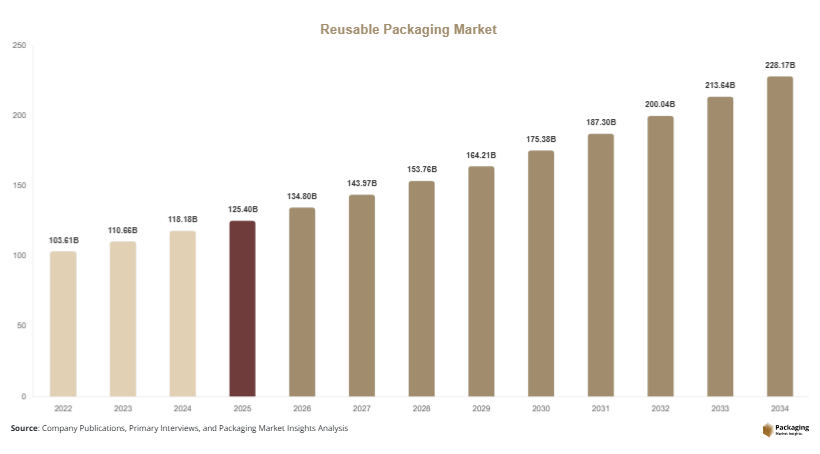
The Reusable Packaging Market is experiencing steady expansion as industries shift toward sustainable packaging systems and circular economy practices. The market size was valued at approximately USD 125.4 billion in 2025 and is projected to reach USD 134.8 billion in 2026. Over the forecast period from 2025 to 2034, the market is expected to grow at a CAGR of 6.8%, reaching an estimated value of USD 221.6 billion by 2034. The increasing focus on reducing packaging waste and improving operational efficiency is driving the adoption of reusable packaging solutions across multiple industries.
One of the key growth factors is the rising implementation of environmental regulations aimed at reducing single-use plastic waste. Governments and regulatory bodies across regions are introducing policies that encourage businesses to adopt reusable packaging systems. Another important factor is the cost efficiency achieved over the lifecycle of reusable packaging products. Although initial investment may be higher, long-term savings in material and disposal costs make reusable packaging economically viable. Additionally, the rapid growth of e-commerce and logistics sectors is supporting demand for durable and reusable transport packaging such as pallets, crates, and containers.
Key Highlights:
- Market size reached USD 125.4 billion in 2025
- Expected to grow to USD 221.6 billion by 2034
- CAGR of 6.8% from 2025 to 2034
- Increasing focus on sustainability and waste reduction
- Growing adoption in logistics and e-commerce sectors
Explore more data points, trends and opportunities Download Free Sample Report
Market Trends
Rising Adoption of Circular Economy Packaging Models
The reusable packaging market is increasingly aligned with circular economy principles, where packaging materials are reused, recycled, and reintegrated into the supply chain. Companies are shifting from traditional linear packaging systems to closed-loop systems that reduce waste and improve resource efficiency. Reusable containers, pallets, and crates are being designed for multiple cycles of use, minimizing environmental impact. This trend is driven by regulatory pressures and corporate sustainability goals. Businesses are also adopting pooling systems, where packaging assets are shared among multiple users. This approach reduces costs and improves utilization rates, supporting overall market growth.
Integration of Smart Tracking Technologies in Reusable Packaging
The integration of smart technologies such as RFID, GPS, and IoT sensors is transforming the reusable packaging market. These technologies enable real-time tracking of packaging assets, improving supply chain visibility and operational efficiency. Companies can monitor the location, condition, and usage cycles of reusable packaging units. This helps reduce losses and optimize asset management. The use of data analytics further enhances decision-making processes. As supply chains become more complex, the demand for intelligent tracking solutions is expected to increase, supporting the growth of reusable packaging systems.
Market Drivers
Increasing Regulatory Pressure on Single-Use Packaging
Government regulations aimed at reducing single-use plastics are a major driver of the reusable packaging market. Policies such as bans on plastic bags and restrictions on disposable packaging are encouraging businesses to adopt reusable alternatives. Regulatory frameworks are becoming stricter, requiring companies to implement sustainable packaging practices. This driver is particularly strong in regions such as Europe and North America. Companies that comply with these regulations can improve their brand image and reduce environmental impact, further supporting market growth.
Cost Efficiency and Operational Benefits of Reusable Systems
Reusable packaging systems offer significant cost advantages over time, driving their adoption across industries. Although the initial investment is higher, the ability to reuse packaging multiple times reduces overall costs. Companies benefit from lower material consumption and reduced waste management expenses. Additionally, reusable packaging improves operational efficiency by providing standardized and durable solutions. This driver is particularly relevant in industries such as automotive, food and beverage, and retail, where large volumes of packaging are required.
Market Restraint
High Initial Investment and Logistics Complexity
The high initial investment required for reusable packaging systems is a key restraint in the reusable packaging market. Businesses must invest in durable packaging materials, tracking technologies, and reverse logistics systems. For small and medium-sized enterprises, this can be a significant financial burden. Additionally, managing the return and reuse of packaging units adds complexity to supply chain operations. For example, a logistics company may face challenges in collecting and redistributing reusable containers across multiple locations. This increases operational costs and requires efficient coordination. These factors can limit the adoption of reusable packaging, particularly in regions with less developed infrastructure.
Market Opportunities
Expansion of E-commerce and Retail Logistics
The growth of e-commerce and retail logistics presents significant opportunities for the reusable packaging market. Online shopping requires efficient and durable packaging solutions to ensure product safety during transit. Reusable packaging systems such as returnable boxes and containers can reduce waste and improve cost efficiency. Companies are increasingly adopting these solutions to meet sustainability goals and enhance customer satisfaction. The expansion of last-mile delivery services further supports the demand for reusable packaging solutions.
Development of Innovative and Lightweight Materials
Advancements in material science are creating opportunities for the development of innovative and lightweight reusable packaging solutions. New materials offer improved durability, reduced weight, and enhanced performance. This makes reusable packaging more efficient and cost-effective. Companies are investing in research and development to create materials that can withstand multiple usage cycles while maintaining quality. The adoption of these materials is expected to drive market growth and expand the range of applications for reusable packaging.
Report Scope
| Report Metric | Details |
|---|---|
| Market Size in 2025 | USD 125.4 Billion |
| Market Size in 2026 | USD 134.8 Billion |
| Market Size in 2034 | USD 221.6 Billion |
| CAGR | 6.8% (2026-2034) |
| Base Year for Estimation | 2025 |
| Historical Data | 2022-2024 |
| Forecast Period | 2026-2034 |
| Report Coverage | Revenue Forecast, Competitive Landscape, Supply Chain Disruption, Growth Factors, Environment & Regulatory Landscape and Trends |
| Geographies Covered | North America, Europe, APAC, Middle East and Africa, LATAM |
| Countries Covered | U.S., Canada, U.K., Germany, France, Spain, Italy, Russia, Nordic, Benelux, Rest of Europe, China, South Korea, Japan, India, Australia, Singapore, Taiwan, South East Asia, Rest of Asia-Pacific, UAE, Turky, Saudi Arabia, South Africa, Egypt, Nigeria, Rest of MEA, Brazil, Mexico, Argentina, Chile, Colombia, Rest of LATAM |
Explore more data points, trends and opportunities Download Free Sample Report
Segmental Analysis
By Type
Reusable pallets dominated the reusable packaging market in 2024, accounting for approximately 38% of the total market share. These pallets are widely used in logistics and transportation due to their durability and ability to handle heavy loads. They provide cost efficiency and reduce waste compared to single-use pallets. Industries such as automotive, retail, and manufacturing rely heavily on reusable pallets for efficient operations. The availability of various materials, including plastic and metal, enhances their performance and lifespan, supporting market growth.
Reusable crates are expected to be the fastest-growing segment, with a CAGR of 7.4% during the forecast period. These crates are widely used in food and beverage and retail industries for transporting goods. Their lightweight design and stackability improve storage efficiency. Increasing demand for sustainable packaging solutions drives the growth of this segment.
By Material
Plastic-based reusable packaging dominated the market in 2024, with a share of approximately 46%. Plastic materials such as polyethylene and polypropylene offer durability, flexibility, and resistance to environmental conditions. These properties make them suitable for multiple usage cycles. The widespread availability and cost efficiency of plastic materials support their dominance in the market.
Metal-based reusable packaging is expected to grow at the highest CAGR of 7.2% during the forecast period. Metal packaging offers high strength and durability, making it suitable for heavy-duty applications. The increasing demand for robust packaging solutions in industrial sectors drives the growth of this segment.
By End-Use
The logistics and transportation sector dominated the market in 2024, accounting for approximately 42% of the total market share. This sector requires efficient and durable packaging solutions to handle large volumes of goods. Reusable packaging systems help reduce costs and improve operational efficiency. The growth of global trade and e-commerce further supports this segment.
The food and beverage sector is expected to grow at the fastest CAGR of 7.5% during the forecast period. Increasing demand for sustainable packaging solutions and stringent food safety regulations drive the adoption of reusable packaging in this sector. This segment is expected to contribute significantly to market growth.
Reusable Packaging Market Segmentations
Product Type
- Pallets
- Crates
- Containers
- Dunnage
Material
- Plastic
- Metal
- Wood
- Others
End-Use
- Logistics & Transportation
- Food & Beverage
- Automotive
- Retail
Regional Analysis
North America
North America accounted for approximately 34% of the reusable packaging market share in 2025 and is expected to grow at a CAGR of 6.2% during the forecast period. The region’s strong regulatory framework and emphasis on sustainability support the adoption of reusable packaging systems. Industries such as automotive and retail are major contributors to market growth.
The United States dominates the regional market due to its large industrial base and advanced logistics infrastructure. A unique growth factor is the increasing adoption of reusable packaging in e-commerce fulfillment centers, which enhances operational efficiency and reduces waste.
Europe
Europe held around 29% of the market share in 2025 and is projected to grow at a CAGR of 6.5% through 2034. The region’s focus on environmental sustainability and circular economy practices drives the adoption of reusable packaging solutions. Regulatory policies play a significant role in shaping market dynamics.
Germany leads the European market, supported by its strong manufacturing sector. A key growth factor is the implementation of strict packaging waste regulations, which encourage businesses to adopt reusable systems.
Asia Pacific
Asia Pacific accounted for approximately 25% of the market share in 2025 and is expected to grow at a CAGR of 7.6% during the forecast period. Rapid industrialization and urbanization drive demand for efficient packaging solutions. The growth of e-commerce further supports market expansion.
China dominates the Asia Pacific market due to its large manufacturing base. A unique growth factor is the increasing investment in logistics infrastructure, which supports the adoption of reusable packaging systems.
Middle East & Africa
The Middle East & Africa region held about 6% of the market share in 2025 and is projected to grow at a CAGR of 6.9% over the forecast period. The market is driven by increasing investments in infrastructure and logistics.
UAE leads the regional market, supported by its growing retail sector. A key growth factor is the adoption of reusable packaging in supply chains to improve efficiency and reduce waste.
Latin America
Latin America accounted for nearly 6% of the market share in 2025 and is expected to grow at a CAGR of 7.1% through 2034. Economic development and increasing awareness of sustainability contribute to market growth.
Brazil dominates the Latin American market due to its expanding industrial sector. A unique growth factor is the increasing demand for cost-effective packaging solutions in logistics and retail industries.
Competitive Landscape
The reusable packaging market is characterized by moderate competition, with several global players focusing on innovation and sustainability. Companies are investing in research and development to create durable and cost-effective packaging solutions. Strategic partnerships and acquisitions are common strategies used to expand market presence.
Brambles Limited is a leading player in the market, known for its pooling solutions and extensive global network. The company recently expanded its reusable pallet services to enhance supply chain efficiency. Other major players such as Schoeller Allibert, ORBIS Corporation, DS Smith Plc, and Nefab Group are also focusing on innovation and expanding their product portfolios. The competitive landscape is expected to remain dynamic as companies adapt to changing market trends.
Key Players List
- Brambles Limited
- Schoeller Allibert
- ORBIS Corporation
- DS Smith Plc
- Nefab Group
- Rehrig Pacific Company
- Myers Industries Inc.
- IPL Plastics Inc.
- TranPak Inc.
- Cabka Group
- Buckhorn Inc.
- Craemer Group
- SSI Schaefer Group
- LOSCAM International Holdings Co., Ltd.
- Schoeller Industries