Retail Shipping Labels Market Size and Growth
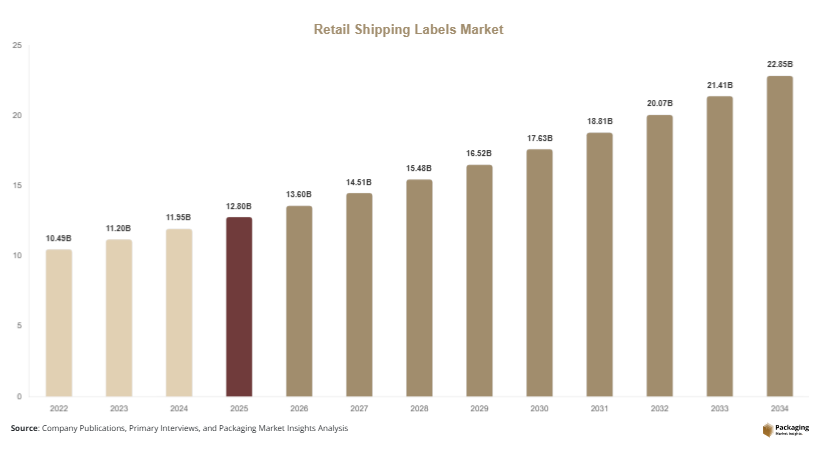
The global retail shipping labels market size was valued at USD 12.8 billion in 2025 and is expected to reach USD 13.6 billion in 2026. Over the forecast period, the market is projected to grow steadily and reach approximately USD 22.9 billion by 2034, registering a CAGR of 6.7% from 2025 to 2034. This growth reflects the increasing reliance on accurate labeling systems for efficient shipping, inventory control, and supply chain optimization. The retail shipping labels market is experiencing consistent growth, supported by the rapid expansion of global retail logistics and e-commerce activities.
A key growth factor is the increasing penetration of online retail platforms. The surge in digital commerce has significantly raised shipment volumes, creating strong demand for reliable shipping labels that ensure proper tracking and delivery accuracy. Labels play a central role in facilitating seamless logistics operations, particularly in high-volume fulfillment environments.
Key Highlights:
- Asia Pacific dominated the market with a 38.2% share in 2025, while Latin America is projected to grow at the fastest CAGR of 7.1%.
- Barcode labels led the type segment with a 41.5% share, while RFID labels are expected to grow at a CAGR of 8.3%.
- Thermal printing technology dominated with a 56.7% share, while digital printing is forecasted to grow at a CAGR of 7.4%.
- E-commerce applications led the segment with 48.6% share, while logistics and warehousing are expected to grow at a CAGR of 6.9%.
- The United States remained the dominant country with a market size of USD 3.8 billion in 2025 and USD 4.1 billion in 2026.
Explore more data points, trends and opportunities Download Free Sample Report
Market Trends
Adoption of Smart and Connected Labeling Systems
The market is witnessing a strong shift toward smart and connected labeling technologies that enhance visibility across supply chains. RFID-enabled labels, QR codes, and NFC-based solutions are increasingly being integrated into retail shipping processes. These advanced labeling systems provide real-time tracking capabilities and allow businesses to monitor shipments more accurately. Retailers are leveraging these technologies to reduce errors, improve inventory accuracy, and enhance operational efficiency. The integration of Internet of Things (IoT) technologies is further strengthening this trend by enabling automated data collection and predictive logistics. As supply chains become more complex and interconnected, the adoption of smart labeling solutions is expected to increase significantly, supporting improved transparency and performance across logistics operations.
Rising Preference for Sustainable and Eco-Friendly Labels
Sustainability has become a major focus area in the retail shipping labels market, with companies actively adopting environmentally responsible labeling solutions. There is growing demand for recyclable, biodegradable, and compostable label materials that reduce environmental impact. Retailers are shifting toward paper-based labels, water-based adhesives, and eco-friendly inks to align with regulatory requirements and consumer expectations. This transition is also driven by increasing awareness about plastic waste and the need to minimize carbon footprints. In addition, businesses are using sustainable packaging and labeling as part of their brand positioning strategies. This trend is encouraging innovation in material development and production processes, leading to the introduction of cost-effective and high-performance sustainable labeling solutions.
Market Drivers
Expansion of Global E-commerce and Retail Logistics
The continuous growth of the global e-commerce sector is a major factor driving demand for retail shipping labels. As online shopping becomes more prevalent, retailers are processing a higher volume of shipments, which increases the need for accurate and efficient labeling systems. Shipping labels ensure that packages are correctly identified, routed, and delivered, reducing the risk of errors and delays. The growing expectation for faster delivery services, including same-day and next-day shipping, further emphasizes the importance of reliable labeling. Retailers are investing in advanced labeling solutions to handle large-scale operations and maintain customer satisfaction. This trend is expected to sustain market growth as e-commerce continues to expand globally.
Advancements in Printing Technologies and Automation
Technological advancements in printing methods are significantly contributing to the growth of the market. Thermal printing, in particular, has gained widespread adoption due to its efficiency, cost-effectiveness, and ability to produce durable labels. Digital printing technologies are also gaining traction, offering flexibility and customization for dynamic labeling requirements. These advancements allow businesses to produce labels quickly and adapt to changing logistics needs. Furthermore, the integration of labeling systems with automated warehouse operations is improving productivity and reducing manual errors. As companies continue to adopt automation and digital tools, the demand for high-performance labeling solutions is expected to rise steadily.
Market Restraint
Volatility in Raw Material Costs and Environmental Regulations
The market faces challenges related to fluctuating raw material prices, particularly for paper and plastic substrates used in label production. These price variations can impact manufacturing costs and create uncertainty for suppliers. Additionally, increasing environmental regulations are pushing companies to adopt sustainable materials, which may involve higher production costs and technological adjustments. Smaller manufacturers often find it difficult to invest in new materials and processes, which can limit their competitiveness. For example, transitioning from traditional plastic-based labels to biodegradable alternatives requires changes in sourcing, production methods, and quality control. These factors can slow down market growth and create operational challenges for industry participants.
Market Opportunities
Growth in Cross-Border Trade and International Shipping
The expansion of cross-border e-commerce is creating significant opportunities for the retail shipping labels market. International shipments require standardized labeling formats that include essential information such as tracking codes, customs details, and multilingual instructions. This increases the demand for advanced labeling solutions that ensure compliance with global regulations. As businesses expand their operations across different regions, the need for reliable and adaptable shipping labels is expected to grow. Companies can capitalize on this opportunity by developing innovative labeling solutions that cater to international logistics requirements and enhance shipment efficiency.
Increasing Adoption of Automated Warehousing Systems
The growing use of automation in warehouses and distribution centers presents a strong opportunity for the market. Automated systems rely heavily on accurate and high-quality labels for sorting, tracking, and inventory management. The integration of labeling technologies with warehouse management systems enables real-time monitoring and improved operational efficiency. As businesses aim to optimize their supply chains, the demand for automation-compatible labeling solutions is increasing. This trend is encouraging manufacturers to develop labels that are durable, scannable, and suitable for high-speed operations. The continued adoption of automation is expected to drive innovation and growth in the labeling market.
Report Scope
| Report Metric | Details |
|---|---|
| Market Size in 2025 | USD 12.8 Billion |
| Market Size in 2026 | USD 13.6 Billion |
| Market Size in 2034 | USD 22.9 Billion |
| CAGR | 6.7% (2026-2034) |
| Base Year for Estimation | 2025 |
| Historical Data | 2022-2024 |
| Forecast Period | 2026-2034 |
| Report Coverage | Revenue Forecast, Competitive Landscape, Supply Chain Disruption, Growth Factors, Environment & Regulatory Landscape and Trends |
| Geographies Covered | North America, Europe, APAC, Middle East and Africa, LATAM |
| Countries Covered | U.S., Canada, U.K., Germany, France, Spain, Italy, Russia, Nordic, Benelux, Rest of Europe, China, South Korea, Japan, India, Australia, Singapore, Taiwan, South East Asia, Rest of Asia-Pacific, UAE, Turky, Saudi Arabia, South Africa, Egypt, Nigeria, Rest of MEA, Brazil, Mexico, Argentina, Chile, Colombia, Rest of LATAM |
Explore more data points, trends and opportunities Download Free Sample Report
Segmental Analysis
By Type
Barcode labels accounted for the largest share of 41.5% in 2024, driven by their widespread use in retail and logistics operations. These labels are cost-effective, easy to implement, and compatible with existing scanning systems. They play a critical role in inventory management, shipment tracking, and order fulfillment processes. The availability of advanced barcode printing technologies has further improved label durability and readability, making them suitable for high-volume operations. Their simplicity and reliability continue to support their dominance in the market.
RFID labels are projected to grow at a CAGR of 8.3% due to their advanced tracking capabilities and ability to store large amounts of data. These labels enable real-time monitoring and improve supply chain visibility. The increasing adoption of automation and IoT technologies is driving demand for RFID solutions. Retailers are using RFID labels to enhance inventory accuracy and reduce operational inefficiencies, making them a key growth segment.
By Application
The e-commerce segment held the largest share of 48.6% in 2024, reflecting the rapid growth of online retail. Shipping labels are essential for managing high volumes of orders and ensuring accurate delivery. The increasing demand for fast and reliable shipping services is driving the adoption of advanced labeling solutions in this segment. Retailers are focusing on improving order fulfillment processes, which is boosting demand for high-quality labels.
The logistics and warehousing segment is expected to grow at a CAGR of 6.9%. The increasing use of automation in warehouses is driving demand for accurate and durable labels that support sorting and tracking operations. Integration with warehouse management systems is improving efficiency and reducing errors. This trend is expected to continue as logistics networks become more complex.
By Printing Technology
Thermal printing dominated the market with a 56.7% share in 2024 due to its efficiency and cost-effectiveness. Thermal printers are widely used in retail and logistics operations because they produce high-quality labels without the need for ink. This reduces operational costs and maintenance requirements. The durability of thermal labels ensures that they remain readable throughout the shipping process.
Digital printing is projected to grow at a CAGR of 7.4%, driven by its flexibility and customization capabilities. This technology allows businesses to produce labels with variable data and adapt quickly to changing requirements. The ability to print on demand reduces waste and inventory costs. As companies seek more adaptable labeling solutions, digital printing is expected to gain significant traction.
Retail Shipping Labels Market Segmentations
By Type
- Barcode Labels
- RFID Labels
- QR Code Labels
By Application
- E-commerce
- Logistics & Warehousing
- Retail Stores
By Printing Technology
- Thermal Printing
- Digital Printing
- Inkjet Printing
Regional Analysis
North America
North America held a significant share of 29.5% in the retail shipping labels market in 2025 and is projected to grow at a CAGR of 5.8% over the forecast period. The region benefits from a well-developed retail infrastructure and high adoption of advanced logistics technologies. The presence of major e-commerce companies and third-party logistics providers contributes to strong demand for efficient labeling solutions. Additionally, increasing consumer expectations for faster delivery services are driving the adoption of high-quality shipping labels that support accurate tracking and timely deliveries.
The United States dominates the regional market due to its extensive retail network and advanced supply chain systems. A major growth factor is the widespread implementation of omnichannel retail strategies, which require seamless integration between online and offline operations. This integration increases the need for accurate labeling systems that ensure efficient order fulfillment and returns management. The country’s focus on technological innovation further supports the adoption of advanced labeling solutions.
Europe
Europe accounted for a 24.3% share in 2025 and is expected to grow at a CAGR of 5.9% during the forecast period. The region’s growth is supported by strong regulatory frameworks and a growing emphasis on sustainable packaging practices. European countries are actively promoting the use of eco-friendly materials, which is influencing the development of recyclable and biodegradable shipping labels. The presence of established retail chains and logistics networks also supports steady market expansion.
Germany is the leading country in the European market, driven by its strong industrial base and advanced logistics infrastructure. A unique growth factor is the country’s commitment to environmental sustainability, which encourages the adoption of eco-friendly labeling solutions. Government policies and consumer awareness are playing a key role in promoting sustainable practices, making Germany a significant contributor to regional growth.
Asia Pacific
Asia Pacific dominated the market with a 38.2% share in 2025 and is projected to grow at a CAGR of 7.4%. The region’s growth is driven by rapid urbanization, increasing internet penetration, and the expansion of e-commerce platforms. Countries such as China, India, and Japan are experiencing significant growth in online retail, which is increasing demand for efficient shipping labels. The presence of large manufacturing hubs also supports cost-effective production and supply.
China leads the Asia Pacific market due to its extensive e-commerce ecosystem and large consumer base. A key growth factor is the rapid adoption of smart logistics technologies, including automated warehouses and AI-driven supply chains. These advancements are increasing the demand for advanced labeling solutions that enable real-time tracking and efficient inventory management.
Middle East & Africa
The Middle East & Africa region accounted for 4.8% of the market share in 2025 and is expected to grow at a CAGR of 6.1%. The region is witnessing increased investment in logistics infrastructure and digital transformation initiatives. Governments are focusing on improving supply chain efficiency, which is driving the adoption of modern labeling solutions. The growth of e-commerce platforms is also contributing to increased demand for shipping labels.
The United Arab Emirates is a key market in the region due to its strategic position as a logistics hub. A unique growth factor is the expansion of free trade zones and cross-border trade activities, which require efficient labeling systems for smooth operations. This is driving demand for high-quality shipping labels that comply with international standards.
Latin America
Latin America held a 3.2% share in 2025 and is projected to grow at a CAGR of 7.1%, making it the fastest-growing region. The growth is driven by increasing internet penetration and rising adoption of online shopping. Retailers in the region are investing in logistics infrastructure to meet growing consumer demand, which is boosting the need for reliable labeling solutions.
Brazil dominates the regional market, supported by its large population and expanding retail sector. A significant growth factor is the rapid development of last-mile delivery services, which require accurate and efficient labeling systems. Companies are adopting advanced labeling technologies to improve delivery performance and enhance customer satisfaction.
Competitive Landscape
The retail shipping labels market is characterized by moderate competition, with key players focusing on innovation, sustainability, and strategic expansion. Companies are investing in advanced printing technologies and eco-friendly materials to meet evolving market demands. The competitive environment is shaped by continuous product development and efforts to improve operational efficiency.
Avery Dennison Corporation is a leading player in the market, known for its extensive portfolio of labeling solutions. The company has recently introduced sustainable shipping labels designed to reduce environmental impact while maintaining performance standards. Other major companies are also focusing on expanding their product offerings and strengthening their market presence through partnerships and technological advancements.
Key Players List
- Avery Dennison Corporation
- CCL Industries Inc.
- 3M Company
- Zebra Technologies Corporation
- UPM Raflatac
- SATO Holdings Corporation
- Brother Industries Ltd.
- Brady Corporation
- Seiko Epson Corporation
- HP Inc.
- Canon Inc.
- Fuji Seal International Inc.
- LINTEC Corporation
- Multi-Color Corporation
- Resource Label Group