Repackaging Service Market Size and Growth
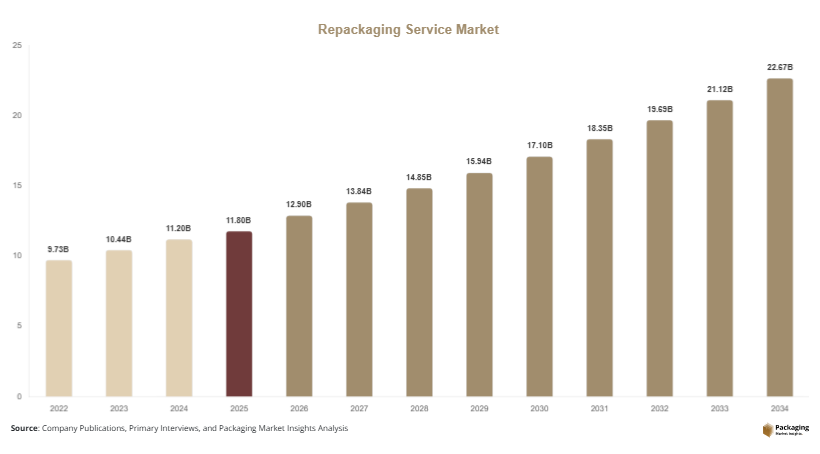
The global repackaging service market has emerged as a critical component of modern supply chains, driven by the need for product customization, regulatory compliance, and efficient logistics. The market size reached USD 11.8 billion in 2025 and is projected to grow to USD 12.9 billion in 2026, further expanding to USD 23.9 billion by 2034, registering a CAGR of 7.3% during 2025–2034. This growth reflects increasing reliance on repackaging solutions across industries such as pharmaceuticals, food and beverages, consumer goods, and industrial manufacturing.
One of the primary growth factors is the rising demand for product differentiation and branding. Companies are increasingly using repackaging services to modify product sizes, labeling, and packaging formats to cater to specific markets and consumer preferences. This trend is especially evident in the e-commerce sector, where customized packaging plays a vital role in enhancing customer experience.
Key Highlights:
- The market size reached USD 11.8 billion in 2025 and is expected to grow significantly, reaching USD 23.9 billion by 2034. This reflects steady expansion driven by increasing demand across multiple end-use industries and evolving supply chain requirements.
- The market is projected to register a CAGR of 7.3% from 2025 to 2034, indicating consistent growth momentum. This growth is supported by rising industrial activities and continuous advancements in packaging services.
- There is strong demand from pharmaceutical, food, and e-commerce sectors, where repackaging plays a critical role in compliance and product presentation. These industries rely on efficient packaging solutions to meet safety and consumer expectations.
- Companies are increasingly focusing on customization, regulatory compliance, and operational efficiency. Repackaging services enable businesses to adapt products for different markets while maintaining quality and consistency.
- The growing adoption of automated and smart packaging technologies is transforming the market landscape. These technologies improve speed, accuracy, and traceability, making repackaging processes more efficient and scalable.
Explore more data points, trends and opportunities Download Free Sample Report
Market Trends
Rising Adoption of Automated Repackaging Solutions
Automation is becoming a defining trend in the repackaging service market as companies aim to improve operational efficiency and reduce labor costs. Automated systems enable high-speed sorting, labeling, and packaging processes, which are essential for handling large volumes of products. These systems also minimize human errors, ensuring consistent quality and compliance with regulatory standards. Industries such as pharmaceuticals and food are particularly adopting automation due to the need for precision and hygiene. The integration of robotics and AI-driven systems further enhances productivity and scalability.
Increasing Demand for Sustainable Repackaging Practices
Sustainability is gaining importance across industries, influencing the repackaging services landscape. Companies are focusing on reducing packaging waste by using recyclable materials and optimizing packaging sizes. Repackaging services are increasingly offering eco-friendly solutions, including biodegradable materials and minimalistic packaging designs. This trend is driven by regulatory pressures and growing consumer awareness regarding environmental impact. Businesses are also adopting circular economy principles, where packaging materials are reused and recycled, contributing to long-term sustainability goals.
Market Drivers
Growth of E-Commerce and Retail Distribution Channels
The rapid expansion of e-commerce has significantly boosted the demand for repackaging services. Online retailers require flexible packaging solutions to accommodate various product sizes and ensure safe delivery. Repackaging services enable businesses to reconfigure bulk shipments into smaller, consumer-ready packages. This is particularly important for last-mile delivery, where packaging must be durable and visually appealing. Additionally, the need for customized packaging for promotional campaigns and seasonal demand further drives market growth.
Increasing Regulatory Compliance Requirements
Strict regulations across industries, especially pharmaceuticals and food, are driving the adoption of repackaging services. Products often require relabeling, serialization, and compliance with regional standards before reaching end consumers. Repackaging providers offer specialized services to ensure adherence to these regulations. This reduces the risk of product recalls and enhances brand credibility. As global trade continues to expand, the complexity of compliance requirements increases, further fueling demand for professional repackaging solutions.
Market Restraint
High Operational Costs and Complexity
Despite its advantages, the repackaging service market faces challenges related to high operational costs and complexity. Setting up repackaging facilities requires significant investment in equipment, technology, and skilled labor. Additionally, maintaining compliance with industry regulations adds to operational expenses. For small and medium-sized enterprises, these costs can be a barrier to adoption.
Moreover, managing diverse packaging requirements across multiple industries increases complexity. Each product category may require specific handling, labeling, and packaging standards, making it difficult to standardize processes. For example, pharmaceutical repackaging demands strict hygiene and traceability, while food packaging requires adherence to safety and freshness standards. These challenges can limit market growth, particularly in regions with limited infrastructure and technological capabilities.
Market Opportunities
Expansion in Emerging Markets
Emerging economies present significant growth opportunities for the repackaging service market. Rapid industrialization, urbanization, and increasing consumer demand are driving the need for efficient packaging solutions. Countries in Asia Pacific, Latin America, and Africa are witnessing growth in sectors such as retail, pharmaceuticals, and food processing. Repackaging services can help businesses adapt products to local market requirements, including language-specific labeling and region-specific packaging formats.
Integration of Smart Packaging Technologies
The adoption of smart packaging technologies offers new opportunities for market players. Features such as QR codes, RFID tags, and temperature-sensitive labels enhance product tracking and consumer engagement. Repackaging services can integrate these technologies into existing packaging formats, adding value to products. This is particularly beneficial for industries such as pharmaceuticals, where traceability and authenticity are critical. The growing demand for connected packaging solutions is expected to drive innovation and create new revenue streams.
Report Scope
| Report Metric | Details |
|---|---|
| Market Size in 2025 | USD 11.8 Billion |
| Market Size in 2026 | USD 12.9 Billion |
| Market Size in 2034 | USD 23.9 Billion |
| CAGR | 7.3% (2026-2034) |
| Base Year for Estimation | 2025 |
| Historical Data | 2022-2024 |
| Forecast Period | 2026-2034 |
| Report Coverage | Revenue Forecast, Competitive Landscape, Supply Chain Disruption, Growth Factors, Environment & Regulatory Landscape and Trends |
| Geographies Covered | North America, Europe, APAC, Middle East and Africa, LATAM |
| Countries Covered | U.S., Canada, U.K., Germany, France, Spain, Italy, Russia, Nordic, Benelux, Rest of Europe, China, South Korea, Japan, India, Australia, Singapore, Taiwan, South East Asia, Rest of Asia-Pacific, UAE, Turky, Saudi Arabia, South Africa, Egypt, Nigeria, Rest of MEA, Brazil, Mexico, Argentina, Chile, Colombia, Rest of LATAM |
Explore more data points, trends and opportunities Download Free Sample Report
Segmental Analysis
By Service Type
The contract repackaging segment dominated the market in 2024, accounting for approximately 48% share. This segment includes services outsourced to third-party providers, offering flexibility and cost efficiency. Companies prefer contract repackaging to focus on core operations while ensuring high-quality packaging solutions. The segment benefits from increasing demand in industries such as pharmaceuticals and consumer goods, where specialized packaging requirements are common.
The on-demand repackaging segment is expected to grow at the fastest CAGR of 8.1% during the forecast period. This growth is driven by the need for flexibility in packaging operations, particularly in e-commerce and retail sectors. On-demand services allow businesses to adapt quickly to changing market demands and reduce inventory costs.
By Application
The food and beverage segment held the largest share of around 40% in 2024. Repackaging services are widely used in this sector to ensure product freshness, portion control, and compliance with safety standards. The segment benefits from increasing demand for packaged and processed foods, as well as the growth of online grocery platforms.
The pharmaceutical segment is projected to grow at a CAGR of 8.4%, driven by stringent regulatory requirements and increasing demand for healthcare products. Repackaging services play a crucial role in ensuring compliance with labeling and safety standards, making them essential for pharmaceutical companies.
By End-Use Industry
The retail and e-commerce segment dominated the market in 2024, accounting for 45% share. This segment relies heavily on repackaging services to handle diverse product categories and ensure efficient distribution. Customized packaging solutions enhance customer experience and support brand differentiation.
The industrial segment is expected to grow at a CAGR of 7.8%, driven by increasing demand for efficient supply chain management. Repackaging services help industrial companies optimize packaging processes and reduce costs, contributing to overall operational efficiency.
Repackaging Service Market Segmentations
By Service Type
- Contract Repackaging
- In-house Repackaging
- On-demand Repackaging
- Specialty Repackaging
By Application
- Food & Beverage
- Pharmaceutical
- Consumer Goods
- Industrial Products
By End-Use Industry
- Retail & E-commerce
- Healthcare
- Manufacturing
- Logistics & Warehousing
Regional Analysis
North America
North America accounted for a significant share of the repackaging service market in 2025, with approximately 32% market share and a projected CAGR of 6.8% during the forecast period. The region’s well-established logistics infrastructure and advanced manufacturing capabilities support the growth of repackaging services. High demand from the pharmaceutical and food industries further contributes to market expansion.
The United States dominates the regional market due to its strong e-commerce sector and stringent regulatory framework. A unique growth factor is the increasing adoption of automation technologies in packaging operations, enabling faster processing and improved efficiency.
Europe
Europe held around 25% of the market share in 2025 and is expected to grow at a CAGR of 6.5%. The region emphasizes sustainability and regulatory compliance, driving demand for eco-friendly repackaging solutions. Industries such as pharmaceuticals and consumer goods play a key role in market growth.
Germany leads the European market, supported by its strong manufacturing base. A unique growth factor is the region’s focus on circular economy practices, encouraging the use of recyclable and reusable packaging materials.
Asia Pacific
Asia Pacific is the fastest-growing region, with a CAGR of 8.2% and a market share of 28% in 2025. Rapid industrialization and expanding retail sectors drive demand for repackaging services. The region’s large population also contributes to increased consumption and packaging needs.
China dominates the market, driven by its manufacturing capabilities and export activities. A unique growth factor is the rapid growth of e-commerce platforms, which require efficient and scalable packaging solutions.
Middle East & Africa
The Middle East & Africa region accounted for 8% of the market share in 2025 and is expected to grow at a CAGR of 6.9%. The region’s growing logistics and retail sectors support market development. Increasing investments in infrastructure further enhance growth prospects.
The UAE leads the regional market due to its strategic location as a trade hub. A unique growth factor is the expansion of free trade zones, which facilitate cross-border trade and increase demand for repackaging services.
Latin America
Latin America held around 7% market share in 2025 and is projected to grow at a CAGR of 6.7%. The region’s growing food and beverage industry drives demand for repackaging solutions. Increasing urbanization also contributes to market expansion.
Brazil dominates the market, supported by its large consumer base. A unique growth factor is the rising demand for affordable and customized packaging solutions in the retail sector.
Competitive Landscape
The repackaging service market is moderately fragmented, with several global and regional players competing based on service quality, technology, and pricing. Leading companies focus on expanding their service portfolios and adopting advanced technologies to maintain competitiveness.
One of the key leaders in the market is Sonoco Products Company, known for its comprehensive packaging solutions and strong global presence. The company has recently invested in automation technologies to enhance efficiency and meet growing demand.
Other prominent players include DHL Supply Chain, UPS Supply Chain Solutions, FedEx Supply Chain, and DB Schenker. These companies leverage their logistics expertise to offer integrated repackaging services. Strategic partnerships, mergers, and acquisitions are common strategies used to strengthen market position and expand geographic reach.
Key Players List
- Sonoco Products Company
- DHL Supply Chain
- UPS Supply Chain Solutions
- FedEx Supply Chain
- DB Schenker
- CEVA Logistics
- GXO Logistics
- Nefab Group
- Unicep Packaging
- Multi-Pack Solutions
- Sharp Packaging Services
- Sterigenics International
- AmeriPac Inc.
- Contract Packaging Inc.
- Summit Packaging Solutions