Recycling Flexible Packaging Market Size and Growth
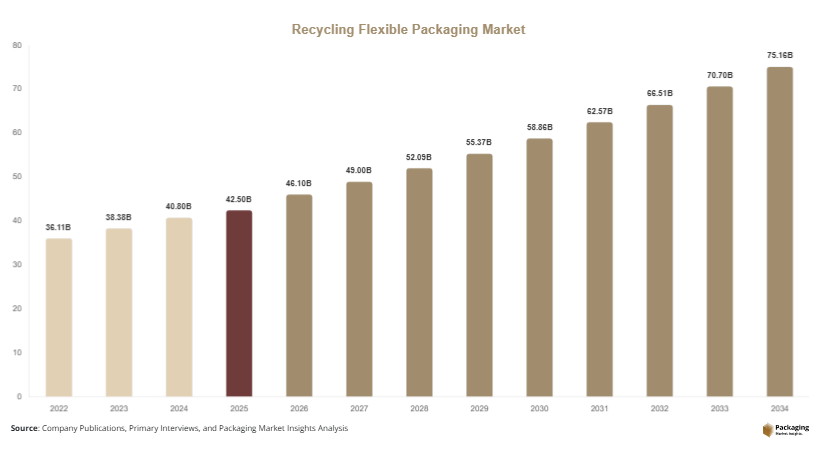
The recycling flexible packaging market is gaining increasing attention as sustainability becomes a central focus across industries. Flexible packaging, widely used in food, beverage, healthcare, and consumer goods sectors, presents recycling challenges due to its multi-layered material composition. However, advancements in recycling technologies and regulatory support are transforming this segment into a high-growth opportunity. The market size was valued at approximately USD 42.5 billion in 2025 and is expected to reach USD 46.1 billion in 2026. It is projected to grow to USD 79.8 billion by 2034, registering a CAGR of 6.3% during 2025–2034.
One of the primary growth factors is the increasing global focus on reducing plastic waste and promoting circular economy practices. Governments and environmental organizations are enforcing regulations that encourage recycling and restrict single-use plastics. Another key driver is the rising demand from food and beverage industries, which rely heavily on flexible packaging but are now shifting toward recyclable alternatives. Additionally, advancements in mono-material packaging and chemical recycling technologies are improving the recyclability of flexible packaging products.
Key Highlights:
- The Recycling Flexible Packaging Market is projected to reach USD 79.8 billion by 2034, growing at a CAGR of 6.3% during 2025–2034.
- Growth is driven by increasing demand for recyclable flexible packaging solutions along with a strong regulatory push toward circular economy practices.
- Additionally, advancements in recycling technologies are further supporting the expansion of the market.
Explore more data points, trends and opportunities Download Free Sample Report
Market Trends
Shift Toward Mono-Material Flexible Packaging for Easier Recycling
A major trend in the recycling flexible packaging market is the transition from multi-layered packaging to mono-material solutions. Traditional flexible packaging often consists of multiple layers of different materials, making recycling complex and inefficient. Manufacturers are now focusing on developing mono-material structures, such as polyethylene-based films, that can be easily processed in existing recycling streams. This shift is supported by advancements in material science, enabling mono-material packaging to achieve similar barrier properties as multi-layer alternatives. The trend is gaining traction among food and beverage companies aiming to meet sustainability targets and regulatory requirements.
Expansion of Chemical Recycling Technologies
Chemical recycling is emerging as a transformative trend in the market. Unlike mechanical recycling, which can degrade material quality, chemical recycling breaks down plastic waste into its मूल molecular components, allowing it to be reused in high-quality applications. This technology is particularly effective for complex flexible packaging materials that are difficult to recycle mechanically. Investments in chemical recycling infrastructure are increasing, driven by partnerships between packaging companies and recycling firms. The adoption of this technology is expected to improve recycling rates and support the development of a circular economy.
Market Drivers
Increasing Regulatory Pressure for Sustainable Packaging
Regulatory frameworks across regions are driving the adoption of recycling flexible packaging solutions. Governments are implementing policies that mandate the use of recyclable materials and impose penalties on non-compliant packaging. For example, extended producer responsibility (EPR) regulations require manufacturers to manage the lifecycle of their packaging products. These regulations are encouraging companies to redesign packaging and invest in recycling infrastructure. The growing emphasis on sustainability is pushing industries to adopt eco-friendly packaging solutions, thereby driving market growth.
Rising Consumer Demand for Eco-Friendly Packaging
Consumer preferences are shifting toward sustainable products, significantly influencing the recycling flexible packaging market. Consumers are becoming more aware of environmental issues and are demanding packaging that is recyclable and environmentally friendly. Brands are responding by incorporating recycled content and promoting sustainability initiatives. This trend is particularly strong in the food and beverage sector, where packaging plays a crucial role in product perception. Companies that adopt sustainable packaging solutions are gaining a competitive advantage, further driving market growth.
Market Restraint
Complexity of Recycling Multi-Layer Flexible Packaging
Despite advancements, the complexity of recycling multi-layer flexible packaging remains a significant restraint. Many flexible packaging products consist of layers of different materials, such as plastics, aluminum, and adhesives, which are difficult to separate during recycling. This complexity limits the efficiency of recycling processes and increases operational costs.
For instance, snack packaging often uses multi-layer films to provide barrier properties, but these materials are challenging to recycle using conventional methods. As a result, a large portion of flexible packaging waste ends up in landfills or incineration facilities. Addressing this issue requires significant investment in advanced recycling technologies and infrastructure. Additionally, the lack of standardized recycling systems across regions further complicates the process. This restraint continues to hinder market growth despite increasing demand for sustainable solutions.
Market Opportunities
Development of Advanced Recycling Infrastructure
The expansion of recycling infrastructure presents a major opportunity for the recycling flexible packaging market. Investments in collection, sorting, and processing facilities are essential to improve recycling rates. Governments and private organizations are collaborating to develop efficient waste management systems. The integration of advanced technologies, such as AI-based sorting systems, is enhancing the accuracy and efficiency of recycling processes. These developments are expected to create significant growth opportunities for market players.
Adoption of Circular Economy Business Models
The adoption of circular economy models is creating new opportunities in the market. Companies are focusing on designing packaging that can be reused, recycled, or repurposed. This approach reduces waste and promotes sustainability. Brands are increasingly adopting closed-loop systems, where recycled materials are used to produce new packaging. This trend is supported by consumer demand and regulatory requirements. The shift toward circular economy practices is expected to drive innovation and growth in the recycling flexible packaging market.
Report Scope
| Report Metric | Details |
|---|---|
| Market Size in 2025 | USD 42.5 Billion |
| Market Size in 2026 | USD 46.1 Billion |
| Market Size in 2034 | USD 79.8 Billion |
| CAGR | 6.3% (2026-2034) |
| Base Year for Estimation | 2025 |
| Historical Data | 2022-2024 |
| Forecast Period | 2026-2034 |
| Report Coverage | Revenue Forecast, Competitive Landscape, Supply Chain Disruption, Growth Factors, Environment & Regulatory Landscape and Trends |
| Geographies Covered | North America, Europe, APAC, Middle East and Africa, LATAM |
| Countries Covered | U.S., Canada, U.K., Germany, France, Spain, Italy, Russia, Nordic, Benelux, Rest of Europe, China, South Korea, Japan, India, Australia, Singapore, Taiwan, South East Asia, Rest of Asia-Pacific, UAE, Turky, Saudi Arabia, South Africa, Egypt, Nigeria, Rest of MEA, Brazil, Mexico, Argentina, Chile, Colombia, Rest of LATAM |
Explore more data points, trends and opportunities Download Free Sample Report
Segmental Analysis
By Material Type
The plastic segment dominated the recycling flexible packaging market in 2024, accounting for approximately 68% of the market share. Plastic materials, particularly polyethylene and polypropylene, are widely used in flexible packaging due to their versatility and cost-effectiveness. These materials are increasingly being recycled through mechanical processes, supported by advancements in sorting and processing technologies. The demand for recyclable plastic packaging is growing as industries seek sustainable alternatives.
The paper-based segment is expected to be the fastest-growing, with a CAGR of 7.5% during the forecast period. Paper-based flexible packaging is gaining popularity due to its biodegradability and recyclability. Innovations in barrier coatings are enabling paper materials to be used in applications traditionally dominated by plastics. This trend is driven by consumer demand for eco-friendly packaging and regulatory support for sustainable materials.
By Application
The food and beverage segment held the largest market share in 2024, accounting for approximately 55%. This segment relies heavily on flexible packaging for product protection and convenience. The increasing demand for sustainable packaging solutions is driving the adoption of recyclable materials in this sector. Companies are investing in innovative packaging designs to meet consumer expectations and regulatory requirements.
The personal care segment is projected to grow at the fastest CAGR of 7.0% during the forecast period. The demand for sustainable packaging in personal care products is increasing, driven by consumer awareness and brand initiatives. Companies are adopting recyclable flexible packaging solutions to reduce environmental impact and enhance brand image.
By End-Use
The consumer goods segment dominated the market in 2024, with a share of approximately 60%. Flexible packaging is widely used in consumer goods due to its lightweight and cost-effective nature. The increasing focus on sustainability is driving the adoption of recyclable packaging solutions in this segment.
The industrial segment is expected to grow at the fastest CAGR of 6.8% during the forecast period. The use of flexible packaging in industrial applications is increasing, supported by advancements in material technology. The demand for sustainable solutions is driving growth in this segment.
Recycling Flexible Packaging Market Segmentations
Material Type
- Plastic
- Paper
Application
- Food & Beverage
- Personal Care
- Industrial
End-Use
- Consumer Goods
- Industrial
Regional Analysis
North America
North America accounted for approximately 30% of the recycling flexible packaging market share in 2025 and is expected to grow at a CAGR of 6.0% during the forecast period. The region benefits from advanced recycling infrastructure and strong regulatory frameworks. The presence of major packaging companies and increasing adoption of sustainable practices are supporting market growth.
The United States dominates the regional market due to its well-established packaging industry. A key growth factor is the implementation of extended producer responsibility programs, which encourage recycling and waste reduction. These initiatives are driving demand for recyclable flexible packaging solutions.
Europe
Europe held a market share of around 27% in 2025 and is projected to grow at a CAGR of 6.2% through 2034. The region is characterized by stringent environmental regulations and strong consumer awareness regarding sustainability. The European Union’s policies are promoting the use of recyclable materials.
Germany is a leading country in the European market, supported by its advanced recycling systems. A unique growth factor is the emphasis on circular economy practices, which is driving innovation in packaging design and recycling technologies.
Asia Pacific
Asia Pacific accounted for approximately 25% of the market share in 2025 and is expected to register the fastest CAGR of 7.1% during the forecast period. Rapid urbanization and industrialization are increasing demand for flexible packaging and recycling solutions.
China dominates the Asia Pacific market due to its large population and expanding manufacturing sector. A key growth factor is government initiatives to improve waste management systems and promote recycling. These efforts are driving market growth.
Middle East & Africa
The Middle East & Africa region held a market share of around 9% in 2025 and is projected to grow at a CAGR of 5.8% during the forecast period. The market is developing due to increasing awareness of environmental issues and growing investments in waste management infrastructure.
Saudi Arabia is a leading country in the region, supported by its focus on sustainability initiatives. A unique growth factor is the development of recycling facilities, which is enhancing the adoption of flexible packaging recycling solutions.
Latin America
Latin America accounted for approximately 9% of the market share in 2025 and is expected to grow at a CAGR of 6.1% through 2034. The region is experiencing growth due to increasing demand for sustainable packaging solutions.
Brazil dominates the regional market due to its large consumer base and growing packaging industry. A key growth factor is the rising adoption of recycling programs, which is supporting market expansion.
Competitive Landscape
The recycling flexible packaging market is highly competitive, with companies focusing on innovation, sustainability, and strategic partnerships. Key players are investing in research and development to improve recycling technologies and develop sustainable packaging solutions. Collaborations with recyclers and brand owners are common strategies to enhance market presence.
Amcor Plc is a leading player in the market, known for its focus on recyclable packaging solutions. The company recently launched new mono-material packaging products designed for improved recyclability. Other companies are also expanding their capabilities to meet growing demand.
Key Players List
- Amcor Plc
- Berry Global Inc.
- Mondi Group
- Sealed Air Corporation
- Huhtamaki Oyj
- Sonoco Products Company
- Constantia Flexibles
- Uflex Ltd.
- Coveris Holdings S.A.
- ProAmpac LLC
- Smurfit Kappa Group
- DS Smith Plc
- Novolex Holdings LLC
- Clondalkin Group
- TC Transcontinental Inc.