Recycled Polypropylene In Packaging Market Size and Growth
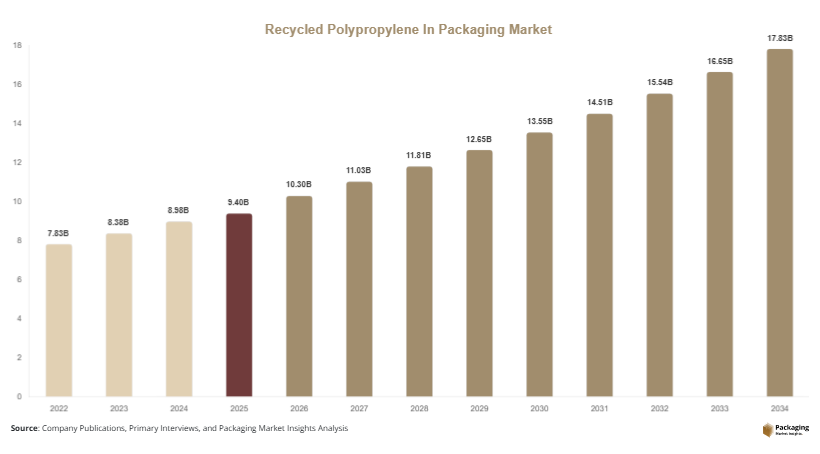
The recycled polypropylene in packaging market is gaining steady traction as industries shift toward sustainable materials and circular economy practices. Recycled polypropylene (rPP) is widely used in packaging applications due to its durability, chemical resistance, lightweight nature, and ability to be reprocessed without significant performance loss. It is increasingly adopted across food containers, caps and closures, rigid packaging, and flexible packaging formats. In 2025, the global market size is estimated at USD 9.4 billion, and it is projected to reach USD 10.3 billion in 2026. Over the forecast period from 2025 to 2034, the market is expected to grow at a CAGR of 7.1%, reaching approximately USD 18.9 billion by 2034.
One of the key growth factors is the increasing regulatory pressure to reduce plastic waste and promote recycling. Governments across regions are implementing policies that mandate the use of recycled materials in packaging. These regulations are encouraging manufacturers to integrate recycled polypropylene into their packaging solutions.
Key Highlights:
- Market size valued at USD 9.4 billion in 2025
- Expected to reach USD 18.9 billion by 2034
- CAGR of 7.1% during 2025–2034
- Strong regulatory push for recycled materials
- Increasing adoption across food and consumer goods packaging
Explore more data points, trends and opportunities Download Free Sample Report
Market Trends
Growing Integration of Food-Grade Recycled Polypropylene
A significant trend in the recycled polypropylene in packaging market is the increasing development and use of food-grade recycled polypropylene. Historically, the use of recycled plastics in food packaging was limited due to safety concerns and regulatory restrictions. However, advancements in purification and recycling technologies are enabling the production of high-quality rPP suitable for direct food contact applications. This trend is supported by regulatory approvals and certifications in several regions. Food and beverage companies are adopting food-grade rPP to meet sustainability targets and reduce their environmental footprint. The integration of rPP in food packaging is expected to expand significantly over the forecast period.
Rise of Closed-Loop Recycling Systems
The adoption of closed-loop recycling systems is another key trend shaping the market. Companies are increasingly focusing on creating circular supply chains where polypropylene waste is collected, recycled, and reused in packaging production. This approach reduces reliance on virgin materials and minimizes waste. Packaging companies are collaborating with recyclers and waste management firms to establish efficient collection and recycling systems. Closed-loop systems are particularly prominent in industries such as consumer goods and retail packaging. This trend is expected to enhance material efficiency and support long-term sustainability goals.
Market Drivers
Regulatory Support for Sustainable Packaging
Regulatory support for sustainable packaging is a major driver of the recycled polypropylene in packaging market. Governments worldwide are implementing policies to reduce plastic waste and promote recycling. These include mandates for minimum recycled content in packaging and restrictions on single-use plastics. Such regulations are encouraging manufacturers to adopt recycled polypropylene as an alternative to virgin plastics. Compliance with these regulations is becoming a key factor for companies operating in the packaging industry. The increasing focus on sustainability is expected to drive the adoption of rPP across various applications.
Increasing Demand from Consumer Goods Industry
The consumer goods industry is a significant driver of market growth. Companies in this sector are adopting recycled polypropylene to meet sustainability goals and enhance brand image. Packaging made from rPP is used for products such as household items, personal care products, and food containers. The growing demand for eco-friendly packaging is influencing purchasing decisions, prompting companies to invest in sustainable materials. Additionally, the expansion of retail and e-commerce sectors is increasing the demand for packaging solutions, further supporting the adoption of recycled polypropylene.
Market Restraint
Quality Variability and Supply Chain Challenges
One of the key restraints in the recycled polypropylene in packaging market is the variability in the quality of recycled materials. Unlike virgin polypropylene, recycled polypropylene can have inconsistencies in properties such as color, strength, and purity. These variations can affect the performance of packaging products and limit their use in certain applications. For example, food packaging requires high levels of purity and consistency, which can be challenging to achieve with recycled materials.
Additionally, the supply chain for recycled polypropylene is often fragmented. The availability of high-quality recycled feedstock depends on efficient waste collection and sorting systems. In regions with limited recycling infrastructure, the supply of rPP can be inconsistent. This can lead to fluctuations in pricing and availability, affecting market growth. Companies are investing in advanced sorting and recycling technologies to address these challenges, but the issue remains a significant restraint.
Market Opportunities
Technological Advancements in Chemical Recycling
Technological advancements in chemical recycling present significant opportunities for the market. Unlike mechanical recycling, chemical recycling processes break down polypropylene into its basic components, allowing for the production of high-quality recycled materials. This technology can produce rPP with properties similar to virgin polypropylene, making it suitable for high-performance applications. The adoption of chemical recycling is expected to expand the use of recycled polypropylene in packaging, particularly in food-grade applications.
Expansion in Emerging Economies
Emerging economies offer substantial growth opportunities for the recycled polypropylene in packaging market. Rapid urbanization, increasing disposable incomes, and growing awareness of environmental issues are driving demand for sustainable packaging solutions. Countries in Asia Pacific and Latin America are witnessing significant growth in packaging demand. The expansion of retail and e-commerce sectors is further supporting market growth. Companies are investing in these regions to tap into the growing demand for recycled packaging materials.
Report Scope
| Report Metric | Details |
|---|---|
| Market Size in 2025 | USD 9.4 Billion |
| Market Size in 2026 | USD 10.3 Billion |
| Market Size in 2034 | USD 18.9 Billion |
| CAGR | 7.1% (2026-2034) |
| Base Year for Estimation | 2025 |
| Historical Data | 2022-2024 |
| Forecast Period | 2026-2034 |
| Report Coverage | Revenue Forecast, Competitive Landscape, Supply Chain Disruption, Growth Factors, Environment & Regulatory Landscape and Trends |
| Geographies Covered | North America, Europe, APAC, Middle East and Africa, LATAM |
| Countries Covered | U.S., Canada, U.K., Germany, France, Spain, Italy, Russia, Nordic, Benelux, Rest of Europe, China, South Korea, Japan, India, Australia, Singapore, Taiwan, South East Asia, Rest of Asia-Pacific, UAE, Turky, Saudi Arabia, South Africa, Egypt, Nigeria, Rest of MEA, Brazil, Mexico, Argentina, Chile, Colombia, Rest of LATAM |
Explore more data points, trends and opportunities Download Free Sample Report
Segmental Analysis
By Type
Post-consumer recycled polypropylene dominated the market in 2024, accounting for approximately 62% of the total share. This segment includes materials collected from consumer waste streams, such as packaging and household products. The widespread availability of post-consumer waste and increasing recycling initiatives are supporting the growth of this segment. Additionally, companies are focusing on improving the quality of post-consumer recycled materials to expand their applications.
The fastest-growing subsegment is post-industrial recycled polypropylene, expected to grow at a CAGR of 7.6%. This segment includes materials generated during manufacturing processes. The growth is driven by the consistent quality and availability of post-industrial waste. Companies are increasingly using these materials to reduce production costs and improve sustainability.
By Application
Rigid packaging held the largest share in 2024, accounting for around 58% of the market. Recycled polypropylene is widely used in rigid packaging applications such as containers, trays, and caps. The demand for durable and lightweight packaging solutions is driving this segment. Additionally, the increasing use of recycled materials in food and consumer goods packaging is supporting growth.
The fastest-growing subsegment is flexible packaging, with a projected CAGR of 7.8%. The growth is driven by the increasing demand for lightweight and cost-effective packaging solutions. Flexible packaging offers advantages such as reduced material usage and improved transportation efficiency, making it a preferred choice in various industries.
By End-Use Industry
The food and beverage industry accounted for the largest share in 2024, contributing approximately 55% of the market. Recycled polypropylene is widely used in this industry for packaging applications. The increasing demand for sustainable packaging solutions is driving the adoption of rPP in food packaging.
The fastest-growing subsegment is the personal care industry, expected to grow at a CAGR of 7.5%. The growth is driven by the increasing demand for eco-friendly packaging for personal care products. Companies are adopting recycled materials to enhance their brand image and meet consumer expectations.
Recycled Polypropylene In Packaging Market Segmentations
Type
- Post-Consumer Recycled Polypropylene
- Post-Industrial Recycled Polypropylene
Application
- Rigid Packaging
- Flexible Packaging
End-Use Industry
- Food & Beverage
- Personal Care
- Healthcare
- Consumer Goods
Regional Analysis
North America
North America accounted for approximately 28% of the recycled polypropylene in packaging market share in 2025 and is expected to grow at a CAGR of 6.7% during the forecast period. The region benefits from strong regulatory frameworks promoting recycling and sustainable packaging. The presence of established recycling infrastructure and advanced technologies supports the adoption of recycled polypropylene in packaging applications.
The United States dominates the regional market due to its large consumer base and strong focus on sustainability initiatives. A unique growth factor is the increasing adoption of extended producer responsibility programs. These programs encourage manufacturers to take responsibility for the lifecycle of their products, driving the use of recycled materials in packaging.
Europe
Europe held around 27% of the market share in 2025 and is projected to grow at a CAGR of 6.8%. The region is characterized by stringent environmental regulations and a strong emphasis on circular economy practices. These factors are driving the adoption of recycled polypropylene in packaging.
Germany leads the European market, supported by its advanced recycling infrastructure. A key growth factor is the implementation of strict recycling targets and packaging waste directives. Companies are investing in sustainable materials to comply with these regulations, driving market growth.
Asia Pacific
Asia Pacific accounted for nearly 30% of the market share in 2025 and is expected to register the highest CAGR of 8.2%. Rapid urbanization and industrialization are driving demand for packaging solutions in the region. The increasing focus on sustainability is supporting the adoption of recycled polypropylene.
China dominates the regional market due to its large manufacturing base. A major growth factor is the growing demand for packaged goods and the expansion of recycling infrastructure. Government initiatives promoting waste management are also supporting market growth.
Middle East & Africa
The Middle East & Africa region held a market share of approximately 7% in 2025 and is projected to grow at a CAGR of 6.9%. The market is driven by increasing awareness of environmental issues and the need for sustainable packaging solutions. Investments in recycling infrastructure are supporting market growth.
Saudi Arabia is a leading country in the region, supported by its growing industrial sector. A unique growth factor is the adoption of sustainability initiatives aligned with national development plans, which is driving demand for recycled materials.
Latin America
Latin America accounted for around 8% of the market share in 2025 and is expected to grow at a CAGR of 7.0%. The region is witnessing steady growth due to increasing demand for packaged goods and rising environmental awareness. Economic development is supporting market expansion.
Brazil dominates the regional market, driven by its large consumer base. A key growth factor is the growth of recycling initiatives and government policies promoting sustainable packaging. These factors are encouraging the adoption of recycled polypropylene.
Competitive Landscape
The recycled polypropylene in packaging market is characterized by moderate competition, with several global and regional players focusing on sustainability and innovation. Companies are investing in advanced recycling technologies and expanding their production capacities to meet growing demand. Strategic partnerships and collaborations are common strategies adopted by market players to strengthen their market position.
Berry Global Inc. is a leading player in the market, known for its focus on sustainable packaging solutions. The company has recently introduced new packaging products made from high-quality recycled polypropylene. Other key players such as Veolia, Suez, KW Plastics, Plastipak Holdings, and Indorama Ventures are also actively investing in recycling technologies and expanding their product portfolios. These companies are focusing on improving the quality and availability of recycled materials to gain a competitive edge.
Key Players List
- Berry Global Inc.
- Veolia
- Suez
- KW Plastics
- Plastipak Holdings, Inc.
- Indorama Ventures
- MBA Polymers
- Republic Services, Inc.
- Waste Management, Inc.
- Borealis AG
- LyondellBasell Industries
- ExxonMobil Corporation
- TotalEnergies SE
- Envision Plastics
- GreenMantra Technologies