Recycled Packaging For Apparel Market Size and Growth
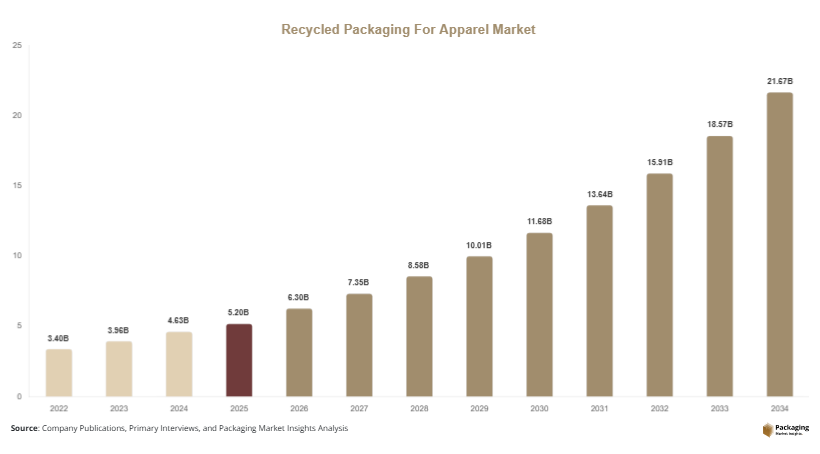
The global recycled packaging for apparel market size is estimated at USD 5.2 billion in 2025 and is expected to reach USD 6.3 billion in 2026. With increasing demand for eco-friendly packaging and stricter environmental regulations, the market is projected to reach USD 21.9 billion by 2034, registering a CAGR of 16.7% during the forecast period (2025–2034).
The recycled packaging for apparel market is witnessing consistent growth as the global fashion and textile industry shifts toward sustainable and environmentally responsible practices. Recycled packaging solutions for apparel include materials such as recycled paper, cardboard, biodegradable plastics, and post-consumer recycled (PCR) polymers used for shipping bags, boxes, tags, and protective wraps.
Key Highlights:
- Market size is projected to reach USD 21.9 billion by 2034, reflecting steady expansion driven by sustainability trends in the apparel industry. Increasing adoption of recycled materials is supporting long-term market growth.
- The market is expected to grow at a CAGR of 16.7% from 2025 to 2034, indicating consistent demand across global markets. Ongoing investments in eco-friendly packaging solutions are further strengthening this growth trajectory.
- There is strong demand from e-commerce and fashion retail sectors due to rising packaging requirements. These industries are actively adopting recycled packaging to reduce waste and improve brand sustainability.
- There is an increasing focus on sustainable and eco-friendly packaging as environmental concerns continue to rise. Companies are aligning their packaging strategies with global sustainability goals and consumer expectations.
- Advancements in recycled material technologies are improving the quality and durability of packaging solutions. Innovations in processing and material recovery are making recycled packaging more efficient and scalable.
Explore more data points, trends and opportunities Download Free Sample Report
Market Trends
Increasing Adoption of Post-Consumer Recycled (PCR) Materials
A major trend in the recycled packaging for apparel market is the growing use of post-consumer recycled (PCR) materials. Apparel brands are increasingly incorporating PCR plastics and recycled paper into their packaging to reduce reliance on virgin materials. These materials are derived from previously used products, making them environmentally sustainable. Companies are highlighting the use of PCR content in their packaging as part of their branding strategies, appealing to environmentally conscious consumers. The availability of improved recycling technologies is enhancing the quality of PCR materials, making them suitable for a wide range of packaging applications in the apparel industry.
Shift Toward Minimalist and Lightweight Packaging Designs
Another significant trend is the shift toward minimalist and lightweight packaging designs. Apparel companies are reducing excess packaging and focusing on efficient designs that use fewer materials while maintaining product protection. Lightweight packaging reduces transportation costs and carbon emissions, making it an attractive option for businesses. This trend is particularly evident in e-commerce, where companies are optimizing packaging to improve logistics efficiency. The adoption of recyclable and biodegradable materials in minimalist designs further supports sustainability goals and enhances the overall environmental impact of packaging solutions.
Market Drivers
Rising Sustainability Initiatives in the Fashion Industry
The increasing emphasis on sustainability within the fashion industry is a major driver of the recycled packaging for apparel market. Brands are adopting eco-friendly practices to reduce their environmental impact and meet consumer expectations. Recycled packaging solutions play a crucial role in these initiatives by minimizing waste and conserving resources. Companies are integrating sustainability into their supply chains, from sourcing materials to packaging and distribution. This shift is supported by collaborations between fashion brands and packaging manufacturers, driving innovation and adoption of recycled materials.
Growth of E-commerce and Direct-to-Consumer Channels
The rapid growth of e-commerce and direct-to-consumer channels is another key driver of the market. Online apparel sales generate significant packaging waste, creating a need for sustainable solutions. Recycled packaging helps companies address this challenge by reducing environmental impact while maintaining product safety. E-commerce platforms are also implementing sustainability guidelines, encouraging sellers to use recycled materials. This trend is driving demand for innovative packaging solutions that meet both environmental and operational requirements.
Market Restraint
Limited Availability of High-Quality Recycled Materials
The recycled packaging for apparel market faces challenges related to the limited availability of high-quality recycled materials. While demand for sustainable packaging is increasing, the supply of consistent and high-quality recycled materials remains constrained. Variations in material quality can affect the performance and durability of packaging solutions. For example, apparel brands may face issues with recycled plastic bags that lack the strength required for shipping heavy garments. This can lead to increased costs and operational challenges. Additionally, the recycling infrastructure in many regions is not sufficiently developed to support large-scale production of high-quality materials, limiting market growth.
Market Opportunities
Expansion of Sustainable Fashion Brands
The growing number of sustainable fashion brands presents significant opportunities for the recycled packaging for apparel market. These brands prioritize eco-friendly practices and are more likely to adopt recycled packaging solutions. As consumer demand for sustainable products increases, more companies are entering this segment, driving demand for innovative packaging solutions. This trend is expected to create new growth opportunities for packaging manufacturers.
Development of Advanced Recycling Technologies
Advancements in recycling technologies offer promising opportunities for the market. Innovations such as chemical recycling and improved sorting systems are enhancing the quality and availability of recycled materials. These technologies enable the production of high-performance packaging materials that meet industry standards. As these technologies become more accessible, the adoption of recycled packaging solutions is expected to increase, supporting market growth.
Report Scope
| Report Metric | Details |
|---|---|
| Market Size in 2025 | USD 5.2 Billion |
| Market Size in 2026 | USD 6.3 Billion |
| Market Size in 2034 | USD 21.9 Billion |
| CAGR | 16.7% (2026-2034) |
| Base Year for Estimation | 2025 |
| Historical Data | 2022-2024 |
| Forecast Period | 2026-2034 |
| Report Coverage | Revenue Forecast, Competitive Landscape, Supply Chain Disruption, Growth Factors, Environment & Regulatory Landscape and Trends |
| Geographies Covered | North America, Europe, APAC, Middle East and Africa, LATAM |
| Countries Covered | U.S., Canada, U.K., Germany, France, Spain, Italy, Russia, Nordic, Benelux, Rest of Europe, China, South Korea, Japan, India, Australia, Singapore, Taiwan, South East Asia, Rest of Asia-Pacific, UAE, Turky, Saudi Arabia, South Africa, Egypt, Nigeria, Rest of MEA, Brazil, Mexico, Argentina, Chile, Colombia, Rest of LATAM |
Explore more data points, trends and opportunities Download Free Sample Report
Segmental Analysis
By Material Type
The recycled paper and cardboard segment dominated the market in 2024, accounting for approximately 46% of the total share. These materials are widely used due to their availability, cost-effectiveness, and recyclability. Apparel brands are increasingly using recycled paper packaging for boxes, tags, and wrapping materials. The growing demand for eco-friendly packaging solutions is driving the adoption of this segment.
The recycled plastics segment is expected to be the fastest-growing, with a CAGR of 17.9% during the forecast period. Recycled plastics offer durability and flexibility, making them suitable for shipping bags and protective packaging. The growth of this segment is driven by advancements in recycling technologies and increasing demand for lightweight packaging solutions.
By Application
The e-commerce packaging segment held the largest market share of approximately 49% in 2024. The rapid growth of online apparel sales is driving demand for sustainable packaging solutions. Recycled packaging materials are widely used in shipping bags and boxes to reduce environmental impact.
The retail packaging segment is expected to grow at the highest CAGR of 17.2% during the forecast period. Apparel brands are adopting recycled packaging solutions for in-store packaging to enhance sustainability and brand image. This trend is supported by increasing consumer awareness and demand for eco-friendly products.
By End-Use Industry
The fashion apparel segment dominated the market in 2024, accounting for around 52% of the total share. The need for sustainable packaging solutions in the fashion industry is driving the adoption of recycled materials. Companies are using recycled packaging to reduce their environmental footprint and improve brand perception.
The sportswear segment is expected to be the fastest-growing, with a CAGR of 18.1% during the forecast period. The increasing popularity of sports and activewear is driving demand for sustainable packaging solutions. Brands are focusing on eco-friendly packaging to align with their sustainability goals.
Recycled Packaging For Apparel Market Segmentations
By Material Type
- Recycled Paper & Cardboard
- Recycled Plastics
By Application
- E-commerce Packaging
- Retail Packaging
By End-Use Industry
- Fashion Apparel
- Sportswear
- Luxury Apparel
- Casual Wear
Regional Analysis
North America
North America accounted for approximately 33% of the global recycled packaging for apparel market share in 2025 and is projected to grow at a CAGR of 15.8% during the forecast period. The region benefits from strong consumer awareness and regulatory support for sustainable packaging. The presence of major apparel brands and e-commerce companies is also driving demand for recycled packaging solutions.
The United States dominates the regional market, supported by its large retail sector and advanced recycling infrastructure. A unique growth factor is the increasing adoption of sustainable packaging by direct-to-consumer apparel brands, which are focusing on reducing their environmental impact and enhancing brand value.
Europe
Europe held around 29% of the market share in 2025 and is expected to grow at a CAGR of 16.1%. The region’s strict environmental regulations and focus on circular economy practices are key drivers of market growth. Governments are encouraging the use of recycled materials to reduce plastic waste.
Germany is the leading country in Europe, driven by its strong manufacturing base and commitment to sustainability. A unique growth factor is the integration of recycled packaging solutions with eco-labeling initiatives, enabling consumers to make informed purchasing decisions.
Asia Pacific
Asia Pacific accounted for approximately 24% of the market share in 2025 and is expected to grow at the fastest CAGR of 18.6%. Rapid industrialization, urbanization, and the growth of e-commerce are driving demand for recycled packaging in the region.
China dominates the Asia Pacific market due to its large manufacturing base and increasing focus on sustainability. A key growth factor is the adoption of recycled packaging solutions by apparel exporters to meet international environmental standards.
Middle East & Africa
The Middle East & Africa region held a market share of around 7% in 2025 and is projected to grow at a CAGR of 15.2%. The market is driven by increasing awareness of environmental sustainability and investments in green technologies.
The United Arab Emirates is a leading country in this region, with growing adoption of sustainable packaging solutions. A unique growth factor is the increasing use of recycled packaging in the retail sector to reduce environmental impact.
Latin America
Latin America accounted for approximately 7% of the market share in 2025 and is expected to grow at a CAGR of 15.7%. The region is witnessing increasing adoption of sustainable packaging solutions in the apparel industry.
Brazil dominates the regional market, supported by its large consumer base and growing focus on sustainability. A key growth factor is the adoption of recycled packaging solutions by local apparel brands to enhance their environmental credentials.
Competitive Landscape
The recycled packaging for apparel market is moderately fragmented, with several global and regional players competing based on innovation, cost efficiency, and sustainability initiatives. Companies are focusing on developing advanced recycled materials and expanding their production capacities to meet growing demand.
Smurfit Kappa Group is considered a leading player in the market, known for its strong focus on sustainable packaging solutions. The company recently introduced a new range of recycled packaging products specifically designed for the apparel industry. Other key players such as Amcor plc, DS Smith Plc, and Mondi Group are also investing in research and development to enhance their product offerings. Strategic collaborations and partnerships are common in this market, enabling companies to expand their reach and improve technological capabilities.
Key Players List
- Smurfit Kappa Group
- Amcor plc
- DS Smith Plc
- Mondi Group
- WestRock Company
- Sonoco Products Company
- Berry Global Inc.
- Sealed Air Corporation
- International Paper Company
- Stora Enso Oyj
- Huhtamaki Oyj
- Ranpak Holdings Corp.
- Coveris Holdings S.A.
- Pregis LLC
- Uflex Ltd.