Recycle Ready Packaging Market Size and Growth
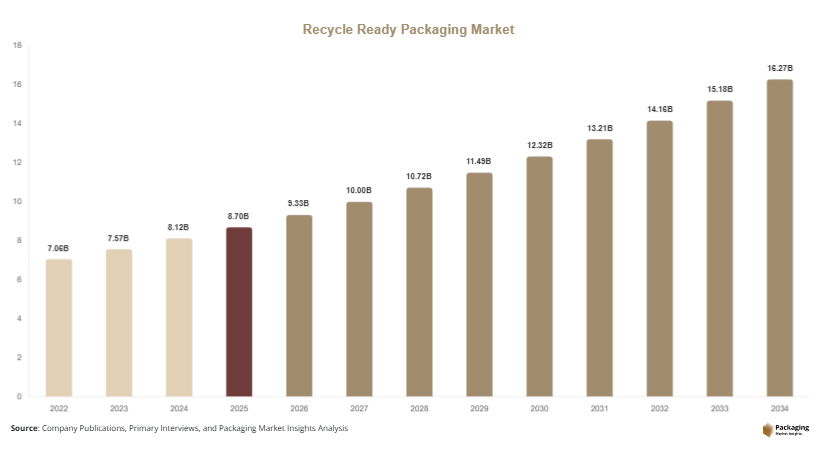
The recycle ready packaging market is projected to witness substantial growth over the forecast period, driven by increasing environmental awareness, regulatory mandates, and the global push toward sustainability in packaging solutions. In 2025, the market size is estimated at USD 8.7 billion and is expected to reach approximately USD 15.9 billion by 2034, expanding at a CAGR of 7.2% during 2025–2034.
The growth of the recycle ready packaging market is fueled by multiple factors. First, there is a growing preference among manufacturers and consumers for eco-friendly packaging solutions, reducing plastic waste and promoting circular economy initiatives. Second, regulatory compliance is playing a significant role, as governments across North America, Europe, and Asia Pacific implement stringent guidelines on recyclable materials and extended producer responsibility (EPR) programs. Third, the rise of e-commerce and retail sectors has increased demand for efficient, recyclable packaging that can minimize shipping costs while ensuring product safety and reducing environmental impact.
Key Highlights:
- The market is projected to reach USD 15.9 billion by 2034.
- CAGR of 7.2% is expected during 2025–2034.
- Growth is driven by regulatory compliance, technological advancements, and sustainability trends.
- Rising e-commerce demand is accelerating adoption of recyclable packaging solutions.
- Food & beverages remain the largest application segment, while personal care and pharmaceuticals are rapidly adopting recycle ready packaging.
Explore more data points, trends and opportunities Download Free Sample Report
Market Trends
Shift Toward Mono-Material Packaging
One of the significant trends in the recycle ready packaging market is the adoption of mono-material packaging solutions. Unlike traditional multi-layer packaging that is difficult to recycle due to combined materials, mono-material packaging is made from a single type of recyclable polymer, such as polyethylene (PE) or polypropylene (PP). This shift allows for easier recycling processes and reduces contamination in recycling streams. Brands and manufacturers are increasingly exploring mono-material pouches, films, and bottles that offer the same functional performance as multi-layer packaging but comply with emerging sustainability regulations. This trend is particularly notable in the food and beverage industry, where maintaining shelf life without compromising recyclability has become a priority. Furthermore, consumer preference for brands that prioritize sustainability is influencing the adoption of mono-material solutions, creating a market-driven incentive for manufacturers to innovate.
Integration of Smart & Recyclable Packaging Technologies
Another growing trend is the integration of smart technologies in recyclable packaging. Manufacturers are embedding QR codes, RFID tags, or interactive labels that educate consumers on proper recycling methods or track the product's end-of-life journey. This trend not only enhances recycling efficiency but also helps companies demonstrate transparency and corporate social responsibility. Smart recyclable packaging is particularly gaining traction in the personal care and pharmaceutical sectors, where consumers are more likely to engage with environmentally responsible brands. Additionally, such technologies enable companies to monitor recycling rates, collect data on consumer behavior, and optimize supply chains for environmental impact. By combining technological innovation with recyclability, companies can maintain product performance, comply with regulations, and strengthen their brand reputation simultaneously.
Market Drivers
Regulatory Push Toward Sustainable Packaging
Government regulations are a key driver of growth in the recycle ready packaging market. Across North America and Europe, extended producer responsibility (EPR) frameworks, plastic bans, and recycling mandates require companies to adopt environmentally sustainable packaging. Companies are mandated to design packaging that is easier to recycle and minimize the environmental footprint. This is particularly evident in the food and beverage sector, where single-use plastics are being replaced by recyclable alternatives. Manufacturers are investing in new materials, designs, and processes to comply with regulatory standards. Such regulatory drivers are accelerating the adoption of recycle ready packaging across industries, creating opportunities for innovation and growth.
Rising Consumer Awareness and Preference for Eco-Friendly Products
Increasing environmental consciousness among consumers is another major driver of the recycle ready packaging market. Modern consumers actively seek brands that demonstrate sustainability and reduce environmental harm. A survey conducted in major North American and European markets indicated that over 65% of consumers prefer products packaged in recyclable materials. This preference influences procurement decisions, prompting companies to invest in recyclable and sustainable packaging solutions. Industries such as personal care, pharmaceuticals, and packaged foods are leading the transition, leveraging recycle ready packaging to improve brand loyalty and appeal to eco-conscious buyers. This driver highlights the critical role of consumer behavior in shaping packaging trends and driving overall market growth.
Market Restraint
Higher Production Costs and Limited Material Availability
Despite its growth potential, the recycle ready packaging market faces certain restraints, with higher production costs being a primary challenge. Recyclable and sustainable materials, such as mono-layer polymers and bio-based plastics, are often more expensive than conventional multi-layer plastics. The additional cost of research, development, and equipment retrofitting for recyclable packaging solutions can increase operational expenses for manufacturers. This challenge is particularly significant for small and medium-sized enterprises (SMEs) that may lack the capital to invest in new technologies.
Moreover, limited availability of suitable recyclable materials in certain regions can impede market growth. Supply chain constraints and dependency on specific polymers can create bottlenecks, delaying adoption. For instance, high-performance recyclable laminates may not be easily accessible in emerging markets, limiting their use in food packaging applications. Companies must balance cost, material availability, and functional performance while meeting sustainability goals. These constraints highlight the need for continued innovation in material development and the importance of government support in expanding the availability of sustainable packaging materials.
Market Opportunities
Expansion in E-Commerce Packaging
The rapid growth of e-commerce provides a significant opportunity for the recycle ready packaging market. As online retail sales surge, companies are seeking packaging solutions that are lightweight, protective, and recyclable. Recyclable mailer bags, corrugated packaging with recyclable coatings, and sustainable flexible packaging solutions are increasingly adopted to meet both consumer expectations and sustainability goals. Companies investing in e-commerce-focused recyclable packaging can reduce shipping costs, maintain product safety, and enhance brand reputation, creating a lucrative growth avenue.
Development of Bio-Based and Compostable Materials
Another opportunity lies in the development of bio-based and compostable recyclable packaging materials. Innovations in polymers derived from renewable sources, such as cornstarch, sugarcane, or cellulose, are driving demand for sustainable alternatives to conventional plastics. These materials not only reduce dependency on fossil fuels but also allow for end-of-life composting in addition to recycling. Companies that develop and adopt bio-based packaging solutions can differentiate themselves in highly competitive industries like personal care and packaged foods. By leveraging these innovative materials, brands can appeal to eco-conscious consumers while complying with evolving environmental regulations.
Report Scope
| Report Metric | Details |
|---|---|
| Market Size in 2025 | USD 8.7 Billion |
| Market Size in 2026 | USD 9.33 Billion |
| Market Size in 2034 | USD 15.9 Billion |
| CAGR | 7.2% (2026-2034) |
| Base Year for Estimation | 2025 |
| Historical Data | 2022-2024 |
| Forecast Period | 2026-2034 |
| Report Coverage | Revenue Forecast, Competitive Landscape, Supply Chain Disruption, Growth Factors, Environment & Regulatory Landscape and Trends |
| Geographies Covered | North America, Europe, APAC, Middle East and Africa, LATAM |
| Countries Covered | U.S., Canada, U.K., Germany, France, Spain, Italy, Russia, Nordic, Benelux, Rest of Europe, China, South Korea, Japan, India, Australia, Singapore, Taiwan, South East Asia, Rest of Asia-Pacific, UAE, Turky, Saudi Arabia, South Africa, Egypt, Nigeria, Rest of MEA, Brazil, Mexico, Argentina, Chile, Colombia, Rest of LATAM |
Explore more data points, trends and opportunities Download Free Sample Report
Segmental Analysis
By Type
The flexible packaging segment accounted for approximately 42% of the market in 2024, owing to its lightweight nature, ease of transportation, and applicability across various industries, including food, personal care, and pharmaceuticals. Flexible packaging solutions, including pouches, films, and bags, are increasingly preferred for their recyclability and adaptability to mono-material designs.
Rigid packaging is the fastest-growing segment, projected to grow at a CAGR of 7.5% during 2025–2034. This growth is driven by innovations in recyclable plastics for bottles, jars, and containers that combine durability with end-of-life recyclability. Brands are investing in rigid solutions that maintain product integrity while meeting sustainability and consumer demands.
By Application
The food & beverage segment dominated the market with a share of 48% in 2024, given the rising demand for packaged foods, ready-to-eat meals, and beverages. Recyclable packaging in this sector reduces waste, aligns with consumer preferences, and helps meet regulatory requirements regarding single-use plastics.
The personal care segment is projected to grow at a CAGR of 8.0% during 2025–2034, driven by heightened consumer expectations for eco-friendly products. Packaging for cosmetics, skincare, and toiletries is increasingly being designed to be recyclable, lightweight, and visually appealing, creating growth opportunities in this subsegment.
By End-Use
The retail end-use segment accounted for approximately 40% of the market in 2024, owing to the proliferation of organized retail, e-commerce, and consumer goods sectors that demand recyclable packaging solutions. Retailers are increasingly aligning with sustainability goals, influencing manufacturers to provide recyclable packaging options.
The pharmaceutical end-use segment is the fastest-growing, with a projected CAGR of 7.8% from 2025–2034. Rising demand for recyclable packaging in medicines, nutraceuticals, and healthcare products is driven by strict regulatory compliance and sustainability initiatives within the healthcare industry.
Recycle Ready Packaging Market Segmentations
Type
- Flexible Packaging
- Rigid Packaging
- Semi-Rigid Packaging
Application
- Food & Beverages
- Healthcare & Pharmaceuticals
- Personal Care
- Industrial
End-Use
- Retail
- Food & Beverage
- Healthcare
- Personal Care
- Industrial
Regional Analysis
North America
In 2025, North America accounted for approximately 35% of the global recycle ready packaging market, making it the largest regional segment. The market is expected to grow at a CAGR of 6.8% during 2025–2034. Growth is driven by stringent regulations promoting recyclability, high consumer awareness, and significant investments in sustainable packaging solutions by leading manufacturers.
The United States dominates the North American market due to proactive regulatory policies, including extended producer responsibility programs and plastic bans at the state level. A unique growth factor is the strong presence of large-scale e-commerce and retail companies actively implementing recyclable packaging to enhance sustainability credentials. Initiatives by companies such as Walmart, Amazon, and major food and beverage brands are accelerating adoption, providing significant opportunities for packaging material suppliers and converters.
Europe
Europe accounted for approximately 30% of the global market in 2025, with a projected CAGR of 7.0% through 2034. The growth is primarily influenced by regulatory enforcement, including EU directives on packaging and packaging waste, and strong consumer demand for environmentally responsible products. European manufacturers are actively adopting recyclable materials, driven by sustainability targets and corporate social responsibility.
Germany emerges as the dominant country in Europe due to its robust recycling infrastructure and well-established regulatory framework. A unique growth factor in Germany is the integration of advanced recycling technologies and closed-loop packaging systems. Companies are designing products to be reused or recycled efficiently, ensuring compliance and promoting circular economy principles, which boosts the recycle ready packaging market.
Asia Pacific
Asia Pacific accounted for 20% of the global market in 2025 and is expected to grow at a CAGR of 8.1% from 2025–2034, representing the fastest regional growth. Rising disposable incomes, urbanization, and the expansion of organized retail sectors are fueling demand for sustainable packaging solutions.
China dominates the region, benefiting from governmental incentives promoting eco-friendly packaging in both industrial and consumer markets. A unique factor driving growth is rapid industrialization coupled with increasing consumer awareness about environmental impacts, encouraging companies to adopt recyclable packaging solutions in the food, beverage, and personal care sectors.
Middle East & Africa
The Middle East & Africa held 8% of the global market in 2025, with a CAGR of 5.5% projected through 2034. Growth is driven by expanding retail sectors, rising import-export activities, and increasing awareness of environmental sustainability in packaging.
The United Arab Emirates dominates due to its strategic position as a logistics hub and government initiatives promoting sustainability. A key growth factor is the rise in eco-friendly consumer products and international brand expansion, which necessitates the use of recyclable packaging to maintain compliance with global environmental standards.
Latin America
Latin America accounted for approximately 7% of the global market in 2025, with a projected CAGR of 6.0% from 2025–2034. Increasing awareness about recycling and sustainability is gradually influencing packaging choices across consumer goods and food industries.
Brazil is the dominant country, driven by government policies encouraging recycling and consumer adoption of sustainable products. A unique growth factor is collaboration between packaging companies and NGOs to implement collection and recycling programs, increasing the adoption of recycle ready packaging in urban and semi-urban regions.
Competitive Landscape
The recycle ready packaging market is highly competitive and includes several global leaders focusing on sustainability-driven innovations. Key players include Amcor PLC, Mondi Group, Berry Global Inc., Huhtamaki Oyj, Sealed Air Corporation, and Sonoco Products Company. Among these, Amcor PLC is recognized as a market leader, having recently launched mono-material flexible packaging solutions for the food and beverage industry that improve recyclability without compromising product protection. Other companies are investing in research and development of bio-based polymers, recyclable laminates, and closed-loop systems. Strategic partnerships, acquisitions, and expansion into emerging markets are common tactics adopted to increase market share. The competitive landscape highlights the importance of innovation, sustainability, and regulatory compliance in maintaining leadership in the recycle ready packaging market.
Key Players List
- Amcor PLC
- Berry Global Inc.
- Sealed Air Corporation
- WestRock Company
- Mondi Group
- Huhtamaki Oyj
- Sonoco Products Company
- Plastipak Holdings, Inc.
- RPC Group
- Coveris Holdings S.A.
- Bemis Company, Inc.
- Smurfit Kappa Group
- DS Smith PLC
- Constantia Flexibles
- ProAmpac