Recyclable Thermoform Blister Packaging Market Report Size and Growth
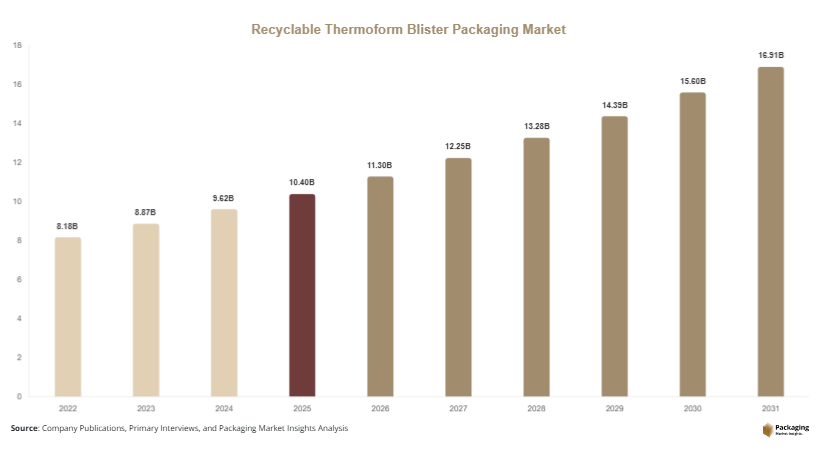
The Recyclable Thermoform Blister Packaging Market was valued at USD 10.4 billion in 2025 and is projected to reach USD 16.8 billion by 2030, expanding at a compound annual growth rate (CAGR) of 8.4% from 2025 to 2031. The market has gained considerable traction as industries increasingly shift toward environmentally responsible packaging solutions. Recyclable thermoform blister packaging is widely used across pharmaceutical, consumer electronics, personal care, and food sectors due to its ability to provide product visibility, durability, and reduced material usage.
One of the major global factors supporting the growth of the Recyclable Thermoform Blister Packaging Market is the rising regulatory focus on sustainable packaging materials. Governments and regulatory authorities across developed and emerging economies have introduced policies that encourage the use of recyclable and eco-friendly materials in packaging. As manufacturers respond to sustainability targets and circular economy initiatives, the demand for recyclable thermoform blister packaging solutions has expanded significantly.
Furthermore, advancements in recyclable plastics such as PET, RPET, and bio-based polymers have improved packaging performance while maintaining recyclability. These developments have enabled packaging companies to design high-clarity blister packs with lower environmental impact. Increased investments in recycling infrastructure and closed-loop packaging systems are also contributing to the steady expansion of the market.
Key Highlights
- North America accounted for 34.2% of the global market share in 2025, while Asia Pacific is expected to record the fastest CAGR of 9.6% during the forecast period.
- PET material dominated the market in 2024 with a 41.5% share, while RPET is projected to grow at the fastest CAGR of 10.2%.
- Pharmaceutical packaging represented the largest application segment with a 48.7% share, whereas consumer electronics packaging is forecast to grow at a CAGR of 9.1%.
- The United States led the market with USD 3.1 billion in 2025 and is expected to reach USD 3.4 billion in 2026.
Explore more data points, trends and opportunities Download Free Sample Report
Market Trends
Expansion of Circular Economy Packaging Models
The adoption of circular economy principles is shaping the evolution of the Recyclable Thermoform Blister Packaging Market. Packaging manufacturers are increasingly designing blister packs that can be easily recycled through existing municipal recycling systems. Mono-material packaging structures are replacing multi-layer combinations that are difficult to recycle. As a result, recyclable PET and RPET thermoform blister packs are gaining strong traction across pharmaceutical and consumer goods industries.
Companies are also investing in closed-loop recycling programs where used blister packaging is collected, processed, and converted into new packaging materials. These initiatives reduce waste generation while supporting corporate sustainability commitments. The growing focus on lifecycle-based packaging design will continue to influence product development in the recyclable thermoform blister packaging industry.
Increasing Adoption of Post-Consumer Recycled Materials
Another key trend in the Recyclable Thermoform Blister Packaging Market is the rising use of post-consumer recycled (PCR) plastics. Manufacturers are integrating higher proportions of recycled PET into thermoform blister packaging without compromising structural strength or product protection.
Brands are also communicating sustainability metrics on packaging labels to attract environmentally conscious consumers. In sectors such as pharmaceuticals and personal care, packaging producers are working closely with raw material suppliers to ensure compliance with regulatory requirements while expanding the use of recycled content. This trend is expected to strengthen the long-term sustainability outlook of the recyclable thermoform blister packaging market.
Market Drivers
Growing Demand for Sustainable Pharmaceutical Packaging
The pharmaceutical sector has emerged as a major driver for the Recyclable Thermoform Blister Packaging Market. Pharmaceutical manufacturers rely on blister packaging for product protection, dosage accuracy, and extended shelf life. With increasing emphasis on sustainability in healthcare supply chains, pharmaceutical companies are transitioning toward recyclable blister packaging formats.
Healthcare regulators and industry associations are also promoting the use of recyclable materials to reduce packaging waste generated by medical products. This transition is encouraging packaging manufacturers to develop recyclable thermoform blister packs that meet stringent pharmaceutical safety standards while supporting sustainability objectives.
Rising Consumer Awareness of Eco-Friendly Packaging
Increasing consumer awareness regarding environmental impact is another major driver supporting the growth of the Recyclable Thermoform Blister Packaging Market. Consumers are becoming more conscious about plastic waste and prefer products packaged in recyclable materials.
Retail brands and consumer goods companies are responding by redesigning packaging formats that align with sustainability goals. Recyclable thermoform blister packaging provides high product visibility and durability while enabling recycling through existing waste management systems. This combination of performance and environmental benefits is accelerating its adoption across multiple industries.
Market Restraint
Limited Recycling Infrastructure in Emerging Economies
Despite the growing demand for sustainable packaging, the Recyclable Thermoform Blister Packaging Market faces challenges related to limited recycling infrastructure in several developing regions. In many emerging economies, waste collection and sorting systems remain underdeveloped, making it difficult to effectively recycle thermoform blister packaging materials.
Blister packs are often composed of plastic and foil layers that require specialized recycling processes. Although new mono-material designs are improving recyclability, large-scale recycling adoption still depends on the availability of advanced recycling facilities. The absence of well-established recycling systems can lead to lower recovery rates of packaging materials.
In addition, the cost associated with integrating recyclable materials and developing recycling infrastructure can be higher than conventional packaging solutions. Small- and medium-sized packaging manufacturers may face financial constraints when adopting sustainable packaging technologies. These challenges may slow the pace of adoption of recyclable thermoform blister packaging in certain markets, particularly in regions where recycling infrastructure is still developing.
Market Opportunities
Expansion of Sustainable Packaging in E-Commerce Retail
The growth of e-commerce platforms is creating new opportunities for the Recyclable Thermoform Blister Packaging Market. Online retailers require packaging solutions that provide strong product protection during shipping while maintaining environmental sustainability.
Recyclable thermoform blister packaging offers durability and product visibility, making it suitable for electronics, personal care products, and small consumer goods sold through e-commerce channels. As online retail continues to expand globally, packaging suppliers are likely to introduce recyclable blister packaging solutions tailored for e-commerce distribution.
Innovation in Bio-Based Thermoform Materials
Advancements in bio-based polymers present another promising opportunity for the Recyclable Thermoform Blister Packaging Market. Researchers and packaging manufacturers are exploring plant-based materials that can be thermoformed into blister packs while maintaining recyclability.
Bio-based PET and other sustainable polymers are gaining attention as they reduce reliance on fossil-based plastics. These materials can support long-term sustainability goals while maintaining the functional benefits of traditional thermoform blister packaging. As innovation continues in sustainable materials, bio-based thermoform packaging is expected to create new growth avenues in the recyclable thermoform blister packaging market.
Report Scope
| Report Metric | Details |
|---|---|
| Market Size in 2025 | USD 10.4 Billion |
| Market Size in 2026 | USD 11.3 Billion |
| Market Size in 2031 | USD 18.2 Billion |
| CAGR | 8.4% (2026-2031) |
| Base Year for Estimation | 2025 |
| Historical Data | 2022-2024 |
| Forecast Period | 2026-2031 |
| Report Coverage | Revenue Forecast, Competitive Landscape, Supply Chain Disruption, Growth Factors, Environment & Regulatory Landscape and Trends |
| Geographies Covered | North America, Europe, APAC, Middle East and Africa, LATAM |
| Countries Covered | U.S., Canada, U.K., Germany, France, Spain, Italy, Russia, Nordic, Benelux, Rest of Europe, China, South Korea, Japan, India, Australia, Singapore, Taiwan, South East Asia, Rest of Asia-Pacific, UAE, Turky, Saudi Arabia, South Africa, Egypt, Nigeria, Rest of MEA, Brazil, Mexico, Argentina, Chile, Colombia, Rest of LATAM |
Explore more data points, trends and opportunities Download Free Sample Report
Segmental Analysis
By Material
PET emerged as the dominant material segment in the Recyclable Thermoform Blister Packaging Market, accounting for 41.5% of the global share in 2024. PET was widely used in blister packaging due to its clarity, strength, and compatibility with recycling systems. Packaging manufacturers preferred PET because it allowed the production of lightweight and durable blister packs while maintaining transparency for product display.
The RPET (Recycled PET) segment is expected to grow at the fastest CAGR of 10.2% during the forecast period. The increasing availability of recycled plastic materials and rising corporate sustainability commitments will encourage manufacturers to adopt RPET in thermoform blister packaging. Companies will increasingly use RPET to reduce their environmental footprint and meet sustainability regulations.
By Type
The carded blister packaging segment dominated the Recyclable Thermoform Blister Packaging Market in 2024 with a 38.6% share. Carded blister packaging was widely used in retail consumer products due to its ability to display products effectively while protecting them from tampering. Retailers preferred this packaging format for electronics accessories, hardware products, and personal care items.
The clamshell blister packaging segment is projected to grow at the fastest CAGR of 8.9% during the forecast period. Clamshell packaging provides strong product protection and is increasingly used in consumer electronics and retail packaging. Its ability to incorporate recyclable materials while maintaining product safety will support future growth.
By Application
The pharmaceutical packaging segment accounted for the largest share of the Recyclable Thermoform Blister Packaging Market, holding 48.7% of the global market in 2024. Pharmaceutical companies widely adopted blister packaging for tablets and capsules due to its ability to maintain product integrity and extend shelf life.
The consumer electronics packaging segment will grow at the fastest CAGR of 9.1% during the forecast period. The rapid expansion of electronics manufacturing and retail distribution will increase the demand for protective packaging solutions. Recyclable thermoform blister packaging will provide a balance between product visibility and sustainability.
Recyclable Thermoform Blister Packaging Market Segmentations
By Material
- PET
- RPET
- PVC
- PLA
- Others
By Type
- Carded Blister Packaging
- Clamshell Packaging
- Full Face Seal Blisters
- Trapped Blisters
By Application
- Pharmaceutical Packaging
- Consumer Electronics Packaging
- Personal Care & Cosmetics
- Food Packaging
- Industrial Goods
Regional Analysis
North America
North America accounted for 34.2% of the global Recyclable Thermoform Blister Packaging Market share in 2025. The region had demonstrated strong adoption of sustainable packaging technologies across pharmaceutical and consumer goods industries. The market in North America will continue to grow steadily and is expected to record a CAGR of 7.8% during the forecast period (2025–2033).
The United States dominated the regional market due to its large pharmaceutical manufacturing base and strong demand for sustainable packaging solutions. Pharmaceutical companies in the country increasingly adopted recyclable blister packaging formats to comply with environmental sustainability targets. The presence of advanced recycling infrastructure and strong regulatory frameworks supporting recyclable materials will continue to drive growth in the U.S. market.
Europe
Europe represented 29.5% of the global Recyclable Thermoform Blister Packaging Market share in 2025. The region had experienced steady growth due to strict environmental regulations related to packaging waste reduction. The European market is projected to expand at a CAGR of 8.1% from 2025 to 2033.
Germany emerged as the dominant country in the European market. The country’s packaging industry has been actively adopting recyclable and circular packaging models supported by strong recycling systems. German pharmaceutical manufacturers have increasingly integrated recyclable blister packaging into their product packaging strategies. This transition is expected to support sustained market expansion in the region.
Asia Pacific
Asia Pacific accounted for 23.7% of the global Recyclable Thermoform Blister Packaging Market share in 2025. Rapid industrialization and expanding consumer goods industries contributed to the growth of recyclable packaging solutions in the region. Asia Pacific is expected to witness the fastest CAGR of 9.6% between 2025 and 2033.
China held the largest share in the regional market due to its large manufacturing sector and increasing investment in sustainable packaging technologies. Chinese packaging manufacturers are focusing on recyclable PET blister packaging to meet sustainability objectives in both domestic and export markets. Growing demand from electronics and consumer goods industries will support further market growth.
Middle East & Africa
The Middle East & Africa accounted for 6.4% of the global Recyclable Thermoform Blister Packaging Market share in 2025. The market had experienced gradual growth as regional governments introduced initiatives promoting sustainable packaging. The region will likely grow at a CAGR of 7.2% during the forecast period.
Saudi Arabia dominated the regional market due to the expansion of pharmaceutical manufacturing and packaging industries. Investments in recycling facilities and sustainability initiatives are expected to encourage the adoption of recyclable thermoform blister packaging across healthcare and consumer goods sectors.
Latin America
Latin America held 6.2% of the global Recyclable Thermoform Blister Packaging Market share in 2025. The market had expanded gradually due to increasing demand for eco-friendly packaging in the pharmaceutical and food sectors. The region is projected to grow at a CAGR of 7.5% between 2025 and 2033.
Brazil represented the largest market within the region. The country’s expanding pharmaceutical industry has increased the demand for blister packaging solutions that support sustainability goals. Growing investment in recycling programs and packaging innovation will continue to support the development of the recyclable thermoform blister packaging market in Latin America.
Competitive Landscape
The Recyclable Thermoform Blister Packaging Market is moderately competitive, with several global packaging manufacturers focusing on sustainable product innovation. Companies are investing in recyclable materials, advanced thermoforming technologies, and circular packaging initiatives.
Amcor plc emerged as a leading player in the market due to its strong portfolio of sustainable packaging solutions. The company recently introduced recyclable PET blister packaging formats designed for pharmaceutical applications. This development reflects the company’s strategy to expand its sustainable packaging offerings.
Other key companies are also focusing on partnerships, material innovation, and geographic expansion to strengthen their market position. These strategic initiatives are expected to intensify competition and accelerate technological advancements in the recyclable thermoform blister packaging industry.
Key Players in the Recyclable Thermoform Blister Packaging Market
- Amcor plc
- Sonoco Products Company
- Constantia Flexibles Group
- Tekni-Plex Inc.
- Klöckner Pentaplast Group
- WestRock Company
- DuPont de Nemours Inc.
- UFlex Limited
- Display Pack Inc.
- FormTight Inc.
- Honeywell International Inc.
- Rohrer Corporation
- Blisterpak Inc.
- Anchor Packaging LLC
- Placon Corporation