Recyclable Packaging Market Size and Growth
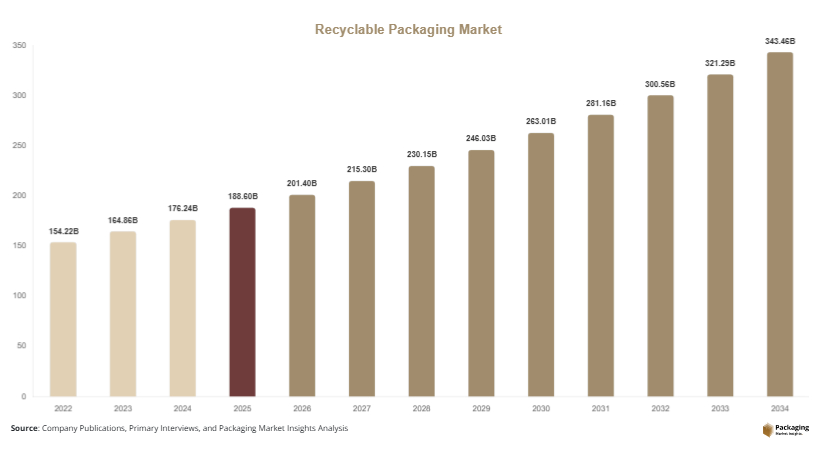
The global recyclable packaging market size is estimated at USD 188.6 billion in 2025. The market is projected to reach USD 201.4 billion in 2026, supported by rising adoption of sustainable packaging solutions across consumer goods industries. Over the forecast period from 2025 to 2034, the market is expected to expand at a compound annual growth rate (CAGR) of 6.9%, reaching approximately USD 348.7 billion by 2034.
The recyclable packaging market has gained steady traction as industries shift toward circular economy models and responsible material management. Recyclable packaging refers to packaging materials that can be collected, processed, and reintroduced into the manufacturing cycle to produce new products. Industries such as food and beverage, personal care, pharmaceuticals, and e-commerce are increasingly adopting recyclable materials including paper, cardboard, aluminum, glass, and recyclable plastics.
Key Highlights
- Global market size estimated at USD 188.6 billion in 2025
- Market expected to reach USD 348.7 billion by 2034
- Forecast CAGR of 6.9% from 2025 to 2034
- Increasing regulations supporting recycling initiatives
- Growing demand from food, beverage, and e-commerce sectors
Explore more data points, trends and opportunities Download Free Sample Report
Market Trends
Increasing Adoption of Mono-Material Packaging
A significant trend in the recyclable packaging market is the transition toward mono-material packaging solutions. Traditional packaging formats often combine multiple materials such as plastic films, aluminum layers, and adhesives. These combinations create challenges during recycling because separating materials is complex and costly. As a result, packaging manufacturers are redesigning products using single-material structures that can be easily processed in existing recycling streams.
Mono-material packaging solutions are widely adopted in flexible packaging applications such as pouches, sachets, and wrappers. Many companies are developing polyethylene-based or polypropylene-based packaging that maintains product protection while remaining recyclable. This approach reduces contamination in recycling systems and improves material recovery rates. As global brands set targets to make packaging recyclable by 2030, demand for mono-material packaging technologies continues to increase across multiple industries.
Expansion of Paper-Based Packaging Alternatives
Another prominent trend is the growing use of paper-based materials as substitutes for traditional plastic packaging. Paper packaging is widely recognized for its recyclability, biodegradability, and established collection infrastructure. Companies in the food, beverage, and consumer goods sectors are increasingly replacing plastic trays, clamshell containers, and wrappers with paperboard solutions.
Advances in coating technologies have also enabled paper packaging to achieve barrier properties required for moisture, grease, and oxygen resistance. These innovations allow paper materials to be used in applications that previously relied on plastic films. Retailers and food service providers are investing in recyclable paper packaging as part of sustainability strategies and regulatory compliance. As a result, paper-based packaging is emerging as a key material category contributing to the expansion of the recyclable packaging industry.
Market Drivers
Government Regulations Supporting Circular Economy Initiatives
Government regulations are a major driver of the recyclable packaging market. Many countries are implementing policies designed to reduce packaging waste and increase recycling rates. These policies include recycling mandates, plastic reduction targets, landfill restrictions, and extended producer responsibility programs that require manufacturers to manage the lifecycle of packaging materials.
Such regulatory frameworks encourage companies to shift toward recyclable packaging formats. For instance, several regions have introduced minimum recycled content requirements and restrictions on non-recyclable plastic packaging. These policies push manufacturers to redesign packaging materials and invest in recyclable alternatives. As compliance requirements increase globally, businesses are prioritizing recyclable packaging to align with environmental policies and avoid regulatory penalties.
Growing Consumer Awareness of Sustainable Packaging
Consumer awareness regarding environmental sustainability is another factor driving the growth of recyclable packaging. Modern consumers are increasingly concerned about plastic pollution, waste management, and the environmental impact of packaging materials. This awareness influences purchasing decisions across multiple product categories including food, beverages, personal care, and household goods.
Brands are responding to these preferences by introducing packaging that clearly communicates recyclability and sustainability benefits. Many companies highlight recyclable packaging features on product labels and marketing materials. In addition, retailers are adopting sustainability guidelines that encourage suppliers to use recyclable materials. As environmental considerations become part of mainstream consumer behavior, recyclable packaging adoption continues to expand across global markets.
Market Restraint
Limitations in Recycling Infrastructure and Material Collection Systems
Despite increasing demand, the recyclable packaging market faces challenges related to insufficient recycling infrastructure in several regions. Efficient recycling requires organized collection systems, sorting facilities, and processing plants capable of handling different packaging materials. In many developing economies, these systems are still underdeveloped or fragmented, limiting the recovery of recyclable packaging materials.
Packaging waste often ends up in landfills or incineration facilities when collection systems are inadequate. Even in regions with established recycling infrastructure, contamination of recyclable materials can reduce processing efficiency. For example, food residue, mixed materials, and incorrect disposal practices may lead to recyclable packaging being rejected during sorting processes.
Another challenge is the cost associated with upgrading recycling facilities to handle newer packaging formats. Advanced technologies such as optical sorting systems and chemical recycling processes require substantial investment. Smaller municipalities and waste management operators may face financial constraints that delay infrastructure development.
The lack of standardized recycling guidelines across countries also affects the market. Packaging that is technically recyclable in one region may not be processed in another due to differences in waste management capabilities. This inconsistency creates uncertainty for manufacturers seeking to design universally recyclable packaging solutions.
Overall, improving recycling infrastructure and establishing consistent waste management systems remain critical for unlocking the full potential of recyclable packaging worldwide.
Market Opportunities
Growth of Sustainable Packaging in E-Commerce Logistics
The rapid expansion of e-commerce presents a major opportunity for the recyclable packaging market. Online retail platforms ship millions of packages daily, generating significant packaging waste. To address environmental concerns, e-commerce companies are exploring recyclable packaging solutions such as corrugated cardboard boxes, paper-based mailers, and recyclable cushioning materials.
Many logistics providers and retailers are introducing sustainable packaging guidelines that encourage suppliers to use recyclable materials. Innovations such as right-sized packaging and recyclable protective fillers are reducing waste while maintaining product protection during transit. As global e-commerce volumes continue to increase, demand for recyclable shipping packaging is expected to grow steadily across retail sectors.
Development of Advanced Recycling Technologies
Technological advancements in recycling processes create additional opportunities for market expansion. Emerging technologies such as chemical recycling, improved polymer sorting systems, and automated waste management facilities enhance the efficiency of recycling operations. These innovations allow more complex packaging materials to be recovered and reused in manufacturing processes.
Advanced recycling technologies also enable higher-quality recycled materials that can compete with virgin materials in packaging production. Many packaging companies are investing in research and development to integrate recycled content into new products without compromising performance. As recycling technologies evolve and become more commercially viable, they will support the growth of recyclable packaging across global supply chains.
Report Scope
| Report Metric | Details |
|---|---|
| Market Size in 2025 | USD 188.6 Billion |
| Market Size in 2026 | USD 201.4 Billion |
| Market Size in 2034 | USD 348.7 Billion |
| CAGR | 6.9% (2026-2034) |
| Base Year for Estimation | 2025 |
| Historical Data | 2022-2024 |
| Forecast Period | 2026-2034 |
| Report Coverage | Revenue Forecast, Competitive Landscape, Supply Chain Disruption, Growth Factors, Environment & Regulatory Landscape and Trends |
| Geographies Covered | North America, Europe, APAC, Middle East and Africa, LATAM |
| Countries Covered | U.S., Canada, U.K., Germany, France, Spain, Italy, Russia, Nordic, Benelux, Rest of Europe, China, South Korea, Japan, India, Australia, Singapore, Taiwan, South East Asia, Rest of Asia-Pacific, UAE, Turky, Saudi Arabia, South Africa, Egypt, Nigeria, Rest of MEA, Brazil, Mexico, Argentina, Chile, Colombia, Rest of LATAM |
Explore more data points, trends and opportunities Download Free Sample Report
Segmental Analysis
By Material Type
The paper and paperboard segment held the dominant position in the recyclable packaging industry, accounting for approximately 38.6% of the market share in 2024. Paper-based materials are widely used in packaging due to their recyclability, cost efficiency, and compatibility with established waste collection systems. Corrugated boxes, cartons, and molded fiber packaging are extensively used in food, beverage, and e-commerce industries. The growth of online retail and shipping logistics has significantly increased the demand for recyclable corrugated packaging. Additionally, improvements in paper coating technologies allow these materials to provide barrier protection against moisture and grease, expanding their use in food packaging applications.
The recyclable plastics segment is expected to register the fastest growth with an estimated CAGR of 7.5% during the forecast period. Manufacturers are developing recyclable polymer solutions such as polyethylene and polypropylene packaging formats designed for compatibility with recycling streams. Innovations in mono-material flexible packaging and recyclable films are enabling broader adoption across industries. Demand is also supported by technological advancements that improve recycling efficiency and enable higher-quality recycled plastic resins. As companies seek alternatives to traditional multilayer packaging, recyclable plastics are gaining importance in packaging design strategies.
By Packaging Type
The rigid packaging segment accounted for the largest share of approximately 54.2% in 2024. Rigid packaging formats such as bottles, jars, containers, and boxes are widely used across food and beverage, pharmaceutical, and household product industries. Materials including glass, aluminum, and rigid plastics are commonly recycled and have well-established recovery systems in several regions. The durability and product protection provided by rigid packaging also contribute to its widespread adoption. Many manufacturers prefer rigid packaging for products requiring structural stability and longer shelf life, further strengthening its position in the recyclable packaging market.
The flexible packaging segment is projected to grow at a CAGR of 7.3% between 2025 and 2034. Flexible packaging formats such as pouches, sachets, and films offer lightweight characteristics and reduced material usage compared to rigid packaging. Advances in recyclable mono-material films and barrier coatings are making flexible packaging compatible with recycling systems. These developments are enabling companies to maintain product freshness while improving environmental performance. Growth of convenience food products and single-serve packaging formats is also contributing to the rising demand for recyclable flexible packaging solutions.
By End-Use Industry
The food and beverage industry held the largest market share of approximately 41.5% in 2024. Packaging plays a critical role in preserving food quality, extending shelf life, and ensuring safe transportation. As sustainability concerns increase, food and beverage manufacturers are adopting recyclable materials such as paperboard cartons, aluminum cans, and recyclable plastic containers. Many global brands are redesigning packaging formats to meet sustainability commitments while maintaining product protection standards. Additionally, rising consumption of packaged foods and beverages worldwide supports consistent demand for recyclable packaging solutions.
The e-commerce sector is anticipated to record the fastest growth with a CAGR of 8.1% during the forecast period. The rapid expansion of online retail has significantly increased demand for shipping and protective packaging materials. E-commerce companies are adopting recyclable packaging options to reduce environmental impact and align with sustainability goals. Corrugated cardboard boxes, recyclable cushioning materials, and paper-based mailers are increasingly used for product shipments. Growing consumer expectations regarding sustainable delivery packaging further encourage e-commerce companies to integrate recyclable materials into their logistics operations.
Recyclable Packaging Market Segmentations
Material Type
- Paper & Paperboard
- Plastic
- Glass
- Metal
- Others
Packaging Type
- Rigid Packaging
- Flexible Packaging
End-Use Industry
- Food & Beverage
- Personal Care & Cosmetics
- Pharmaceuticals
- E-Commerce
- Industrial Goods
Regional Analysis
North America
North America accounted for approximately 28.4% of the global recyclable packaging market share in 2025. The region is projected to grow at a CAGR of 6.2% during the forecast period. Growth is driven by regulatory frameworks focused on waste reduction and increased investment in recycling infrastructure. Many packaging manufacturers in the region are transitioning toward recyclable materials to comply with sustainability commitments and environmental regulations.
The United States dominates the regional market due to strong demand from food and beverage packaging industries. A key growth factor in the country is the expansion of corporate sustainability programs among large consumer brands. Companies are setting goals to achieve fully recyclable packaging portfolios, which is encouraging innovation in recyclable materials and packaging design across multiple product categories.
Europe
Europe held around 30.1% of the global market share in 2025 and is forecast to grow at a CAGR of 6.5% through 2034. The region has well-established recycling infrastructure and strict environmental policies that encourage the adoption of recyclable packaging materials. European Union regulations focused on circular economy strategies are also promoting investments in sustainable packaging technologies.
Germany represents the dominant country within the European market. A unique growth factor in the country is its advanced waste collection and sorting systems, which support high recycling rates for packaging materials. Strong collaboration between government agencies, packaging manufacturers, and recycling organizations further strengthens the development of recyclable packaging solutions.
Asia Pacific
Asia Pacific accounted for approximately 26.7% of the recyclable packaging market in 2025 and is projected to register a CAGR of 7.8%, making it one of the fastest-growing regions. Rising industrialization, increasing consumer awareness regarding environmental issues, and expanding e-commerce activities are contributing to regional market growth.
China leads the Asia Pacific market due to large manufacturing capacity and government initiatives aimed at reducing plastic waste. A major growth factor is the rapid development of recycling infrastructure supported by national sustainability policies. Investments in waste management systems and circular economy programs are accelerating the adoption of recyclable packaging across industries.
Middle East & Africa
The Middle East & Africa region accounted for approximately 7.6% of the global market share in 2025 and is projected to grow at a CAGR of 5.9% during the forecast period. Increasing awareness of sustainable waste management practices and government initiatives promoting recycling programs are gradually driving demand for recyclable packaging materials.
United Arab Emirates represents a leading market within the region. A unique growth factor in the country is the introduction of sustainability initiatives focused on reducing single-use plastic packaging. Several retail and hospitality companies are adopting recyclable packaging solutions as part of broader environmental strategies and national sustainability goals.
Latin America
Latin America captured approximately 7.2% of the global market share in 2025 and is expected to grow at a CAGR of 6.3% through 2034. Rising urbanization and increasing environmental awareness among consumers are influencing the adoption of recyclable packaging across industries such as food processing and consumer goods manufacturing.
Brazil is the dominant country in the regional market. A key growth factor is the development of recycling cooperatives and community-based waste collection programs that improve material recovery rates. These initiatives support the availability of recyclable raw materials and encourage manufacturers to adopt packaging formats compatible with existing recycling systems.
Competitive Landscape
The recyclable packaging market is moderately competitive with the presence of several global and regional packaging manufacturers focusing on sustainable material innovation. Companies are investing in research and development to create recyclable packaging solutions that meet performance requirements while complying with environmental regulations.
Amcor plc is considered one of the leading companies in the market due to its strong portfolio of recyclable flexible and rigid packaging solutions. The company continues to develop mono-material packaging formats designed for compatibility with recycling systems. A recent development includes the introduction of recyclable polyethylene-based flexible packaging designed for food products.
Other major companies such as Berry Global Group, Mondi Group, Sealed Air Corporation, and Smurfit Kappa Group are also actively expanding recyclable packaging portfolios. These companies focus on product innovation, strategic partnerships, and sustainable packaging initiatives. Collaborations with consumer brands and recycling organizations are becoming common as companies work toward circular packaging systems.
Competition in the market is increasingly centered around sustainability goals, material efficiency, and recycling compatibility. Companies that invest in recyclable material technologies and integrated recycling solutions are expected to strengthen their competitive position in the coming years.
Key Players List
- Amcor plc
- Berry Global Group Inc.
- Mondi Group
- Smurfit Kappa Group
- Sealed Air Corporation
- DS Smith plc
- International Paper Company
- Tetra Pak International S.A.
- WestRock Company
- Sonoco Products Company
- Huhtamaki Oyj
- Stora Enso Oyj
- Ball Corporation
- Crown Holdings Inc.
- Uflex Limited